
Church History · Early Church · Historical Background
HISTORICAL SOURCES FOR JESUS AND EARLY CHRISTIANITY
Scripture, Jewish and Roman Testimony, Archaeology, Manuscripts, and Historical Method
Geography and Sources Library
Start Here
Church history begins with surviving evidence. To ask what can be known historically about Jesus Christ and the earliest Christians is to ask what sources remain, how close they stand to the events, what kind of documents they are, and how responsibly they should be interpreted.
The New Testament is the central documentary witness. Jewish and Roman authors supplement it. Archaeology, inscriptions, coins, papyri, manuscripts, burial evidence, and early Christian writings provide additional context and corroboration.
No serious historical method begins by dismissing Christian texts because Christians wrote them. Nor does it accept every claim without analysis. Sources must be studied according to genre, date, purpose, transmission, knowledge of the setting, and relationship to other evidence.
What Historians Mean by a Source
A historical source is a surviving witness that can inform us about the past. Sources include written texts, inscriptions, coins, buildings, artifacts, burial remains, legal records, papyri, oral traditions later written down, and artistic evidence.
A primary source comes from the period under study or preserves testimony close to it. A secondary source interprets earlier evidence from a later vantage point. These categories are useful, but they should not be applied mechanically. A later writer may preserve early material, while a contemporary writer may be selective or mistaken.
Perfect neutrality is not the standard because perfectly neutral sources scarcely exist. The proper questions concern competence, proximity, purpose, consistency, transmission, and comparison.
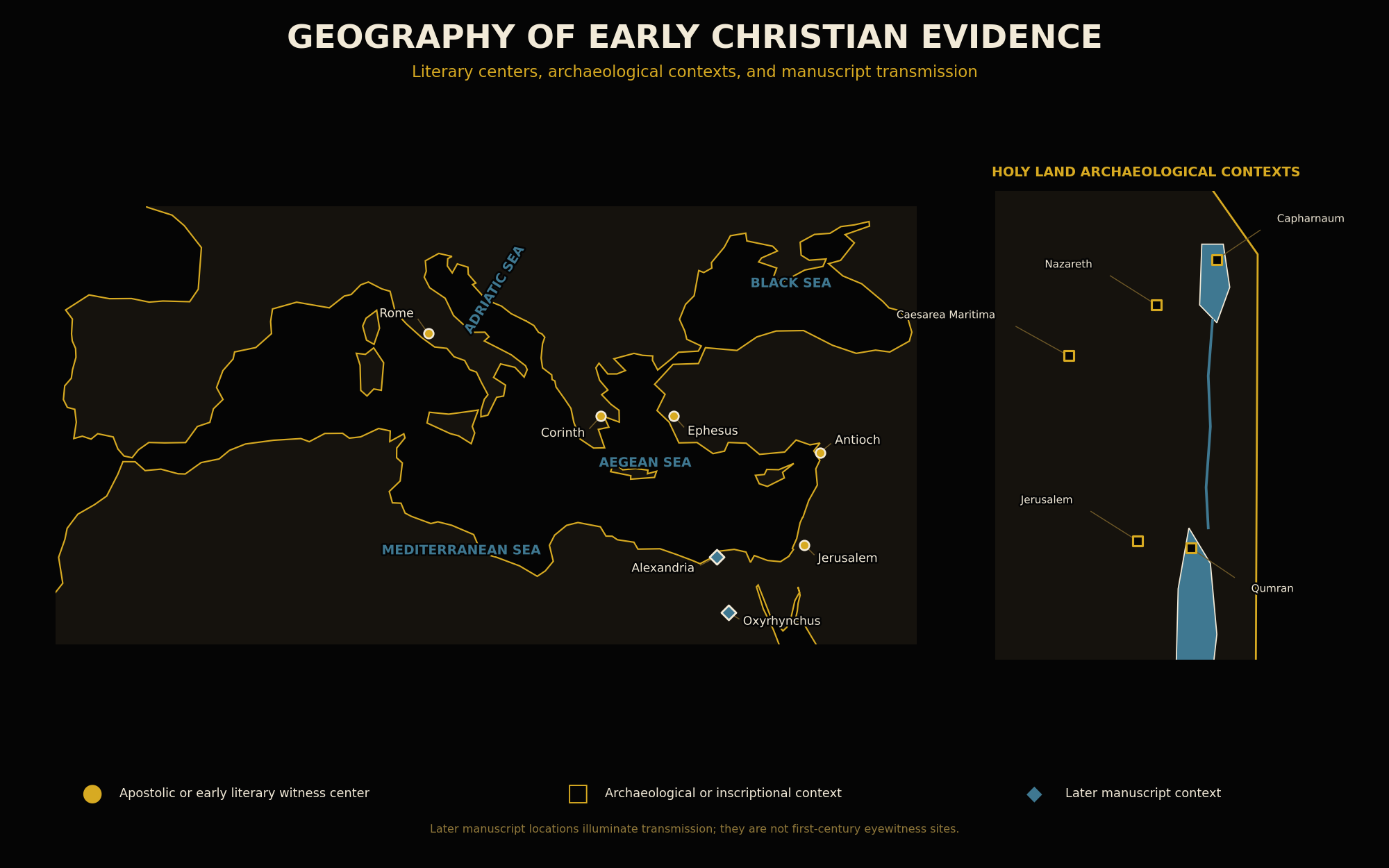
Map One: Geography of the Evidence
How the Evidence Fits Together
New Testament
First century
The fullest evidence for Jesus, the apostolic proclamation, early churches, worship, leadership, and doctrine.
Jewish Witness
First century
Josephus, the Dead Sea Scrolls, inscriptions, coins, and material evidence illuminate the Jewish world in which Christianity arose.
Roman Witness
Early second century
Pliny, Tacitus, and Suetonius provide brief external testimony concerning Christians, Roman policy, and Christ under Pontius Pilate.
Archaeology
Material contexts
Places, buildings, inscriptions, burials, roads, coins, and domestic remains clarify the world described in literary sources.
Early Christian Writings
Late first–early second century
First Clement, the Didache, St. Ignatius, and related texts show continuity beyond the apostolic age.
Manuscript Tradition
Later surviving copies
Papyri, codices, translations, and patristic quotations illuminate textual transmission rather than functioning as first-century eyewitnesses.
Three Different Uses of Evidence
Evidence does not contribute in only one way. Some sources bear direct literary witness to persons, teachings, actions, and communities. Other evidence establishes the historical setting in which those reports belong. A third group illuminates how texts were copied, preserved, translated, and received.
The Pauline letters and Gospels are literary witnesses to the apostolic proclamation. The Pilate inscription and first-century archaeology establish political and material context. Later papyri and codices illuminate transmission. These categories can support one another, but they should not be confused.
A later manuscript may preserve a much earlier text without becoming an eyewitness to the events described. An inscription may confirm an official’s title without proving every theological claim associated with the narrative. Good historical reasoning respects the proper scope of each kind of evidence.
The New Testament as Historical Evidence
The New Testament is the primary documentary source for Jesus and the apostolic Church. The four Gospels preserve His words, deeds, Passion, Death, and Resurrection proclamation. Acts narrates the Church’s expansion. The epistles disclose actual communities, disputes, worship, moral instruction, leadership, and doctrine.
These writings are confessional because their authors and communities believed the events they proclaimed. Confessional purpose does not erase historical value. Ancient historians, biographers, philosophers, and political writers commonly wrote with commitments and aims.
Catholics receive these books as inspired Scripture. Historical study asks additional questions concerning their human authors, genres, sources, settings, and literary composition. As Dei Verbum teaches, God chose human authors who employed their own powers and abilities, and the Gospels faithfully hand on what Jesus truly did and taught for our salvation.
The Gospels and Apostolic Memory
The Gospels are the earliest sustained narratives of Jesus. They preserve rulers, places, feasts, customs, disputes, geography, and social realities belonging to first-century Judaism under Roman rule.
They are not modern audio transcripts. They are ancient theological narratives formed through apostolic preaching, memory, selection, arrangement, and inspired composition.
The literary relationship among Matthew, Mark, and Luke must be considered. They should not be treated as three wholly independent modern reports. Yet literary dependence does not reduce them to one meaningless copy. Each Gospel preserves its own arrangement, emphases, traditions, and witness within the apostolic Church.
Their common proclamation that Jesus taught publicly, gathered disciples, was crucified under Pontius Pilate, and was proclaimed risen is historically central.
St. Paul and the Earliest Surviving Christian Letters
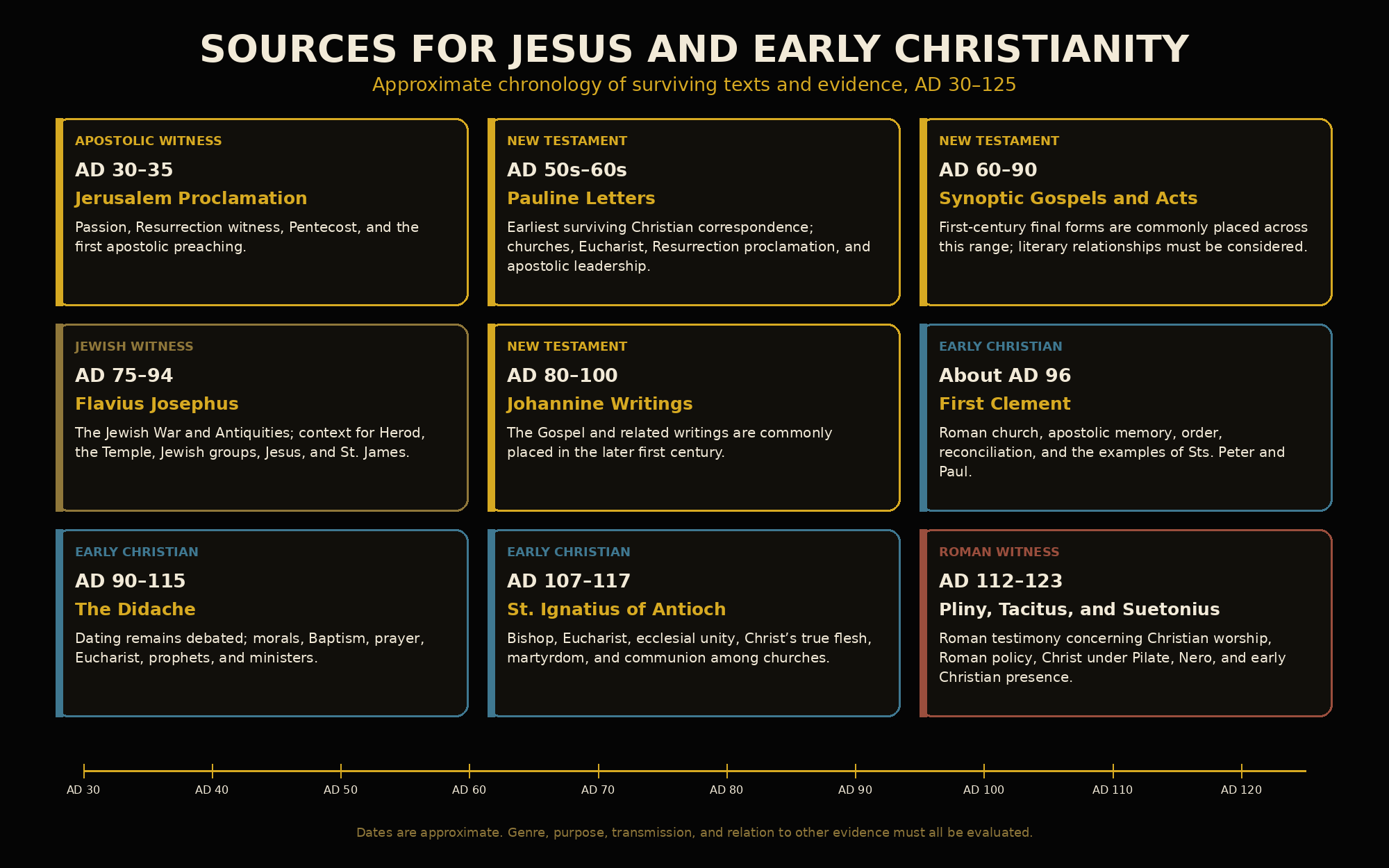
Several letters of St. Paul belong to the AD 50s and early 60s, making them the earliest surviving Christian writings that can be dated with reasonable confidence.
They attest churches across several provinces, faith in Jesus as Lord, the Crucifixion, Resurrection appearances, Baptism, the Eucharist, apostolic authority, moral discipline, persecution, and organized communal life.
First Corinthians 15 preserves an early summary of the Resurrection proclamation that St. Paul says he received and handed on. Galatians records his contact with St. Peter and St. James. First Corinthians 11 preserves tradition concerning the Last Supper and Eucharistic worship.
These letters are occasional documents written to address particular churches. Their very particularity gives historians direct access to real communities rather than an abstract later theory of Christian origins.
Jewish Sources
Flavius Josephus is the most important non-Christian Jewish historian for the first century. His works illuminate Herodian rule, the Temple, Jewish groups, Roman administration, the Jewish War, and the destruction of Jerusalem.
Josephus refers to St. James as the brother of Jesus who was called Christ. His longer passage concerning Jesus, commonly called the Testimonium Flavianum, requires careful textual judgment because some wording appears to have been affected by Christian transmission. Many scholars nevertheless judge that the passage contains an authentic Josephan core.
The Dead Sea Scrolls do not mention Jesus. They illuminate Scripture, Jewish interpretation, purity, communal discipline, apocalyptic expectation, and messianic language near the time of Christ.
Rabbinic literature was compiled later. It may preserve older traditions, but it cannot simply be projected backward into the first century without analysis.
Roman and Pagan Sources
Roman authors offer brief external testimony. Tacitus states that Christus suffered the extreme penalty under Pontius Pilate during the reign of Tiberius and describes Christians in Rome under Nero.
Pliny the Younger reports Christians gathering before dawn, singing to Christ as to a god, binding themselves to moral conduct, and meeting for common food. His correspondence with Trajan also reveals Roman legal uncertainty about prosecuting Christians.
Suetonius contains short notices concerning disturbances connected with “Chrestus” and punishments inflicted upon Christians. These passages must be interpreted cautiously because their wording and historical reference are brief.
Hostile or indifferent testimony can corroborate limited facts, but Roman authors do not replace the much fuller Christian evidence.
Archaeology, Inscriptions, and Coins
Archaeology clarifies settlements, domestic life, synagogues, public buildings, roads, ports, burial practices, trade, and religious environments. It is strongest when it establishes context, confirms plausibility, or corrects mistaken reconstructions.
The Pilate inscription from Caesarea Maritima confirms Pontius Pilate’s historical office. Excavations at Jerusalem, Nazareth, Capharnaum, Corinth, Ephesus, and Rome illuminate places named in Christian sources.
Coins preserve rulers, titles, symbols, dates, economic circulation, and imperial propaganda. Inscriptions preserve officials, benefactors, civic institutions, religious titles, and public honors.
Archaeology does not normally prove a theological doctrine. Nor does the absence of an archaeological discovery automatically disprove a literary report.
Map Two: Chronology of the Sources
Early Christian Writings Outside the New Testament
First Clement, commonly placed near the end of the first century, reflects the Roman church’s concern for order, apostolic example, and reconciliation.
The Didache contains teaching on Christian morals, Baptism, fasting, prayer, Eucharistic practice, prophets, and local ministers. Its date and compositional history are debated, but substantial portions are commonly placed near the late first or early second century.
The letters of St. Ignatius of Antioch witness to episcopal leadership, Eucharistic faith, ecclesial unity, the reality of Christ’s flesh and suffering, and the bishop’s pastoral role.
These writings do not add new books to Scripture. They show that Catholic structures and sacramental life did not suddenly appear centuries after the Apostles.
Manuscripts and Textual Transmission
The New Testament survives in a large manuscript tradition containing papyri, parchment codices, ancient translations, lectionaries, and quotations in early Christian writers.
The surviving manuscripts are generally later than the original compositions. A fourth-century codex is not a fourth-century invention of the text it contains. Historians study copying relationships, variants, scribal habits, geographical distribution, and early quotations to reconstruct the earliest attainable wording.
Scribes made ordinary mistakes, omitted or repeated lines, clarified wording, and occasionally harmonized parallel passages. Textual criticism compares the evidence rather than pretending such variants do not exist.
The abundance of evidence makes textual history visible and testable. Most variants are minor, and disputed readings do not erase the central historical proclamation of the New Testament.
How Historians Evaluate Sources
Historical evaluation asks several connected questions:
- How close is the source to the event or persons described?
- What kind of document is it?
- What purpose does the author pursue?
- Does it display knowledge of the relevant geography, customs, institutions, and chronology?
- What earlier traditions or witnesses may stand behind it?
- Can it be compared with independent literary or material evidence?
- How securely has the text been transmitted?
Bias must be examined, but bias does not automatically invalidate testimony. A committed witness may be well informed, while a detached writer may be ignorant.
No single test decides every question. Historical judgment normally arises from converging evidence.
What Historical Inquiry Can and Cannot Do
Historical inquiry strongly supports that Jesus of Nazareth lived in first-century Galilee and Judea, gathered disciples, taught publicly, was crucified under Pontius Pilate, and was proclaimed risen by followers who formed missionary communities across the Roman world.
It also shows that the earliest churches possessed worship, moral discipline, leadership, sacramental practices, and continuity with Israel while increasingly distinguishing themselves from synagogue communities.
Historical method can examine testimony to the Resurrection, the transformation of the disciples, the early proclamation, and the consequences that followed. It cannot force supernatural faith as though faith were merely the conclusion of an archaeological calculation.
Catholic faith does not fear historical inquiry. Grace does not abolish truth, and divine revelation entered real human history.
Common Mistakes to Avoid
- Do not dismiss the New Testament because it is confessional.
- Do not pretend the Synoptic Gospels are wholly independent modern transcripts.
- Do not treat Roman references as the only respectable evidence.
- Do not claim the Dead Sea Scrolls mention Jesus.
- Do not present the Testimonium Flavianum without acknowledging textual questions.
- Do not treat later manuscript discovery sites as first-century eyewitness locations.
- Do not use archaeology only for sensational claims.
- Do not confuse historical method with theological skepticism.
Key Takeaways
- The New Testament is the primary historical witness to Jesus and the apostolic Church.
- St. Paul’s letters are among the earliest surviving Christian documents.
- The Gospels are theological narratives and genuine historical witnesses.
- Josephus provides indispensable Jewish context and important references to Jesus and St. James.
- Tacitus, Pliny, and Suetonius offer limited external testimony.
- Archaeology, inscriptions, coins, and papyri illuminate the literary record.
- Early Christian writings reveal continuity beyond the apostolic age.
- Historical judgment depends upon genre, proximity, purpose, corroboration, and transmission.
Continue Your Study
Sources and Further Reading
- Holy Bible, Douay-Rheims: Luke 1; John 19–21; Acts 1–28; First Corinthians 11 and 15; Galatians 1–2; Philippians 2.
- Catechism of the Catholic Church, 101–141 and 156–159.
- Second Vatican Council, Dei Verbum, 11–12 and 18–19.
- Pontifical Biblical Commission, The Interpretation of the Bible in the Church.
- Flavius Josephus, The Jewish War and Jewish Antiquities, especially Book XVIII and Book XX.
- Tacitus, Annals, 15.44.
- Pliny the Younger, Letters, 10.96–97.
- Suetonius, Claudius, 25.4, and Nero, 16.2.
- First Clement; the Didache; the letters of St. Ignatius of Antioch.
- John P. Meier, A Marginal Jew: Rethinking the Historical Jesus.
- Craig S. Keener, The Historical Jesus of the Gospels.
- Richard Bauckham, Jesus and the Eyewitnesses.
- Larry W. Hurtado, Lord Jesus Christ: Devotion to Jesus in Earliest Christianity.
- N. T. Wright, The Resurrection of the Son of God.
- Brant Pitre, The Case for Jesus.