
Church History · Early Church · Historical Background
CHRONOLOGY OF THE FIRST-CENTURY SETTING
From Herod and the Nativity to Pentecost, Apostolic Mission, Nero, and the Fall of Jerusalem
Geography and Sources Library
Start Here
Chronology places biblical and early Christian events in historical sequence. It shows which rulers and events overlap, how quickly the apostolic mission developed, and where historians must distinguish secure dates from reasonable estimates.
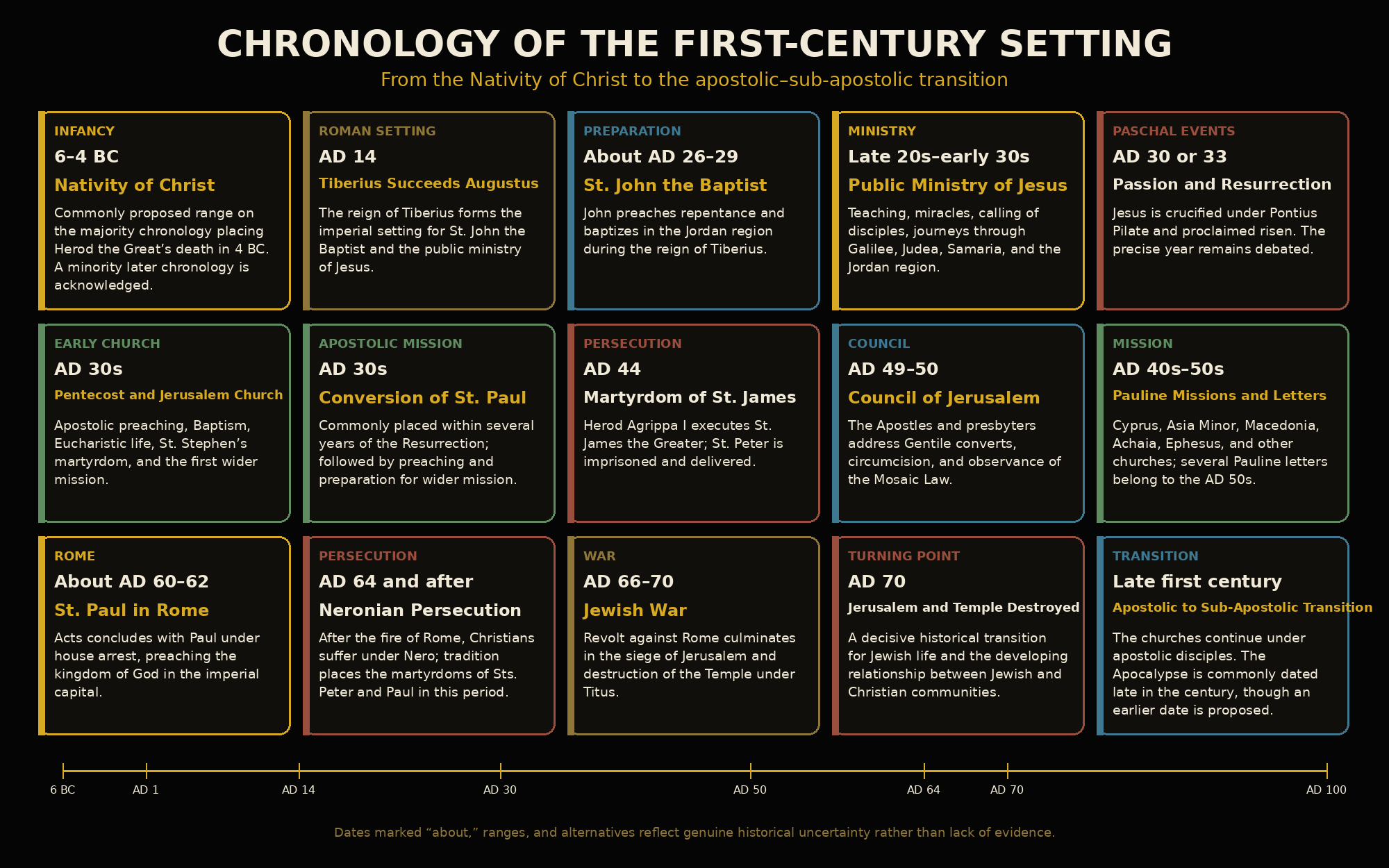
The first century includes the later reign of Herod the Great, Augustus and Tiberius, St. John the Baptist, the public ministry of Jesus Christ, the Passion and Resurrection, Pentecost, the Jerusalem Church, St. Paul’s missions, the Neronian persecution, the Jewish War, and Jerusalem’s destruction in AD 70.
Some dates are fixed securely. Others are approximate or debated. Good chronology combines real knowledge with intellectual modesty.
The First Century at a Glance
How to Read the Dates
Secure Anchor
High confidence
A reign, inscription, war, execution, or public event can often be placed within a well-established historical framework.
Probable Date
Strong reconstruction
The evidence supports one period more strongly than its alternatives, though absolute precision is unavailable.
Approximate Range
Useful sequence
A range identifies order and historical relationship without inventing an exact day or year.
Debated Alternative
Responsible qualification
A minority proposal may deserve acknowledgment even when the majority chronology remains preferable.
Herod the Great and the Nativity
The Gospel of St. Matthew places the Nativity before the death of Herod the Great. On the commonly accepted chronology, Herod died in 4 BC, so the birth of Christ is commonly placed several years before AD 1, often within approximately 6–4 BC.
A minority chronology proposes a later death for Herod. That proposal should be acknowledged without obscuring the majority reconstruction used in most historical summaries.
The discrepancy does not disprove the Christian calendar. The AD dating system was calculated centuries later by Dionysius Exiguus and was not designed with access to every modern chronological reconstruction.
The infancy narratives place the birth of Christ within real Davidic, Jewish, and Roman history. They do not present the Incarnation as an event detached from rulers, places, families, and political circumstances.
Augustus, Tiberius, and Pontius Pilate
Caesar Augustus forms the imperial background of the Nativity narratives. Tiberius succeeded him in AD 14.
St. Luke situates the beginning of St. John the Baptist’s ministry in the fifteenth year of Tiberius. Different ancient methods of counting regnal years affect the exact calculation, but John’s appearance belongs securely to the later AD 20s.
Pontius Pilate governed Judea from approximately AD 26 to 36. The public ministry, Passion, and Crucifixion of Jesus therefore belong within a well-defined Roman administrative setting.
St. John the Baptist and the Public Ministry of Jesus
St. John preached repentance, baptized in the Jordan region, rebuked sin, and prepared the people for the Messiah. His imprisonment and death belong within the rule of Herod Antipas.
The public ministry of Jesus is commonly placed in the later AD 20s and early AD 30s. The Synoptic Gospels can give the impression of a shorter span, while the Gospel of St. John records several Passovers and supports a longer ministry.
Many reconstructions therefore place the public ministry at approximately two or three years. The precise beginning remains debated, but the ministry belongs securely under Tiberius and Pilate.
The Passion, Resurrection, and Pentecost
Jesus Christ was crucified under Pontius Pilate. This chronological fact is central to the New Testament proclamation and is also reflected in later Roman testimony.
The Passion is commonly dated to AD 30 or AD 33. Calendar reconstruction, Passover dates, astronomical calculations, and the Gospel narratives produce arguments for both years.
The Resurrection proclamation follows immediately within the apostolic testimony. Pentecost follows the Ascension and inaugurates the Church’s public missionary life.
Acts describes preaching, Baptism, Eucharistic communion, apostolic leadership, charity, conflict with authorities, and the martyrdom of St. Stephen within the AD 30s.
Jerusalem to Rome
The Conversion of St. Paul
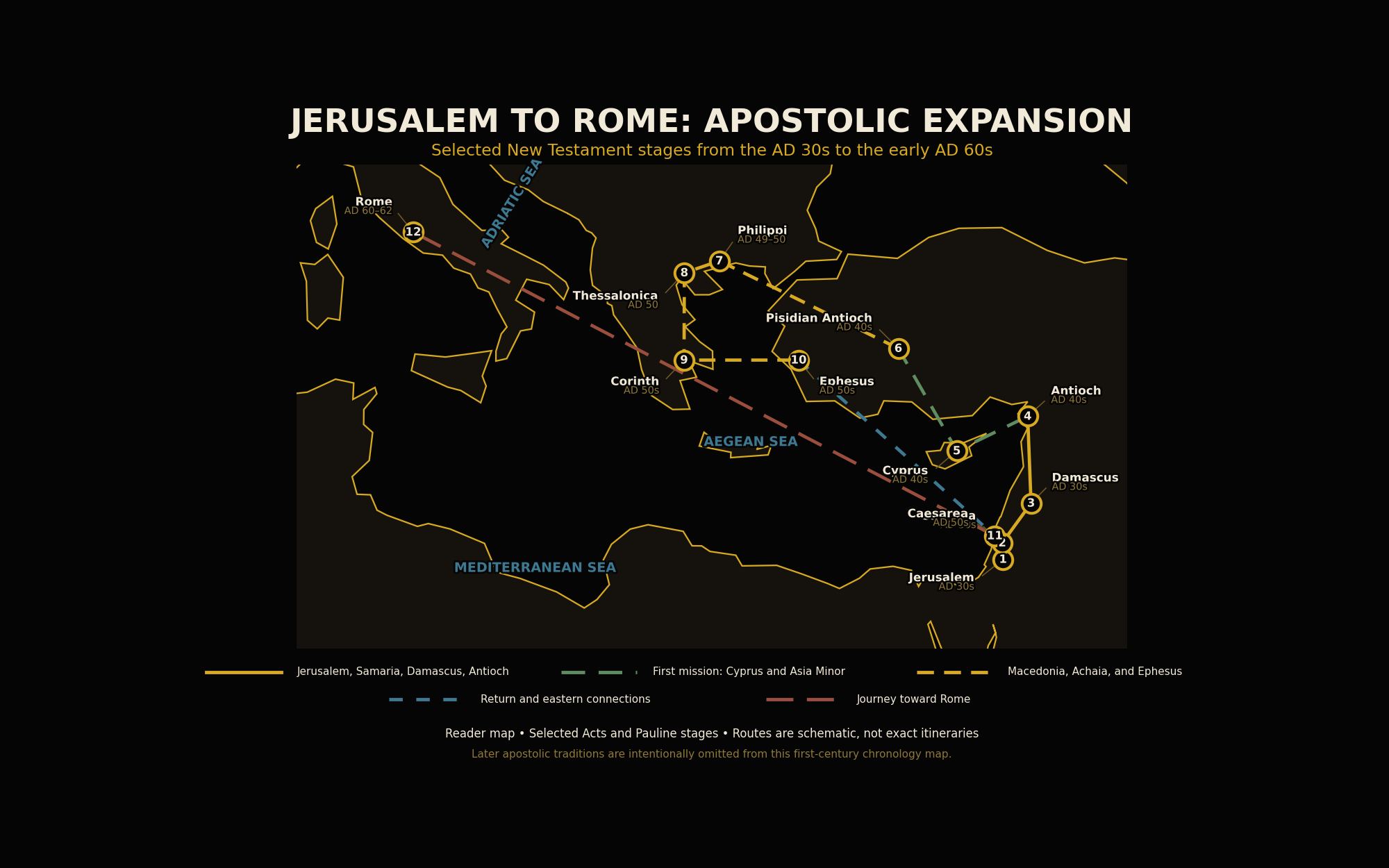
St. Paul’s conversion belongs within several years of the Passion and Resurrection, commonly in the AD 30s. Galatians provides relative chronological information concerning his early years, contacts with St. Peter and St. James, and later visit to Jerusalem.
Paul’s subsequent missions extend through the AD 40s and 50s. His letters preserve direct evidence from actual churches and missionary situations.
The map presents only stages supported by the New Testament and Pauline evidence. It intentionally excludes later regional claims about apostolic foundations because those belong on a separate page about apostolic traditions.
St. James, Herod Agrippa, and the Jerusalem Council
Acts places the martyrdom of St. James the Greater under Herod Agrippa I, who died in AD 44. St. Peter’s imprisonment and deliverance belong to the same episode.
The Council of Jerusalem is commonly placed around AD 49 or 50. The Apostles and presbyters addressed the reception of Gentile converts and the claim that circumcision and observance of the Mosaic Law were necessary for salvation.
The council’s judgment was then communicated to other churches. This event provides one of the most important chronological and ecclesial anchors in Acts.
Pauline Missions and Letters
St. Paul’s first major mission is commonly placed in the AD 40s. His missions through Macedonia, Achaia, and Ephesus belong principally to the AD 50s.
Several Pauline letters can be placed within this decade with varying degrees of confidence. First Thessalonians is frequently regarded as one of the earliest surviving letters. Galatians, First and Second Corinthians, and Romans arise from identifiable missionary controversies and relationships.
Paul later travels as a prisoner toward Rome. Acts concludes with him under house arrest around AD 60–62, preaching the kingdom of God.
Chronology and the New Testament Writings
Chronology also helps readers place the New Testament documents within the life of the early Church. Several Pauline letters belong to the AD 50s and early AD 60s, while the final forms of the Gospels and Acts are commonly placed across the middle and later first century.
Exact dates remain debated, and one should not confuse the date when a book reached its final written form with the date of every tradition it preserves. Apostolic preaching, liturgical formulas, hymns, sayings, narratives, and confessions circulated before and during the composition of the surviving books.
First Corinthians 15 preserves a Resurrection tradition that St. Paul says he received and handed on. First Corinthians 11 similarly preserves tradition concerning the Last Supper and the Eucharist. These passages show that the written letters contain material already transmitted within the Church.
Chronology therefore prevents two opposite errors: imagining that every New Testament book was written immediately after the Resurrection, or imagining that Christian belief remained undefined until the books were written decades later. The Church preached, baptized, celebrated the Eucharist, appointed ministers, and handed on apostolic teaching throughout this period.
Nero and Apostolic Martyrdom
The fire of Rome occurred in AD 64. Tacitus later describes Nero’s punishment of Christians in connection with the disaster.
Christian tradition places the martyrdoms of Sts. Peter and Paul within the Neronian period. The exact year of each martyrdom is not fixed with the same certainty as the fire itself.
This persecution should not be projected backward as a uniform empire-wide legal policy from the beginning. Christian experience varied according to place, ruler, accusation, and local authority.
The Jewish War and AD 70
The Jewish revolt began in AD 66. Roman forces eventually besieged Jerusalem, and the city and Temple were destroyed under Titus in AD 70.
The destruction ended the Temple sacrifices and transformed Jewish communal life. It also contributed to a gradual and regionally varied differentiation between developing rabbinic Judaism and Christian communities during the following decades.
AD 70 is therefore a major historical boundary, but it should not be treated as though every Jewish–Christian relationship changed identically on one day.
For Christians, the event was also read in relation to Christ’s warnings concerning Jerusalem. Historical and theological interpretation must remain connected without being confused.
The Later First Century
During the later first century, Christian communities continued to grow, exchange letters, preserve apostolic teaching, celebrate the sacraments, and develop more visible regional relationships.
The death of the Apostles did not end the Church. Their disciples and successors carried the apostolic faith into the sub-apostolic period.
The Apocalypse is commonly dated to the later first century, although an earlier date has also been proposed. Its precise dating should not be stated more absolutely than the evidence allows.
By approximately AD 100, the Church remained young but was already recognizably historical, sacramental, missionary, episcopal, and apostolic.
Why Sequence Matters for Historical Interpretation
Dates are valuable because sequence affects interpretation. St. Paul’s letters precede the destruction of Jerusalem in AD 70 and provide evidence for Christian belief and worship before that decisive event. Acts describes the Church expanding while the Temple still stood and while Roman provincial institutions shaped travel and legal procedure.
Josephus writes after many of the events he narrates but remains indispensable because he knew the political, priestly, military, and regional world of first-century Judea. Tacitus writes later still, yet his testimony helps confirm the Roman setting of Christ’s execution and Nero’s treatment of Christians.
A later source is not automatically worthless, just as an earlier source is not automatically complete. Historians ask what information the writer possessed, what earlier testimony may stand behind the text, what purpose governed the work, and whether other evidence supports or qualifies it.
A sound timeline thus does more than arrange dates. It helps readers evaluate proximity, continuity, development, and the relationship among Scripture, Jewish history, Roman testimony, archaeology, and early Christian memory.
A Working Chronological Sequence
- 6–4 BC: commonly proposed Nativity range under the majority Herodian chronology.
- AD 14: Tiberius succeeds Augustus.
- About AD 26–29: ministry of St. John the Baptist begins.
- Later AD 20s–early AD 30s: public ministry of Jesus.
- AD 30 or 33: Passion, Death, and Resurrection.
- AD 30s: Pentecost, Jerusalem Church, St. Stephen, and St. Paul’s conversion.
- AD 44: martyrdom of St. James the Greater.
- AD 49–50: Council of Jerusalem.
- AD 40s–50s: principal Pauline missions and early letters.
- About AD 60–62: St. Paul in Rome.
- AD 64 and after: Neronian persecution and traditional setting of Sts. Peter and Paul’s martyrdoms.
- AD 66–70: Jewish War.
- AD 70: destruction of Jerusalem and the Temple.
- Later first century: transition from the apostolic to the sub-apostolic period.
Common Mistakes to Avoid
- Do not assume Jesus was born in AD 1 merely because of the calendar label.
- Do not present Herod’s 4 BC death without acknowledging the minority later chronology.
- Do not force every Gospel event into a modern day-by-day schedule.
- Do not treat AD 30 and AD 33 as equally certain facts rather than competing reconstructions.
- Do not confuse later apostolic traditions with events securely dated in Acts.
- Do not imagine persecution was uniform across the empire from the beginning.
- Do not describe the Jewish–Christian separation as completed instantly in AD 70.
- Do not state the late date of the Apocalypse as though no earlier proposal exists.
Key Takeaways
- The first-century chronology contains both secure anchors and responsible approximations.
- The Nativity is commonly placed before Herod’s death in 4 BC under the majority chronology.
- St. John the Baptist and the public ministry of Jesus belong under Tiberius.
- The Passion is commonly dated to AD 30 or AD 33.
- Pentecost inaugurates the Church’s public missionary life.
- The Council of Jerusalem belongs around AD 49–50.
- St. Paul’s missions and letters structure much of the middle first century.
- Nero’s persecution follows the fire of Rome in AD 64.
- The Jewish War culminates in Jerusalem’s destruction in AD 70.
- The apostolic age passes gradually into the sub-apostolic period.
Continue Your Study
Sources and Further Reading
- Holy Bible, Douay-Rheims: Matthew 1–2 and 24–28; Mark 1 and 13–16; Luke 1–3 and 21–24; John 2, 6, 11–21; Acts 1–28; Galatians 1–2; First Corinthians 11 and 15.
- Catechism of the Catholic Church, 484–570 and 758–769.
- Flavius Josephus, Jewish Antiquities, Books XVII–XX.
- Flavius Josephus, The Jewish War, Books II–VII.
- Tacitus, Annals, 15.44.
- Eusebius of Caesarea, Ecclesiastical History, Books II–III.
- Jack Finegan, Handbook of Biblical Chronology: Principles of Time Reckoning in the Ancient World and Problems of Chronology in the Bible.
- Harold W. Hoehner, Chronological Aspects of the Life of Christ.
- Colin J. Hemer, The Book of Acts in the Setting of Hellenistic History.
- Rainer Riesner, Paul’s Early Period: Chronology, Mission Strategy, Theology.
- Paul L. Maier, Josephus: The Essential Works.
- Raymond E. Brown, The Death of the Messiah.