

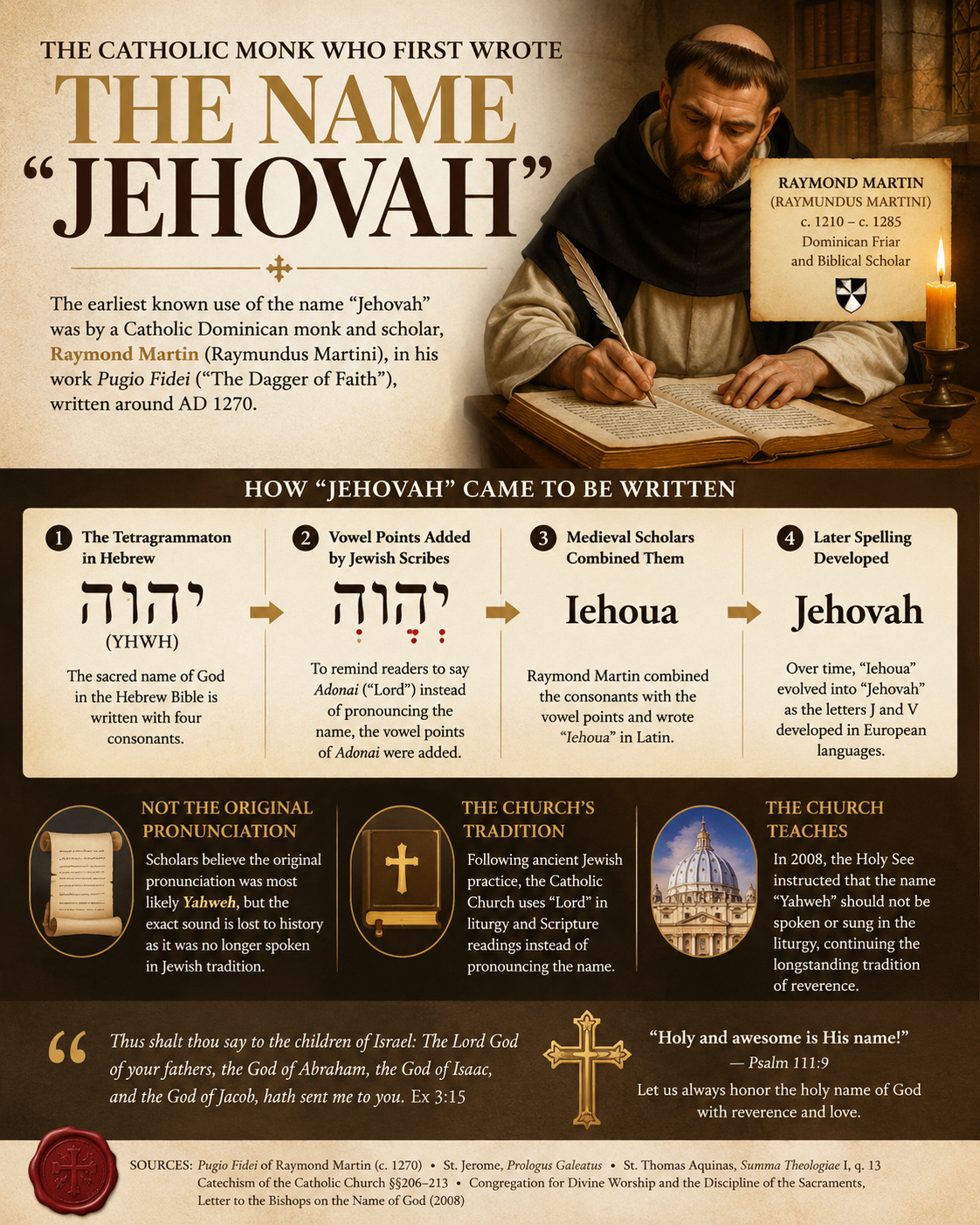
Many people are surprised to learn that the form “Jehovah” was first written by a Catholic scholar during the Middle Ages. The earliest known use of this spelling is generally attributed to the Dominican friar Raymond Martin (Raymundus Martini) in his work Pugio Fidei (“The Dagger of Faith”), written around AD 1270.
In the Hebrew Bible, God’s covenant name is represented by the four Hebrew consonants יהוה (YHWH), known as the Tetragrammaton. Ancient Hebrew manuscripts originally recorded only consonants. By the Middle Ages, Jewish scribes had added vowel markings to the text. Out of reverence, however, they did not pronounce the divine name. Instead, when readers encountered YHWH, they would say Adonai (“Lord”). To remind readers of this tradition, the vowel points of Adonai were placed with the consonants YHWH.
Raymond Martin, working with Hebrew manuscripts, combined these consonants and vowel markings into the Latinized form Iehoua (later spelled Jehovah as the letters J and V developed in European languages). This was not intended to preserve the ancient Hebrew pronunciation but reflected a medieval scholarly reading of the written text.
Modern biblical scholarship agrees that the original pronunciation of the Tetragrammaton was most likely Yahweh, although absolute certainty is impossible because the ancient pronunciation was no longer preserved in Jewish tradition.
The Catholic Church has consistently emphasized reverence for the divine name. Following the ancient practice inherited from Judaism, Catholic liturgy ordinarily substitutes “Lord” for the Tetragrammaton in Scripture readings and prayers. In 2008, the Holy See instructed that the name “Yahweh” should not be spoken or sung in the liturgy, continuing the longstanding Christian tradition of using “Lord” instead.
The history of the word “Jehovah” illustrates how medieval biblical scholarship sought to understand the sacred text. While “Jehovah” became well known in later centuries, especially through some Bible translations and hymns, it is best understood as a Latinized medieval form rather than the original pronunciation of God’s covenant name.
Sources: Pugio Fidei of Raymond Martin (c. AD 1270); St. Jerome, Prologus Galeatus; St. Thomas Aquinas, Summa Theologiae I, q. 13; Catechism of the Catholic Church §§206–213; Congregation for Divine Worship and the Discipline of the Sacraments, Letter to the Bishops on the Name of God (2008).