

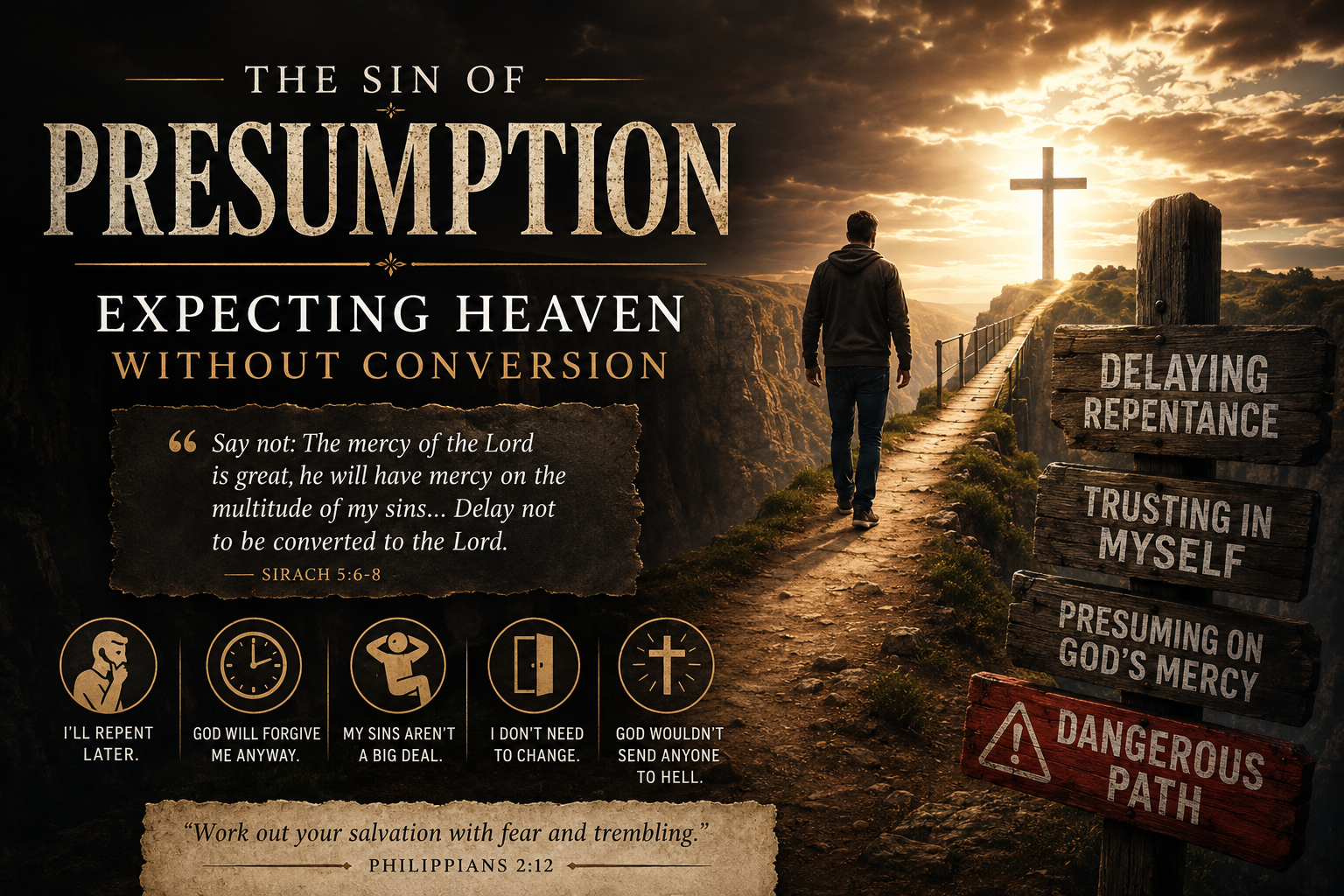
“Work out your salvation with fear and trembling.” — Philippians 2:12 (Douay-Rheims)
Many people assume that because God is loving and merciful, everyone will eventually be saved regardless of how they live. Others believe they can spend their lives in serious sin and simply repent at the last moment. While God’s mercy is infinite, this attitude can become one of the most dangerous spiritual sins: the sin of presumption.
Presumption is subtle because it disguises itself as confidence in God’s goodness. In reality, it twists God’s mercy into an excuse for sin.
What Is Presumption?
The Catechism of the Catholic Church identifies presumption as a sin against the theological virtue of hope:
“There are two kinds of presumption. Either man presumes upon his own capacities… or he presumes upon God’s almighty power or his mercy, hoping to obtain his forgiveness without conversion and glory without merit.” (CCC 2092)
Hope trusts that God will provide the grace necessary for salvation. Presumption expects salvation while refusing the path God has established to receive it.
In simple terms, presumption says:
- “God will forgive me no matter what.”
- “I don’t really need to repent.”
- “I’ll go to Confession later.”
- “I’m basically a good person.”
- “God wouldn’t send anyone to hell.”
These attitudes replace trust with spiritual complacency.
The Two Forms of Presumption
The Church recognizes two principal forms of this sin.
1. Trusting in Yourself Instead of God
This occurs when someone believes they can attain heaven by their own efforts without God’s grace.
This was the temptation of the Pharisee in Christ’s parable, who boasted of his righteousness while despising others (Luke 18:9–14).
Salvation is always a gift of grace.
“For by grace you are saved through faith… not of works, that no man may glory.” (Ephesians 2:8–9)
Our good works cooperate with God’s grace—they never replace it.
2. Presuming Upon God’s Mercy
This is the more common danger.
Instead of rejecting God outright, a person assumes God will forgive them even while they deliberately continue in grave sin.
Examples include:
- delaying repentance for years
- planning to confess “someday”
- intentionally committing mortal sin while expecting automatic forgiveness
- refusing to amend one’s life
God’s mercy is limitless, but He never forces forgiveness upon someone unwilling to repent.
What Scripture Says
Sacred Scripture repeatedly warns against presumption.
Sirach gives perhaps the clearest warning:
“Say not: The mercy of the Lord is great, he will have mercy on the multitude of my sins. For mercy and wrath quickly come from him… Delay not to be converted to the Lord, and defer it not from day to day.” (Sirach 5:6–8)
St. Paul likewise warns:
“Be not deceived: God is not mocked.” (Galatians 6:7)
And our Lord Himself teaches:
“Not every one that saith to me, Lord, Lord, shall enter into the kingdom of heaven: but he that doth the will of my Father who is in heaven.” (Matthew 7:21)
Faith without conversion is not enough.
St. Thomas Aquinas on Presumption
St. Thomas Aquinas discusses presumption in the Summa Theologiae (II-II, q. 21).
He explains that presumption is not excessive hope but a false hope.
Hope trusts God while recognizing the need for repentance, virtue, perseverance, and grace.
Presumption expects the reward while rejecting the means God has established to obtain it.
It is like expecting a harvest without planting seeds.
Or expecting to graduate without studying.
The goal is desired while the necessary journey is ignored.
Presumption vs. Christian Hope
Many people confuse hope with presumption.
Christian hope says:
- God will give me grace.
- I trust in Christ.
- I will repent when I fall.
- I will strive to follow Him.
- I rely on His mercy every day.
Presumption says:
- God has to forgive me.
- My sins aren’t a big deal.
- I don’t need to change.
- I’ll worry about holiness later.
Hope leads to conversion.
Presumption delays it.
Why This Sin Is So Dangerous
Presumption keeps people from seeking God’s mercy precisely because they assume they already possess it.
Ironically, those who presume upon forgiveness often neglect:
- Confession
- prayer
- repentance
- the sacraments
- growth in holiness
The devil does not always tempt people to deny God’s mercy.
Sometimes he tempts them to abuse it.
Avoiding Presumption
The remedy begins with humility.
Recognize that salvation is entirely God’s gift, yet one that requires our free cooperation with His grace.
Frequent Confession, daily prayer, examination of conscience, worthy reception of the Eucharist, and sincere repentance help keep the soul rooted in authentic hope.
Whenever we fall, we should immediately return to Christ—not because we presume upon His mercy, but because we trust it.
Mercy Is Greater Than Our Sin
The answer to presumption is not despair.
Despair says:
“There is no hope for me.”
Presumption says:
“I don’t need to repent.”
The Gospel proclaims something entirely different:
“Repent, believe, and trust in God’s mercy.”
Jesus welcomed sinners—but He always called them to conversion.
To the woman caught in adultery He said:
“Neither will I condemn thee. Go, and now sin no more.” (John 8:11)
Notice both mercy and transformation.
Christ forgives.
Christ heals.
Christ calls us to holiness.
Final Thoughts
God’s mercy is infinite.
No sinner is beyond forgiveness.
Yet forgiveness is never separated from repentance.
The Christian life is neither anxious fear nor careless presumption. It is confident hope—a humble trust that God will faithfully give every grace necessary to those who seek Him with sincere hearts.
May we never presume upon God’s mercy, nor despair of it, but live each day in faithful hope, continually turning back to the One who “is patient toward you, not willing that any should perish, but that all should return to penance” (cf. 2 Peter 3:9).
Sources: Catechism of the Catholic Church §§1817–1821, 2090–2092; Summa Theologiae, II-II, q. 21; Douay-Rheims Bible: Philippians 2:12; Sirach 5:6–8; Luke 18:9–14; Matthew 7:21; John 8:11; Galatians 6:7; Ephesians 2:8–9; 2 Peter 3:9.