

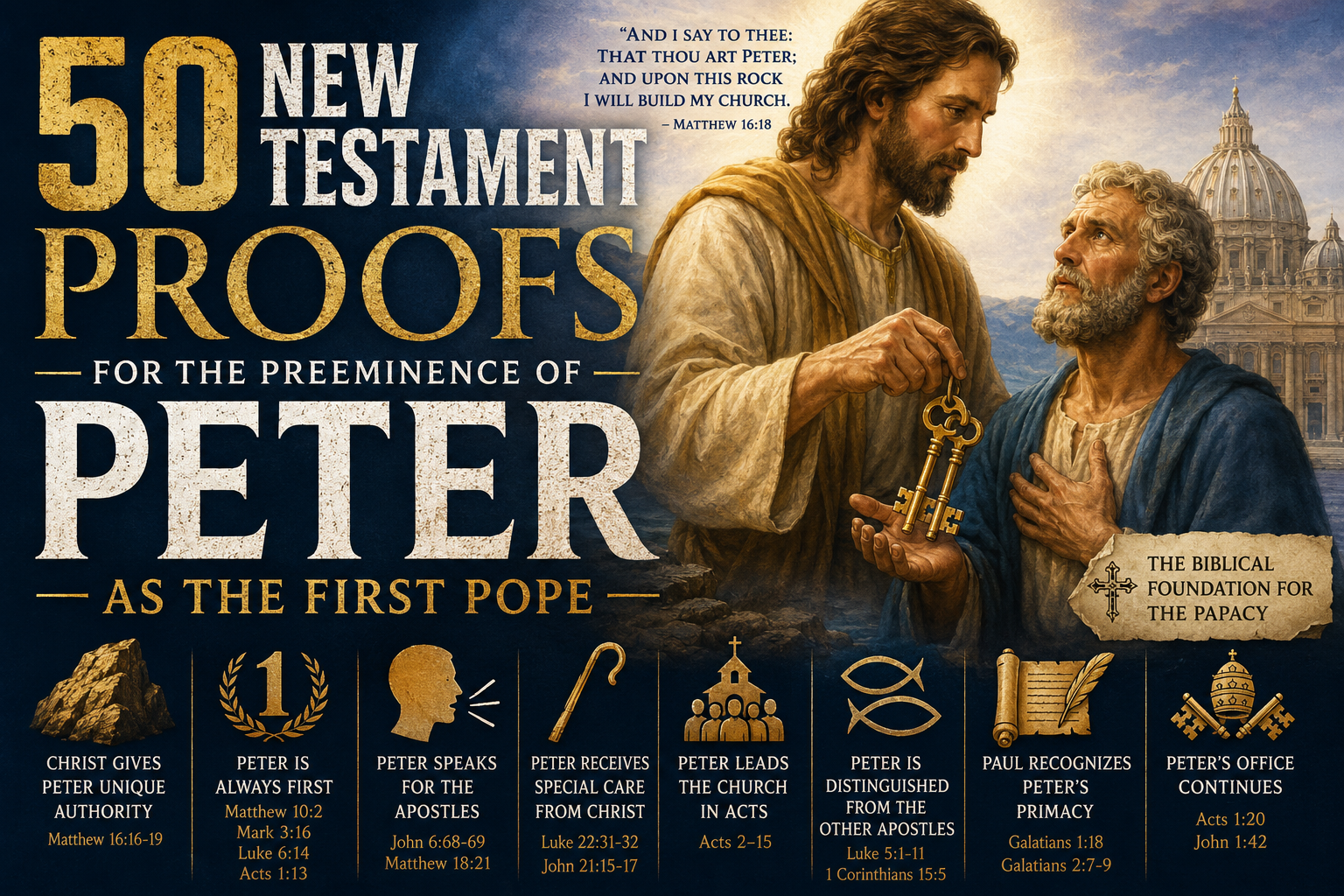
“And I say to thee: That thou art Peter; and upon this rock I will build my Church.” — Matthew 16:18 (Douay-Rheims)
Introduction
One of the most common objections to the papacy is the claim that “the Bible never says Peter was the Pope.” Catholics readily agree that Sacred Scripture never uses the word pope as a title for St. Peter. However, this objection misses the point entirely.
The doctrine of the papacy is not built upon a single proof text but upon the cumulative witness of the New Testament. When all the biblical evidence is considered together, Peter consistently emerges as the chief of the Apostles, the visible head of Christ’s Church, the spokesman for the apostolic college, the shepherd of Christ’s flock, and the holder of a unique office that continues after the Apostles.
The following fifty biblical proofs demonstrate why Catholics have always recognized St. Peter as the first Pope.
I. Christ Gives Peter Unique Authority
1. Matthew 16:16–19 — Peter’s Great Confession
Peter proclaims:
“Thou art Christ, the Son of the living God.”
In response, Jesus gives Peter four unique privileges:
- Simon receives a new name: Peter (Rock).
- Jesus declares, “Upon this rock I will build my Church.”
- Peter alone receives the Keys of the Kingdom of Heaven.
- Peter alone is given the authority to bind and loose before the other Apostles receive a shared authority.
This is the foundational papal passage.
2. Isaiah 22:20–22 — The Old Testament Background
Matthew 16 cannot be fully understood without Isaiah 22.
In the Davidic Kingdom, the king appointed a royal steward or prime minister who possessed the key of the House of David.
The office was permanent, surviving the death of its holder.
Jesus, the Son of David, deliberately echoes this passage when He entrusts Peter with the keys of the Kingdom, establishing him as chief steward over His Kingdom.
3. Matthew 16:18 — The Rock
Jesus says:
“Upon this rock I will build my Church.”
Notice:
- Christ speaks of one Church.
- Peter is appointed as its visible foundation under Christ, the true cornerstone.
4. Matthew 16:19 — The Keys
Only Peter receives the Keys.
Although the other Apostles later receive authority to bind and loose (Matthew 18:18), only Peter receives the symbol of supreme governing authority: the Keys of the Kingdom.
II. Peter Is Always First
5. Matthew 10:2
“The first, Simon who is called Peter…”
The Greek word prōtos can indicate rank as well as order.
6. Mark 3:16
Peter heads the list of Apostles.
7. Luke 6:14
Again Peter appears first.
8. Acts 1:13
Even after Christ’s Ascension, Peter continues to head every apostolic list.
9. Judas Is Always Last
In every list:
- Peter is first.
- Judas is last.
This consistent ordering is not accidental.
III. Peter Speaks for the Apostles
Throughout the Gospels, Peter naturally becomes the spokesman for the Twelve.
10. Matthew 18:21
Peter asks questions on behalf of the Apostles.
11. Mark 8:29
Peter confesses Christ as the Messiah.
12. Luke 8:45
Peter answers Jesus when everyone is silent.
13. John 6:68–69
After many disciples leave Jesus, Peter speaks for all:
“Lord, to whom shall we go? Thou hast the words of eternal life.”
14. Matthew 19:27
Peter asks what reward awaits the Apostles.
15. John 13:6–9
Peter speaks during the washing of the feet.
Again, he represents the group.
IV. Peter Receives Special Care from Christ
16. Luke 22:31–32
Jesus tells Peter:
“I have prayed for thee, that thy faith fail not: and thou, being once converted, confirm thy brethren.”
Peter alone receives this commission.
17. The Plural and Singular
Jesus first says:
Satan has desired to sift you (plural).
Then:
I have prayed for thee (Peter alone).
Peter is strengthened so that he may strengthen the others.
18. John 21:15–17
Three times Christ commands Peter:
- Feed My lambs.
- Feed My sheep.
- Feed My flock.
Peter receives pastoral responsibility over Christ’s entire flock.
19. Universal Shepherd
Christ entrusts all His sheep—not merely a local congregation—to Peter.
V. Peter Leads the Early Church
The Acts of the Apostles reads like a history of Peter’s leadership before shifting its focus to Paul’s missionary journeys.
20. Acts 1:15–26
Peter presides over the election of Matthias to replace Judas.
21. Acts 2
Peter preaches the first Christian sermon.
22. Acts 2:14
Peter stands with the Eleven and addresses the crowd.
23. Acts 2:37–41
The people respond directly to Peter’s preaching.
24. Acts 3
Peter performs the Church’s first recorded apostolic miracle.
25. Acts 4
Peter boldly speaks before the Sanhedrin.
26. Acts 5
Peter judges Ananias and Sapphira.
27. Acts 5:15
Even Peter’s shadow heals the sick.
28. Acts 8:14–24
Peter rebukes Simon Magus, giving rise to the term simony.
29. Acts 9
Peter heals Aeneas.
30. Acts 9
Peter raises Tabitha (Dorcas) from the dead.
31. Acts 10
Peter receives the vision opening the Church to the Gentiles.
32. Acts 10
Peter baptizes Cornelius and his household.
33. Acts 11
Peter explains his actions, and the Church accepts his judgment.
34. Acts 12
Peter’s miraculous release from prison highlights his importance to the Church.
35. Acts 15
At the Council of Jerusalem, Peter gives the decisive doctrinal address.
36. Acts 15:7–11
After Peter speaks:
“All the multitude held their peace.”
His words settle the theological dispute.
37. James Gives the Practical Judgment
James proposes the pastoral application after Peter has already resolved the doctrinal question.
VI. Peter Is Distinguished from the Other Apostles
38. Luke 5:1–11
Jesus teaches from Peter’s boat before calling the Apostles.
39. Matthew 17:24–27
The Temple tax collectors approach Peter specifically.
40. Jesus Pays for Himself and Peter
Christ miraculously provides the tax payment for Himself and Peter together.
41. Luke 24:34
The risen Christ appears personally to Peter before many others.
42. 1 Corinthians 15:5
St. Paul likewise emphasizes Christ’s appearance to Cephas before the Twelve.
VII. St. Paul Recognizes Peter’s Primacy
43. Galatians 1:18
Paul travels to Jerusalem specifically to visit Peter.
44. The Greek Word Historeō
The verb suggests more than a casual visit—it carries the sense of consulting or becoming personally acquainted with someone of importance.
45. Galatians 2:7–8
Peter receives a distinct mission to the circumcised.
46. Galatians 2:9
Peter is named first among the “pillars.”
47. Galatians 2:11–14
Paul rebukes Peter’s conduct—not his doctrine.
The incident actually illustrates Peter’s prominence: his actions influenced the entire Church.
VIII. Peter’s Office Continues
48. Acts 1:20
Judas’ episcopal office (episkopē) is filled by another.
The apostolic office itself continues beyond the lifetime of its holder.
49. John 1:42
Jesus renames Simon as Cephas (“Rock”) long before Peter performs any apostolic work, demonstrating that his role is established by Christ’s sovereign choice rather than by human merit.
50. The Complete New Testament Pattern
Throughout the New Testament Peter consistently:
- receives unique promises,
- receives the Keys,
- serves as the visible rock,
- strengthens the Apostles,
- shepherds Christ’s flock,
- opens the Church to Jews and Gentiles,
- presides over the Church’s earliest decisions,
- settles doctrinal disputes,
- serves as chief spokesman,
- and exercises a unique pastoral leadership among the Twelve.
Taken together, these passages reveal a consistent biblical portrait of Peter’s preeminence.
Conclusion
No single verse states, “Peter is the Pope.” Instead, the New Testament presents a rich tapestry of evidence pointing to Peter’s unique role in Christ’s Church.
Jesus gives Peter alone the Keys of the Kingdom (Matthew 16:19). He establishes Peter as the visible rock upon which He will build His Church (Matthew 16:18). He prays specifically for Peter so that he may strengthen his brethren (Luke 22:31–32). After the Resurrection, Christ entrusts Peter with the care of His entire flock (John 21:15–17). Throughout the Acts of the Apostles, Peter consistently acts as the Church’s visible leader, speaking first, judging disputes, opening the Gospel to both Jews and Gentiles, and guiding the early Christian community.
Finally, Acts 1 demonstrates that apostolic offices continue through succession, providing the biblical foundation for the continuation of Peter’s office in the bishops of Rome.
The earliest generations of Christians understood these passages in precisely this way. St. Clement of Rome, St. Ignatius of Antioch, St. Irenaeus of Lyons, St. Cyprian of Carthage, and Pope St. Leo the Great all testify to the unique authority of the Church of Rome and the enduring office of Peter. This understanding is faithfully preserved in the Catechism of the Catholic Church (§§551–553, 816, 881–882) and solemnly defined by the First Vatican Council in Pastor Aeternus.
When read as a whole, the New Testament presents not isolated proof texts but a coherent and compelling portrait of Peter’s God-given primacy—a primacy that continues in the papacy to this day.


Leave a Reply