

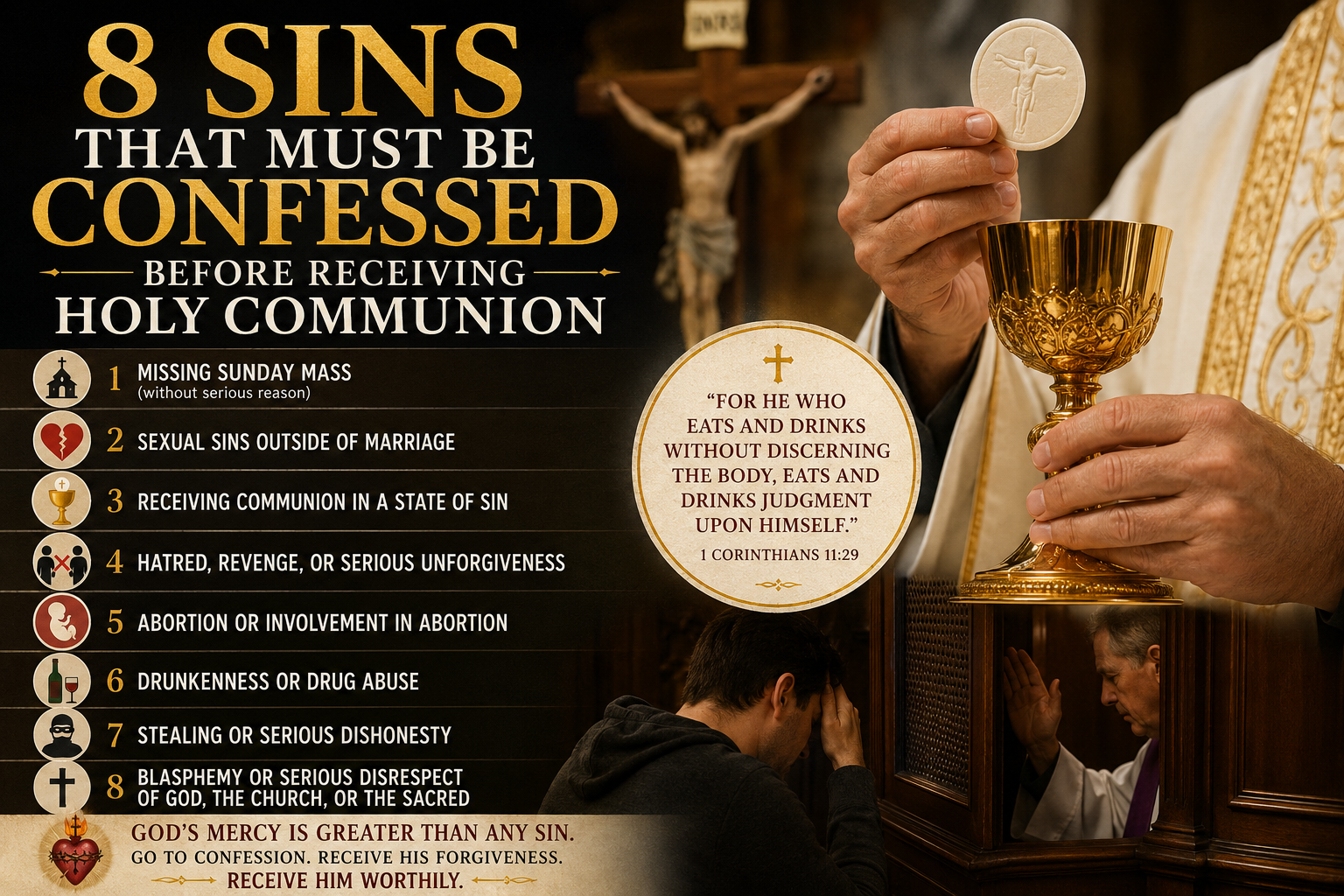
The Holy Eucharist is the greatest treasure of the Catholic Church. It is not merely a symbol—it is the true Body, Blood, Soul, and Divinity of Jesus Christ. Every time we receive Holy Communion, we are entering into the most intimate union possible with our Lord on this side of heaven.
Because the Eucharist is so sacred, the Church teaches that Catholics must receive Holy Communion worthily, meaning they must be in a state of grace. Anyone conscious of having committed a mortal sin should first receive the Sacrament of Reconciliation before approaching the altar.
St. Paul gives this solemn warning:
“Therefore whosoever shall eat this bread, or drink the chalice of the Lord unworthily, shall be guilty of the body and of the blood of the Lord… For he that eateth and drinketh unworthily, eateth and drinketh judgment to himself.” (1 Corinthians 11:27–29, Douay-Rheims)
What Is a Mortal Sin?
The Catechism of the Catholic Church teaches that for a sin to be mortal, three conditions must be present:
- Grave matter
- Full knowledge
- Deliberate consent
When all three are present, mortal sin destroys the life of grace in the soul and separates us from friendship with God (CCC 1855–1861).
Below are eight common examples of grave sins that should be confessed before receiving Holy Communion. This is not an exhaustive list, but these are among the most frequently encountered.
1. Deliberately Missing Sunday Mass
Knowingly and willingly missing Sunday Mass or a Holy Day of Obligation without a serious reason—such as illness, caring for someone who is sick, or another grave circumstance—is a mortal sin.
The Third Commandment calls us to keep the Lord’s Day holy, and the Church obliges Catholics to participate in the Holy Sacrifice of the Mass.
See: CCC 2180–2181.
2. Sexual Sins Outside of Marriage
God created human sexuality as a beautiful gift reserved for marriage between one man and one woman.
Grave violations of chastity include:
- Fornication
- Adultery
- Pornography
- Masturbation
- Sexual acts outside marriage
- Other deliberately chosen grave acts against chastity
These sins should be brought to Confession before receiving Holy Communion.
See: CCC 2331–2400.
3. Receiving Holy Communion While in Mortal Sin
If someone knowingly receives the Eucharist while conscious of mortal sin, they commit another grave sin: sacrilege.
Instead of receiving Communion, Catholics should first go to Confession, where Christ lovingly restores them to grace.
See: CCC 1385; 1 Corinthians 11:27–29.
4. Serious Hatred or Refusing to Forgive
Jesus repeatedly commands His followers to forgive others.
Knowingly nurturing deep hatred, seeking revenge, or deliberately refusing forgiveness in a grave matter can seriously damage our relationship with God. While feelings of hurt or anger are not sins in themselves, freely choosing to cling to hatred or reject forgiveness is spiritually dangerous.
Jesus taught:
“If you will not forgive men, neither will your Father forgive you your offences.” (Matthew 6:15)
5. Abortion or Deliberate Cooperation in Abortion
The Church has always taught that every human life is sacred from conception.
Procuring an abortion or deliberately assisting, encouraging, or formally cooperating in one is an extremely grave sin.
The good news is that no sin is beyond God’s mercy. Through sincere repentance and the Sacrament of Reconciliation, healing and forgiveness are always possible.
See: CCC 2270–2275.
6. Drunkenness or Drug Abuse
Intentionally becoming drunk or abusing drugs to the point of seriously impairing reason can be gravely sinful, especially when it endangers oneself or others.
Our bodies are temples of the Holy Spirit, and we are called to practice the virtue of temperance.
See: CCC 2290–2291.
7. Serious Theft, Fraud, or Dishonesty
Stealing property of significant value, committing fraud, cheating others, serious tax evasion, or deliberately deceiving people in grave matters violates the Seventh Commandment.
Whenever possible, true repentance also includes making restitution for what was unjustly taken.
See: CCC 2401–2418.
8. Blasphemy or Serious Disrespect Toward God
Blasphemy is the deliberate use of words of hatred, reproach, or defiance against God. It also includes showing grave disrespect toward the Holy Eucharist, sacred objects, or holy things dedicated to God.
The Second Commandment calls us to reverence God’s holy name.
See: CCC 2148.
God’s Mercy Is Greater Than Every Sin
The purpose of this article is not to frighten anyone, but to encourage Catholics to approach Jesus with reverence and confidence in His mercy.
No matter how far we have wandered, Christ is always waiting for us in the confessional. Through the Sacrament of Reconciliation, He forgives our sins, restores sanctifying grace, and prepares our hearts to receive Him worthily in the Holy Eucharist.
As St. John reminds us:
“If we confess our sins, he is faithful and just, to forgive us our sins, and to cleanse us from all iniquity.” (1 John 1:9)
If you have been away from Confession for months—or even years—don’t be afraid. The Father is waiting with open arms.
Continue Growing in Your Catholic Faith
If this article helped you, consider sharing it with family and friends. Together, we can help more people rediscover the beauty of Confession, the holiness of the Eucharist, and the infinite mercy of Jesus Christ.
May God bless you, and may every Holy Communion draw you ever closer to Him.