

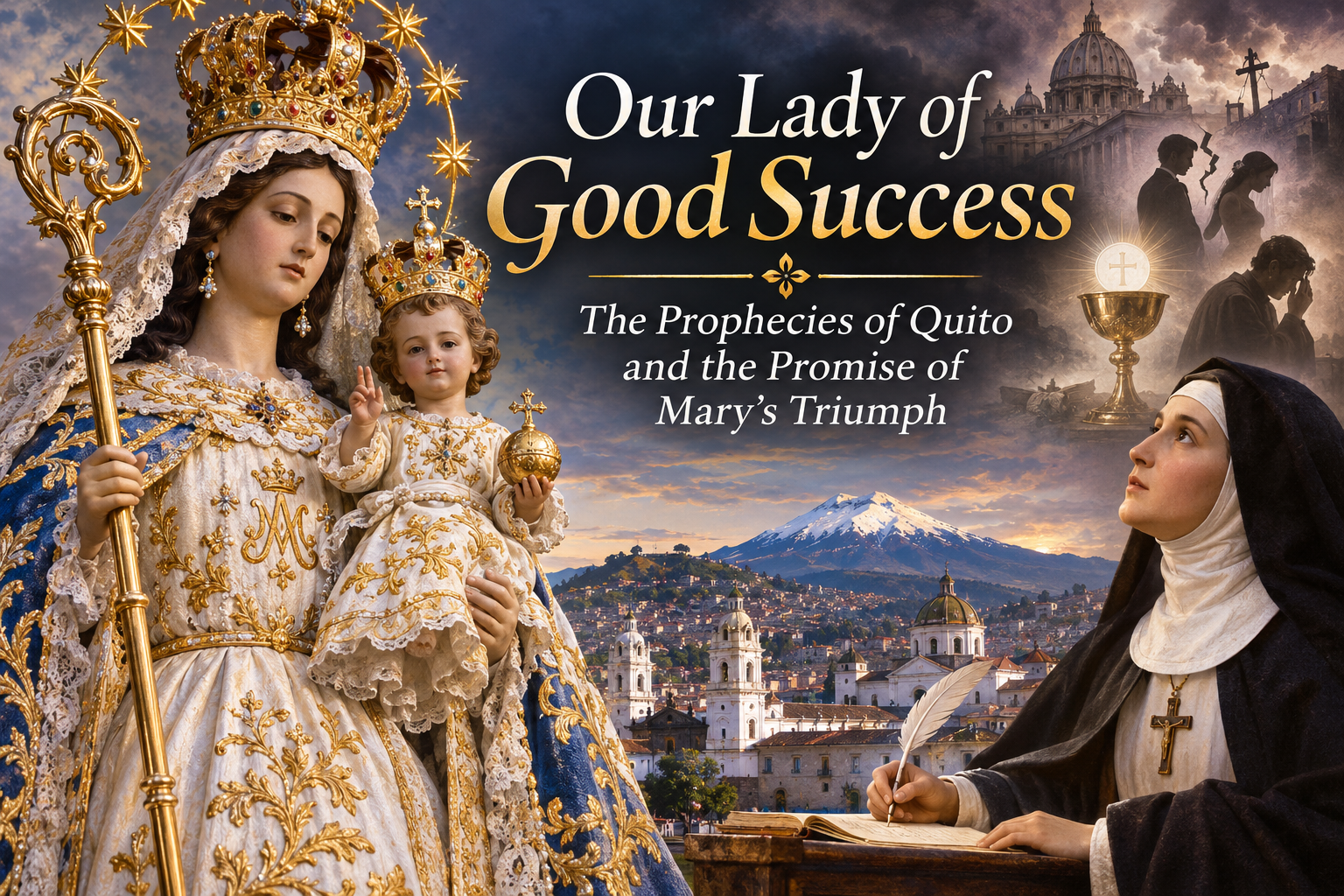
The extraordinary Marian revelations traditionally associated with Mother Mariana de Jesús Torres, their warnings about the future of the Catholic Church, and their enduring message of repentance, perseverance, and hope.
A Heavenly Warning from the Seventeenth Century
More than four centuries ago, in the city of Quito, Ecuador, a Conceptionist religious sister named Mother Mariana Francisca de Jesús Torres was said to have received extraordinary revelations from the Blessed Virgin Mary under the title Our Lady of Good Success (Nuestra Señora del Buen Suceso).
According to the convent’s tradition, these mystical experiences occurred between 1594 and 1634. The messages attributed to Our Lady contained solemn warnings about spiritual dangers that would arise centuries later, particularly during the nineteenth and twentieth centuries.
They described a future in which Catholic morality would deteriorate, Christian marriage would come under attack, reverence for the Holy Eucharist would diminish, and many souls would grow indifferent to the truths of the Faith.
Yet the message was not simply one of catastrophe. At its heart was a promise of divine assistance, Mary’s maternal protection, and the eventual restoration of the Church after a period of great suffering.
These revelations belong to the realm of private revelation. Although devotion to Our Lady of Good Success has a long ecclesiastical history in Quito, the precise historical authenticity of all the prophecies circulated today has not been definitively established by the Church.
The Apparitions and the Sacred Image
Mother Mariana entered religious life at the Monastery of the Immaculate Conception in Quito, where she became known for her prayer, penance, humility, and fidelity to her vocation.
The tradition places the beginning of her Marian revelations in 1594. A particularly important apparition is associated with January 21, 1610, when the Blessed Virgin reportedly identified herself as Mary of Good Success and requested that an image be made in her likeness.
The Virgin was described as holding the Divine Child in one arm and an abbess’s staff in the other, signifying her maternal guardianship over the religious community.
The sacred image became the center of a devotion that spread beyond the monastery. February 2, the Feast of the Presentation of the Lord, became especially associated with Our Lady of Good Success.
In 1991, the Archbishop of Quito authorized the canonical coronation of the venerable image and recognized the monastery church as an archdiocesan Marian shrine.
The Prophecy of a Great Crisis of Faith
Among the most striking messages attributed to Our Lady of Good Success is the warning that a profound moral and spiritual crisis would unfold in later centuries.
The traditional accounts speak of a period when the light of faith would be weakened in many souls through widespread moral corruption.
This prophecy describes a society increasingly governed by worldly desires rather than divine law, where religious indifference would spread and many would lose the understanding of sin.
These warnings echo the perennial teaching of Sacred Scripture. Saint Paul wrote of times when people would turn away from sound doctrine and seek teachers who satisfied their own desires (2 Timothy 4:3–4).
The Catholic interpretation of such warnings must always begin with personal conversion. The question is not merely whether the world has become sinful, but whether we ourselves are living in friendship with God.
Prophecies Concerning Marriage, the Eucharist, and the Priesthood
The revelations attributed to Mother Mariana contain several particularly serious warnings.
The attack upon Christian marriage. The traditional prophecy says that the Sacrament of Matrimony would be attacked and that laws and social customs would increasingly undermine its sacred character.
Catholic teaching recognizes marriage as a covenant between one man and one woman, ordered toward the good of the spouses and the generation and education of children. Christ raised marriage between the baptized to the dignity of a sacrament (Catechism of the Catholic Church, 1601).
The loss of Eucharistic reverence. The accounts also warn of indifference toward the Blessed Sacrament, sacrilege, and a weakening of belief and devotion among the faithful.
For Catholics, the Holy Eucharist is truly the Body, Blood, Soul, and Divinity of Jesus Christ. The Church calls it the source and summit of Christian life (Catechism, 1324).
The appropriate response is greater reverence at Holy Mass, worthy reception of Holy Communion, frequent Confession, and Eucharistic adoration.
Trials within the priesthood. Another part of the reported message concerns priests who would neglect their sacred responsibilities and souls who would suffer from a lack of spiritual guidance.
Yet the same tradition speaks of courageous and faithful clergy who would defend the truth despite persecution and hardship.
This reminds Catholics of the need to pray for priests, encourage holy vocations, and remain faithful to the Church’s authentic teachings.
The Prophecies Concerning the Nineteenth Century
Devotional accounts of Our Lady of Good Success also attribute to the revelations predictions of events that later occurred in the Catholic Church.
These include the solemn definition of the dogma of the Immaculate Conception by Pope Pius IX in 1854 and the definition of papal infallibility by the First Vatican Council in 1870.
Some accounts also associate the prophecies with the death of Ecuadorian President Gabriel García Moreno, who was assassinated in 1875.
These historical events are established facts. However, demonstrating their fulfillment as supernatural prophecy requires reliable evidence that the precise predictions were recorded before the events occurred.
Much of the detailed prophetic material known today comes through later biographies and devotional publications, particularly the biography composed by Franciscan Father Manuel de Sousa Pereira in the late eighteenth century. The manuscript history therefore matters when evaluating claims of fulfillment.
The Promise of Restoration and Victory
The most encouraging aspect of the revelations is the promise that spiritual darkness would not have the final word.
The traditional accounts describe a time when the forces opposed to the Church would appear victorious, but when divine intervention would bring a renewal of faith.
Mary is portrayed as a mother protecting her children during spiritual danger and leading them back to her Divine Son.
This hope is firmly rooted in Catholic doctrine, quite apart from the historical authenticity of any particular apparition.
Christ Himself promised:
“And the gates of hell shall not prevail against it.”
— Matthew 16:18, Douay-Rheims Bible
The Church may suffer persecution, scandal, and internal weakness, but Christ will never abandon His Church.
Mary’s maternal mission is never independent of her Son. She leads souls to Jesus Christ, encourages repentance, and assists the faithful through her intercession.
As the Mother of God, she is honored by the Church as a powerful intercessor and a model of perfect obedience to the divine will (Second Vatican Council, Lumen Gentium, 62–65).
How Catholics Should Respond to These Prophecies
The message traditionally associated with Our Lady of Good Success should not lead Catholics into fear, speculation, or accusations against others.
Rather, it invites a renewed commitment to the spiritual life.
Catholics can respond by praying the Holy Rosary, receiving the sacraments frequently and worthily, practicing penance, strengthening Catholic family life, supporting faithful priests, studying the teachings of the Church, and carrying out works of charity.
Above all, they must remain united to Christ and His Church.
The Catechism reminds us that private revelations do not complete or surpass the Revelation given through Jesus Christ (Catechism, 67). Their proper purpose is to help believers live the Gospel more fully.
Consequently, no Catholic is obliged to accept the reported apparitions or prophecies of Our Lady of Good Success as articles of faith.
Conclusion: The Triumph of Faith Over Darkness
The story of Our Lady of Good Success continues to inspire Catholics because it combines serious warnings with a message of hope.
Its prophetic tradition reminds us that the greatest danger to souls is not suffering, persecution, or worldly opposition, but the loss of faith and charity.
The answer to spiritual darkness is not despair. It is holiness.
The answer to confusion is fidelity to Catholic truth.
The answer to sin is repentance and God’s mercy.
And the answer to fear is confidence in Jesus Christ, who conquered sin and death through His Cross and Resurrection.
The final lesson of Our Lady of Good Success is therefore a call to remain close to the Mother of God, who always directs her children toward her Son.
At Cana, the Blessed Virgin gave a command that remains the perfect expression of authentic Marian devotion:
“Whatsoever he shall say to you, do ye.” — John 2:5, Douay-Rheims Bible
May Our Lady of Good Success intercede for the Church, strengthen families, protect priests, obtain the conversion of sinners, and lead all souls to the Sacred Heart of Jesus.
Our Lady of Good Success, pray for us.
Principal Historical and Doctrinal References
Father Manuel de Sousa Pereira, O.F.M. Vida Admirable de la Reverendísima Madre Mariana de Jesús Torres, composed in the late eighteenth century. A principal source for the later accounts of her mystical life.
Monsignor Luis E. Cadena y Almeida. Mensaje Profético de la Sierva de Dios Sor Mariana Francisca de Jesús Torres y Berriochoa y su fiel cumplimiento a través de los siglos.
Father Félix Carmona Moreno, O.S.A. “Primer monasterio de religiosas contemplativas en El Ecuador: El Real de la Limpia Concepción en Quito,” in La Clausura Femenina en España e Hispanoamérica: Historia y Tradición Viva (2020), pp. 967–988.
Pope Pius IX. Ineffabilis Deus (December 8, 1854).
First Vatican Council. Pastor Aeternus (July 18, 1870), chapter 4.
Second Vatican Council. Lumen Gentium (November 21, 1964), chapter 8.
Catechism of the Catholic Church. Paragraphs 66–67, 1324, 1601, and 971.
Dicastery for the Doctrine of the Faith. Norms for Proceeding in the Discernment of Alleged Supernatural Phenomena (May 17, 2024), paragraphs 11–13.