

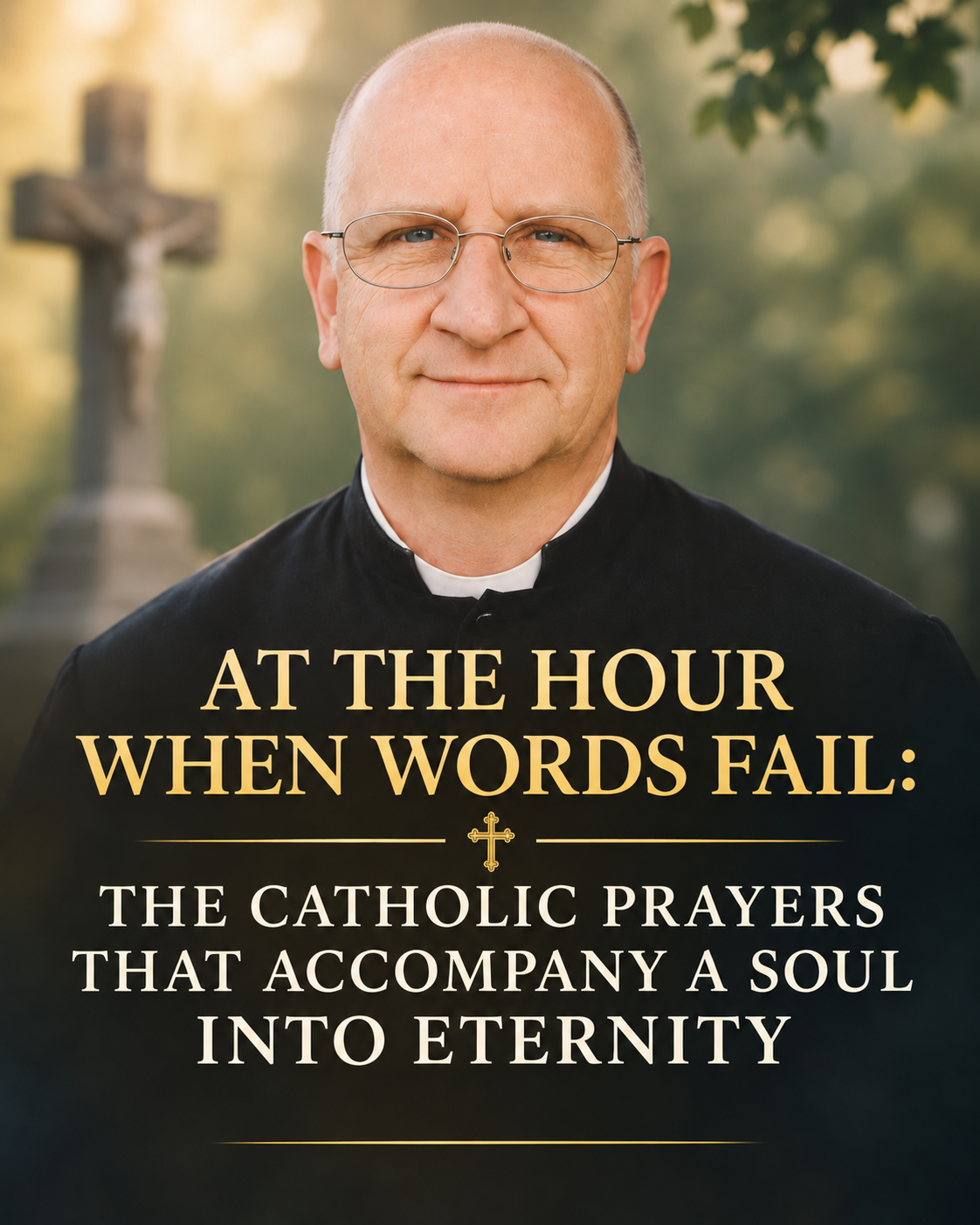
What Fr. Chad Ripperger’s farewell to his mother reveals about the Last Rites, the power of the Holy Name of Jesus, and the forgotten Catholic art of preparing for a holy death.
By Catholicg33k
There comes a moment in human life when almost everything we ordinarily consider important suddenly becomes secondary.
The conversations we never finished. The plans we made for next year. The responsibilities that once demanded our attention.
All of them give way to one inescapable reality.
A human being is approaching death.
For the family gathered nearby, this can be an overwhelming experience. There may be medical equipment, unfamiliar sounds, tears, silence, and the terrible awareness that the person they love may soon take a final breath.
Words that once came easily may become impossible to find.
What should a Catholic say at such a moment?
Should we continue praying the Rosary? Should we call for a priest? What if our loved one can no longer speak? What if the final moments are frightening rather than peaceful?
The Catholic Church has not left these questions unanswered.
For centuries, she has accompanied her dying children with the sacraments, Sacred Scripture, invocations of the Holy Name of Jesus, and solemn prayers entrusting the departing soul to God.
And in August 2026, an American priest’s deeply personal farewell to his mother brought this ancient tradition into renewed focus.
1. A Priest, His Mother, and the Final Rosary
On August 13, 2026, Joyce Elaine Ripperger died in Casper, Wyoming, at the age of 89.
She was the mother of Father Chad Ripperger, a Catholic priest known for his theological teaching and exorcism ministry.
In a recorded reflection published later that August, Father Ripperger spoke about his mother’s final days and the Catholic faith that had shaped her life.
His account describes a family determined to surround their mother with prayer.
The Rosary occupied an important place during her final days. The family also maintained a continual presence of prayer around her.
As death approached, she received the spiritual assistance of the Church, including the Anointing of the Sick, Holy Communion in preparation for death, the Apostolic Pardon, and prayers for the dying.
Father Ripperger recounts that his mother’s final moments unfolded amid the family’s prayers.
As they recognized that death was near, they turned to the traditional Catholic prayers accompanying the departure of a soul.
Among these is the ancient invocation:
Jesus, Jesus, Jesus.
They also prayed for Christ to receive her spirit.
Father Ripperger subsequently described his mother’s death as peaceful and holy.
Yet the deepest meaning of this account does not lie in the particular circumstances of one family’s farewell.
It lies in what the Church was doing through those prayers and sacraments.
A mother who had spent her life practicing the Catholic faith was being accompanied by that same faith at the end of her earthly pilgrimage.
Her family could not prevent her death.
They could not accompany her beyond the boundary separating this life from eternity.
But they could place her in the hands of Jesus Christ.
And that is one of the greatest acts of love a Christian family can offer.
2. Death Is Not Merely a Medical Event
Modern medicine has accomplished extraordinary things in relieving suffering, treating disease, and caring for the seriously ill.
Doctors, nurses, hospice professionals, and caregivers provide essential assistance to people approaching death.
The Catholic Church deeply values this work.
But Catholic teaching recognizes that something more than a biological event is taking place when a human being dies.
Death is the separation of the soul from the body.
It marks the conclusion of earthly life and the soul’s entrance into the judgment of God.
The Letter to the Hebrews declares:
“And as it is appointed unto men once to die, and after this the judgment.” — Hebrews 9:27, Douay-Rheims.
The Catechism explains that death ends the time during which a person can freely accept or reject the divine grace manifested in Christ.
At death, each person receives the particular judgment, which determines his eternal destiny.
See CCC 1021–1022.
This is why the Church has always treated the final moments of life with profound seriousness.
Yet seriousness must not be confused with despair.
For the Christian, death has been transformed by the Passion and Resurrection of Jesus Christ.
Our Lord did not merely teach humanity how to face death.
He entered death Himself.
He suffered it in His sacred humanity, conquered it through His Resurrection, and opened the way to eternal life.
At the tomb of Lazarus, Jesus proclaimed:
“I am the resurrection and the life: he that believeth in me, although he be dead, shall live.” — John 11:25.
Consequently, Catholic prayers at the deathbed are expressions of supernatural hope.
They are grounded in the victory of Christ.
We pray at the hour of death because the dying person is not simply approaching the end of earthly existence, but the moment of meeting the Lord who created and redeemed him.
3. Why the Church Invokes the Name of Jesus Three Times
One of the most moving elements of the traditional prayers for the dying is their simplicity.
In the older Roman Ritual, the section devoted to the moment of death directs those present to pray earnestly.
If the dying person is capable, he is encouraged to invoke the Holy Name himself.
If he cannot speak, the priest or another person present may pronounce the words on his behalf.
The invocation is remarkably brief:
Jesus, Jesus, Jesus.
The ritual also provides short prayers of surrender to God.
These include the words of St. Stephen:
“Lord Jesus, receive my spirit.” — Acts 7:59.
Why is the name of Jesus so central?
Because the Church understands that the Holy Name identifies the divine Savior through whom humanity receives redemption.
At the Annunciation, the angel announced that Mary’s Child would receive the name Jesus.
As St. Matthew explains, this name expresses His mission of saving His people from their sins (Matthew 1:21).
St. Paul declares that God has exalted Jesus and bestowed upon Him the name above every name (Philippians 2:9–11).
And St. Peter proclaims that salvation comes through no other name (Acts 4:12).
The Church’s devotion to the Holy Name is therefore profoundly biblical.
At a deathbed, the invocation expresses the dying Christian’s dependence upon the Savior.
It is a prayer of trust.
A plea for mercy.
An act of surrender.
A turning toward the One who has conquered death.
But an important distinction must be made.
There is no magical power in repeating a particular word a specified number of times.
The invocation is not an incantation. It is not a guarantee that the dying person will experience a particular sensation, nor does it replace repentance, the sacraments, or persevering faith.
Its power is found in Jesus Christ, whom the faithful invoke.
The repeated Holy Name belongs to the Church’s traditional devotional and liturgical inheritance. The current prayers for the dying also provide many short scriptural invocations.
Catholics may use these prayers appropriately without believing that one particular threefold repetition is obligatory.
The Church offers them so that, even when speech becomes difficult, the dying Christian can be surrounded by the name of his Redeemer.
4. The Last Rites: Christ Comes to the Dying Through His Church
There is a painful misunderstanding among many Catholics.
They believe that a priest should be called only when someone has minutes left to live.
This can result in families waiting until their loved one is unconscious or even until after death.
The Church teaches something different.
The Sacrament of Anointing of the Sick is not reserved exclusively for the final moments of life.
According to CCC 1514–1515, the appropriate time has already arrived when a Christian begins to face danger because of serious illness or old age.
The Last Rites commonly refer to the Church’s sacramental and liturgical assistance near death.
This assistance may include several distinct realities.
The Sacrament of Penance
When a dying Catholic is conscious and capable of confession, the priest can offer the Sacrament of Reconciliation.
Through sacramental absolution, sins are forgiven by the authority Christ entrusted to His Church.
This is an extraordinary gift of divine mercy.
At the approach of death, the Church desires that the faithful be reconciled to God, sincerely repentant, and strengthened in hope.
No one should presume upon the opportunity for a final confession.
But neither should anyone despair of God’s mercy.
The good thief, turning toward Jesus during the Crucifixion, received the promise of Paradise (Luke 23:39–43).
His conversion reminds us that divine mercy can reach a repentant sinner even at the very end of earthly life.
The Anointing of the Sick
The Sacrament of Anointing is rooted in the Letter of St. James.
The Apostle instructs Christians who are sick to call upon the priests of the Church, who are to pray and anoint them with oil (James 5:14–15).
This sacrament provides a special grace for those suffering from serious illness or the frailty of old age.
The Catechism describes its effects in CCC 1520–1523 and 1532.
These include strengthening, peace, courage, union with Christ’s Passion, forgiveness of sins when the person could not obtain it through confession, and preparation for eternal life.
Physical recovery may also occur if it is conducive to the person’s salvation.
But the sacrament is not merely a supernatural attempt to cure an illness.
It is an encounter with the healing and saving mercy of Jesus Christ.
Only a bishop or priest can validly administer it.
A family member cannot substitute personal prayers for this sacrament, however sincere those prayers may be.
This is why calling a priest early is so important.
Viaticum: The Final Holy Communion
Among the Church’s most beautiful provisions for the dying is Viaticum.
The word comes from Latin terminology associated with provisions for a journey.
In Catholic usage, it describes the Holy Eucharist received by a Christian preparing to leave this earthly life.
What could be more fitting?
At the end of life’s pilgrimage, Christ offers Himself as spiritual nourishment for the journey toward eternity.
The same Lord who declared Himself the Bread of Life now comes sacramentally to the dying Christian.
CCC 1524 identifies Viaticum as the Eucharist received at this decisive passage from earthly life toward the Father.
This is why Viaticum occupies such a central position in the Church’s preparation for death.
The dying Christian is not merely remembered by Christ.
When reception is possible, he is nourished by Christ’s own Body and Blood.
If the person cannot safely receive Holy Communion, the family should not attempt to force its reception.
The Church’s sacramental care respects the person’s actual physical condition.
The Apostolic Pardon
The Apostolic Pardon, also called the Apostolic Blessing at the hour of death, is another extraordinary gift.
It is a priestly blessing associated with a plenary indulgence.
An indulgence concerns the remission of temporal punishment due to sins whose guilt has already been forgiven.
It is not permission to sin.
It does not replace repentance.
And it is not a second absolution that automatically saves a soul irrespective of its relationship with God.
The relevant teaching is found in CCC 1471–1479 and the Enchiridion Indulgentiarum, concession 12.
The Church also provides for a plenary indulgence at the point of death for a properly disposed member of the faithful who cannot be assisted by a priest, provided the person has habitually prayed during life.
That provision is a beautiful expression of the Church’s maternal concern.
Nevertheless, Catholics should seek the assistance of a priest whenever possible.
We should never voluntarily neglect the ordinary sacramental means Christ has provided.
5. The Commendation of the Dying: When the Church Prays at the Threshold
After the sacraments, or when death is approaching and further sacramental reception is no longer possible, the Church continues to pray.
One particularly beautiful part of her tradition is the Commendation of the Dying.
The Catechism includes the Church’s solemn prayer entrusting the departing Christian to God in CCC 1020.
The prayer begins by calling the Christian soul to depart in the name of the Most Holy Trinity.
The Church invokes the Father who created the person, the Son who redeemed him, and the Holy Ghost who sanctifies.
She also invokes the company of the Blessed Virgin Mary, St. Joseph, the angels, and the saints.
This prayer reveals something wonderful about the Catholic understanding of death.
The dying Christian is not regarded as an isolated individual facing eternity without spiritual companionship.
He belongs to the Mystical Body of Christ.
And the Church prays for him until the very end.
The Commendation may be prayed by a priest, deacon, or layperson as appropriate.
It must not be confused with sacramental absolution or Anointing, which require a priest.
But the family’s prayer is not insignificant simply because it is offered by laypeople.
Parents, children, spouses, siblings, and friends can all participate in this final work of charity.
They can recite the Our Father.
They can pray the Hail Mary.
They can invoke St. Joseph.
They can read the Psalms or the account of Christ’s Passion.
They can gently commend their loved one to God’s mercy.
And when they cannot remember anything elaborate, they can call upon the Holy Name of Jesus.
6. Why Catholics Ask Our Lady to Pray at the Hour of Death
The Hail Mary contains words that every Catholic should learn to appreciate more deeply.
Throughout our lives, we ask the Blessed Virgin to intercede for us both in the present and at the hour of death.
This is not incidental.
It expresses the Church’s recognition that our final perseverance is a gift of grace and that the prayers of the saints assist the faithful.
Mary stood beneath the Cross of her divine Son (John 19:25–27).
She witnessed the suffering and death of Jesus Christ.
Her maternal intercession is always subordinate to His unique mediation.
She is not our Redeemer.
She does not replace the saving sacrifice of Calvary.
But as the Mother of God and the spiritual Mother of Christ’s disciples, she intercedes for those entrusted to her maternal care.
The Catechism expressly encourages the faithful to seek Mary’s intercession at the hour of death (CCC 1014).
For this reason, the Rosary has long accompanied Catholics through illness, suffering, and bereavement.
At a deathbed, the Rosary directs the mind toward the mysteries of Christ’s life, Passion, Death, and Resurrection.
Its familiar rhythm can provide spiritual reassurance when the dying person is too weak to participate verbally.
And the repeated invocation of Our Lady’s intercession reminds the family that the Christian never ceases to depend upon God’s grace.
The Rosary should be prayed with tenderness and consideration for the dying person’s condition.
It need not be loud.
It need not be hurried.
It should never become a burden imposed upon someone in distress.
Its purpose is to direct hearts toward Christ through the prayers of His Blessed Mother.
7. St. Joseph and the Grace of a Holy Death
Catholic tradition also venerates St. Joseph as the patron of a happy death.
The Gospels do not describe the circumstances of his death.
Nevertheless, Catholic devotion contemplates the extraordinary privilege of a man who lived in intimate union with Jesus and Mary.
The traditional image of St. Joseph dying in their presence has inspired generations of Christians to ask for his intercession.
The Catechism expressly recommends entrusting ourselves to St. Joseph in preparation for death (CCC 1014).
But what does the Church mean by a happy death?
It does not necessarily mean a death without pain.
It does not mean the absence of fear, physical struggle, or sorrow.
A person may die peacefully after a long illness.
Another may suffer intensely.
Another may die suddenly.
Another may die without family present.
We cannot judge the spiritual condition of these people from the outward circumstances of their deaths.
A holy death is fundamentally concerned with dying in God’s grace, united to Christ, and prepared for the fulfillment of His promises.
The visible appearance of death is not an infallible sign of the soul’s eternal destiny.
This truth should console families who have witnessed difficult deaths.
An agonizing final illness does not mean a person lacked holiness.
And a peaceful final breath does not, by itself, establish that a person died in a state of grace.
God sees the heart.
God knows the soul.
God alone is the final Judge.
8. When the Breathing Changes: What Families Should Know
The final phase of dying can involve significant bodily changes.
Breathing may become irregular.
There may be long pauses between breaths.
The dying person may become less responsive, lose consciousness, or develop noisy breathing associated with secretions.
These changes can be frightening for family members.
But they do not necessarily mean that the person is suffering in the way the sounds might suggest.
Doctors and hospice nurses can help families understand what is happening and provide appropriate comfort care.
If death is expected under hospice care, the family should follow the hospice team’s instructions and contact them when concerning changes occur.
If a person unexpectedly becomes unresponsive or develops severe breathing difficulty outside an established end-of-life care plan, seek emergency medical assistance.
Prayer and medical care are not competitors.
The Church encourages responsible care for the sick, the relief of suffering, and respect for human dignity.
Families should not interpret breathing patterns as supernatural signs or attempt to determine the spiritual state of the dying person from physical symptoms.
Most importantly, they should remember that love does not require perfect words.
Sometimes the most charitable thing is to sit quietly, hold a hand if welcome, and remain present.
The Church’s prayers can be spoken gently, alternating with silence.
A person who can no longer respond verbally should still be treated with dignity, tenderness, and respect.
We need not know precisely what a dying person can perceive in order to offer both loving presence and prayer.
9. What to Do When Someone You Love Is Dying
The Church’s teaching can be translated into a simple plan that every Catholic family should know.
- Contact the parish as soon as a serious illness develops. Ask about Confession, the Anointing of the Sick, and, when death approaches, Viaticum and the Apostolic Pardon. Do not wait for the final breaths.
- Provide loving and appropriate medical care. Work with healthcare professionals to relieve distress, ensure comfort, and understand the person’s condition.
- Keep prayer close to the bedside. A crucifix, Rosary, familiar prayers, and passages of Scripture can provide a setting of Christian hope, according to the person’s wishes and needs.
- When death is near, pray the Commendation of the Dying. If the full prayers are unavailable, invoke Jesus, pray the Our Father and Hail Mary, and entrust the person to God’s mercy.
- Do not mistake outward suffering for spiritual failure. Remain patient, gentle, and hopeful, even if death is physically difficult.
- After death, continue praying. Offer the Eternal Rest prayer, arrange a Funeral Mass when appropriate, and remember the deceased in future Masses and personal prayers.
No family can control the precise circumstances of death.
Not every family will have enough time to gather.
Not every dying Catholic will have the opportunity to receive every sacrament.
And a person who dies alone is not thereby abandoned by God.
But when we have the opportunity to prepare and accompany someone, we should take that responsibility seriously.
The greatest preparation begins before the final hours.
It begins with a life of prayer, repentance, fidelity to the sacraments, charity, and hope.
10. The Final Perseverance We Should Ask for Every Day
There is another lesson in Father Ripperger’s account of his mother.
Her final days cannot be separated from the Catholic life she had lived.
His reflection emphasizes her habits of prayer, devotion to the Blessed Virgin Mary, participation in the sacramental life of the Church, and concern for eternal salvation.
The closing moments of her life were surrounded by practices familiar from the years that preceded them.
This teaches an important spiritual principle.
We should not postpone preparing for death until death appears imminent.
The Church urges every Christian to prepare for the hour of death.
CCC 1014 explicitly recommends a life lived in readiness to meet God.
That does not mean living in constant anxiety.
It means living faithfully.
Going to Confession.
Receiving Holy Communion worthily.
Practicing charity.
Forgiving others.
Avoiding deliberate mortal sin.
Growing in devotion to Christ.
Seeking the intercession of the Blessed Virgin Mary and St. Joseph.
And asking God for the grace of final perseverance.
Yet even here, we must avoid a dangerous misunderstanding.
A faithful life does not guarantee a painless death.
Nor does a sinful past make a person’s conversion impossible.
God’s grace is capable of transforming a human heart, and a genuinely repentant sinner can turn to Christ even near death.
We should therefore avoid both presumption and despair.
The purpose of preparing for a holy death is not to predict how we will die, but to learn how to live in friendship with God.
11. After the Final Breath, Charity Must Continue
When someone dies, the Church’s prayers do not suddenly become irrelevant.
They change their immediate focus.
Before death, we pray that the person may receive strength, repentance, grace, and perseverance.
After death, we commend the soul to God’s mercy.
The Church also prays for the purification of those who die in God’s grace and friendship but are not yet perfectly purified.
This is the doctrine of Purgatory.
The Catechism teaches that such souls are assured of salvation, although they undergo purification before entering the fullness of heavenly glory (CCC 1030–1032).
For this reason, Catholics offer the Holy Sacrifice of the Mass for the faithful departed.
They pray for them.
They perform works of charity on their behalf.
They seek indulgences applicable to the departed under the Church’s prescribed conditions.
We do not need to claim knowledge of an individual person’s eternal state in order to pray for that person.
Indeed, praying for the dead is an expression of humility and love.
The Church asks us to entrust our beloved dead to the mercy of the Lord, who knows them more completely than we ever could.
This is why the traditional Eternal Rest prayer remains so important.
It reminds us that death does not terminate the Christian’s obligation of charity.
Even when we can no longer speak to someone, we can speak to God on that person’s behalf.
12. A Prayer to Keep for the Hour of Death
The following is an original prayer of intercession for a Catholic family to use at the bedside, especially when the dying person can no longer pray aloud.
It is not a substitute for the Church’s official rites or sacraments.
Prayer for a Loved One Approaching Death
Lord Jesus Christ, Son of the living God,
You are the Resurrection and the Life.
Look with mercy upon Your servant, whom we entrust to Your Sacred Heart.
If there are sins to be forgiven, grant repentance and the fullness of Your mercy.
If there is fear, grant confidence in Your love.
If there is suffering, bring comfort and strength.
If there is weakness, sustain this soul by Your grace.
May Your Precious Blood, shed upon Calvary for the salvation of the world, be the source of our hope.
Jesus, Jesus, Jesus.
Receive Your servant according to Your holy will.
Blessed Virgin Mary, Mother of God, intercede for this soul at the hour of death.
St. Joseph, patron of a happy death, pray for us.
Holy guardian angel, continue your loving ministry according to God’s will.
All holy angels and saints, pray for this departing Christian.
Lord Jesus, into Your merciful hands we commend the one we love.
Grant us faith when we are afraid, patience when we are helpless, and hope when our hearts are breaking.
May Your holy will be done.
Amen.
13. The Last Act of Love
There is something profoundly humbling about standing beside someone who is dying.
We discover how little control we possess over the most important realities of human existence.
We cannot command another breath.
We cannot prevent the separation that death brings.
We cannot accompany another person into the particular judgment.
But we can love.
We can pray.
We can call upon the priest while there is still time.
We can ensure that the person receives appropriate medical and spiritual care.
We can ask the Blessed Virgin and St. Joseph to intercede.
And we can entrust the departing soul to Jesus Christ.
Father Ripperger’s account of his mother’s death is moving precisely because it demonstrates the Church’s faith becoming personal.
The ancient prayers were not merely words preserved in a liturgical book.
They became the prayers of a son for his mother.
The Rosary was not simply a devotional object.
It became part of a family’s final offering of love.
The sacraments were not abstract doctrines.
They were encounters with the grace of Christ at the end of an earthly life.
And the invocation of the Holy Name was not a dramatic performance.
It was a plea to the Savior.
One day, every one of us will face the end of earthly life.
For some, that hour will come after many years of illness.
For others, it will come unexpectedly.
Some will be surrounded by family.
Others will face death in circumstances beyond their control.
But the Christian hope remains the same.
Jesus Christ has conquered death.
He remains the one Savior of mankind.
And He has given His Church the sacraments, prayers, and spiritual assistance through which she accompanies her children toward eternity.
So prepare now.
Learn the Church’s prayers.
Teach your children to pray.
Ask the Lord for the grace of final perseverance.
And never be afraid to call a priest when someone you love is seriously ill.
When the time comes and ordinary words become difficult, remember the name in which our hope is found.
Jesus. Jesus. Jesus.
Not because three words can control death.
But because Jesus Christ has already conquered it.
And when death has come, continue to pray:
Eternal rest grant unto them, O Lord, and let perpetual light shine upon them. May the souls of the faithful departed, through the mercy of God, rest in peace. Amen.
Sources and Doctrinal References
Historical testimony: Father Chad Ripperger, We Die the Way We Live: Fr. Ripperger on His Mother’s (Joyce Elaine Ripperger) Holy Death, recorded reflection published by Sensus Fidelium/Sensus Traditionis, August 2026. Joyce Elaine Ripperger’s obituary, Newcomer Funeral Home, Casper, Wyoming, August 2026.
Sacred Scripture (Douay-Rheims): Matthew 1:21; Luke 23:39–46; John 11:25–26; John 19:25–27; Acts 4:12; Acts 7:59; Philippians 2:9–11; Hebrews 9:27; James 5:14–15; Apocalypse 21:1–4.
Catechism of the Catholic Church: 1005–1014 (Christian death); 1020–1022 (death and judgment); 1030–1032 (Purgatory); 1471–1479 (indulgences); 1499–1532 (Anointing of the Sick and Viaticum); 1680–1690 (Christian funerals).
Liturgical sources: Rituale Romanum, traditional rites for the commendation of a departing soul and prayers at the moment of death; Philip T. Weller, The Roman Ritual, Part I (1964); Pastoral Care of the Sick: Rites of Anointing and Viaticum, particularly the Commendation of the Dying.
Canon Law: Code of Canon Law, canons 998–1007, concerning the Sacrament of Anointing of the Sick.
Indulgences: Apostolic Penitentiary, Enchiridion Indulgentiarum, fourth edition, concession 12, In articulo mortis.
Pastoral care: United States Conference of Catholic Bishops, Caring for Loved Ones at Life’s End and Prayers for Death and Dying.
Editorial clarification: The circumstances of Joyce Ripperger’s death are presented according to published family testimony and her obituary. The exact wording of every quotation in the circulating social-media account has not been independently authenticated against a complete transcript. The Church’s traditional deathbed prayers have been verified separately. This article does not assert knowledge of any deceased person’s particular judgment or eternal state.
Catholicg33k — Original Catholic reflection, theological commentary, and pastoral guidance.
#Catholicg33k #CatholicFaith #LastRites #HolyDeath #PrayForTheDying #ChadRipperger #CatholicTradition #AnointingOfTheSick #Viaticum #JesusMaryJoseph #CatholicApologetics #EternalLife #PrayForTheDead