

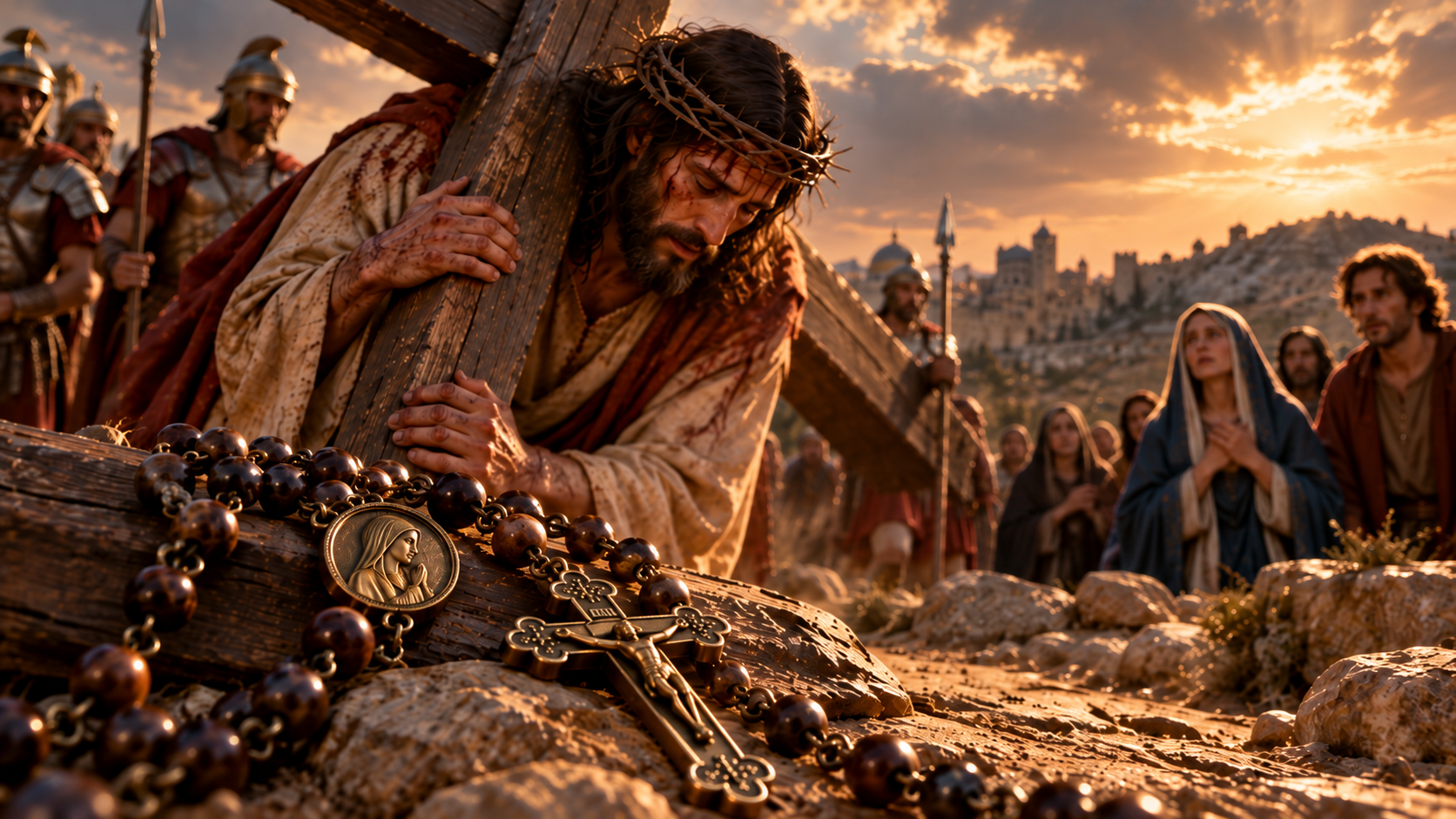
The Rosary, Rediscovered — Article 10 of 12
Discover how the five Sorrowful Mysteries reveal the depths of God’s love through the Passion of Jesus Christ, and how His suffering and sacrifice teach us the true meaning of mercy, repentance, forgiveness, and faithful discipleship.
Scripture for Meditation: Matthew 26:36–46; John 18–19; Philippians 2:5–11
What does the Passion of Jesus Christ reveal about suffering, sin, mercy, and the love of God?
The Sorrowful Mysteries bring us face to face with the most solemn events in human history.
We enter the Garden of Gethsemane, where Christ prays in anguish.
We witness His scourging.
We behold Him crowned with thorns and mocked as a king.
We accompany Him as He carries His Cross toward Calvary.
And finally, we stand beneath the Cross as the Savior of the world offers His life for our redemption.
These are not comfortable mysteries.
They confront us with human cruelty, the seriousness of sin, the reality of suffering, and the terrible consequences of a fallen world.
Yet they also reveal something far greater.
The love of God.
For the Passion of Jesus Christ is not simply the story of an innocent man who suffered injustice.
It is the saving sacrifice of the eternal Son of God, who freely gave Himself for the redemption of humanity.
The Sorrowful Mysteries invite us to contemplate that love, recognize our need for mercy, and learn what it means to follow the Crucified Lord.
Do Not Hurry Past Calvary
Christianity is a religion of hope.
Its central proclamation is that Jesus Christ has conquered sin and death through His Resurrection.
But the Church never allows us to separate Easter Sunday from Good Friday.
There can be no proper understanding of the Resurrection without first recognizing the meaning of the Cross.
The Sorrowful Mysteries therefore ask us to remain with Jesus during His Passion.
We may naturally wish to turn away from suffering.
We may prefer the joy of Bethlehem, the glory of the Transfiguration, or the triumph of the empty tomb.
Yet the Church calls us to contemplate Christ crucified because His Passion reveals the depths of divine love.
St. Paul writes:
“But God commendeth his charity towards us; because when as yet we were sinners, according to the time, Christ died for us.”
— Romans 5:8, Douay-Rheims
Notice the extraordinary truth contained in these words.
Christ did not wait for humanity to become righteous before offering Himself.
He died for sinners.
He came to redeem a world that had rebelled against its Creator.
His Passion reveals the initiative of divine mercy.
But we must also understand His suffering correctly.
Jesus was not simply the helpless victim of forces stronger than God.
His arrest, condemnation, torture, and Crucifixion involved real human actions and genuine moral responsibility.
The Church does not excuse the injustice committed against Him.
Nor does she place collective responsibility for His death upon the Jewish people. The Catechism explicitly rejects such collective blame (CCC 597).
Yet within these terrible events, God accomplished His saving plan.
Christ freely accepted His Passion.
He did not surrender His life because divine power had failed.
He offered Himself in obedience to the Father’s will.
The Catechism of the Catholic Church explains the relationship between God’s saving plan, human responsibility, and Christ’s voluntary sacrifice in CCC 599–605.
The Passion was not an accident that interrupted the mission of Jesus.
It was the culmination of His mission of redemption.
We must also avoid imagining the Father as an angry God reluctantly persuaded to show mercy by a more compassionate Son.
The Father sends the Son in love.
The Son freely offers Himself in love.
The Holy Spirit is inseparably involved in the divine work of salvation.
There is no conflict between the love of the Father and the love of the Son.
The Cross reveals the one saving purpose of the Holy Trinity.
The Sorrowful Mysteries therefore do not invite us merely to feel sadness over what happened to Jesus.
They invite us to recognize the seriousness of sin and the greatness of the love by which we have been redeemed.
The First Sorrowful Mystery: The Agony in the Garden
Scripture: Matthew 26:36–46; Luke 22:39–46
Contemplate: Christ’s human suffering and His perfect obedience to the Father’s saving will.
Grace to Seek: Contrition, trust, and surrender to God.
The first Sorrowful Mystery brings us into the Garden of Gethsemane.
Jesus has celebrated the Last Supper with His Apostles.
He knows that His betrayal, arrest, and suffering are approaching.
He withdraws to pray.
Peter, James, and John accompany Him, but they struggle to remain awake.
The Gospel reveals the profound anguish of Christ.
He does not approach His Passion with emotional indifference.
He experiences the horror of what lies before Him.
He knows that He will be betrayed, abandoned, humiliated, tortured, and crucified.
His suffering is real because His humanity is real.
Jesus Christ is not God merely appearing to possess human emotions.
He is the eternal Son who has truly assumed a complete human nature.
His human soul experiences sorrow.
His human body will experience pain.
His human will freely embraces the saving plan of the Father.
In the garden, Jesus prays:
“My Father, if it be possible, let this chalice pass from me. Nevertheless not as I will, but as thou wilt.”
— Matthew 26:39, Douay-Rheims
These words reveal the mystery of Christ’s obedience.
Jesus does not pretend that suffering is pleasant.
He does not deny the natural human desire to avoid death.
Yet He freely submits His human will to the divine will.
The Catechism of the Catholic Church explains this mystery in CCC 612.
The Son accepts the chalice of suffering in obedience to the Father’s plan of salvation.
This obedience is not weakness.
It is the perfect expression of filial love.
Christ’s surrender in Gethsemane also provides an essential lesson for our own spiritual lives.
Many Christians mistakenly believe that trusting God means never experiencing fear, sadness, or uncertainty.
But Jesus Himself experienced profound anguish.
His example teaches us that surrender does not require pretending our suffering is insignificant.
We may speak honestly to God about our fears.
We may ask Him to remove a burden.
We may acknowledge the difficulty of obedience.
But we must also learn to place ourselves within His providence.
The words of Gethsemane are not an invitation to despair.
They are a model of faith.
We ask for what we desire while submitting ourselves to the wisdom of the Father.
Carry the Mystery into Daily Life
Identify one fear or uncertainty that has been weighing upon your heart.
Perhaps it concerns illness, financial hardship, family difficulties, grief, or an important decision.
Bring that concern before God honestly.
Ask Him for help.
Then pray with Christ:
Not as I will, but as thou wilt.
Choose one good and responsible action you can take today, even while the outcome remains uncertain.
Trusting God does not mean abandoning responsibility.
It means fulfilling our duties while entrusting the future to Him.
The Second Sorrowful Mystery: The Scourging at the Pillar
Scripture: John 19:1; Matthew 27:24–26
Contemplate: The innocent Christ endures human cruelty for the salvation of sinners.
Grace to Seek: Purity, repentance, justice, and compassion.
The second Sorrowful Mystery brings us to the scourging of Jesus.
The Gospel of John records the event with striking brevity.
Pilate has Jesus scourged.
The evangelist does not provide an elaborate description of every wound.
Yet the meaning is unmistakable.
The innocent Savior is subjected to brutal violence.
The One who healed the sick, welcomed sinners, and proclaimed the Kingdom of God is treated with contempt.
His body is wounded through the cruelty of human beings.
The scourging reveals something terrible about sin.
Sin is not merely an abstract violation of a religious rule.
It is a disorder that damages our relationship with God and with one another.
Human beings created in the image of God can become capable of extraordinary cruelty when they turn away from truth and charity.
The Passion reveals the seriousness of that disorder.
Christ suffers at the hands of sinners.
Yet He remains the beloved Son of the Father.
His dignity is not diminished by the violence inflicted upon Him.
This mystery is particularly important when considering the dignity of every human person.
The same Lord who endured humiliation and suffering calls us to recognize His image in those who are vulnerable, neglected, or abused.
We cannot contemplate the scourging of Jesus while remaining indifferent to human suffering.
The mystery demands moral conversion.
It challenges cruelty.
It condemns exploitation.
It confronts the tendency to treat other people as objects for personal gratification, advantage, or domination.
Traditionally, Catholics also meditate upon the Scourging while asking for the grace of purity.
Purity is not simply the avoidance of particular sins.
It is the proper ordering of our desires according to truth and love.
It includes learning to see other people as persons possessing God-given dignity rather than as objects to be used.
The Scourging therefore calls us to repent of anything that dishonors the dignity of ourselves or others.
But an important distinction must be made.
Christ’s voluntary acceptance of suffering for our redemption does not mean that suffering is good merely because it is painful.
Nor does the Passion require victims of violence or abuse to remain in danger.
The Lord’s willingness to suffer does not excuse perpetrators.
It does not remove our responsibility to protect the vulnerable.
It does not prohibit seeking justice.
Christian charity requires us to oppose evil, protect human dignity, and assist those who suffer.
The Scourging of Christ should awaken compassion, not indifference.
Carry the Mystery into Daily Life
Choose one concrete act of mercy for someone whose dignity is being overlooked.
Offer assistance to a person experiencing hardship.
Speak respectfully about someone who is often mocked or dismissed.
Support someone who is suffering.
If you recognize attitudes of contempt, impurity, or cruelty within yourself, ask God for repentance and make a sincere effort to change.
Let contemplation of Christ’s wounded body deepen your respect for every human life.
The Third Sorrowful Mystery: The Crowning with Thorns
Scripture: Matthew 27:27–31; John 19:2–5
Contemplate: The true King accepts humiliation and mockery while remaining faithful to His saving mission.
Grace to Seek: Humility and freedom from pride.
The third Sorrowful Mystery presents one of the most striking scenes of the Passion.
Roman soldiers mock Jesus by dressing Him in the symbols of kingship.
They place a crown of thorns upon His head.
They give Him a reed.
They kneel before Him in false homage.
Then they insult and strike Him.
Their actions are intended to humiliate.
They believe they are mocking a powerless prisoner.
Yet the One standing before them is truly the King of kings.
The irony is profound.
Those who possess earthly power are ridiculing the Lord from whom all legitimate authority ultimately derives.
Jesus does not cease to be King because the soldiers fail to recognize Him.
His kingship does not depend upon their acknowledgment.
Nor is His authority measured by the outward displays of power that the world admires.
Christ’s Kingdom is revealed through truth, obedience, justice, and self-giving love.
The crown of thorns exposes the contrast between worldly ambition and divine kingship.
Human beings often seek honor through domination, recognition, wealth, or public admiration.
We want others to notice our accomplishments.
We become offended when our importance is questioned.
We defend our reputation even when doing so requires pride, dishonesty, or cruelty.
The mocked Christ confronts these tendencies.
He reveals a kingship that does not depend upon vanity.
His authority is inseparable from His perfect obedience to the Father.
The Crowning with Thorns therefore invites us to examine our attachment to status and approval.
How much of our behavior is directed toward being admired?
How often do we become resentful when we are overlooked?
How frequently do we treat the opinions of others as more important than the truth?
These questions reveal the spiritual danger of pride.
Pride turns the soul inward.
It teaches us to seek our own glory rather than the glory of God.
Humility corrects this disorder.
But humility must be understood properly.
It does not require denying the dignity God has given us.
It does not mean pretending that our abilities, responsibilities, or legitimate achievements have no value.
True humility means living in the truth.
We recognize that our gifts come from God.
We acknowledge our dependence upon His grace.
And we refuse to place personal prestige above obedience and charity.
Christ’s crown of thorns reminds us that greatness in the Kingdom of God is measured differently from greatness in the world.
The true King reigns through sacrificial love.
Carry the Mystery into Daily Life
Examine one area in which pride influences your behavior.
Perhaps you become defensive when corrected.
Perhaps you seek recognition for acts of service.
Perhaps you find it difficult to admit a mistake.
Choose one opportunity to practice humility.
Accept a minor slight without unnecessary retaliation.
Acknowledge a fault honestly.
Perform a good deed without announcing it.
And refuse to join in the mockery or humiliation of another person.
The Fourth Sorrowful Mystery: The Carrying of the Cross
Scripture: John 19:16–17; Luke 23:26–32
Contemplate: Jesus carries His Cross in sacrificial love and calls His disciples to follow Him.
Grace to Seek: Perseverance, patience, and solidarity with those who suffer.
The fourth Sorrowful Mystery brings us onto the road to Calvary.
Jesus has been condemned.
He is led toward the place of execution.
The Gospel of John tells us that He goes forth bearing His Cross.
The Gospel of Luke records that Simon of Cyrene is compelled to help carry it.
Women mourn along the road.
The scene is filled with suffering, exhaustion, injustice, and sorrow.
Yet the theological significance extends far beyond the visible brutality of the event.
Christ is moving toward the sacrifice through which He will redeem humanity.
The Cross is the instrument of Roman execution.
But through the free offering of Jesus Christ, it becomes the sign of salvation.
This transformation stands at the center of Christian faith.
The Cross does not become holy because cruelty is good.
It becomes the sign of redemption because the Son of God freely offers Himself in love.
His obedience transforms the meaning of what was intended as an instrument of shame and death.
Jesus also calls His disciples to take up their own crosses.
“If any man will come after me, let him deny himself, and take up his cross daily, and follow me.”
— Luke 9:23, Douay-Rheims
This command is frequently quoted.
But it can also be misunderstood.
Taking up the cross does not mean deliberately seeking unnecessary suffering.
It does not require remaining in an abusive relationship.
It does not mean ignoring injustice, neglecting medical care, or refusing legitimate help.
Nor does it mean treating every inconvenience as though it were equivalent to Christ’s Passion.
The Christian cross consists in the real sacrifices demanded by faithful discipleship.
Sometimes following Christ requires resisting temptation.
Sometimes it requires forgiving someone.
Sometimes it involves caring for a sick family member.
Sometimes it means telling the truth when dishonesty would be easier.
Sometimes it requires accepting hardship that cannot be avoided without abandoning our duties.
These sacrifices become spiritually meaningful when they are borne in faith and charity.
The Carrying of the Cross also teaches us that Christian suffering must never become an excuse for indifference toward others.
Simon of Cyrene reminds us of the importance of helping another person bear a burden.
The suffering of Christ should make us more compassionate.
We cannot sincerely claim to follow the Crucified Lord while deliberately ignoring the needs of those around us.
The Cross calls us not only to perseverance in our own difficulties, but also to solidarity with others.
Carry the Mystery into Daily Life
Think of someone who is carrying a difficult burden.
Perhaps the person is facing illness, grief, financial hardship, loneliness, or overwhelming family responsibilities.
Ask what you can do to help.
Offer a meal.
Provide transportation.
Assist with a practical responsibility.
Listen patiently.
Pray with or for the person.
Do something concrete.
Then consider your own responsibilities.
Ask God for the grace to carry the legitimate burdens of your vocation with faith rather than resentment.
The Cross teaches us to persevere in love.
The Fifth Sorrowful Mystery: The Crucifixion and Death of Our Lord
Scripture: John 19:25–37; Luke 23:33–49
Contemplate: Jesus Christ freely offers Himself for the redemption of humanity.
Grace to Seek: Love of God, forgiveness, repentance, and final perseverance.
The fifth Sorrowful Mystery brings us to Calvary.
Jesus is nailed to the Cross.
The soldiers divide His garments.
Onlookers mock Him.
His enemies believe that they have defeated Him.
Yet the Church confesses that something infinitely greater is taking place.
The Son of God is offering Himself for the salvation of the world.
At Calvary, the gravity of human sin and the greatness of divine mercy are revealed together.
Christ suffers because humanity has fallen into sin.
But He offers Himself because God loves humanity and wills its salvation.
The Crucifixion is therefore not simply an example of heroic endurance.
It is a unique and definitive sacrifice.
The Catechism of the Catholic Church teaches that Christ’s death is both the Paschal sacrifice accomplishing redemption and the sacrifice of the New Covenant that reconciles humanity to God (CCC 613).
His sacrifice is complete.
It surpasses the sacrifices of the Old Covenant.
It is sufficient for the salvation of the world.
No human being could accomplish what Jesus Christ accomplished through His Passion.
His saving sacrifice has infinite worth because He is the eternal Son of God made man.
The Cross also reveals that divine mercy is not indifference toward sin.
God does not pretend that evil is insignificant.
The Passion reveals the true seriousness of sin.
Yet divine love is greater than human rebellion.
Through His obedience, Christ accomplishes the reconciliation that humanity could not achieve through its own efforts.
St. Paul expresses the mystery of the Savior’s humility and obedience in Philippians 2:5–11.
Christ, though truly divine, humbled Himself and became obedient unto death, even death upon a cross.
His humiliation is inseparable from the glory of His exaltation.
At Calvary, the Blessed Virgin Mary stands near her Son.
She does not abandon Him in His suffering.
St. John’s Gospel records Jesus entrusting Mary and the beloved disciple to one another (John 19:26–27).
The Church has long contemplated this scene as revealing a dimension of Mary’s spiritual motherhood.
The Second Vatican Council reflects upon her faithful union with Christ’s sacrifice in Lumen Gentium, paragraph 58.
Mary’s presence at the Cross is a model of persevering faith.
She does not possess the power to redeem humanity through her own suffering.
Christ alone is the Redeemer.
Yet she remains faithfully united to His saving mission.
Her example teaches us to remain close to Jesus even when we cannot fully understand the mystery of suffering.
The Crucifixion also calls us to forgiveness.
Christ’s self-offering is the foundation of reconciliation with God.
Those who receive His mercy are called to become merciful toward others.
This does not mean that every damaged relationship can immediately be restored.
Forgiveness does not require denying the seriousness of wrongdoing.
It does not eliminate the demands of justice.
And it does not oblige a person to remain in an unsafe situation.
But it does call us to reject hatred and vengeance, seeking the grace to entrust justice to God while fulfilling our own moral responsibilities.
At the Cross, we discover that Christian love is not merely a feeling.
It is a gift of self.
The Son offers Himself to the Father for our salvation.
His love is freely given, sacrificial, and faithful.
Carry the Mystery into Daily Life
Spend a few moments contemplating a crucifix.
Consider the price of your redemption.
Make an act of thanksgiving for the love of Jesus Christ.
Then examine whether you are holding resentment against someone.
If possible, take one honest step toward forgiveness or reconciliation.
Where serious harm has occurred, seek a response consistent with justice, prudence, and personal safety.
Finally, ask God for the grace of final perseverance.
Pray that you may remain faithful to Christ throughout your life and at the hour of death.
Why the Cross Is the Greatest Revelation of Love
The Passion reveals a truth that challenges nearly every worldly understanding of greatness.
God saves humanity through the self-offering of His Son.
The Cross appears to be a place of defeat.
Yet through the obedience of Jesus Christ, it becomes the place of redemption.
The world often associates power with domination.
Christ reveals divine power through sacrificial love.
The world seeks honor through recognition.
Christ accepts humiliation.
The world attempts to overcome enemies through force.
Christ offers Himself for sinners.
This does not mean that divine love is weak.
It means that God’s saving wisdom surpasses the standards by which fallen humanity measures success.
The Cross also corrects a shallow understanding of love.
Love is not simply an emotional experience.
It is not merely affection, attraction, or agreement.
Authentic love seeks the true good of another.
Sometimes it requires sacrifice.
Sometimes it involves patience.
Sometimes it demands difficult obedience.
In Christ, we behold love in its supreme human expression, united to the divine love of the eternal Son.
Jesus gives Himself completely.
His Passion is not a failure of His mission.
It is the fulfillment of His mission.
Pope St. John Paul II emphasizes this truth in Rosarium Virginis Mariae, paragraph 22.
He presents the Sorrowful Mysteries as an invitation to contemplate the saving love of God revealed in the Passion.
The mysteries lead us to stand spiritually beneath the Cross, alongside the Blessed Virgin Mary, and enter more deeply into the love by which humanity has been redeemed.
Understanding Suffering United to Christ
Catholics often speak of offering up suffering or uniting suffering to the Cross of Christ.
These expressions belong to the Church’s spiritual tradition.
But they must be understood correctly.
Christianity does not teach that pain is good simply because it hurts.
Illness, cruelty, injustice, and death are not blessings in themselves.
They belong to the suffering and disorder of a fallen world.
The Christian response is not to celebrate evil.
We are called to relieve suffering when we can, protect the vulnerable, seek justice, and practice works of mercy.
Yet the Passion reveals that God can bring spiritual good even from suffering.
Because Jesus Christ freely endured His Passion, the sufferings of believers can be united to His sacrifice through grace.
This does not add anything lacking to the sufficiency of Christ’s redemption.
His sacrifice is complete.
The Catechism of the Catholic Church teaches that Christ invites His disciples to share in His Paschal Mystery (CCC 618).
Through union with Him, our sufferings can become occasions for faith, charity, perseverance, and self-offering.
A person enduring illness may unite that suffering to Christ while also seeking proper medical treatment.
A parent sacrificing sleep to care for a child may offer that act of love to God.
Someone experiencing grief may remain faithful in prayer even while struggling with sorrow.
A person facing persecution for the faith may persevere through grace.
The spiritual value does not arise from pain considered by itself.
It arises from union with Jesus Christ and cooperation with His grace.
This distinction protects Christian teaching from becoming a glorification of suffering.
We do not seek suffering for its own sake.
We seek Christ.
And when suffering cannot be avoided without abandoning what is good, we ask for the grace to endure it faithfully.
The Sorrowful Mysteries and the Call to Conversion
The Passion of Christ should never remain merely an object of emotional sympathy.
It must lead us toward repentance.
We cannot sincerely contemplate the Agony in the Garden while deliberately resisting the will of God.
We cannot meditate upon the Scourging while remaining indifferent to cruelty or impurity.
We cannot behold the Crowning with Thorns while refusing to confront our pride.
We cannot follow Christ carrying His Cross while rejecting the sacrifices required by charity.
And we cannot stand beneath the Crucifixion while refusing to acknowledge our need for forgiveness.
The Sorrowful Mysteries are a school of conversion.
They reveal the seriousness of sin.
They show the cost of redemption.
They teach the meaning of sacrifice.
They deepen our gratitude for divine mercy.
And they call us to imitate the love of the Crucified Lord.
But this conversion is not accomplished through human effort alone.
We depend entirely upon the grace of God.
The Rosary helps us meditate upon the mysteries of salvation so that we may respond more faithfully to that grace.
The purpose is not simply to become more emotionally moved by the Passion.
It is to become more deeply united to Christ.
The CatholicG33k Practice: Five Days at the Foot of the Cross
This Week’s Spiritual Practice: Living the Sorrowful Mysteries
Scripture: Matthew 26–27; Luke 22–23; John 18–19
Grace to Seek: Repentance, perseverance, forgiveness, and deeper love for Jesus Christ.
For this week’s practice, meditate upon one Sorrowful Mystery each day for five days.
Begin by reading the corresponding Gospel passage.
Pray one decade of the Rosary.
Ask for the grace associated with the mystery.
Then perform one concrete action inspired by what you have contemplated.
Day 1: The Agony in the Garden — Surrender to God
Read Matthew 26:36–46.
Pray one decade asking for the grace of trusting obedience.
Bring a particular fear or difficulty before the Lord.
Ask Him for guidance and strength.
Then complete one good action you have been postponing because of fear.
End by praying:
Not as I will, but as thou wilt.
Day 2: The Scourging at the Pillar — Repentance and Compassion
Read John 19:1.
Pray one decade asking for purity of heart and greater compassion.
Examine whether your words, attitudes, or actions have dishonored the dignity of another person.
Ask for forgiveness where needed.
Then perform one act of mercy for someone who is suffering or overlooked.
Day 3: The Crowning with Thorns — Humility
Read Matthew 27:27–31.
Pray one decade asking for freedom from pride.
Consider one area in which you seek approval or recognition too eagerly.
Perform a good deed without drawing attention to yourself.
Ask Christ to teach you the humility of the true King.
Day 4: The Carrying of the Cross — Perseverance
Read Luke 23:26–32.
Pray one decade asking for patience and fidelity.
Identify one burden that belongs to your responsibilities.
Ask for the grace to carry it without unnecessary resentment.
Then help another person bear a burden through a specific act of charity.
Day 5: The Crucifixion — Love and Forgiveness
Read John 19:25–37.
Pray one decade asking for deeper love of Christ and the grace of forgiveness.
Spend several minutes contemplating a crucifix.
Thank Jesus for His sacrifice.
Examine whether you need to seek forgiveness, offer forgiveness, or begin the process of reconciliation.
Take one prudent and honest step.
Where harm has occurred, remember that forgiveness and justice are not enemies.
At the End of the Five Days
Reflect upon the week.
Which Sorrowful Mystery most deeply challenged you?
What did the Passion reveal about your relationship with God?
Did your prayer lead to greater repentance, compassion, humility, or charity?
Consider whether there is a particular sin or attachment that you need to bring to the Sacrament of Confession.
The goal of this practice is not simply to complete five decades.
It is to allow contemplation of Christ’s Passion to transform the way you live.
Questions for Reflection
1. Repentance and the Passion
Which scene of Christ’s Passion most clearly reveals my need for conversion and greater dependence upon God’s mercy?
2. Understanding the Cross
Have I confused carrying my cross with accepting harm, injustice, or abuse that I am free and sometimes obliged to resist?
3. Suffering and Charity
How can contemplating Christ’s suffering make me more compassionate toward those who suffer in my family, parish, workplace, or community?
These questions invite us to move beyond merely remembering the Passion.
They call us to examine whether the love of the Crucified Lord is shaping our hearts.
A Prayer Beneath the Cross
Lord Jesus Christ,
By Your holy Passion and Cross, You redeemed the world.
You entered the Garden of Gethsemane and freely accepted the will of the Father.
Teach me to surrender my fears and trust in Your divine providence.
You endured the scourging and suffered the cruelty of sinners.
Grant me sincere contrition for my sins, purity of heart, and compassion toward those who suffer.
You were crowned with thorns and mocked as a king.
Free me from pride, vanity, and the desire for worldly recognition.
Teach me the humility of Your Sacred Heart.
You carried Your Cross toward Calvary.
Strengthen me to persevere in the duties and sacrifices of Christian life.
Help me to recognize the burdens of others and respond with generous charity.
You offered Yourself upon the Cross for the salvation of humanity.
Deepen my gratitude for Your sacrifice.
Give me the grace to forgive those who have wronged me, to seek forgiveness where I have sinned, and to remain faithful to You throughout my life.
Through the intercession of Your Blessed Mother, who stood beneath Your Cross, teach me to remain close to You in suffering and in joy.
May Your Passion lead me to repentance.
May Your wounds remind me of the greatness of divine mercy.
May Your Cross strengthen my hope.
And may I never forget that the love revealed at Calvary is stronger than sin and death.
Keep me faithful beneath Your Cross.
And lead me into the glory of Your Resurrection.
Amen.
Conclusion: The Love Revealed at Calvary
The Sorrowful Mysteries lead us into the heart of the Christian faith.
They confront us with the suffering of Jesus Christ.
They reveal the seriousness of human sin.
They expose the cruelty, pride, injustice, and selfishness that mark a fallen world.
Yet they also proclaim the extraordinary love of God.
In Gethsemane, Christ teaches obedience through anguish.
At the scourging, He endures human cruelty without surrendering His saving mission.
In the crowning with thorns, the true King reveals the emptiness of worldly pride.
On the road to Calvary, He carries the Cross in sacrificial love.
And upon the Cross, He freely offers Himself for the redemption of humanity.
Each mystery reveals another dimension of His saving sacrifice.
Together, they show us that the Passion is not merely a tragedy.
It is the supreme revelation of divine love.
The Father sends His Son for our salvation.
The Son offers Himself in perfect obedience.
And through the Holy Spirit, the saving work of Christ draws humanity toward communion with God.
The Cross is not evidence that God has abandoned the world.
It is the sign of how deeply He loves it.
The Sorrowful Mysteries also correct our understanding of suffering.
Christianity does not glorify cruelty.
It does not command indifference toward injustice.
It does not teach that pain is valuable simply because it is painful.
Rather, it proclaims that God can bring redemption and grace even through the suffering that sin has brought into human history.
Christ’s sacrifice is complete and sufficient.
Yet He invites His disciples to unite their lives, sacrifices, and unavoidable sufferings to His saving love.
This is why contemplation of the Passion must lead toward charity.
Someone who meditates upon the wounded Christ should become more compassionate toward the wounded.
Someone who contemplates His forgiveness should become more willing to forgive.
Someone who reflects upon His humility should become less attached to pride.
Someone who remembers His obedience should become more faithful to the will of God.
The Rosary invites us to remain with these mysteries long enough for their meaning to penetrate our hearts.
We should not hurry past Calvary.
We should not look away simply because the Cross makes us uncomfortable.
For at Calvary, we discover the true meaning of Christian love.
Love that does not abandon sinners.
Love that remains faithful through suffering.
Love that gives itself completely.
Love that seeks the salvation of others.
And love that ultimately triumphs through the Resurrection.
The Sorrowful Mysteries remind us that the Christian journey passes through the Cross.
But the Cross is not the end.
Christ has risen.
Death has been conquered.
And the sacrifice of Calvary has opened the way to eternal life.
As we meditate upon the Passion, we stand spiritually beside the Blessed Virgin Mary and the beloved disciple.
We behold the Crucified Lord.
We recognize our need for mercy.
And we hear again the invitation to follow Him.
Not merely by admiring His sacrifice.
But by allowing His love to transform our lives.
The Sorrowful Mysteries are therefore not simply meditations upon suffering.
They are meditations upon love.
A love stronger than hatred.
A mercy greater than sin.
And a sacrifice through which the world has been redeemed.
This is the love revealed at Calvary.
The love of Jesus Christ.
The love that carries the Cross.
Sources and Further Reading
Sacred Scripture
- Matthew 26:36–46 — The Agony in the Garden.
- Matthew 27:24–31 — The Scourging and Crowning with Thorns.
- Luke 22:39–46 — Christ’s prayer of surrender in Gethsemane.
- Luke 23:26–32 — The Carrying of the Cross.
- Luke 23:33–49 — The Crucifixion and Death of Jesus.
- John 18–19 — The Passion of Our Lord Jesus Christ.
- Romans 5:6–11 — Christ’s death for sinners and reconciliation with God.
- Philippians 2:5–11 — Christ’s humility, obedience, and exaltation.
- Luke 9:23 — The call to take up the cross daily and follow Christ.
Catechism of the Catholic Church
- CCC 595–598 — Responsibility for Christ’s Passion and the rejection of collective blame.
- CCC 599–605 — Christ’s death within God’s saving plan.
- CCC 606–611 — The voluntary offering of Jesus Christ.
- CCC 612 — The Agony in Gethsemane and Christ’s human obedience.
- CCC 613–617 — The unique and definitive sacrifice of Christ.
- CCC 618 — Our participation in Christ’s sacrifice through grace.
Ecumenical Councils and Magisterial Teaching
- Second Vatican Council, Lumen Gentium, paragraph 58 — The Blessed Virgin Mary’s faithful union with Christ in His Passion.
- Pope St. John Paul II, Rosarium Virginis Mariae (2002), paragraph 22 — The Sorrowful Mysteries and the revelation of God’s saving love through the Passion of Christ.
The Rosary, Rediscovered — Article 10 of 12
CatholicG33k — Faith. Truth. Reason.