

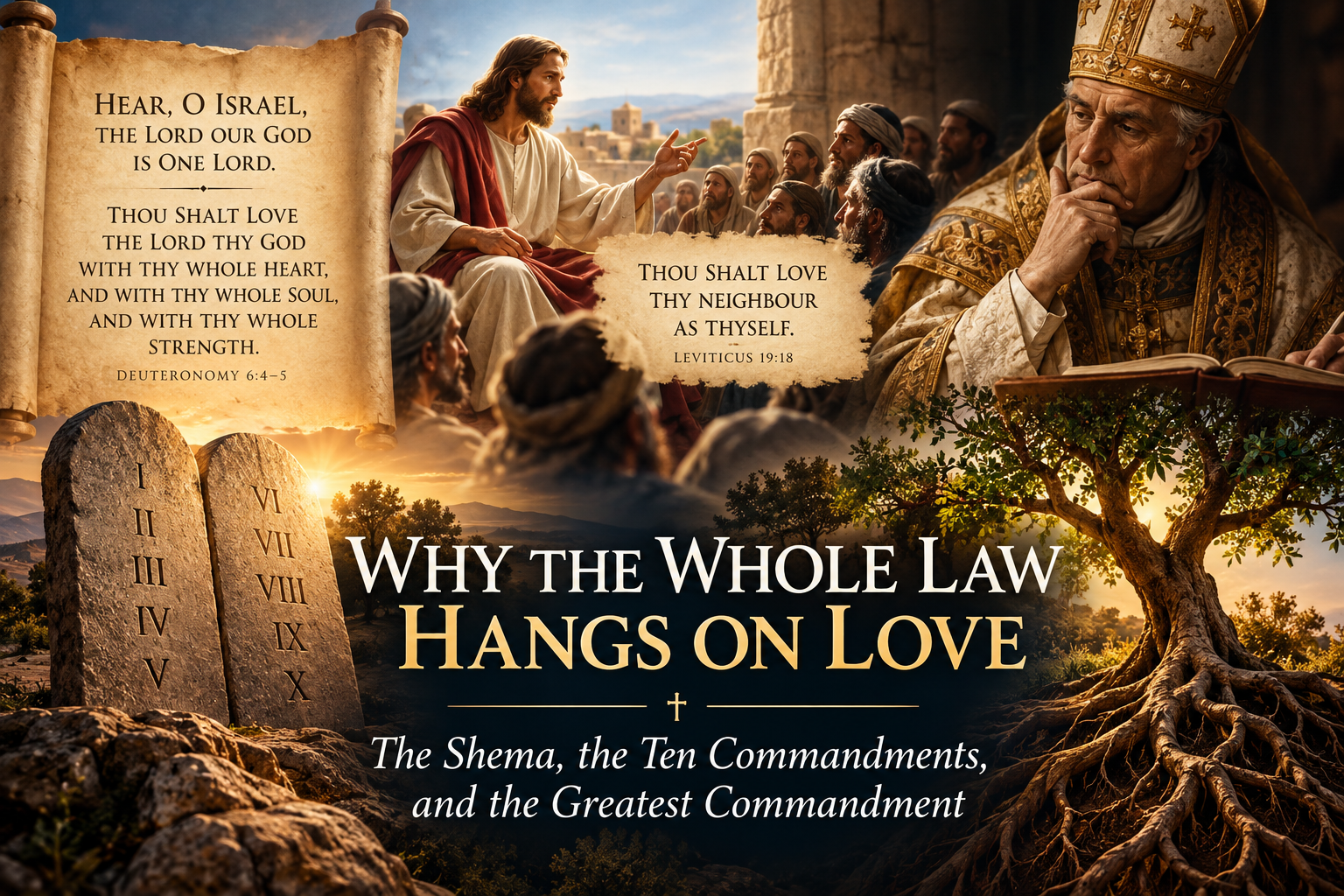
How Jesus Christ reveals the unity of God’s Law through love of God and love of neighbor.
By CatholicG33K | Scripture & Catholic Theology
What connects the ancient Jewish prayer known as the Shema, the Ten Commandments given to Moses, the teaching of St. Gregory the Great, and Jesus’ words in Matthew 22:34–40?
At first glance, these may appear to be separate teachings from different moments in salvation history. Yet they reveal one profound truth at the heart of Catholic moral theology:
Love is the foundation of God’s entire moral law.
When Jesus identifies the two greatest commandments, He is not introducing a new moral system or setting aside the Law given through Moses. Rather, He reveals what has always been at its heart: the inseparable relationship between love of God and love of neighbor.
The Ten Commandments are not simply a collection of rules. They teach us how to live in right relationship with God and one another. The two greatest commandments reveal the principle that unites them.
And centuries later, St. Gregory the Great would explain this relationship through a beautiful image of roots, branches, and spiritual growth.
1. The Shema: The Foundation of Love for God
Our journey begins in Deuteronomy 6:4–5, where Moses proclaims:
“Hear, O Israel, the Lord our God is one Lord. Thou shalt love the Lord thy God with thy whole heart, and with thy whole soul, and with thy whole strength.”
— Deuteronomy 6:4–5, Douay-Rheims
These words form the heart of the Shema, one of the most important prayers in Judaism.
The Hebrew word Shema means “Hear” or “Listen.” But this command to hear carries a deeper meaning. It calls Israel not merely to listen to God’s words, but to receive them faithfully and respond through obedience.
The Shema reveals two essential truths.
First, there is only one God. He alone is worthy of our worship, loyalty, and complete devotion.
Second, our response to God must be love. This love is not partial or occasional. It involves our whole heart, our whole soul, and our whole strength.
In other words, God does not simply demand outward obedience. He calls His people into a relationship of covenantal love.
This is the foundation upon which the moral life is built.
2. Matthew 22:34–40: Jesus Reveals the Two Greatest Commandments
In Matthew 22, the Pharisees gather after Jesus has silenced the Sadducees. One of them, a doctor of the Law, approaches Him with a question:
“Master, which is the greatest commandment in the law?”
— Matthew 22:36
Jesus answers by drawing directly from the Shema:
“Thou shalt love the Lord thy God with thy whole heart, and with thy whole soul, and with thy whole mind.”
— Matthew 22:37
He then declares that this is the greatest and first commandment.
But Jesus does not stop there. He immediately joins it to another commandment from Leviticus 19:18:
“And the second is like to this: Thou shalt love thy neighbour as thyself.”
— Matthew 22:39
And then comes the statement that reveals how the entire moral law fits together:
“On these two commandments dependeth the whole law and the prophets.”
— Matthew 22:40
Consider the significance of the word “dependeth.”
Jesus teaches that the whole Law and the Prophets depend upon these two commandments. They are the foundation upon which the moral teaching of Scripture rests.
Everything God commands concerning our relationship with Him and with other human beings must be understood in light of these two loves.
The first commandment directs us toward God, our Creator and ultimate end. The second directs us toward our neighbor, who is also created in God’s image.
These commandments cannot be separated without distorting the meaning of Christian love.
To love God authentically is to recognize the dignity of those He has created. And to love our neighbor rightly is to love that person for God’s sake.
This is not the replacement of God’s Law with an undefined idea of love. It is the revelation of the love that gives God’s commandments their unity and purpose.
3. St. Gregory the Great: Love of God Is the Root, Love of Neighbor Is the Fruit
St. Gregory the Great offers a beautiful explanation of how these two commandments are connected.
In his Moralia in Iob (Morals on the Book of Job), Book VII, Chapter 24, §28, St. Gregory teaches that love for our neighbor is born from love for God, while our acts of charity toward our neighbor help strengthen our love for God.
He expresses this relationship through the image of a living plant.
Love of God is the root planted in the human heart. From that root grows love for our neighbor, just as branches and leaves grow from a tree.
The image teaches something profound.
We cannot separate the spiritual life from the moral life.
If our love for God is genuine, it must bear fruit in the way we treat others. Likewise, when we serve others with authentic charity, our relationship with God is deepened.
This is why the Apostle St. John teaches:
“If any man say, I love God, and hateth his brother; he is a liar.”
— 1 John 4:20
Love of neighbor is not an optional addition to love of God. It is one of the essential ways that love becomes visible.
Pope Benedict XVI on St. Gregory’s Teaching
Pope Benedict XVI returned to this very image in his Message for the 49th World Day of Prayer for Vocations (2012).
Drawing upon St. Gregory, he explained that love of God and love of neighbor are inseparably united because both come from the same divine source.
The Pope emphasized that God’s love takes root in the heart and produces the fruit of charity toward others.
This means that Christian charity is not merely philanthropy or human kindness. It is a participation in God’s love, made possible by His grace.
The more deeply we love God, the more we are called to love our neighbor. And the more sincerely we practice charity, the more our hearts are opened to God.
4. The Ten Commandments: The Practical Expression of the Two Greatest Commandments
How do the Ten Commandments fit into this relationship?
The Catechism of the Catholic Church provides the answer.
In paragraph 2067, the Church teaches that the Ten Commandments express what love of God and love of neighbor require.
The first three commandments concern our love for God. The remaining seven concern our love for neighbor.
In the traditional Catholic numbering, the Decalogue is arranged as follows.
The First Great Commandment: Love God
Deuteronomy 6:5 — The Shema
The first three commandments teach us how to direct our love toward God.
- I am the Lord thy God; thou shalt not have strange gods before Me. We love God by worshiping Him alone and placing nothing above Him.
- Thou shalt not take the name of the Lord thy God in vain. We love God by honoring His holy name and treating sacred things with reverence.
- Remember to keep holy the Lord’s Day. We love God by setting aside time for worship, prayer, and holy rest.
These commandments help order our lives toward God as our highest good.
The Second Great Commandment: Love Your Neighbor
Leviticus 19:18 — Love thy neighbor as thyself
The remaining seven commandments show us how love must shape our relationships with others.
- Honor thy father and thy mother. Love begins with respect for our parents, family, and rightful authority.
- Thou shalt not kill. Love requires respect for the dignity and sacredness of human life.
- Thou shalt not commit adultery. Love calls us to faithfulness, chastity, and respect for marriage.
- Thou shalt not steal. Love requires justice and respect for the property and rights of others.
- Thou shalt not bear false witness against thy neighbor. Love demands truthfulness and respect for another person’s reputation.
- Thou shalt not covet thy neighbor’s wife. Love requires purity of heart and respect for the marital bond.
- Thou shalt not covet thy neighbor’s goods. Love calls us to gratitude, contentment, and freedom from envy.
The Ten Commandments are therefore concrete expressions of the two great commandments of love.
This is precisely the relationship explained in the Catechism of the Catholic Church, §§2055–2069.
The commandments are not arbitrary restrictions imposed upon humanity. They protect the relationships that love is meant to perfect.
To violate them is to act against the very love that God commands.
5. Jesus Christ: The Fulfillment of the Shema and the Law
There is another remarkable connection.
In Mark’s account of the greatest commandment, Jesus explicitly begins His response with the opening words of the Shema:
“Hear, O Israel: the Lord thy God is one God.”
— Mark 12:29
This is significant because it reveals the continuity between the revelation given to Israel and the teaching of Jesus Christ.
Jesus is not rejecting what Moses taught. He is revealing its deepest fulfillment.
Moses commands Israel to love the one true God.
The Law teaches God’s people how to express their covenantal fidelity through obedience.
Jesus reveals that love of God and love of neighbor are inseparable and that the entire Law depends upon them.
St. Gregory explains how these two loves are spiritually connected.
And the Ten Commandments show us how to live that love through concrete moral actions.
But the fulfillment of this teaching is not found merely in an explanation.
It is found in the Person of Jesus Christ Himself.
Christ perfectly loves the Father and perfectly loves humanity.
His obedience to the Father and His self-sacrificial love for mankind meet upon the Cross.
As Pope St. John Paul II explains in Veritatis Splendor, §14, the two commandments of love are profoundly connected, and their inseparable unity is revealed in Christ’s life and redeeming sacrifice.
The Cross is therefore the supreme manifestation of the love that fulfills the Law.
Jesus offers Himself to the Father in perfect obedience while giving His life for the salvation of His neighbor.
In Christ, love of God and love of neighbor find their perfect expression.
6. Why This Matters for Our Catholic Life
This teaching has practical consequences for every Catholic.
We cannot claim to love God while deliberately rejecting His commandments. Neither can we claim to love God while refusing to show charity toward the people around us.
Our worship, our moral choices, and our relationships must form one coherent life of faith.
Love of God calls us to prayer, participation in the Holy Mass, reverence, fidelity, and obedience to His will.
Love of neighbor calls us to patience, forgiveness, honesty, justice, generosity, and works of mercy.
Yet we should also remember that the supernatural virtue of charity is God’s gift. We do not achieve holiness through human effort alone.
Through grace, especially the grace received in the sacraments, God strengthens us to love as Christ loves.
When we receive the Eucharist, we encounter the Lord who gave Himself completely in love. That encounter should transform how we live when we leave the church.
The love we profess before the altar must bear fruit in our homes, workplaces, parishes, and communities.
Here the teaching of St. Gregory becomes especially meaningful: love planted in the heart must grow and become visible.
Conclusion: One Divine Law, Two Great Commandments, Ten Expressions of Love
The connection between the Shema, the Ten Commandments, St. Gregory the Great, and Matthew 22:34–40 reveals the extraordinary unity of Sacred Scripture and Catholic moral teaching.
The Shema teaches us that the one true God deserves our complete love.
Jesus Christ reveals that love of God and love of neighbor are the two commandments upon which the whole Law and the Prophets depend.
The Ten Commandments give concrete moral expression to those two loves.
St. Gregory the Great teaches that love of God gives rise to love of neighbor, while love of neighbor helps nourish our love for God.
And the Cross of Jesus Christ reveals the perfect fulfillment of both.
St. Paul summarizes this entire teaching in one sentence:
“Love therefore is the fulfilling of the law.”
— Romans 13:10
Love does not make the commandments unnecessary. Rather, genuine charity leads us to fulfill what God commands.
The commandments reveal what love requires, while God’s grace enables us to live that love more perfectly.
The Shema tells us whom to love above all things. Jesus reveals the inseparable union of love of God and neighbor. The Ten Commandments teach us how to live that love. St. Gregory explains how it grows. And Christ Himself shows us what perfect love looks like.
That is why the whole Law hangs on love.
Scripture and Catholic References
Sacred Scripture
- Deuteronomy 6:4–5 — The Shema
- Leviticus 19:18 — Love of neighbor
- Matthew 22:34–40 — The two greatest commandments
- Mark 12:28–34 — Jesus and the Shema
- 1 John 4:20 — Love of God and love of brother
- Romans 13:8–10 — Love fulfills the Law
Scripture quotations are taken from the Douay-Rheims Bible.
Catechism of the Catholic Church
- §§2055–2056 — The Decalogue and the commandments of love
- §2067 — The first three and last seven commandments
- §§2068–2069 — The obligation and unity of the Decalogue
Church Fathers and Magisterium
- St. Gregory the Great, Moralia in Iob, Book VII, Chapter 24, §28 (PL 75, 780).
- Pope Benedict XVI, Message for the 49th World Day of Prayer for Vocations (2012).
- Pope St. John Paul II, Veritatis Splendor (1993), §14.
CatholicG33K — Exploring Sacred Scripture, Catholic theology, and the timeless wisdom of the Church.