

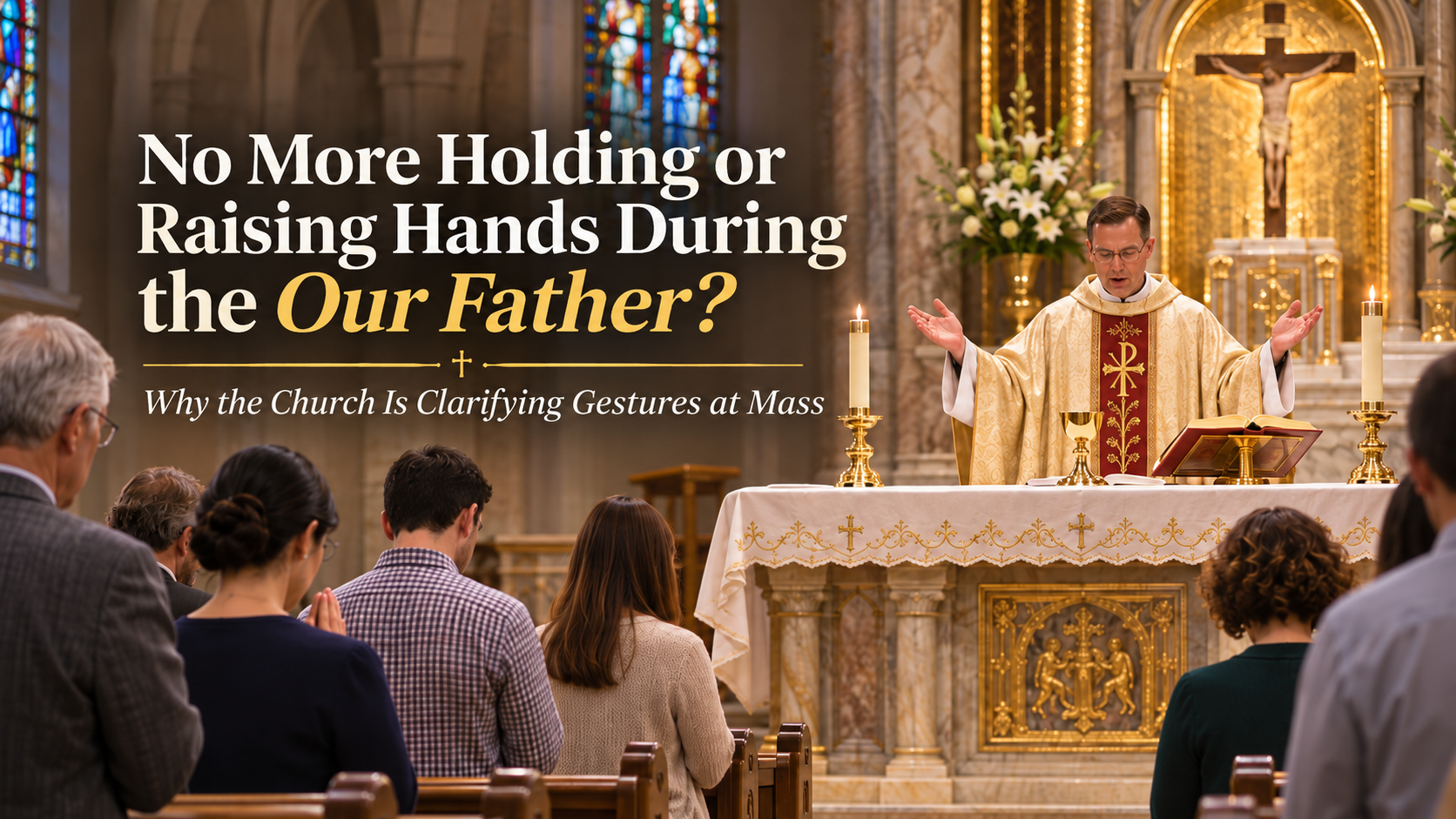
The Archdiocese of Portland has instructed Catholics to stop holding hands or adopting the priest’s prayer posture during the Our Father. But the deeper issue is not simply what we do with our hands. It concerns the sacred nature of the Mass, the priesthood, authentic participation, and the authority of the Church.
By Catholicg33k | November 12, 2026
A Simple Gesture, a Profound Catholic Question
Every Sunday, millions of Catholics stand together during the Holy Sacrifice of the Mass and begin one of Christianity’s most recognizable prayers:
Our Father, who art in heaven…
In some parishes, families join hands. In others, worshippers extend their arms with palms facing upward, imitating the priest’s posture. Elsewhere, Catholics quietly fold their hands in prayer.
To many, these differences appear insignificant. After all, everyone is praying the same words.
But a recent clarification from the Archdiocese of Portland, Oregon, raises a much deeper theological question:
Does sincerity alone determine how Catholics should worship, or does the Church have the responsibility to regulate even the outward gestures of her sacred liturgy?
On November 6, 2026, the archdiocese published guidance from its Office of Divine Worship directing the lay faithful to refrain from holding hands or adopting the orans posture during the Lord’s Prayer at Mass.
The announcement, subsequently reported by EWTN News on November 10, has renewed discussion about liturgical tradition, obedience, and the relationship between the priest and the congregation.
To understand why this matters, we must look beyond the outward gesture and examine what the Catholic Church actually teaches about divine worship.
1. What Did the Archdiocese of Portland Actually Say?
The archdiocese’s clarification appeared in its November 2026 Divine Worship Newsletter under the subject of the orans posture during Mass.
The word orans comes from Latin and refers to a posture of prayer in which the arms are extended and the hands are raised or held open.
This posture is familiar to Catholics because priests regularly assume it when offering particular liturgical prayers.
The archdiocese explained that while the General Instruction of the Roman Missal does not expressly prohibit laypeople from adopting the posture during the Our Father, its instructions assign that gesture specifically to the celebrating priest and, in concelebrated Masses, to the concelebrating priests.
The archdiocese therefore directed the laity and assisting deacons to refrain from using it.
The guidance also discourages holding hands during the prayer.
An essential distinction must be made: This is a clarification issued by the Archdiocese of Portland for its own liturgical life. It is not a newly announced universal prohibition imposed upon every Catholic throughout the world.
The distinction matters because accurate Catholic teaching requires us to differentiate universal liturgical law, particular diocesan direction, and personal devotional customs.
Furthermore, this is not an entirely new concern in Portland.
The archdiocese’s 2018 Archdiocesan Liturgical Handbook, sections 3.27.4–3.27.5, had already addressed the same practices, explaining that the priest’s extended hands are prescribed by the Missal while congregational hand-holding is not a prescribed liturgical posture.
The November 2026 announcement therefore represents a renewed and more explicit emphasis upon an established local approach.
2. What Does the Roman Missal Actually Require?
The most important text is paragraph 152 of the General Instruction of the Roman Missal (GIRM).
It directs the priest to introduce the Lord’s Prayer with his hands joined and then pronounce the prayer with his hands extended, together with the people.
Notice the distinction.
The priest receives an express instruction concerning his hands. The faithful receive the instruction to pray together with him.
In a concelebrated Mass, GIRM 237 also specifies that the concelebrating priests extend their hands.
However, the Missal does not prescribe the same gesture for the congregation.
Indeed, the United States Conference of Catholic Bishops, when addressing this question, explains that the Roman Missal does not prescribe a particular assembly gesture for the Lord’s Prayer.
This creates an important distinction between what the universal liturgical books explicitly require and the manner in which a diocesan authority directs their observance.
The absence of a universally prescribed gesture is not identical to an explicit universal prohibition of every alternative gesture.
Nevertheless, the faithful do not possess unlimited authority to establish new communal liturgical customs.
The Church entrusts the ordering of public worship to legitimate ecclesiastical authority.
The issue is therefore not merely whether raising one’s hands is personally meaningful.
It is whether that gesture belongs to one’s particular role within the Church’s public worship.
3. Why Does the Priest Extend His Hands?
To understand this question, we must understand the sacred priesthood.
The Catholic priest at Mass is not merely a religious speaker, community organizer, or designated representative of the congregation.
Through the Sacrament of Holy Orders, he is configured to Christ in a particular way and acts sacramentally in persona Christi capitis—in the person of Christ the Head.
The Catechism teaches that Christ Himself remains the principal agent of the Eucharistic celebration and that the bishop or priest presides as His sacramental representative.
See Catechism of the Catholic Church, paragraphs 1142, 1348, and 1548.
The priest’s liturgical gestures therefore have a meaning beyond personal devotion.
When he extends his hands during prescribed prayers, he visibly expresses his ministerial role in offering the Church’s prayer to the Father through Christ.
This does not mean that the priest is holier than every person sitting in the pews.
Nor does it mean that ordinary Catholics are somehow incapable of praying directly to God.
Rather, the distinction concerns the sacramental office entrusted to him.
Christ established different ministries within His Church, and those ministries have distinct functions.
The Mass communicates that reality through sacred words, gestures, vestments, and actions.
When the distinction between the celebrant’s prescribed actions and those of the congregation becomes blurred, the liturgy can lose some of its visible clarity.
The purpose of preserving these distinctions is not to diminish the laity.
It is to make the Church’s sacramental nature more intelligible.
4. What About the Common Priesthood of All Baptized Catholics?
An important objection immediately arises.
Doesn’t Baptism make every Catholic a participant in Christ’s priesthood?
Absolutely.
The Catholic Church emphatically teaches the common priesthood of the faithful.
The Catechism explains that the entire Christian assembly participates in the celebration of the sacred liturgy.
But it also teaches that the members of Christ’s Body do not all exercise identical functions.
Catechism 1141–1144 establishes this complementary relationship between the common priesthood of the baptized and the distinct ministries of the Church.
The lay faithful offer spiritual sacrifices through their baptismal priesthood.
At Mass, they unite their prayers, sufferings, thanksgiving, and entire lives to Christ’s sacrifice.
They genuinely participate in the Eucharistic offering.
But participation in Christ’s priesthood does not mean that every baptized person possesses the same liturgical responsibilities as an ordained priest.
The distinction between the baptismal priesthood and the ministerial priesthood is essential to Catholic sacramental theology.
There is only one High Priest, Jesus Christ.
Yet His members participate in His priesthood according to the gifts, offices, and sacramental responsibilities He has entrusted to them.
The Church is united precisely because her members cooperate in their proper roles.
Unity does not require identical functions.
5. But Doesn’t the Bible Tell Christians to Raise Their Hands in Prayer?
Yes. And this is an essential point that must not be ignored.
Sacred Scripture presents raised hands as an authentic expression of prayer.
Saint Paul writes:
“I will therefore that men pray in every place, lifting up pure hands, without anger and contention.”
— 1 Timothy 2:8, Douay-Rheims Bible
In Exodus 17:11–12, Moses raises his hands during Israel’s struggle against Amalec, while Aaron and Hur support him.
Raised hands also appear throughout the Psalms as signs of supplication, praise, and dependence upon God.
The posture has deep roots in Christian history.
Early Christian art, including imagery associated with the Roman catacombs, depicts people praying with extended arms.
Therefore, it would be incorrect to claim that raising one’s hands in prayer is inherently sinful or that such a gesture belongs exclusively to ordained priests in every circumstance.
The central distinction is between a legitimate gesture of Christian prayer and the specific gestures prescribed for particular ministers during the sacred liturgy.
A Catholic raising his hands in private prayer is not necessarily performing a priestly liturgical action.
A family praying together at home is not subject to precisely the same ritual requirements as the celebration of Holy Mass.
The Church’s concern in Portland’s announcement is not with the physical movement in isolation, but with its use within the ordered celebration of the Roman Rite.
This distinction reconciles the biblical legitimacy of raised hands with the need to respect liturgical norms.
6. Vatican II Did Not Authorize Personal Reinvention of the Mass
Some Catholics associate informal communal gestures with the reforms following the Second Vatican Council.
But the Council itself established strict principles concerning liturgical authority.
In Sacrosanctum Concilium, paragraph 22, the Council taught that the regulation of the sacred liturgy belongs to the competent authority of the Church.
It also made clear that individual persons, including priests, do not have authority simply to change the liturgy according to personal preference.
Paragraph 28 teaches another important principle: Every participant should fulfill the functions belonging to his or her particular office.
These teachings are not opposed to the Council’s call for active participation.
They help explain it.
In Sacrosanctum Concilium 14, the Council strongly promotes the full, conscious, and active participation of the faithful.
But active participation does not mean that everyone must perform the same external actions.
Nor does it mean inventing new gestures whenever they seem spiritually expressive.
A Catholic may participate profoundly in the Mass through attentive listening, reverent silence, sincere responses, interior prayer, and union with Christ’s sacrifice.
The depth of participation cannot be measured simply by the amount of visible movement.
Sometimes the most profound participation is almost completely hidden.
A widow silently offering her grief to God, a father praying for his children, or a person struggling with temptation while surrendering his will to Christ may participate more deeply than someone making numerous external gestures without interior attention.
The outward actions of the liturgy are sacred and important.
But their ultimate purpose is to draw the soul into the worship of God.
7. Canon Law and the Authority of the Church
The Portland announcement also refers to Canon 907 of the Code of Canon Law.
This canon protects the distinction between priestly liturgical functions and the functions of deacons and laypeople.
It prohibits deacons and laypersons from taking over prayers or actions that properly belong to the priest celebrating the Eucharist.
Importantly, this canon must not be misread as forbidding laypeople from praying aloud during Mass.
That would contradict the Roman Missal itself, which directs the entire assembly to recite the Our Father.
The issue concerns the assumption of liturgical functions reserved to the celebrant.
Portland applies this principle to the orans posture during the Lord’s Prayer.
That application should be understood in light of the archdiocese’s own liturgical guidance, not exaggerated into a claim that Canon 907 explicitly mentions or universally forbids the raising of hands during the Our Father.
Another important provision is Canon 838, which recognizes the authority of the diocesan bishop to regulate the liturgy within the limits of his competence.
This authority exists to protect ecclesial worship, not to replace divine law with arbitrary preferences.
Catholic obedience to legitimate liturgical authority is ultimately an expression of communion with the Church.
It recognizes that the Mass belongs to Christ and His Church rather than to each individual celebrant or congregation.
8. Why Hand-Holding Is a Different Question
Holding hands during the Our Father deserves separate consideration.
Unlike the priest’s orans posture, communal hand-holding is not ordinarily an attempt to imitate a specifically priestly action.
Most Catholics who practice it intend to express affection, family unity, or solidarity with fellow worshippers.
Those intentions are generally good.
A family that has practiced this gesture for years may associate it with tender memories of children learning to pray.
Such people should not automatically be accused of deliberate irreverence.
Nevertheless, a good intention does not by itself establish a gesture as part of the Church’s prescribed liturgy.
Hand-holding can also create practical and pastoral problems.
Some people are uncomfortable with physical contact. Others may feel pressured when an entire congregation links hands or when a stranger unexpectedly reaches toward them.
In addition, the gesture can unintentionally suggest that the congregation must create its own visible sign of unity at precisely the moment when the Church already expresses that unity through a common prayer.
The congregation is united not because everyone physically touches another person, but because everyone belongs to Christ’s Body.
The Church’s unity is sacramental and spiritual before it is physically expressed.
Indeed, the Eucharist is the supreme sacrament of ecclesial communion.
The solution is not to condemn affection.
It is to recognize that affection can be expressed appropriately without introducing an additional communal ritual.
9. The Our Father Is Much More Than a Moment of Fellowship
Perhaps the most important aspect of this discussion is also the easiest to overlook.
The Our Father is not inserted into Mass merely to create a feeling of community.
It is the prayer taught by Jesus Christ Himself.
In Matthew 6:9, Our Lord begins:
“Thus therefore shall you pray: Our Father who art in heaven, hallowed be thy name.”
— Douay-Rheims Bible
The first words establish something extraordinary.
Jesus permits His disciples to address God as Father.
Through Baptism, Christians receive adoption as children of God and are brought into communion with His Son.
The Lord’s Prayer expresses that supernatural relationship.
And notice that Christ teaches us to say Our Father, not simply My Father.
This reveals that Christian prayer is inherently ecclesial.
Even when praying alone, the Christian does not approach God as though isolated from the Church.
The prayer binds us to Christ and to all who belong to Him.
The Catechism explains in paragraph 2770 that the Lord’s Prayer reveals its particular meaning in the Eucharistic liturgy.
Placed between the Eucharistic Prayer and Holy Communion, it prepares the faithful for the sacred banquet.
Its petitions carry profound Eucharistic significance.
When we ask for our daily bread, we ask for God’s providence and, in a particularly profound Christian sense, for the heavenly nourishment of the Eucharist.
When we seek forgiveness, we acknowledge our sins and the obligation to forgive others.
When we ask to be delivered from evil, we turn toward the victory Christ accomplished through His Passion, Death, and Resurrection.
The Our Father prepares us to approach Holy Communion with humility, repentance, and trust.
Its deepest significance is therefore not found in whether our hands are joined together.
It is found in our union with Jesus Christ.
10. Is It a Sin to Raise Your Hands During the Our Father?
This question demands a careful answer.
It would be misleading to claim that every Catholic who raises his hands during the Our Father automatically commits a mortal sin—or even that every instance necessarily involves personal sin.
The moral evaluation of an action includes its object, circumstances, knowledge, and freedom.
The Catechism discusses these principles in paragraphs 1750–1754 and explains the conditions for mortal sin in paragraphs 1857–1859.
Many Catholics have raised their hands or held hands during the Our Father simply because they learned to do so in their parish.
Some have never been taught the distinction between the priest’s prescribed gestures and those of the congregation.
Personal culpability cannot be presumed.
Nevertheless, Catholics should take legitimate liturgical guidance seriously.
Those attending Mass within the Archdiocese of Portland should respect its direction concerning these gestures.
Catholics elsewhere should follow the applicable norms and legitimate instructions of their own ecclesiastical authorities.
The proper response is neither casual disregard for the Church nor harsh judgment of fellow parishioners.
It is faithful obedience joined to charity.
Correcting someone publicly or humiliating a family over hand-holding could cause harm entirely disproportionate to the gesture being addressed.
Good liturgical formation teaches the truth patiently.
It does not turn the pews into a battleground.
11. What Should Catholics Do During the Our Father?
The practical response is straightforward.
At Mass, the faithful should stand and pray the Our Father attentively, in accordance with the liturgical norms that apply.
Where the archdiocese has directed the faithful not to adopt the orans posture or hold hands, they should refrain from doing so.
Keeping one’s hands quietly joined in prayer or resting naturally at one’s side allows attention to remain upon the sacred words.
But the more important question is not merely where our hands should be.
It is where our minds and hearts should be.
When we say hallowed be Thy name, do we truly desire God’s glory?
When we say Thy will be done, are we prepared to surrender our personal preferences to Him?
When we ask for forgiveness, do we sincerely intend to forgive those who have injured us?
When we ask for our daily bread, do we recognize our complete dependence upon divine providence?
Those are questions every Catholic should ask.
A person can fold his hands perfectly and still pray distractedly.
Another can observe every external rubric while withholding his heart from God.
The Church seeks something far greater than external correctness alone.
She desires worship in spirit and truth, in which outward reverence and inward devotion are united.
12. The Deeper Lesson: The Mass Is Not Ours to Reinvent
Modern culture frequently encourages us to treat personal preference as the ultimate measure of authenticity.
If something feels meaningful, we assume it should automatically be acceptable.
But the Catholic understanding of sacred worship is different.
The Mass is not a religious event assembled from whichever practices each congregation happens to enjoy.
It is the public worship of the Church, entrusted to her by Christ and regulated through legitimate ecclesiastical authority.
The faithful receive the liturgy as a sacred inheritance.
This does not mean that every liturgical custom is unchangeable or that the Church cannot authorize legitimate adaptations.
Catholic liturgical history includes genuine development.
But development belongs to the Church acting through her proper authority, not to individual improvisation.
Saint Paul teaches:
“But let all things be done decently, and according to order.”
— 1 Corinthians 14:40, Douay-Rheims Bible
Sacred order is not opposed to authentic love.
Properly understood, it is one of the ways love honors what is holy.
When Catholics accept the discipline of the Church in matters of worship, they make a small but meaningful act of humility.
They acknowledge that the wisdom of the Church extends beyond the preferences of the individual.
That humility is especially appropriate before the Eucharist, where Christ gives Himself entirely for our salvation.
Conclusion: The Most Important Posture Is the Posture of the Soul
The Archdiocese of Portland’s November 2026 clarification concerns a gesture that may seem small.
Yet beneath that gesture lies a profound truth.
The Holy Mass is the sacred action of Jesus Christ and His Church.
Every word, posture, and ritual action should serve that mystery.
The priest has a distinct sacramental role. The faithful have their own genuine and indispensable participation. Neither role should be diminished, confused, or treated as unimportant.
The Church’s direction concerning the Our Father invites Catholics to rediscover the beauty of ordered worship.
But it must also invite us to greater charity toward those who may have practiced different customs in good faith.
We should not use liturgical fidelity as an excuse for pride, suspicion, or contempt.
Rather, let us learn the Church’s teachings, follow her legitimate directions, and pray with deeper reverence.
For ultimately, the question is not whether we have raised our hands high enough.
The question is whether we have raised our hearts toward God.
The most beautiful act of worship is not a gesture invented by human preference, but a heart united with Christ in the prayer of His Church.
And when the entire congregation says Our Father, may those words become more than a familiar recitation.
May they become a genuine act of faith, humility, forgiveness, and filial love.
Because true participation in the Mass is not about making ourselves more visible. It is about allowing Jesus Christ to become the center of everything.
Ad Majorem Dei Gloriam — For the Greater Glory of God.
Catholicg33k | Doctrinal and Liturgical References
Sacred Scripture: Matthew 6:9–13; Exodus 17:11–12; 1 Timothy 2:8; 1 Corinthians 14:40. Biblical quotations follow the Douay-Rheims translation.
Catechism of the Catholic Church: §§1140–1144, 1348, 1548, 1750–1754, 1857–1859, 2767–2772.
Second Vatican Council: Sacrosanctum Concilium, §§14, 22, 28, 30.
General Instruction of the Roman Missal: §§43, 81, 94, 152, 237.
Code of Canon Law: Canons 838 and 907.
Archdiocese of Portland in Oregon: Archdiocesan Liturgical Handbook (2018), §§3.27.1–3.27.5; Office of Divine Worship, Divine Worship Newsletter, November 2026, Chapter 4, “Orans Posture During Mass.”
News report: Kate Quiñones, EWTN News, November 10, 2026, reporting on the Archdiocese of Portland’s liturgical clarification.
© 2026 Catholicg33k. Catholic commentary, catechesis, and analysis.