

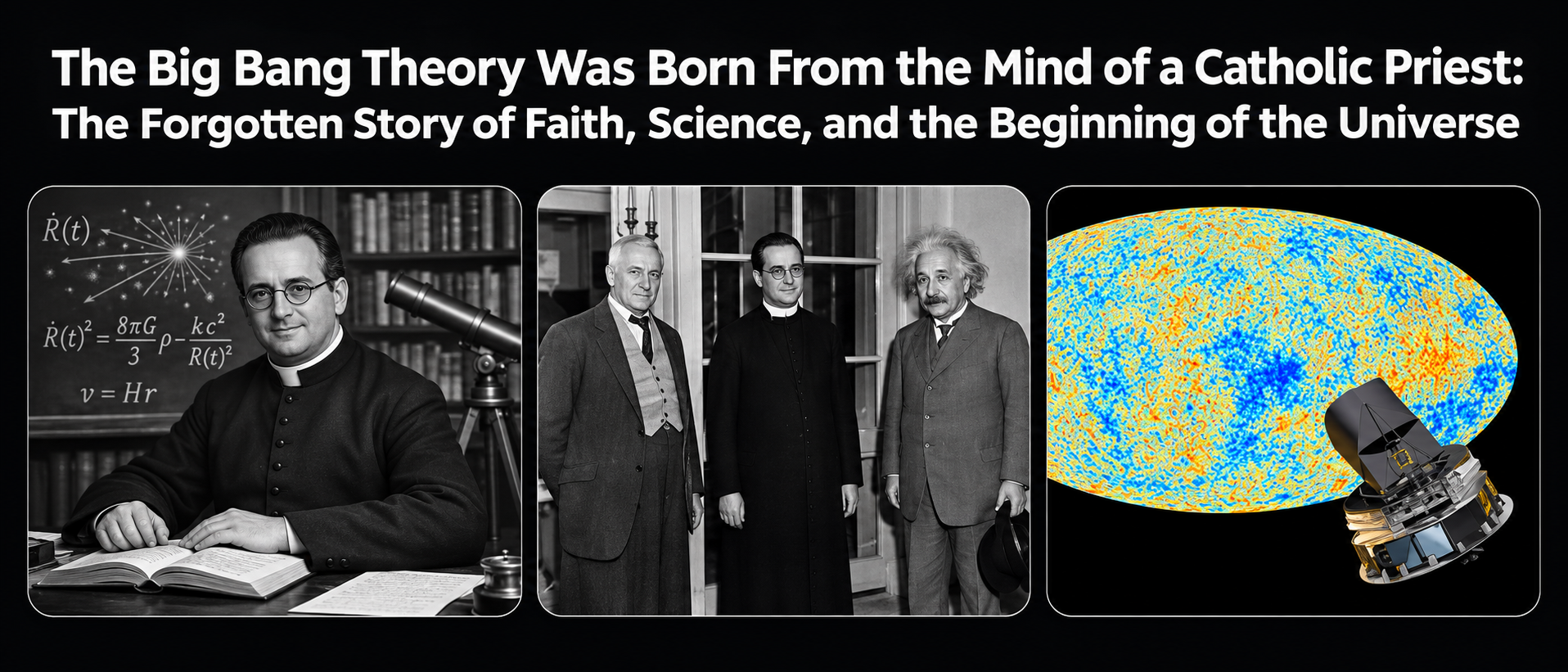
The Forgotten Story of Father Georges Lemaître, the Origin of the Universe, and Why Science and Faith Are Not Enemies
By CatholicG33k | Faith. Truth. Reason.
Introduction: What If One of the Greatest Scientific Discoveries Came From a Catholic Priest?
For decades, popular culture has promoted a familiar narrative: science and religion are enemies, scientific discoveries undermine belief in God, and Christianity stands in opposition to intellectual progress.
But what happens when one of the most revolutionary scientific ideas in human history comes from a Catholic priest?
Not a scientist who happened to be baptized Catholic.
Not a researcher who abandoned his religious convictions to pursue physics.
An ordained Catholic priest who celebrated Mass, prayed, studied theology, and devoted his intellectual life to understanding the universe.
His name was Father Georges Lemaître (1894–1966).
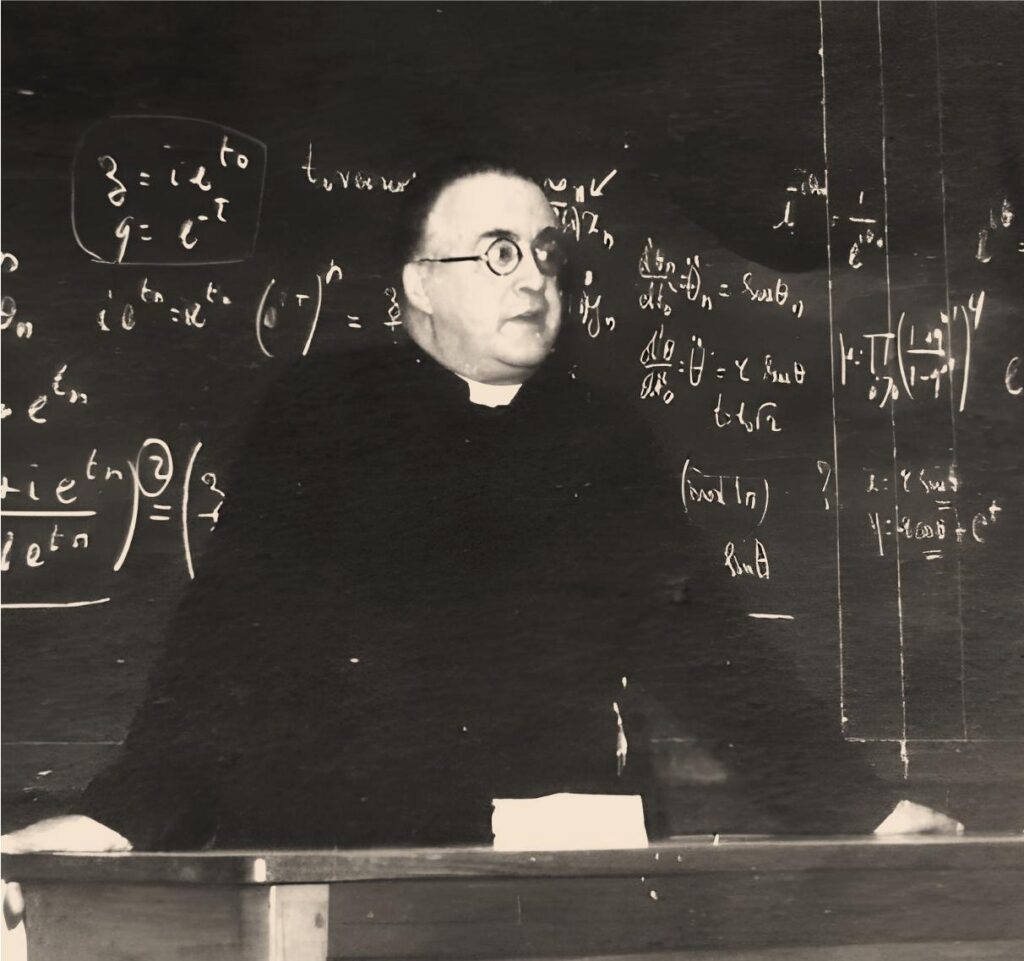
He was a Belgian priest, mathematician, physicist, and cosmologist whose groundbreaking research helped establish what we now call the Big Bang theory.
Long before modern space telescopes photographed distant galaxies, Lemaître proposed that the universe was expanding and had evolved from an extraordinarily compressed initial state.
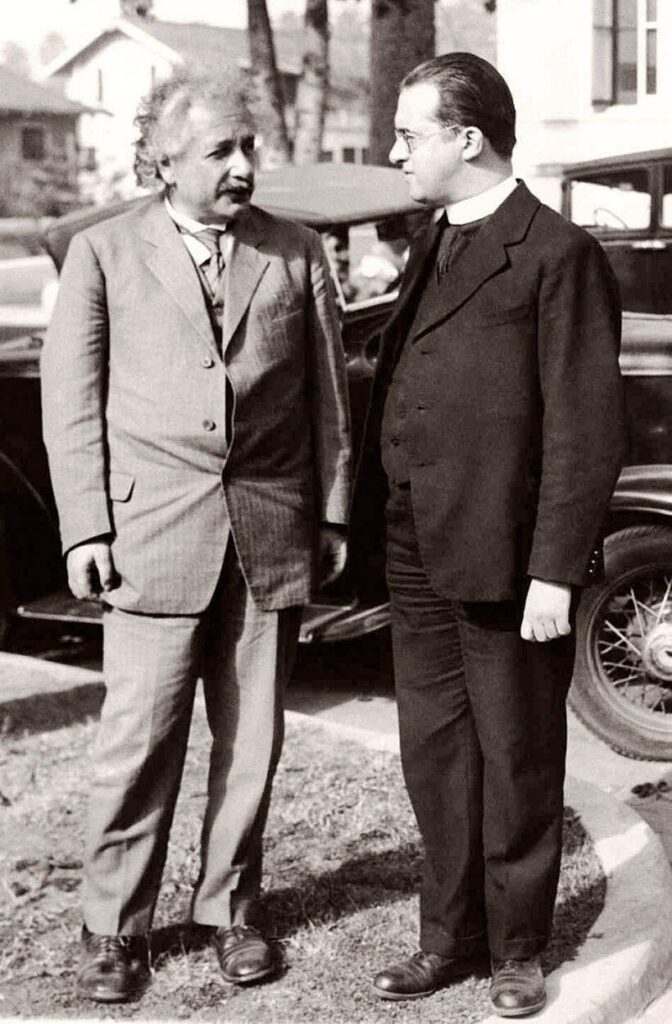
His ideas challenged some of the most influential scientific minds of his generation, including Albert Einstein.
And remarkably, the theory that many people today mistakenly associate with atheism was pioneered by a man who believed deeply in God.
But the significance of Lemaître’s discovery goes far beyond an interesting historical fact.
His life raises profound questions.
Can science and faith coexist?
Does the Big Bang prove that God exists?
Did the universe really have a beginning?
What happened before the Big Bang?
And if the universe began approximately 13.8 billion years ago, how should Catholics understand the opening words of Sacred Scripture?
“In the beginning God created heaven, and earth.”
— Genesis 1:1, Douay-Rheims Bible
To answer these questions, we must examine both the science and the theology carefully.
Because the real story is far more extraordinary than the popular myth of an eternal conflict between religion and science.
1. Before the Big Bang: When Scientists Believed the Universe Was Eternal
At the beginning of the twentieth century, many prominent scientists favored a universe that was fundamentally static.
The universe was understood as something that existed on the grandest scale without expanding or contracting.
Albert Einstein’s general theory of relativity, published in 1915, provided an entirely new mathematical description of gravity.
According to Einstein, gravity is not simply an invisible force pulling objects together. Mass and energy affect the geometry of spacetime, and that geometry influences how objects move.
Yet Einstein initially developed a cosmological model that preserved a static universe.
In 1917, he introduced a term called the cosmological constant into his gravitational field equations, allowing a static solution under particular assumptions.
An important detail is often overlooked: Einstein’s equations also permitted dynamic cosmological models.
In 1922, Russian physicist Alexander Friedmann published mathematical solutions describing universes that could expand or contract.
But mathematical possibility was not enough.
Someone needed to connect the equations with observations of the actual universe.
That is where a Catholic priest entered the story.
2. Father Georges Lemaître: A Priest Who Studied the Heavens
Georges Lemaître was born on July 17, 1894, in Charleroi, Belgium.
He grew up with a fascination for mathematics, science, and the natural world.
His early academic development was interrupted by the First World War, during which he served in the Belgian army.
After the war, he pursued advanced studies in mathematics and physics while discerning a vocation to the priesthood.
In 1923, Georges Lemaître was ordained a Catholic priest.
His priesthood did not mean abandoning science.
He continued his education at major research institutions, including Cambridge University, where he studied with astronomer Arthur Eddington, and the Massachusetts Institute of Technology, where he earned his doctorate.
Eventually, he became a professor at the Catholic University of Louvain.
Lemaître was exceptionally skilled in Einstein’s theory of relativity, mathematical physics, and observational cosmology.
He also remained committed to his priestly vocation.
To him, scientific investigation and religious belief were not competing occupations.
They were different intellectual pursuits concerned with different aspects of reality.
One involved examining the mathematical and physical structure of the universe.
The other concerned God, creation, and the ultimate meaning of existence.
Lemaître understood that these questions could be related without being identical.
This distinction would become essential to his scientific legacy.
3. The Revolutionary Discovery of 1927: The Universe Is Expanding
In 1927, Lemaître published a remarkable scientific paper with the French title:
Un Univers homogène de masse constante et de rayon croissant, rendant compte de la vitesse radiale des nébuleuses extra-galactiques.
In English, the title describes a homogeneous universe of constant mass and increasing radius that accounts for the radial velocities of extragalactic nebulae.
The title was technical.
The implications were revolutionary.
Using Einstein’s general relativity and the available astronomical observations, Lemaître developed a model of an expanding universe.
He recognized that the observed recession velocities of distant galaxies could be understood through cosmic expansion.
More importantly, he estimated a relationship between galactic distances and recession velocities.
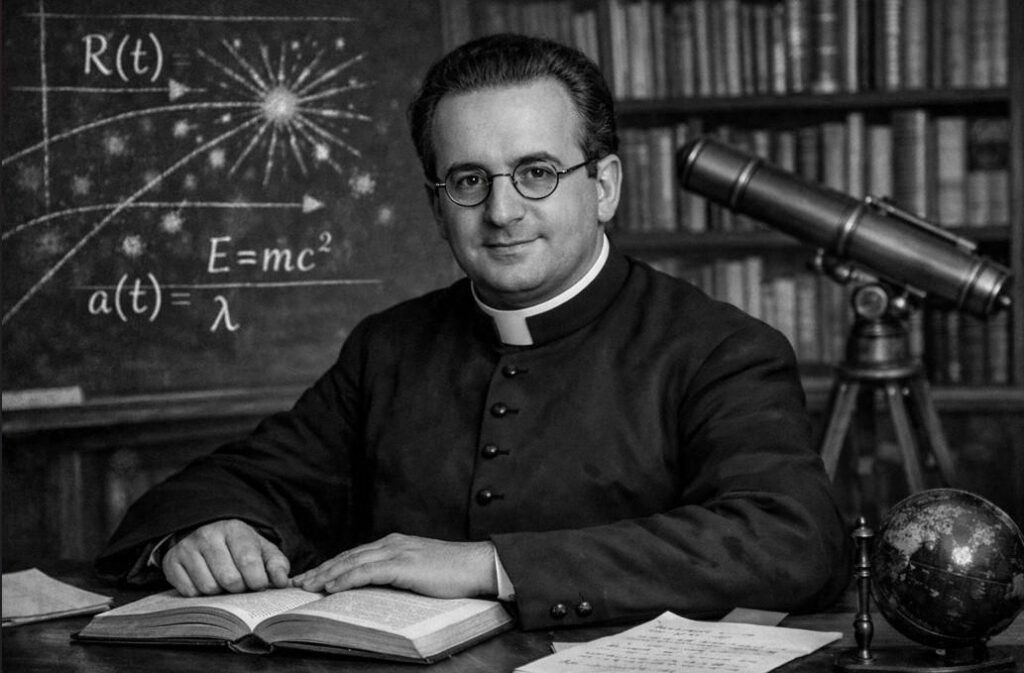
In simplified modern notation, this relationship is expressed as:
v = H₀ × d
Here:
- v represents a galaxy’s recession velocity.
- d represents its distance.
- H₀ represents the present-day expansion rate of the universe, known as the Hubble constant.
For sufficiently nearby galaxies participating in the general expansion, greater distances correspond approximately to greater recession velocities.
In other words, distant galaxies generally appear to move away from us faster than nearby ones.
This does not mean Earth occupies the center of the universe.
It means space itself is expanding on cosmic scales.
Astronomer Vesto Slipher had already performed important measurements of galactic redshifts, and other astronomers were establishing distances to external galaxies.
In 1929, Edwin Hubble published his influential observational analysis of the distance–velocity relationship.
Hubble’s work became famous, while Lemaître’s earlier contribution received comparatively little recognition.
For decades, the relationship was commonly called Hubble’s law.
However, in 2018, the International Astronomical Union voted to recommend the name Hubble–Lemaître law, recognizing the essential contributions of both scientists.
The priest who had mathematically described the universe’s expansion was finally receiving broader recognition.
Scientific reference: G. Lemaître, Annales de la Société Scientifique de Bruxelles, vol. 47A (1927), pp. 49–59; E. Hubble, Proceedings of the National Academy of Sciences, vol. 15 (1929), pp. 168–173.
4. The Primeval Atom: The Birth of Big Bang Cosmology
Lemaître’s next great insight was even more profound.
If the universe is expanding today, what happens when we mathematically trace its history backward?
Galaxies would have been closer together.
The average density of matter would have been greater.
The universe would have been hotter and more compressed.
Lemaître recognized that the expansion of the universe suggested a radically different cosmic past.
In 1931, he published a short but influential paper in the scientific journal Nature.
Its title was:
“The Beginning of the World from the Point of View of Quantum Theory.”
In this paper, Lemaître proposed that the universe might have originated from a single extremely compressed quantum state, a concept he developed into his famous hypothesis of the primeval atom.
He imagined the earliest physical state as possessing an extraordinary concentration of energy, from which the expanding universe developed.
This was not the complete modern Big Bang model.
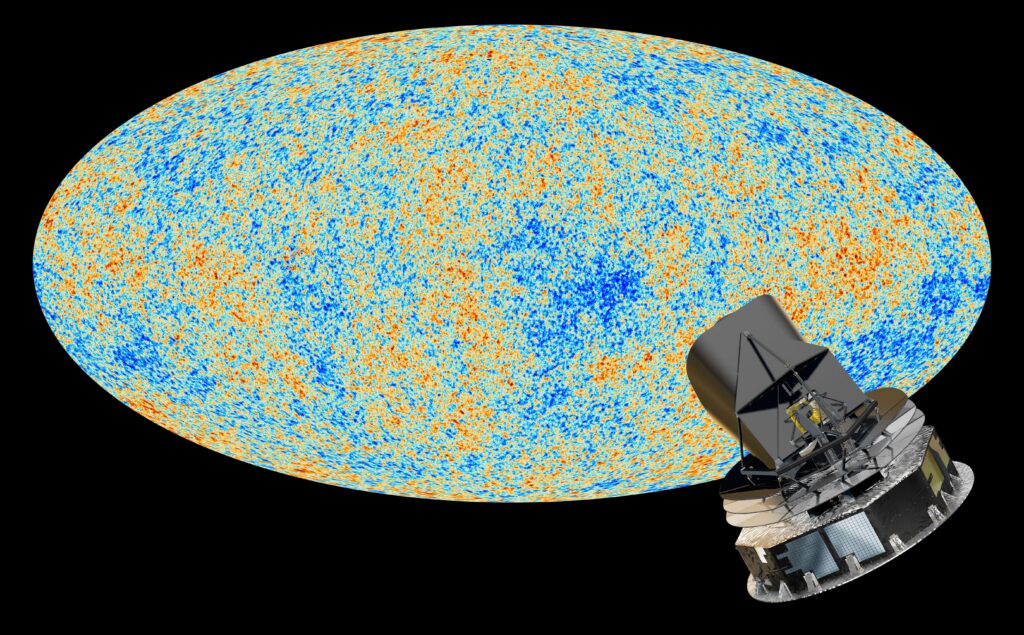
Lemaître did not possess today’s understanding of particle physics, cosmic inflation, nuclear reactions in the early universe, or the cosmic microwave background.
Nevertheless, his proposal was a foundational step toward modern Big Bang cosmology.
There is an important historical distinction here.
Lemaître did not single-handedly discover everything that scientists now include within the Big Bang theory. Alexander Friedmann, Edwin Hubble, Vesto Slipher, George Gamow, Ralph Alpher, Robert Herman, and many later researchers made indispensable contributions.
But Lemaître was among the earliest scientists to connect cosmic expansion with a physical hypothesis concerning the universe’s initial state.
That is why he is frequently called the father of the Big Bang theory.
Scientific reference: G. Lemaître, “The Beginning of the World from the Point of View of Quantum Theory,” Nature, vol. 127 (May 9, 1931), p. 706.
5. Why Einstein Initially Rejected Lemaître’s Idea
One of the most remarkable episodes in this story involves Albert Einstein.
When Lemaître presented his expanding-universe model to Einstein in 1927, Einstein was unconvinced of its physical interpretation.
Although the mathematics was relevant to general relativity, Einstein initially found an expanding universe physically unacceptable.
His position reflected the prevailing scientific difficulties surrounding dynamic cosmological models.
Over time, however, astronomical observations made the static model increasingly difficult to defend.
Einstein eventually accepted the expanding-universe interpretation.
In January 1933, Einstein and Lemaître participated in scientific discussions at the California Institute of Technology.
Their relationship illustrates a fundamental principle of genuine science:
Scientific theories must be judged by their reasoning and evidence, not merely by the reputation or religious identity of the person proposing them.
Lemaître was not correct because he was a priest.
Neither was he wrong because he believed in God.
His cosmological work deserved consideration because it followed mathematical reasoning and sought consistency with astronomical observations.
That distinction is essential.
If we want to defend the intellectual compatibility of Catholicism and science, we must respect the scientific method rather than use religious identity as a substitute for evidence.
6. What the Big Bang Theory Actually Says
A common misconception is that the Big Bang describes a gigantic explosion occurring somewhere inside an already existing, empty universe.
That picture is misleading.
The Big Bang model describes the early evolution of an expanding universe from a state that was extremely hot and dense.
It is not an ordinary explosion of matter outward into surrounding empty space.
Instead, the distances between sufficiently separated, gravitationally unbound regions increase as the universe expands.
A useful illustration is to imagine dots placed on the surface of an inflating balloon.
As the balloon expands, the dots become farther apart.
No dot needs to be the center of expansion on the balloon’s surface.
Likewise, the large-scale expansion of the universe does not require Earth, the Milky Way, or any other galaxy to occupy a privileged central position.
The analogy is imperfect because the universe is not necessarily the surface of a balloon, and it need not be expanding into a surrounding physical space.
But it helps illustrate an important point:
The Big Bang is about the expansion and early physical history of the universe, not an explosion from one location into empty space.
The cosmic timeline
Modern cosmological research indicates that our universe has evolved over approximately 13.8 billion years.
Scientists reconstruct this history using general relativity, astronomical observations, particle physics, and measurements of the cosmic microwave background.
The earliest stages: The observable universe was once extraordinarily hot and dense. Many physicists investigate a possible brief period of accelerated expansion called cosmic inflation, although its precise mechanism remains unconfirmed.
The first seconds: The universe contained an extremely hot mixture of radiation and elementary particles. As it expanded, it cooled.
The first minutes: Protons and neutrons participated in nuclear reactions that produced much of the universe’s primordial helium, along with hydrogen nuclei and small quantities of other light nuclei.
Approximately 380,000 years later: The universe cooled enough for electrons and nuclei to combine into neutral atoms. Light could then travel much more freely through space.
Hundreds of millions of years later: The first generations of stars and galaxies emerged through gravitational structure formation.
Billions of years later: Galaxies continued evolving, stars formed and died, and heavier chemical elements accumulated through stellar processes.
Approximately 4.6 billion years ago: Our solar system formed.
Today: The universe continues expanding, and observations indicate that its large-scale expansion is accelerating.
This timeline is not merely speculation.
It is supported by multiple independent lines of observational evidence.
7. The Three Major Scientific Pillars of the Big Bang
The strength of the Big Bang theory rests not on the religious beliefs of its early proponents but on the evidence supporting it.
Evidence One: The Expansion of the Universe
Light traveling from distant galaxies carries information about their motion and the expansion of space.
Astronomers observe that characteristic spectral features in many distant galaxies are shifted toward longer, redder wavelengths.
This phenomenon is called redshift.
For cosmologically distant galaxies, the redshift is explained primarily by the expansion of space during the light’s journey.
The resulting pattern is consistent with a universe that has expanded over cosmic time.
This is the observational foundation of the Hubble–Lemaître law.
Evidence Two: The Cosmic Microwave Background
One of the most important discoveries in modern cosmology occurred in the 1960s.
Radio astronomers Arno Penzias and Robert Wilson detected an unexpected, nearly uniform microwave signal coming from the sky.
Their results were published in 1965.
This radiation is known as the cosmic microwave background, or CMB.
It is the surviving radiation from the early universe, released when the cosmos became transparent approximately 380,000 years after the beginning of the hot expansion.
As space expanded, the wavelengths of this radiation were stretched.
Today, its measured temperature is approximately 2.7 kelvin, only slightly above absolute zero.
Scientists have mapped extraordinarily small variations in this radiation using instruments such as COBE, WMAP, and the Planck satellite.
These fluctuations contain information about the density, geometry, and evolution of the early universe.
The cosmic microwave background is one of the most compelling confirmations of the hot Big Bang model.
Scientific references: A. A. Penzias and R. W. Wilson, “A Measurement of Excess Antenna Temperature at 4080 Mc/s,” Astrophysical Journal, vol. 142 (1965), pp. 419–421; Planck Collaboration, “Planck 2018 Results. VI. Cosmological Parameters,” Astronomy & Astrophysics, vol. 641 (2020), A6.
Evidence Three: The Abundance of Light Elements
The Big Bang model predicts that nuclear reactions in the early universe produced particular quantities of light elements.
These include hydrogen, helium, and traces of lithium.
Astronomers can compare theoretical predictions with measurements of ancient gas clouds and other cosmic environments.
The broad agreement between theory and observation provides another major confirmation of the hot, dense early universe.
Some outstanding problems remain, including the discrepancy between predicted and observed primordial lithium abundance.
That is not a reason to discard the entire theory.
It is an example of how science progresses: a successful model can still contain important unresolved questions.
Together, cosmic expansion, background radiation, and primordial element abundances provide an exceptionally strong foundation for modern Big Bang cosmology.
8. Does the Big Bang Prove That God Exists?
Here we arrive at one of the most important theological distinctions in the entire discussion.
Some Christians argue:
“The Big Bang proves that the universe had a beginning. Therefore, science has proven that God created the universe.”
Although the conclusion that God is Creator agrees with Catholic faith, this particular scientific argument requires greater precision.
The Big Bang theory does not, by itself, scientifically demonstrate God’s existence.
Why?
Because cosmology studies the physical universe through measurable quantities, mathematical models, and observable evidence.
It investigates how cosmic structures developed and what physical conditions existed in the past.
Questions concerning God’s existence require philosophical and theological reasoning that goes beyond the direct methods of physics.
Furthermore, although the standard Big Bang model describes a hot, dense early universe, it does not establish with certainty that absolutely everything began to exist at the earliest moment represented in the model.
General relativity, when extrapolated toward extremely early conditions, can encounter a mathematical singularity.
Such a singularity signals a limitation in the classical description, not a complete scientific explanation of ultimate reality.
A successful theory of quantum gravity may provide a more complete account of those conditions.
Therefore, physicists do not yet possess a universally established explanation of the ultimate origin of spacetime.
Lemaître himself understood the danger of equating a scientific theory with a theological demonstration.
He wanted his cosmological hypothesis to stand on its scientific merits.
This was not a rejection of God.
It was an acknowledgment that the scientific and theological questions were distinct.
And this distinction protects Catholic theology from an unnecessary weakness.
If someone claims that the Big Bang scientifically proves God, what happens if scientists revise their understanding of the universe’s earliest history?
Catholic belief in creation must not depend on the continued acceptance of one specific cosmological model.
God’s existence is not a temporary hypothesis inserted into a gap in scientific knowledge.
The Catholic doctrine of creation is much deeper.
9. Creation From Nothing: What Catholics Actually Believe
The Catholic Church teaches that God created the universe freely and ex nihilo — from nothing.
The Catechism states:
“God creates freely ‘out of nothing’.”
— Catechism of the Catholic Church, 296
What does this mean?
It does not mean that God used an empty region of space as raw material.
It does not mean that God transformed an existing quantum vacuum into the universe.
In physics, a vacuum is not the same thing as absolute nothingness. A physical vacuum belongs to a theoretical framework involving fields, physical laws, and a spacetime structure.
By contrast, creation from nothing means that God did not require any preexisting material from which to make the universe.
Everything that exists apart from God ultimately depends on Him for its existence.
This includes matter, energy, space, time, and the physical order itself.
Consider the difference between a carpenter and God.
A carpenter can make a wooden table.
But the carpenter does not create the wood from nothing.
He works with material that already exists.
God, by contrast, is not merely an extraordinarily powerful craftsman.
He is the ultimate source of the existence of created reality.
And according to Catholic theology, God’s creative action does not end once the universe begins.
The Catechism teaches that God continually sustains creatures in existence (CCC 301).
Therefore:
Creation is not merely something God did at the beginning of time. It also expresses the continuing dependence of everything that exists upon Him.
Even if the universe had existed eternally — a possibility debated by ancient philosophers — it would still require a metaphysical explanation of its dependent existence.
This brings us to a remarkably important Catholic thinker.
10. St. Thomas Aquinas Understood the Distinction Centuries Before Modern Cosmology
Approximately seven centuries before Lemaître proposed his cosmological theory, St. Thomas Aquinas addressed the relationship between creation and the beginning of time.
In the Summa Theologiae, First Part, Question 46, Article 2, Aquinas argued that the temporal beginning of the world could not be established through philosophical demonstration alone.
Catholic faith teaches that the created world had a beginning.
But Aquinas distinguished this revealed truth from what unaided philosophical reasoning could demonstrate.
His reasoning contains an important insight:
Proving that the universe depends upon God is not the same thing as proving that the universe began at a particular moment.
The distinction matters because God’s role as Creator is not reducible to being the first event in a sequence of physical events.
God is not simply an earlier object within the universe.
He is the transcendent cause of the very existence of created reality.
Aquinas’ philosophical reasoning begins with the existence, change, causality, and contingency of things.
The question is not merely:
“What happened billions of years ago?”
It is also:
“Why does anything exist at all, rather than possess no existence?”
Even if physics could trace cosmic history back through every preceding physical state, philosophical questions about existence and ultimate causality would remain.
Conversely, philosophical arguments for God do not eliminate the need for physics to investigate the universe.
This is why Catholic intellectual tradition can affirm both genuine scientific inquiry and philosophical reflection.
Theological reference: St. Thomas Aquinas, Summa Theologiae, I, q. 44, a. 1; q. 45, a. 1; q. 46, a. 2.
11. What About Genesis? Does a 13.8-Billion-Year-Old Universe Contradict the Bible?
The first verse of Genesis declares:
“In the beginning God created heaven, and earth.”
— Genesis 1:1, Douay-Rheims Bible
Is Genesis making the same kind of statement as a modern cosmological model?
No.
Genesis is inspired Sacred Scripture. It teaches fundamental truths about God and creation, including that the universe is not divine, not self-sufficient, and not the product of competing eternal gods.
The creation account proclaims the sovereignty, goodness, and wisdom of the Creator.
It is not written as a twenty-first-century physics textbook.
The Catechism acknowledges the enormous value of scientific investigations into the origins, development, and dimensions of the universe (CCC 283).
It then distinguishes these investigations from deeper questions about the meaning and ultimate source of existence (CCC 284).
This distinction does not mean Genesis is meaningless history or that Catholics may dismiss its theological truths.
Rather, Catholics must interpret Sacred Scripture according to its literary forms, human authorship, unity with the whole of Scripture, Sacred Tradition, and the teaching authority of the Church.
The Second Vatican Council explains these principles in Dei Verbum, 12.
When Genesis teaches that God created heaven and earth, it reveals a truth about the origin of all created reality.
When cosmology reconstructs the development of the early universe, it examines physical processes.
A statement about divine creation and a scientific description of cosmic development are not automatically contradictory.
They need not even address exactly the same question.
Consider a simpler example.
Suppose someone asks, “Why does this cathedral exist?”
One answer might explain the architectural plans, workers, stone, engineering, and construction methods.
Another might explain that a community built it to worship God.
Those explanations address different dimensions of the same reality.
Similarly, cosmic physics and the doctrine of creation can offer distinct, complementary forms of understanding.
We should not force Scripture to function as a technical cosmology manual.
Nor should we demand that physics settle every question about God, purpose, and ultimate meaning.
12. Pope Pius XII and the Big Bang: An Important Lesson
In 1951, Pope Pius XII delivered an address to the Pontifical Academy of Sciences titled:
The Proofs for the Existence of God in the Light of Modern Natural Science.
The Pope discussed the remarkable advances in astronomy and physics, reflecting on how scientific discoveries could support philosophical consideration of a Creator.
The emerging picture of a universe with a finite physical past appeared particularly significant.
However, Lemaître was cautious about identifying a cosmological hypothesis too closely with theological claims about creation.
He did not want the scientific theory to become merely a religious argument.
This historical episode is sometimes presented as a conflict between Lemaître and the Pope.
A more careful interpretation recognizes the underlying distinction.
Pius XII was reflecting on the philosophical and religious significance of scientific discoveries.
Lemaître wanted to preserve the independence and rigor of the scientific explanation.
Both concerns have continuing relevance.
Catholics can regard the discoveries of astronomy as occasions for wonder and philosophical reflection.
But they should not claim that a physical theory demonstrates more than its evidence establishes.
Good apologetics should never exaggerate what science has actually proven.
That principle strengthens faith rather than weakening it.
13. If God Created the Universe, Who Created God?
This is one of the most common objections raised in discussions about cosmic origins.
“If everything needs a cause, then who caused God?”
But classical Catholic philosophy does not teach that everything whatsoever requires a cause.
Rather, it examines the dependence of things whose existence, change, or actuality requires explanation.
God is understood as necessary, uncreated Being — not as another contingent object existing somewhere within the universe.
Aquinas describes God as the ultimate source of being, without the limitations and dependencies characteristic of creatures.
In the Summa Theologiae, I, q. 3, Aquinas explains divine simplicity. In I, q. 44, he addresses God as the first cause of beings.
Therefore, asking “Who created God?” assumes that God belongs to the category of created things.
But the God of classical Catholic theology is precisely the One who is not created.
This does not mean that merely defining God as uncreated proves His existence.
Arguments for God’s existence require philosophical reasoning.
Rather, it clarifies what Catholics actually mean when they use the word God.
The Creator is not simply the oldest or most powerful inhabitant of the universe.
God transcends the physical order while sustaining it.
That understanding is fundamentally different from imagining God as an invisible object that existed somewhere in empty space before the Big Bang.
14. What Happened Before the Big Bang?
This question is more complicated than it first appears.
Ordinarily, when we ask what happened before an event, we assume time already existed.
But if physical time itself has a beginning, the word before may not apply in the ordinary sense.
There would not necessarily be an earlier physical moment waiting to be described.
However, scientists have not established definitively that time began at the hot Big Bang.
Some theoretical models investigate earlier physical phases, bouncing cosmologies, quantum-gravitational scenarios, or other possibilities.
These models remain subjects of research and debate.
An important distinction must be maintained:
We have strong observational evidence for an early hot, dense phase of cosmic evolution. We do not yet possess a complete scientific account of why the universe exists at all.
And we should not confuse these two questions.
The first belongs principally to physical cosmology.
The second opens into philosophical and theological inquiry.
When Catholics speak of God as eternal, we do not mean merely that God has existed for an extraordinarily long number of years.
Divine eternity transcends the temporal succession experienced by created beings.
St. Thomas Aquinas addresses this in Summa Theologiae, I, q. 10.
God does not have to wait through empty centuries before deciding to create.
He is not subject to a cosmic clock.
Time belongs to the created order.
15. Does Modern Cosmology Leave Room for God?
The phrase “leave room for God” can itself be misleading.
It sometimes suggests that God can exist only where science has failed to provide an explanation.
For example:
“We don’t know what caused the Big Bang, so God must have done it.”
This is commonly called a God of the gaps argument.
It is an intellectually fragile way to defend belief in God.
Suppose tomorrow scientists discovered a deeper physical mechanism explaining an earlier cosmic state.
Would God’s existence suddenly become less plausible?
Not according to classical Catholic theology.
Because God is not proposed as merely one more physical mechanism alongside gravity, quantum fields, and nuclear forces.
God is understood as the transcendent source of the existence and activity of the created order.
Scientific explanations describe relationships and processes within physical reality.
A theological account of creation explains the complete dependence of created reality on God.
The two explanations operate at different levels.
This distinction does not magically resolve every philosophical disagreement between believers and nonbelievers.
There are serious debates concerning causality, contingency, physical laws, and the foundations of cosmology.
Those debates deserve careful reasoning.
But it shows why a more complete scientific explanation does not automatically make God unnecessary.
Catholics need not fear the discovery of additional natural causes, because natural causes are not rivals to the Creator.
The Catechism expresses this confidence in paragraph 159, explaining that authentic scientific investigation and faith cannot ultimately contradict each other, since truth cannot contradict truth.
16. The Remarkable Legacy of Father Lemaître
Father Georges Lemaître died on June 20, 1966.
By then, the cosmic microwave background had been discovered, and the evidence supporting a hot early universe was becoming increasingly persuasive.
Lemaître had lived long enough to learn of that important observational breakthrough.
His legacy is exceptional.
He helped connect general relativity with observational cosmology.
He developed an early expanding-universe model.
He proposed a finite, compressed early state of the universe.
His research contributed to what became the foundation of modern Big Bang cosmology.
And throughout his intellectual career, he remained a Catholic priest.
From 1960 until his death, he also served as president of the Pontifical Academy of Sciences.
His story challenges the simplistic assumption that serious science requires a rejection of religious faith.
It also challenges Catholics to avoid the opposite mistake of dismissing science whenever scientific discoveries raise difficult questions.
Lemaître was not afraid of equations.
He was not afraid of new astronomical evidence.
And he did not regard his religious vocation as permission to take shortcuts in scientific reasoning.
His example invites Catholics to pursue intellectual excellence, honesty, and humility.
Those qualities are not enemies of faith.
They are virtues worth cultivating.
17. A Universe That Invites Wonder
Imagine looking into the night sky.
The light reaching your eyes may have traveled for thousands, millions, or even billions of years.
Some distant galaxies are observed as they existed long before our solar system formed.
The chemical elements in our bodies were produced through cosmic processes involving earlier generations of stars.
We inhabit a universe whose history can be partially reconstructed through mathematics, telescopes, and physical experiments.
The remarkable thing is not only that the universe exists.
It is also that human beings can investigate it.
We can formulate mathematical laws, study ancient radiation, and discover relationships that apply across enormous cosmic distances.
For Catholics, this intelligibility can become an occasion for gratitude and contemplation.
It does not function as an automatic scientific proof of every religious doctrine.
But it can deepen our appreciation of creation.
The Book of Wisdom speaks of knowing the Creator through the things He has made, and the Church encourages believers to contemplate God’s wisdom in the created order.
We should remember, however, that the God of Catholic faith is not merely the explanation of astronomical mysteries.
He is the God revealed in Jesus Christ.
The One whom Christians confess as Creator is also the One who enters human history through the Incarnation.
The Gospel of John declares:
“All things were made by him: and without him was made nothing that was made.”
— John 1:3, Douay-Rheims Bible
For the Catholic believer, the investigation of creation can lead naturally to wonder before its Creator.
But that response belongs to faith and philosophical reflection, not to a measurement made by a telescope.
Conclusion: The Big Bang Did Not Destroy Faith — And a Catholic Priest Helped Give It Scientific Form
The history of the Big Bang teaches us something important.
One of the foundational ideas in modern cosmology was developed by an ordained Catholic priest.
That fact alone refutes the sweeping claim that Catholic belief necessarily prevents someone from doing groundbreaking scientific work.
Yet the deeper lesson is not that Catholics should claim scientific ownership of the universe.
Scientific truth is not Catholic, Protestant, atheist, or agnostic.
It is truth about the natural world, investigated through reason and evidence.
Father Georges Lemaître’s work deserves recognition because of its scientific significance, not because the scientist who developed it happened to wear a Roman collar.
His Catholic faith nevertheless makes his story especially meaningful.
He demonstrated through his life that a person could be devoted to God while participating at the highest levels of scientific discovery.
He understood that studying the physical development of the universe and believing in its divine Creator were not inherently contradictory commitments.
For the faithful Catholic, the universe is not merely a collection of particles and galaxies.
It is creation.
Its grandeur invites wonder.
Its mathematical intelligibility invites investigation.
Its existence invites philosophical reflection.
And its ultimate meaning leads us toward questions that no scientific instrument, however powerful, can settle on its own.
The Big Bang theory tells us an extraordinary story about the early history of the universe.
Catholic theology teaches that the universe ultimately depends upon God for its very existence.
These truths should not be confused.
But neither must they be treated as enemies.
Perhaps the most enduring lesson of Father Lemaître’s life is this:
A Catholic does not have to choose between loving God and seeking an accurate understanding of His creation.
And sometimes, the person challenging humanity to rethink the universe is not standing against the Church.
He is a Catholic priest standing before a blackboard, writing equations.
Faith and reason need not fear one another. Truth is never the enemy of truth.
References and Further Reading
Sacred Scripture and Catholic teaching
- The Holy Bible, Douay-Rheims, Genesis 1:1; John 1:3.
- Catechism of the Catholic Church, 159, 283–284, 295–296, 300–301.
- St. Thomas Aquinas, Summa Theologiae, I, questions 3, 10, 44–46.
- Second Vatican Council, Dei Verbum, 12.
- Pope Pius XII, The Proofs for the Existence of God in the Light of Modern Natural Science, Address to the Pontifical Academy of Sciences, November 22, 1951.
Historical and scientific research
- Georges Lemaître, “Un Univers homogène de masse constante et de rayon croissant, rendant compte de la vitesse radiale des nébuleuses extra-galactiques,” Annales de la Société Scientifique de Bruxelles, 47A (1927), 49–59.
- Georges Lemaître, “The Beginning of the World from the Point of View of Quantum Theory,” Nature, 127 (1931), 706.
- Edwin Hubble, “A Relation Between Distance and Radial Velocity Among Extra-Galactic Nebulae,” Proceedings of the National Academy of Sciences, 15 (1929), 168–173.
- Arno A. Penzias and Robert W. Wilson, “A Measurement of Excess Antenna Temperature at 4080 Mc/s,” Astrophysical Journal, 142 (1965), 419–421.
- Planck Collaboration, “Planck 2018 Results. VI. Cosmological Parameters,” Astronomy & Astrophysics, 641 (2020), A6.
- International Astronomical Union, Resolution B4, recognition of the Hubble–Lemaître law (2018).
CatholicG33k | Faith. Truth. Reason.
Defending the Catholic Faith through Sacred Scripture, Sacred Tradition, sound philosophy, and the honest pursuit of truth.
Discussion question: Did you know that a Catholic priest helped pioneer the Big Bang theory? Does learning about Father Georges Lemaître change how you understand the relationship between science and faith?