

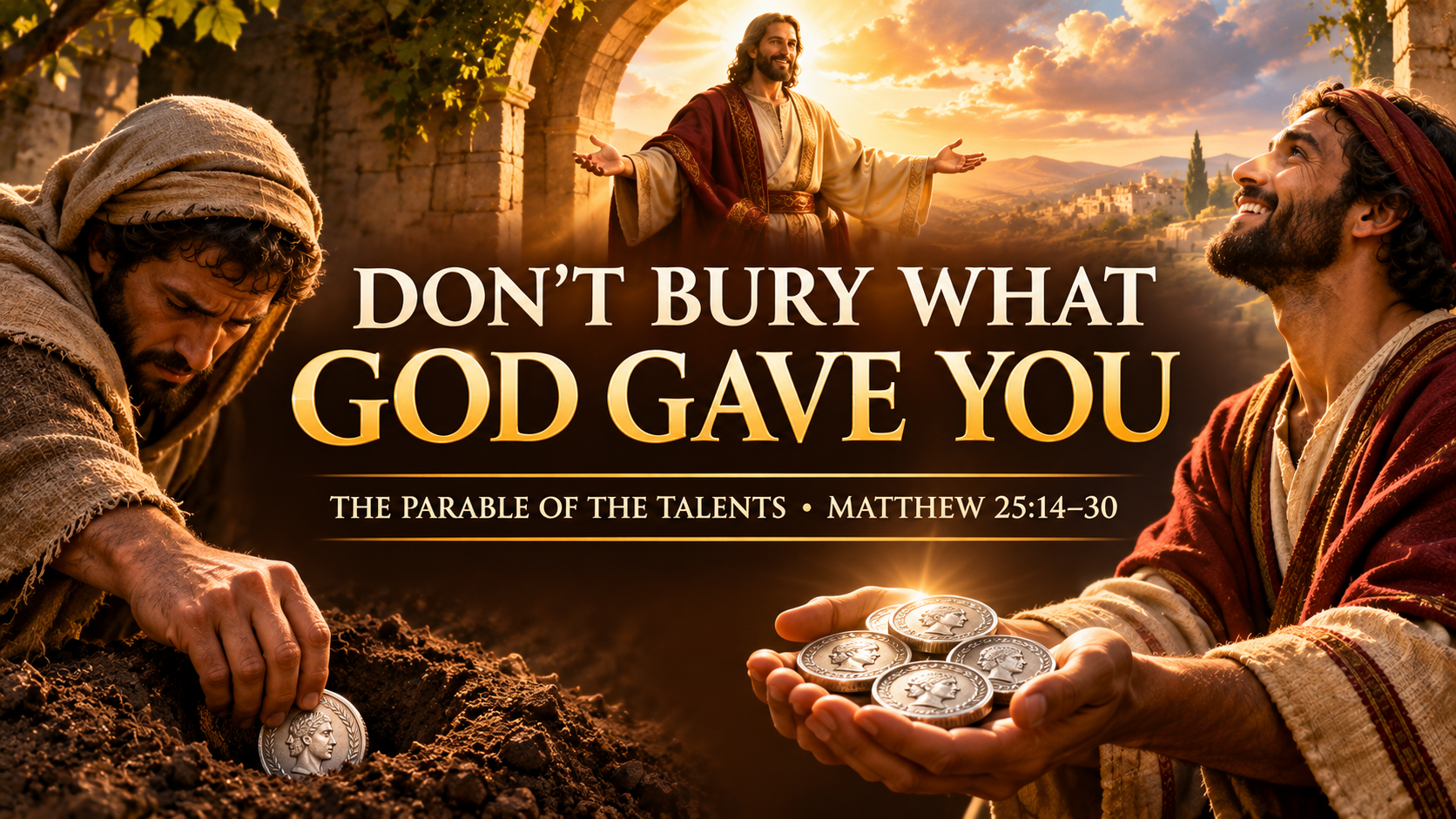
The Parable of the Talents: Faith, Fear, and Our Responsibility Before God
By Catholicg33k
What if I told you that God has already entrusted you with something more valuable than anything you could ever purchase?
Not just your intelligence, your abilities, your money, or your opportunities.
Something infinitely more precious.
Your life. Your calling. And the opportunity to share in His divine life through grace.
The real question isn’t whether God has given you something valuable.
The question is: What are you doing with what He has given you?
That’s the challenge Jesus places before us in the Parable of the Talents.
And when we understand this parable through the teaching of the Catholic Church, we discover that it’s about much more than being productive.
It’s about salvation, responsibility, grace, and the kind of person we are becoming as we prepare to meet Jesus Christ.
1. The Church’s Calendar Is Pointing Us Toward Eternity
One of the beautiful things about being Catholic is that our faith has its own rhythm.
The Church doesn’t simply move through another ordinary calendar year. She leads us through the mysteries of Christ’s life, death, Resurrection, and glorious return.
As we approach the conclusion of the liturgical year and the Solemnity of Our Lord Jesus Christ, King of the Universe, the Church directs our attention toward the last things: death, judgment, Heaven, and Hell.
Why?
Because Christianity isn’t simply about becoming a better person during our time on earth.
It’s about becoming a saint and spending eternity with God.
The Church teaches that every human person will face a particular judgment immediately after death, and that Christ will return in glory for the final judgment.
Sources: Catechism of the Catholic Church (CCC), 1021–1022, 1038–1041.
This is why Jesus repeatedly warns His disciples to remain spiritually awake.
St. Paul writes:
“Therefore, let us not sleep, as others do; but let us watch, and be sober.”
— 1 Thessalonians 5:6, Douay-Rheims
Christ isn’t calling us to live in panic.
He’s calling us to live with purpose.
There is an enormous difference between being terrified of the future and being prepared for eternity.
And that brings us directly to the Parable of the Talents.
2. God Has Entrusted You With a Fortune
In Matthew 25:14–30, Jesus describes a master who prepares to leave on a journey.
Before departing, he entrusts his property to three servants.
One receives five talents.
Another receives two.
The third receives one.
Now here’s something important.
When we hear the word talent today, we usually think about a natural ability.
Maybe someone is good at music, technology, public speaking, or athletics.
But in the historical setting of this parable, a talent was a measure of weight used for precious metals and represented an enormous amount of wealth.
Even the servant who received only one talent was entrusted with something extraordinarily valuable.
That changes the way we should understand the story.
The third servant wasn’t handed some insignificant leftover.
He was entrusted with a treasure.
And so are we.
God has given each of us life, opportunities, responsibilities, and natural abilities. Through the sacraments, He also communicates supernatural grace and calls us into a deeper relationship with Him.
The Catechism explains that grace is God’s free and undeserved help, given so that we can respond to His call to become His adopted children.
Source: CCC 1996–2000.
But there is an important distinction.
Our natural abilities are gifts of creation. Sanctifying grace is a supernatural gift that shares in God’s divine life.
They are not the same thing.
Nevertheless, both remind us that everything good ultimately comes from God.
And what God gives us is meant to bear fruit.
3. The Greatest Danger Isn’t Having Too Little. It’s Doing Nothing.
The first two servants put their master’s money to work.
Both doubled what they had received.
When the master returned, each received the same extraordinary praise:
“Well done, good and faithful servant.”
— Matthew 25:21, 23, Douay-Rheims
Notice something beautiful.
One servant began with five talents.
The other began with two.
Yet their master praised both for their faithfulness.
This teaches us something important about the spiritual life.
Holiness is not a competition.
God isn’t asking you to become somebody else.
He’s calling you to become the saint He created you to be, through His grace.
You might not be a gifted speaker.
You might not have a theological degree.
You might not have thousands of followers or an impressive career.
But you can pray.
You can forgive.
You can learn your faith.
You can help someone who’s suffering.
You can defend the truth with charity.
You can be faithful in the responsibilities God has placed before you.
The third servant, however, chose a different path.
He buried the talent.
He didn’t multiply it.
He didn’t even attempt to use it.
He simply gave it back.
And his master condemned his wickedness and laziness.
Why?
Because refusing to do the good entrusted to us can itself become a moral failure.
4. The Sin We Often Forget
Catholics are generally familiar with sins such as lying, stealing, or deliberately harming another person.
These are examples of sins of commission: wrong actions that we choose to perform.
But Catholic moral theology also recognizes sins of omission.
These occur when we culpably fail to do something that we have a moral obligation to do.
St. James teaches:
“To him therefore who knoweth to do good, and doth it not, to him it is sin.”
— James 4:17, Douay-Rheims
Think about that.
Sometimes the question isn’t merely, “What wrong thing did I do?”
Sometimes we also need to ask:
“What good thing should I have done?”
Did I refuse to help when I reasonably could have?
Did I avoid standing up for someone who was being mistreated?
Did I neglect an important responsibility to my family?
Did I refuse to forgive?
Did I deliberately ignore God’s invitation to grow in holiness?
The Catechism explicitly teaches that sin can occur through thoughts, words, deeds, or omissions.
Source: CCC 1853.
This is one reason the Confiteor at Mass is so powerful.
When Catholics confess that we have sinned in what we have done and in what we have failed to do, we acknowledge that love requires more than avoiding evil.
Love also requires choosing the good.
Of course, not every missed opportunity is automatically a sin. Moral responsibility depends upon our actual duties, knowledge, freedom, and circumstances.
But the lesson is clear.
Christianity cannot be reduced to simply avoiding wrongdoing.
Christ calls us to active charity.
5. Fear Can Distort Our Understanding of God
There is another important detail in the parable.
When the master questions the third servant, the servant explains that he was afraid.
He viewed his master as a harsh and demanding man.
That fear influenced his decision to bury the talent.
Consider how this applies to our relationship with God.
If we imagine God as an unreasonable tyrant who waits for every opportunity to punish us, we may begin to hide from Him rather than trust Him.
But this is not the Father revealed by Jesus Christ.
God is perfectly just, but He is also infinitely merciful.
We need only look at the Crucifix.
There we see the seriousness of sin.
But there we also see the immeasurable depth of God’s love.
St. Paul reminds us that Christ died for us while we were still sinners.
Source: Romans 5:8.
The Cross reveals a God who loves us enough to offer His own Son for our redemption.
This does not mean God’s judgment is imaginary or that our choices have no consequences.
It means that the proper response to our sins is repentance, not despair.
When you fall, don’t bury yourself in shame.
Turn toward Christ.
Seek His mercy.
Go to Confession if you have received the sacrament of Penance.
Begin again.
God doesn’t call us to trust in our own perfection.
He calls us to cooperate with His grace.
6. Faith, Hope, and Charity: The Real Spiritual Investment
So how do we make good use of what God has given us?
The Catholic Church identifies three theological virtues: faith, hope, and charity.
These virtues are infused by God and direct us toward Him.
Source: CCC 1812–1813.
Faith: Believe God and respond to His revelation
Faith is not merely believing that God exists.
It is the supernatural virtue through which we believe in God and everything He has revealed, because He is Truth Himself.
Source: CCC 1814.
Faith calls us to trust the Lord even when we do not understand every detail of His plan.
We nourish faith through prayer, Scripture, sound Catholic teaching, and participation in the life of the Church.
And authentic faith must bear fruit in our actions.
As St. James teaches, faith without works is dead.
Source: James 2:17.
Hope: Trust in God’s promises
Hope is not simply positive thinking.
Christian hope is the supernatural virtue by which we desire the Kingdom of Heaven and eternal life, trusting in Christ’s promises and relying on the grace of the Holy Spirit.
Source: CCC 1817.
The faithful servants acted because they trusted that their efforts had a purpose.
Likewise, Christian hope strengthens us to persevere even when the spiritual life becomes difficult.
We don’t place our ultimate confidence in our own strength.
We place it in God.
Charity: Love God above all and your neighbor for His sake
Charity is the greatest of the theological virtues.
It is the supernatural virtue by which we love God above everything for His own sake and our neighbor as ourselves for the love of God.
Source: CCC 1822.
St. Paul tells us:
“And now there remain faith, hope, and charity, these three: but the greatest of these is charity.”
— 1 Corinthians 13:13, Douay-Rheims
Here’s where the entire parable becomes personal.
You can have tremendous intelligence.
You can possess impressive abilities.
You can memorize Catholic doctrine.
You can have extensive knowledge of Scripture.
But if that knowledge never leads you toward greater love for God and neighbor, something essential is missing.
The purpose of growing in the Catholic faith is not merely to know more about Christ. It is to know Him, love Him, and follow Him.
And charity is how that relationship becomes visible in our lives.
7. Holiness Is Found in Ordinary Life
One of the greatest misunderstandings about sainthood is the belief that holiness belongs only to extraordinary people.
We imagine missionaries traveling across continents, martyrs defending the faith, or religious spending their lives in monasteries.
Those are beautiful vocations.
But the universal call to holiness includes every baptized Catholic.
Source: CCC 2013–2014; Second Vatican Council, Lumen Gentium 39–42.
A mother caring patiently for her children can grow in holiness.
A father working honestly to support his family can grow in holiness.
A student refusing to cheat can grow in holiness.
A teenager defending an unpopular classmate can grow in holiness.
An employee treating a difficult coworker with charity can grow in holiness.
A Catholic who takes five minutes to pray instead of endlessly scrolling through a phone can take a genuine step toward God.
None of these actions will necessarily make you famous.
But every good act performed in cooperation with God’s grace and motivated by charity matters.
The virtuous woman described in Proverbs 31 provides a beautiful biblical example of wisdom expressed through everyday faithfulness, diligence, generosity, and concern for others.
Her life reminds us that virtue is not merely something we discuss.
It’s something we practice.
Source: Proverbs 31:10–31.
We don’t need extraordinary circumstances to begin living as saints.
We need to respond faithfully to the grace God is offering us today.
8. Stay Spiritually Awake
As the liturgical year draws toward its conclusion, the Church reminds us that this earthly life is temporary.
Christ will come again.
And each of us must eventually give an account of our lives before God.
That reality should inspire seriousness without destroying our peace.
The Christian life is not supposed to be a frantic attempt to earn Heaven through our own achievements.
Salvation is God’s gift, made possible through the saving work of Jesus Christ.
Even the good we do through grace begins with God’s initiative.
Source: CCC 1996, 2008–2011.
Our responsibility is to respond freely and faithfully to that gift.
This is why spiritual vigilance matters.
We must resist the temptation to become so absorbed in comfort, entertainment, possessions, and everyday distractions that we forget our eternal destination.
Think about how easy it is to spend hours learning about the newest technology, watching videos, or following online controversies while giving almost no attention to prayer.
Technology itself isn’t the enemy.
Neither is rest or recreation.
The problem begins when temporary things consistently displace what is eternal.
For Catholicg33k, here’s one way to remember it:
You can have the most powerful hardware in the world, but if you never put it to its intended use, its potential remains unrealized.
Likewise, receiving gifts from God comes with the responsibility to use them according to His will.
Don’t let your spiritual life become something you keep meaning to get around to.
Begin now.
9. What Will You Do With Your Talent?
Before we finish, I want you to consider three questions.
First: What has God entrusted to me?
Think beyond money or natural abilities.
Consider your relationships, your responsibilities, your opportunities to serve, and the spiritual gifts you have received.
Second: What am I burying?
Is fear preventing you from sharing your faith?
Is pride keeping you from apologizing?
Is laziness weakening your prayer life?
Is attachment to comfort preventing you from serving others?
Ask the Holy Spirit to show you where you need to grow.
Third: What one thing can I do today?
Not next month.
Not when life becomes easier.
Today.
Pray with your family.
Read a chapter of Scripture.
Invite someone to Mass.
Learn something about your Catholic faith.
Perform a hidden act of charity.
Reach out to someone who feels forgotten.
Whatever it is, begin with love.
The spiritual life grows through faithful cooperation with grace, one decision at a time.
Final Reflection: The Words We Long to Hear
There will come a day when our earthly lives are finished.
Our possessions, accomplishments, social status, and worldly recognition will no longer define us.
We will stand before the Lord who created us, redeemed us, and invited us into His eternal Kingdom.
And the words every faithful Christian should long to hear are those spoken by the master in the parable:
“Well done, good and faithful servant.”
— Matthew 25:21, Douay-Rheims
Not because we saved ourselves.
Not because we were better than everybody else.
But because God’s grace was not received in vain.
Because we trusted Him.
Because we repented when we fell.
Because we learned to love.
And because, with His help, we faithfully responded to the treasure He entrusted to us.
God has given you a life. Don’t bury it.
God has offered you His grace. Don’t take it for granted.
God has called you to holiness. Answer that call.
Your goal is not simply to make it through another day.
Your goal is Heaven.
And the road to Heaven begins with loving God faithfully today.
Closing Prayer
Heavenly Father,
Everything good in my life comes from You.
Thank You for creating me, loving me, and calling me to share in Your eternal Kingdom.
Forgive me for the times I have wasted the opportunities You have given me, hidden my gifts out of fear, or failed to love when love was required.
Increase my faith when I struggle to trust You.
Strengthen my hope when I become discouraged.
Above all, fill my heart with charity, so that everything I do may bring glory to Your holy name.
Help me to use the gifts You have entrusted to me in service of Your Church and my neighbor.
And when my earthly journey is complete, may I, through Your mercy and grace, enter into the joy of Your Kingdom.
Through Christ our Lord.
Amen.
Catholicg33k
Know your faith. Live your faith. Defend your faith.
Biblical and doctrinal references:
- Matthew 25:14–30 — The Parable of the Talents
- 1 Thessalonians 5:1–11 — Spiritual vigilance
- Proverbs 31:10–31 — Wisdom and virtuous living
- James 2:14–26; 4:17 — Faith, works, and sins of omission
- 1 Corinthians 13:1–13 — The supremacy of charity
- CCC 1812–1829 — The theological virtues
- CCC 1849–1853 — The nature of sin
- CCC 1996–2011 — Grace and merit
- CCC 1021–1041 — Particular and final judgment