

Understanding the Liturgy, the Paschal Mystery, and Why Catholic Worship Is Unlike Anything Else
By Catholicg33k
Have you ever stopped to think about what actually happens when you attend Catholic Mass?
I mean, really think about it.
You walk into a church. You bless yourself with holy water. You genuflect toward the tabernacle. You listen to Scripture. The priest offers prayers, bread and wine are brought to the altar, and eventually Catholics receive Holy Communion.
From the outside, it might look like a beautiful religious ceremony.
But here’s something that might completely change how you understand the Catholic faith:
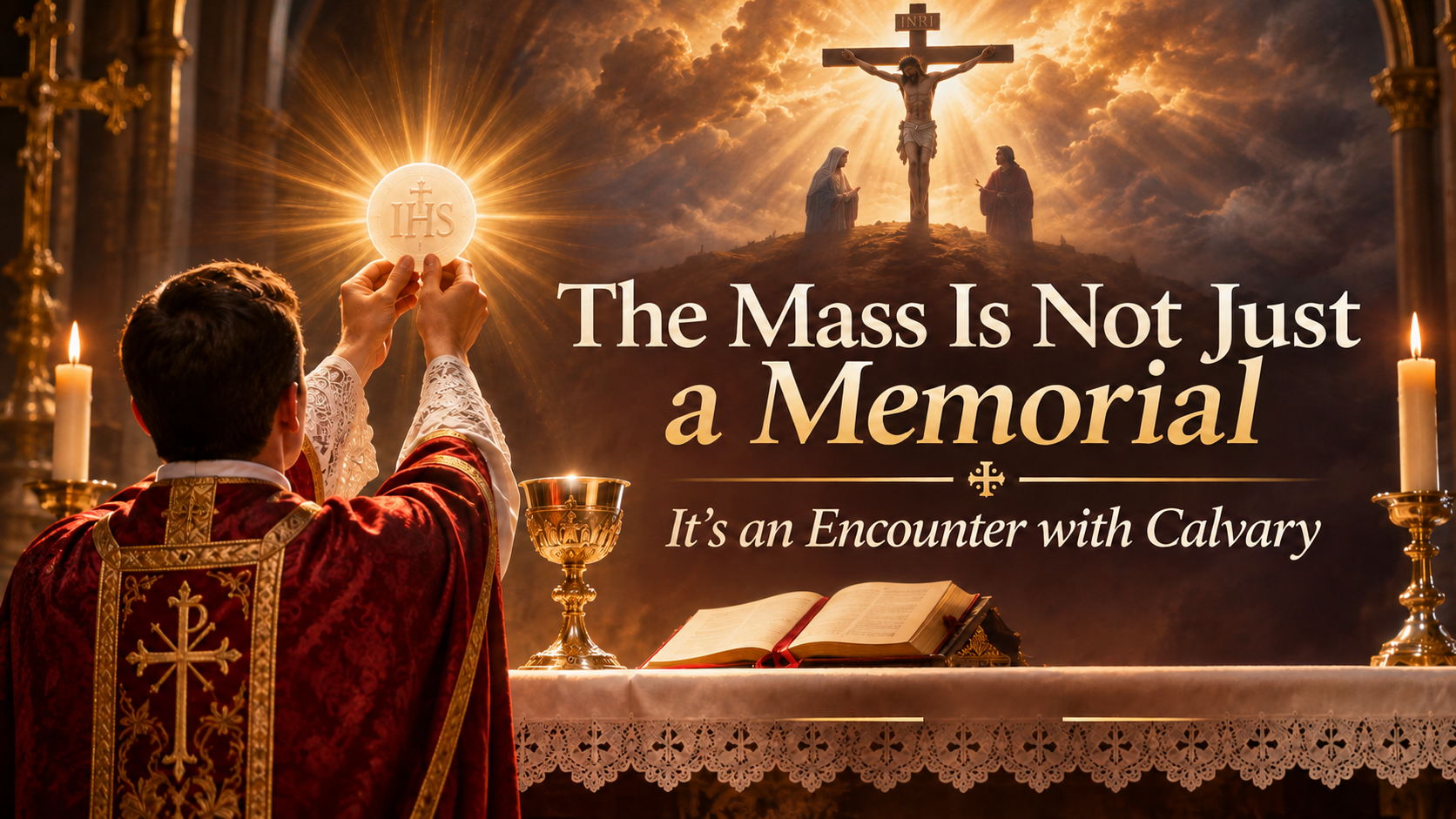
The Mass is not simply a gathering where Christians remember something Jesus did 2,000 years ago.
It is where the one sacrifice of Jesus Christ becomes sacramentally present to us.
The saving work of Christ is not repeated, but we are given a real participation in its fruits.
And to understand why this matters, we need to unpack three essential concepts:
Mystery. Paschal Mystery. Liturgy.
These aren’t just complicated theological words.
They explain the very heart of Catholic worship.
And once you understand them, you’ll never have to look at the Mass in quite the same way again.
1. What Does the Catholic Church Mean by “Mystery”?
When most people hear the word mystery, they imagine something that needs to be solved.
Maybe a detective story.
Maybe a crime drama.
Maybe some strange event that science hasn’t figured out yet.
The assumption is that a mystery is something unknown, and once we discover the answer, the mystery disappears.
But that’s not what the Catholic Church means when she speaks about a mystery of faith.
In Catholic theology, a divine mystery is a truth revealed by God that exceeds the complete comprehension of our finite human intelligence.
It isn’t necessarily something we know nothing about.
Rather, it is something we can truly know without ever exhausting its meaning.
Consider the Most Holy Trinity.
Catholics believe in one God eternally existing in three distinct divine Persons:
- The Father
- The Son
- The Holy Spirit
We know this because God has revealed Himself.
But can our limited human minds fully comprehend the infinite inner life of God?
No.
And that doesn’t make the Trinity irrational.
It means that God’s infinite being exceeds the limitations of human understanding.
As the Catechism teaches, the Trinity is the central mystery of Christian faith and life.
Source: Catechism of the Catholic Church (CCC), 234, 237.
Here’s one way to think about it.
Imagine trying to explore the entire ocean with nothing but snorkeling equipment.
You could discover beautiful coral reefs, remarkable creatures, and amazing underwater landscapes.
You might spend years studying what you find.
But no matter how much you explore, you would never exhaust the ocean’s depths.
Now consider the infinite mystery of God.
The more deeply you enter into the mysteries of faith, the more there is to discover.
A mystery of faith isn’t a problem waiting to be eliminated. It is a divine reality inviting us into deeper understanding and communion with God.
And nowhere is that invitation more important than in the Paschal Mystery.
2. The Paschal Mystery: The Greatest Rescue Mission in Human History
The word Paschal comes to us through the Greek and Latin forms of the Hebrew word Pesach, meaning Passover.
And the Paschal Mystery refers to the saving work of Jesus Christ, particularly His Passion, Death, Resurrection, and glorious Ascension.
The Catechism identifies Christ’s Paschal Mystery as the central event of God’s plan of salvation.
Source: CCC 1067, 1085.
These events cannot be separated from one another.
Christ’s Passion reveals the depth of His obedient love.
His Death accomplishes our redemption.
His Resurrection conquers death.
His Ascension brings His glorified humanity into heavenly glory.
Together, these mysteries form the foundation of the Christian life.
But why does the Church use the word Paschal?
To answer that, we need to go back to the Old Testament.
3. From the Exodus to the Cross: Jesus Is the True Passover Lamb
Centuries before the birth of Christ, the people of Israel were enslaved in Egypt.
God chose Moses to confront Pharaoh and lead His people into freedom.
After Pharaoh repeatedly refused to release the Israelites, God sent a series of plagues upon Egypt.
The final plague involved the death of the firstborn.
But God provided His people with a means of protection.
In Exodus 12, He commanded the Israelites to sacrifice a lamb without blemish and place its blood on the doorposts of their houses.
They were also commanded to eat the lamb in a sacred meal.
When the final plague came upon Egypt, the houses marked with the blood were spared.
This event became known as Passover.
The Israelites were delivered from slavery and began their journey toward the Promised Land.
But here’s what makes this particularly important for Catholics.
The original Passover was pointing toward something infinitely greater.
It foreshadowed the saving sacrifice of Jesus Christ.
Consider the parallels.
| The Passover in Exodus | Fulfillment in Jesus Christ |
|---|---|
| An unblemished lamb was sacrificed | Jesus is the sinless Lamb of God |
| The lamb’s blood marked the homes of Israel | Christ’s Precious Blood redeems humanity |
| Israel was delivered from slavery in Egypt | Christ delivers us from slavery to sin |
| The lamb was eaten in a sacred meal | Christ gives Himself to us in the Eucharist |
| Passover commemorated God’s deliverance | The Eucharist celebrates Christ’s definitive saving sacrifice |
When St. John the Baptist saw Jesus, he proclaimed:
“Behold the Lamb of God, behold him who taketh away the sin of the world.”
— John 1:29, Douay-Rheims
And St. Paul writes:
“For Christ our pasch is sacrificed.”
— 1 Corinthians 5:7, Douay-Rheims
These connections are not accidental.
They are part of the unity of God’s plan of salvation.
The Old Covenant prepares for the New Covenant.
The Passover lamb prefigures Christ.
The Exodus foreshadows liberation from sin.
And the Eucharist gives us a sacramental participation in Christ’s saving sacrifice.
Sources: Exodus 12:1–28; Luke 22:14–20; John 19:31–36; CCC 1340, 1364.
Now we can begin to understand why the Mass is so much more than an ordinary religious service.
4. What Is the Liturgy, and Who Is Really Doing the Work?
The word liturgy comes from the Greek leitourgia, traditionally associated with public service or work carried out for the people.
But in Catholic theology, liturgy means something much greater than a community coming together to perform religious activities.
The Catechism explains that Christian liturgy is a participation of the People of God in the work of God.
Source: CCC 1069.
Think about that.
We aren’t simply gathering to perform a ceremony for God.
We are being drawn into the worship of Jesus Christ.
Christ is the eternal High Priest.
He is the principal actor in the Church’s sacred liturgy.
The Church, united to Him as His Mystical Body, participates in His priestly worship.
The Catechism explains:
“Liturgy is an ‘action’ of the whole Christ.”
— CCC 1136
This means the liturgy isn’t something the priest performs while everyone else watches.
Nor is it something the congregation invents together.
It is Christ’s sacred action, in which the Church participates according to the different roles given to her members.
The ordained priest acts in the person of Christ the Head in the Eucharistic sacrifice.
The faithful unite their prayers, thanksgiving, sacrifices, and lives to Christ’s perfect offering.
And the worship of the Church on earth is joined to the heavenly worship of the saints and angels.
Sources: CCC 1140–1144, 1324–1327; Lumen Gentium 10.
Every Catholic Mass, therefore, opens our earthly worship to the heavenly liturgy.
That is an extraordinary reality.
We may be standing in a small parish church, surrounded by ordinary people.
But the worship taking place is united to the eternal priesthood of Jesus Christ.
5. The Mass Is Trinitarian Worship
Here’s something that often gets overlooked.
Catholic worship is fundamentally Trinitarian.
We worship the Father, through the Son, in the Holy Spirit.
The Father is the source and final end of the divine blessings communicated in the liturgy.
The Son, our eternal High Priest, makes His saving mystery present.
The Holy Spirit prepares the faithful, recalls Christ’s mystery, and makes the sacramental celebration fruitful.
Sources: CCC 1077–1112.
Listen closely to the prayers of the Mass.
Notice how frequently they are directed to God the Father, through Jesus Christ, in the unity of the Holy Spirit.
This isn’t simply beautiful language.
It reflects the very nature of Christian salvation.
Through Baptism, we are united to Christ.
Through Christ, we have access to the Father.
And through the Holy Spirit, we are sanctified and drawn more deeply into divine life.
The Holy Trinity is not just a doctrine we memorize.
The Holy Trinity is the divine communion into which God invites us.
And the sacred liturgy is one of the greatest ways we participate in that communion.
6. Are Catholics Sacrificing Jesus Over and Over Again?
This is where Catholic apologetics becomes especially important.
One of the most common Protestant objections to the Catholic Mass goes something like this:
“If Jesus died once for all, why do Catholics keep offering Him as a sacrifice?”
It’s a reasonable question if someone misunderstands what the Church actually teaches.
But the objection depends on a false premise.
Catholics do not believe Jesus is crucified again at every Mass.
The Church explicitly teaches that Christ’s sacrifice on Calvary happened once for all.
The Letter to the Hebrews makes this unmistakably clear.
“For this he did once, in offering himself.”
— Hebrews 7:27, Douay-Rheims
Christ’s sacrifice is perfect.
It is sufficient.
It is unrepeatable.
So what happens at Mass?
The answer is found in the Church’s teaching about sacramental memorial.
Anamnesis: More than remembering
The Greek word anamnesis refers to remembrance or memorial.
In ordinary life, remembering means recalling a past event.
You can remember your wedding day.
You can remember the birth of your child.
You can remember the first time you attended Mass.
But remembering these events does not make them present again.
The Eucharistic memorial is different.
Because of Christ’s divine power and His institution of the sacrament, His one saving sacrifice becomes sacramentally present.
The priest does not create a new sacrifice of Christ.
Jesus does not suffer or die again.
Rather, the same Christ who offered Himself once upon the Cross is made present under the sacramental signs of bread and wine.
The Catechism teaches that the Eucharist is a sacrifice because it makes present the sacrifice of the Cross, is its memorial, and applies its fruit.
Source: CCC 1362–1367.
Here’s the important distinction:
Calvary is not repeated at Mass. Calvary is made sacramentally present.
The Mass is not time travel.
It is not a theatrical reenactment.
And it is certainly not another crucifixion.
It is the sacramental re-presentation of Christ’s one sacrifice through the power of God.
There is one Victim: Jesus Christ.
There is one definitive sacrifice.
And there is one eternal High Priest.
This is why Catholic worship is sacrificial without contradicting the Letter to the Hebrews.
The sacrifice of the Mass and the sacrifice of the Cross are not competing sacrifices.
They are one and the same sacrifice, offered in different manners: once in a bloody manner on Calvary, and sacramentally in an unbloody manner at Mass.
Source: Council of Trent, Session XXII, Chapter 2; CCC 1367.
That’s Catholic teaching.
And it changes everything about how we approach the Eucharist.
7. The Eucharist Is the Source and Summit of Catholic Life
The Catechism calls the Eucharist:
“The source and summit of the Christian life.”
— CCC 1324
But what does that actually mean?
Let’s begin with the summit.
The summit is the highest point.
The Eucharist is the highest form of Christian worship because Christ Himself, truly present under the appearances of bread and wine, is the gift being offered.
At Mass, the Church participates in the perfect sacrifice of Christ.
There is no greater sacrifice that human beings can offer to the Father than the sacrifice of His beloved Son, in which we are invited to participate.
Now consider the source.
The Eucharist is also the source of Christian life because it contains Christ Himself and nourishes our union with Him.
All the sacraments are ordered toward communion with God, and all derive their saving efficacy from Christ’s Paschal Mystery.
But the Eucharist holds a unique place because it contains the whole spiritual good of the Church: Christ Himself.
Sources: CCC 1127, 1324, 1327.
This helps explain the seven sacraments.
8. How the Seven Sacraments Connect Us to the Paschal Mystery
The seven sacraments are not seven disconnected religious traditions.
They are effective signs of grace instituted by Christ and entrusted to His Church.
Through them, God communicates the saving fruits of Christ’s Passion, Death, and Resurrection.
Baptism: Dying and Rising With Christ
St. Paul teaches:
“For we are buried together with him by baptism into death.”
— Romans 6:4, Douay-Rheims
Through Baptism, we are united to Christ’s Death and Resurrection.
Original sin is washed away.
We receive sanctifying grace.
We become adopted children of God and members of the Church.
Baptism isn’t merely an outward symbol of a decision we made.
It actually accomplishes what Christ instituted it to accomplish.
Source: CCC 1213, 1262–1274.
Confirmation: Strengthened by the Holy Spirit
The risen and ascended Christ pours out the Holy Spirit upon His Church.
Confirmation strengthens baptismal grace and seals the Christian with the gift of the Holy Spirit.
This sacrament equips Catholics to witness to Christ more courageously.
Source: CCC 1285, 1302–1305.
The Eucharist: Receiving Christ Himself
In the Eucharist, bread and wine become the true Body and Blood of Jesus Christ through the consecration.
Catholics do not merely receive a reminder of Jesus.
We receive Jesus Christ Himself: Body, Blood, Soul, and Divinity.
Source: CCC 1374, 1376.
Penance and Reconciliation: Encountering the Mercy of the Risen Christ
After His Resurrection, Jesus appeared to the Apostles and gave them authority regarding the forgiveness of sins.
“Whose sins you shall forgive, they are forgiven them.”
— John 20:23, Douay-Rheims
Through sacramental absolution, Christ reconciles repentant sinners to Himself and His Church.
Source: CCC 1441–1446, 1468–1470.
Anointing of the Sick: Christ’s Healing Presence
Christ continues to care for those who suffer through the ministry of His Church.
The Anointing of the Sick gives spiritual strength, peace, courage, and forgiveness of sins when the necessary conditions are present.
It may also bring bodily healing if this serves the person’s salvation.
Source: CCC 1499, 1520–1523.
Holy Orders: Christ’s Priesthood at Work
Through Holy Orders, bishops, priests, and deacons receive a sacramental configuration for service in the Church.
The ordained priest participates in Christ’s ministerial priesthood and acts in the person of Christ the Head when offering the Eucharistic sacrifice.
Source: CCC 1536, 1548.
Matrimony: A Living Sign of Christ’s Love
Christian marriage is a sacrament that signifies and communicates grace for the covenant between husband and wife.
The love of Christian spouses is called to reflect Christ’s faithful, sacrificial love for His Church.
Source: Ephesians 5:25–32; CCC 1612–1617, 1641–1642.
Each sacrament draws its power from Christ.
None of them would have their saving efficacy apart from His redeeming work.
The sacraments are not merely things Catholics do for God. They are privileged ways in which God acts in our lives.
9. Why Confess to a Priest Instead of Going Directly to God?
This is another question Catholics frequently encounter.
“Why do I need to confess my sins to a priest? Can’t I just tell God I’m sorry?”
First, Catholics absolutely should repent of their sins and ask God directly for forgiveness.
We should do that regularly.
But the real question is not whether God hears our prayers.
The question is:
How did Jesus choose to give His Church the ministry of reconciliation?
After His Resurrection, Christ appeared to the Apostles and said:
“As the Father hath sent me, I also send you.”
— John 20:21, Douay-Rheims
He then breathed upon them, gave them the Holy Spirit, and entrusted to them the ministry of forgiving and retaining sins.
This is a remarkable moment.
Jesus deliberately chose to communicate His forgiveness through a visible sacramental ministry.
The Church has preserved this ministry through apostolic succession.
When a Catholic confesses to a priest and receives valid absolution, it is Christ who forgives the sins through the priest’s sacramental ministry.
The priest isn’t competing with Jesus.
He is Christ’s minister.
And while the priest remains a human being, Christ is the principal source of the forgiveness being given.
Sources: John 20:21–23; CCC 1442, 1444–1446, 1461.
Why does this matter?
Because God knows that we are not merely spiritual creatures.
We are human beings with bodies and souls.
We hear words.
We experience physical signs.
We encounter God’s grace through the sacraments.
And in Confession, we hear the words of absolution.
This is not simply emotional reassurance.
It is the sacramental action of Christ.
For sins committed after Baptism, individual and integral confession with absolution is the ordinary means of reconciliation with God and the Church for those conscious of grave sin.
Perfect contrition, arising from love of God above all things, can obtain forgiveness of mortal sins when joined to the firm resolution to receive sacramental Confession as soon as possible.
Sources: CCC 1452, 1455–1458; Code of Canon Law, canon 960.
God’s mercy is not limited by our imagination.
And when Christ gives us an ordinary sacramental means of receiving that mercy, we should embrace it.
10. Is the Seal of Confession Really Absolute?
Yes.
One of the most extraordinary protections in Catholic sacramental life is the seal of Confession.
The priest is strictly forbidden from revealing anything learned from a penitent in sacramental Confession.
There are no exceptions that permit a priest to disclose a penitent’s sins.
He also cannot use knowledge acquired in Confession to the detriment of the penitent.
This obligation is so serious that a priest who directly violates the sacramental seal incurs automatic excommunication reserved to the Apostolic See.
Sources: Code of Canon Law, canons 983–984, 1386 §1; CCC 1467.
Why is the Church so firm about this?
Because Confession isn’t a casual private conversation.
It is a sacred encounter between the penitent and Christ through the sacrament.
The priest is entrusted with something that does not belong to him to disclose.
What is revealed in sacramental Confession is protected by the sacred seal.
If you’ve been afraid to go to Confession because of what the priest might think, remember this:
The priest is there to minister Christ’s mercy.
The confessional is not meant to be a place of humiliation without hope.
It is a place of repentance, reconciliation, and healing.
11. What Do You Bring to the Altar?
Now let’s make this personal.
At every Mass, bread and wine are brought forward to the altar.
These gifts will become the Body and Blood of Christ through the consecration.
But there’s another offering we should be thinking about.
The offering of ourselves.
The Catechism teaches that the lives of the faithful, their prayers, work, sufferings, and praise are united to Christ’s offering.
Source: CCC 1368.
Consider what this means.
You can unite your worries to Christ.
You can offer your gratitude.
You can bring your struggles, your fears, and your disappointments.
You can unite the hardships of family life, the pressures of work, the pain of illness, and the burden of grief to the sacrifice of Jesus.
This does not mean our sufferings literally undergo transubstantiation.
Only the bread and wine become Christ’s Body and Blood.
Rather, through our participation in His sacrifice, we freely offer ourselves to the Father in union with Jesus.
And our ordinary lives take on a supernatural meaning through that union.
You don’t have to arrive at Mass pretending your life is perfect.
You can bring your weaknesses.
Your wounds.
Your unanswered prayers.
Your struggles against sin.
Bring them honestly before the Lord.
As St. Paul teaches:
“Present your bodies a living sacrifice, holy, pleasing unto God.”
— Romans 12:1, Douay-Rheims
When we unite our lives to Christ, even suffering can become an occasion for deeper charity and holiness.
12. When God Doesn’t Answer the Way We Want
There is something deeply powerful about the Passion of Jesus.
Before His arrest, Christ prayed in the Garden of Gethsemane.
He knew the suffering awaiting Him.
He knew the betrayal, the scourging, the crucifixion, and the death He was about to endure.
And in His true humanity, He prayed:
“Father, if thou wilt, remove this chalice from me: but yet not my will, but thine be done.”
— Luke 22:42, Douay-Rheims
Jesus did not approach suffering as if pain were meaningless or desirable for its own sake.
He freely embraced the Father’s saving will.
This teaches us something essential about prayer.
Faith does not mean that God must give us every earthly outcome we ask for.
Sometimes we pray for healing, and someone we love still dies.
Sometimes we pray for a relationship to be restored, and the relationship remains broken.
Sometimes we ask God to remove a burden, and that burden continues.
These experiences can leave us confused, disappointed, or grieving.
But Gethsemane reminds us that the Son of God entered fully into human suffering.
He knows what anguish is.
He knows what sorrow is.
He knows what it means to entrust everything to the Father.
The Resurrection then reveals that suffering and death do not have the final word.
This doesn’t mean every painful situation will receive a happy earthly resolution.
It means that, in Christ, suffering can be united to redemption and death has been conquered.
The Paschal Mystery does not promise a life without suffering. It reveals that suffering cannot defeat the saving love of God.
Sources: Luke 22:39–46; Romans 8:18–39; CCC 612, 1505.
13. The Mass Is Where Heaven Meets Earth
Think about what you are participating in the next time you attend Mass.
You are not simply sitting through a sermon.
You are not attending a motivational presentation.
You are not merely watching the priest perform ancient rituals.
You are participating in the sacred liturgy of the Church.
You are hearing the Word of God proclaimed.
You are joining your prayers to the prayer of Christ.
You are united to the worship of Heaven.
And at the heart of the Eucharistic celebration, the one sacrifice of Christ is made sacramentally present.
The same Jesus who died upon Calvary and rose gloriously from the dead is truly present in the Most Holy Eucharist.
This is why Catholics genuflect before the Blessed Sacrament.
This is why we worship Christ present in the Eucharist.
This is why we prepare ourselves properly for Holy Communion.
And this is why receiving the Eucharist is never supposed to become a casual routine.
When a Catholic receives Holy Communion worthily, that person receives Christ Himself.
And through that communion, the Lord deepens our union with Him and strengthens us in charity.
Source: CCC 1374, 1385, 1391–1397.
That reality deserves our reverence.
It deserves our attention.
And it deserves a response from our hearts.
14. Stop Attending Mass on Autopilot
Let me offer a little Catholicg33k challenge.
We live in a world filled with technology.
Computers can process billions of calculations.
Artificial intelligence can analyze enormous amounts of information.
Our phones can connect us to people thousands of miles away.
And yet, even the most advanced technology cannot accomplish what happens at the altar during Mass.
No machine can turn bread and wine into the Body and Blood of Jesus Christ.
No algorithm can forgive mortal sin.
No scientific achievement can generate sanctifying grace.
These are supernatural gifts that come from God.
And that means the most important thing happening in your week may not be your biggest work accomplishment, your most exciting entertainment, or your latest technological discovery.
It may be your encounter with Jesus Christ in the Holy Eucharist.
So here’s my challenge for the next time you attend Mass.
Don’t just show up.
Prepare your heart.
Listen carefully to the readings.
Pay attention to the prayers.
At the Offertory, unite your life to Christ’s offering.
At the Consecration, adore the Lord truly present upon the altar.
And if you are properly disposed and eligible to receive Holy Communion, approach with gratitude and reverence.
Then leave Mass determined to live what you have celebrated.
Because the Eucharist is not intended to remain an isolated experience that ends when you walk out of the church doors.
It is meant to transform how you live.
How you love.
How you forgive.
How you serve.
And how you carry your cross.
Final Reflection: The Cross, the Altar, and Your Eternal Destiny
Here’s the truth I want you to remember.
The Catholic Mass is not simply about looking backward at a historical event.
It is about encountering the saving work of Jesus Christ through the sacred mysteries He entrusted to His Church.
The Cross happened once.
The Resurrection happened once.
Christ ascended into Heaven.
And now, through the Church’s sacramental life, we are invited to share in the fruits of His victory.
This is the beauty of Catholicism.
Our faith isn’t built on human inspiration alone.
It is built upon the revelation of God, the saving work of Jesus Christ, and the life of grace communicated through His Church.
At every Mass, Heaven touches earth in a profound sacramental way.
Christ the High Priest draws His Church into His perfect offering to the Father.
And we are invited to respond with faith, hope, and charity.
So the next time somebody asks you:
“Why do Catholics make such a big deal about the Mass?”
You can tell them:
Because at Mass, we encounter the same Jesus Christ who gave His life for us on Calvary, conquered death through His Resurrection, and now offers us His very Body and Blood as the food of eternal life.
That is not an ordinary religious gathering.
That is the sacred mystery of our redemption.
And it is the heart of the Catholic faith.
Closing Prayer
Heavenly Father,
We thank You for the immeasurable gift of Your Son, Jesus Christ, who offered Himself for our salvation.
Through His Passion, Death, Resurrection, and Ascension, You have opened for us the way to eternal life.
Help us to understand more deeply the sacred mysteries we celebrate in the Holy Sacrifice of the Mass.
Forgive us for the times we have approached Your altar with distracted minds, divided hearts, or insufficient reverence.
Increase our faith in the Real Presence of Jesus Christ in the Most Holy Eucharist.
Teach us to unite our joys, struggles, sufferings, and daily responsibilities to the perfect sacrifice of Your Son.
May the Holy Spirit strengthen us to live what we celebrate and to carry the love of Christ into our families, workplaces, and communities.
And when our earthly pilgrimage is complete, may we be welcomed into the eternal heavenly liturgy, where we shall worship You forever.
Through the same Christ our Lord.
Amen.
Catholicg33k
Know your faith. Live your faith. Defend your faith.
Biblical and Magisterial References
Sacred Scripture
- Exodus 12:1–28 — The institution of Passover
- John 1:29 — Jesus, the Lamb of God
- Luke 22:14–20 — The institution of the Eucharist
- Luke 22:39–46 — Christ’s agony in Gethsemane
- John 20:21–23 — The institution of the ministry of forgiveness
- Romans 6:3–5 — Baptism into Christ’s Death and Resurrection
- Romans 12:1 — Offering our lives to God
- 1 Corinthians 5:7 — Christ our Passover
- 1 Corinthians 11:23–29 — The Eucharistic tradition
- Hebrews 7:27; 9:11–28; 10:10–14 — Christ’s once-for-all sacrifice
Catechism of the Catholic Church
- CCC 232–267 — The mystery of the Holy Trinity
- CCC 1066–1112 — The Paschal Mystery and sacred liturgy
- CCC 1113–1134 — Christ and the seven sacraments
- CCC 1136–1144 — Celebrants of the heavenly and earthly liturgy
- CCC 1213–1284 — The sacrament of Baptism
- CCC 1285–1321 — Confirmation
- CCC 1322–1419 — The Most Holy Eucharist
- CCC 1362–1372 — The Eucharist as sacrifice
- CCC 1422–1498 — Penance and Reconciliation
- CCC 1499–1532 — Anointing of the Sick
- CCC 1536–1600 — Holy Orders
- CCC 1601–1666 — Matrimony
Magisterial and Canonical Sources
- Council of Trent, Session XXII, Chapters 1–2 — The Sacrifice of the Mass
- Second Vatican Council, Sacrosanctum Concilium, 5–10 — The Paschal Mystery and the liturgy
- Second Vatican Council, Lumen Gentium, 10–11 — Priesthood and sacramental life
- Code of Canon Law, canons 960, 983–984, 1386 — Sacramental Confession and its seal