

POPE #2
Pope St. Linus
The Second Pope of the Catholic Church
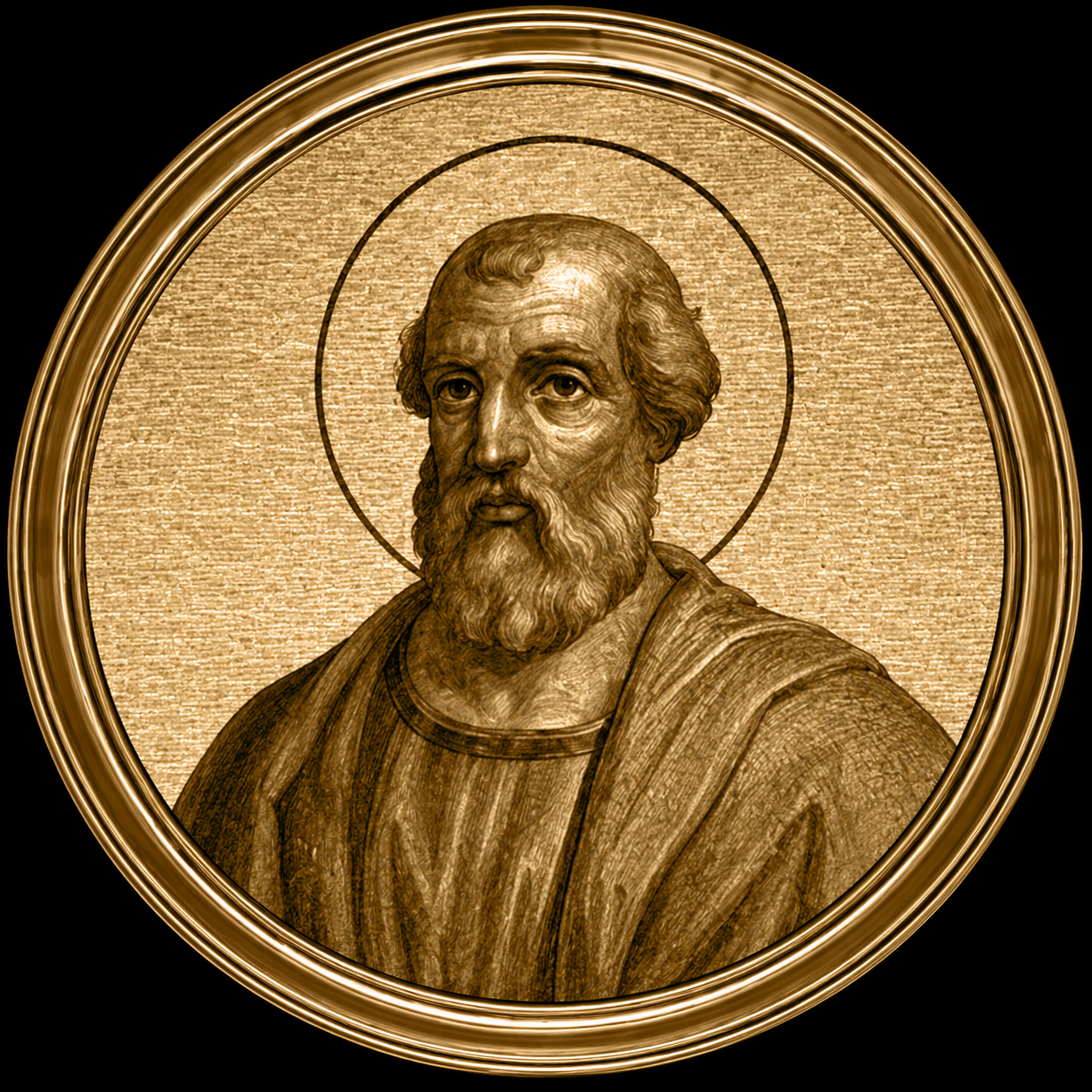
The First Successor of St. Peter
St. Linus stands at the beginning of the post-apostolic succession of the Roman Church. Ancient witnesses place him immediately after St. Peter, making his importance greater than the small number of surviving details about his life might suggest.
A careful biography must distinguish the early testimony to his succession from later claims about decrees, martyrdom, and the precise boundaries of his ministry.
“Eubulus and Pudens, and Linus and Claudia, and all the brethren, salute thee.”
Explore This Pope
Quick Facts
Overview
Linus is named by St. Irenaeus of Lyons as the man to whom the blessed Apostles entrusted the episcopate of the Church at Rome. Irenaeus also connects him with the Linus mentioned by St. Paul in the Second Epistle to Timothy. This witness, written in the second century, is much earlier and more valuable than the elaborate medieval stories that later accumulated around the first popes.
The official Vatican list places Linus from AD 68 to 79. Other ancient chronologies vary, which is not surprising for a period when Christians were a vulnerable minority and did not preserve papal archives in the later administrative sense.
Linus matters chiefly because the Roman ministry did not disappear with Peter. The Church remembered a real succession of pastors, and Linus stands first in that remembered line.
What the Earliest Sources Actually Say
St. Irenaeus of Lyons
In Against Heresies III.3.3, Irenaeus gives the Roman succession beginning with Peter and Paul, then Linus, Anacletus, and Clement. His purpose is theological and historical: the public succession of bishops safeguards the apostolic faith against secret or invented teachings.
Eusebius of Caesarea
Eusebius preserves earlier traditions and places Linus as the first to receive the episcopate of the Roman Church after Peter. His chronology is not identical in every manuscript tradition, but the order of succession is stable.
The Liber Pontificalis
The Liber Pontificalis supplies additional biographical details, yet its earliest papal notices were compiled long after Linus lived. It must be used critically: it can preserve genuine Roman memory, but its precise decrees and administrative descriptions may reflect later church life projected backward.
Linus in the New Testament
Near the end of Second Timothy, Paul sends greetings from several Christians in Rome, including Linus. The identification of this Linus with the future Bishop of Rome is ancient and reasonable, especially because Irenaeus explicitly makes the connection.
The text itself does not call Linus a bishop or describe his later office. Catholic history therefore presents the identification as a strong ancient tradition rather than as a conclusion proved by the verse alone.
“Make haste to come before winter. Eubulus and Pudens, and Linus and Claudia, and all the brethren, salute thee.”
Receiving the Roman Ministry
The first generation of Roman Christians had been formed by apostolic preaching and sealed by the martyrdom of Peter and Paul. After their deaths, the community still needed pastors who could preserve doctrine, celebrate the Eucharist, reconcile sinners, ordain ministers, care for the poor, and maintain communion with other churches.
The historical vocabulary of office developed over time, and the exact internal organization of first-century Roman Christianity is debated. That debate does not erase the ancient Roman succession. By the late second century, writers geographically distant from one another knew that Linus belonged immediately after Peter in the line of the Roman Church.
Catholic teaching does not require that Linus possessed every later papal administrative structure in fully developed form. It requires continuity in the apostolic ministry whose visible Roman center was inseparable from Peter and his successors.
The Roman Church under Linus
Rome was the capital of the empire and a meeting place for people from every province. Its Christian community likely consisted of several house churches rather than one public basilica. Worship was celebrated in homes; instruction depended upon oral apostolic teaching, Scripture, and authorized ministers; charity supported widows, orphans, prisoners, travelers, and the poor.
Nero died in AD 68, but the end of his persecution did not make Christianity a legally protected religion. Believers continued to live with social suspicion and the possibility of local hostility. Linus therefore governed not as a public prince but as a pastor of a Church still shaped by martyrdom.
Later Traditions and Their Limits
The Veiling of Women
A later notice attributes to Linus a decree that women should cover their heads in church. The custom itself is witnessed in First Corinthians 11, but historians cannot securely demonstrate that Linus issued a distinct universal papal decree on the matter.
Fifteen Bishops
Some later accounts say that Linus ordained fifteen bishops. Such a number may preserve a memory of early ordinations, but the terminology and jurisdiction should not be read as though first-century dioceses already functioned exactly like later medieval dioceses.
Martyrdom
Linus has long been honored as a saint and is sometimes called a martyr. No contemporary account describes his death, and some modern reference works judge martyrdom historically uncertain. His sanctity and ancient veneration do not depend upon overstating what the sources can prove.
Historical Context
- The destruction of Jerusalem in AD 70 profoundly changed Jewish and Christian life.
- The Gospels and apostolic writings were being composed, copied, received, and exchanged among local churches.
- The Roman Church carried the memory of Peter and Paul after their martyrdom.
- The distinction and relationship among apostles, presbyters, overseers, and deacons continued to develop in the Church’s lived practice.
Common Misconceptions
“Nothing is known about Linus, so he may not have existed.”
The scarcity of personal details is not the same as absence of historical testimony. Irenaeus and Eusebius preserve a stable succession in which Linus follows Peter.
“The date AD 68-79 is absolutely certain.”
It is the chronology used by the official Vatican list, but ancient sources differ. Responsible history identifies the official chronology while acknowledging uncertainty.
“Every act in the Liber Pontificalis is contemporary evidence.”
The work is valuable but later. Its early notices require comparison with Scripture, second-century writers, archaeology, and the broader history of Roman Christianity.
Why Pope St. Linus Matters
Linus represents the passage from apostolic foundation to apostolic succession. The Church did not treat Peter as an isolated hero whose ministry ended at death. It remembered a continuing Roman office entrusted to real successors.
His quiet place in history also teaches an important spiritual lesson. The Church is not preserved only through dramatic councils and famous writings. It is also preserved through faithful pastors who hand on what they received, maintain communion, and serve believers whose names history may never record.
Prayer through the Intercession of St. Linus
Lord Jesus Christ, eternal Shepherd of the Church, Thou didst preserve the apostolic faith through the ministry of St. Linus. Through his intercession, grant fidelity to the successor of Peter, courage to bishops and priests, unity to Thy people, and perseverance to Christians who serve Thee without earthly recognition. Amen.
Sources and Further Study
- Sacred Scripture: 2 Timothy 4:19-22; 1 Corinthians 11; 1 Peter 5:1-4.
- St. Irenaeus of Lyons, Against Heresies III.3.3.
- Eusebius of Caesarea, Ecclesiastical History III.2 and III.4.
- St. Jerome, On Illustrious Men.
- Liber Pontificalis, used with historical caution.
- The Holy See, official list of Supreme Pontiffs.
- Rupert Matthews, The Popes: Every Question Answered, used as a comparative secondary source.
- William J. La Due, The Chair of Saint Peter, used as a comparative history of the papacy.
Timeline
Beginning of the pontificate in the official Vatican chronology.
Jerusalem and the Second Temple are destroyed by Roman forces.
End of Linus's pontificate and death in the official Vatican chronology.
Traditional feast day of St. Linus.