

POPE #3
Pope St. Anacletus (Cletus)
The Third Pope of the Catholic Church
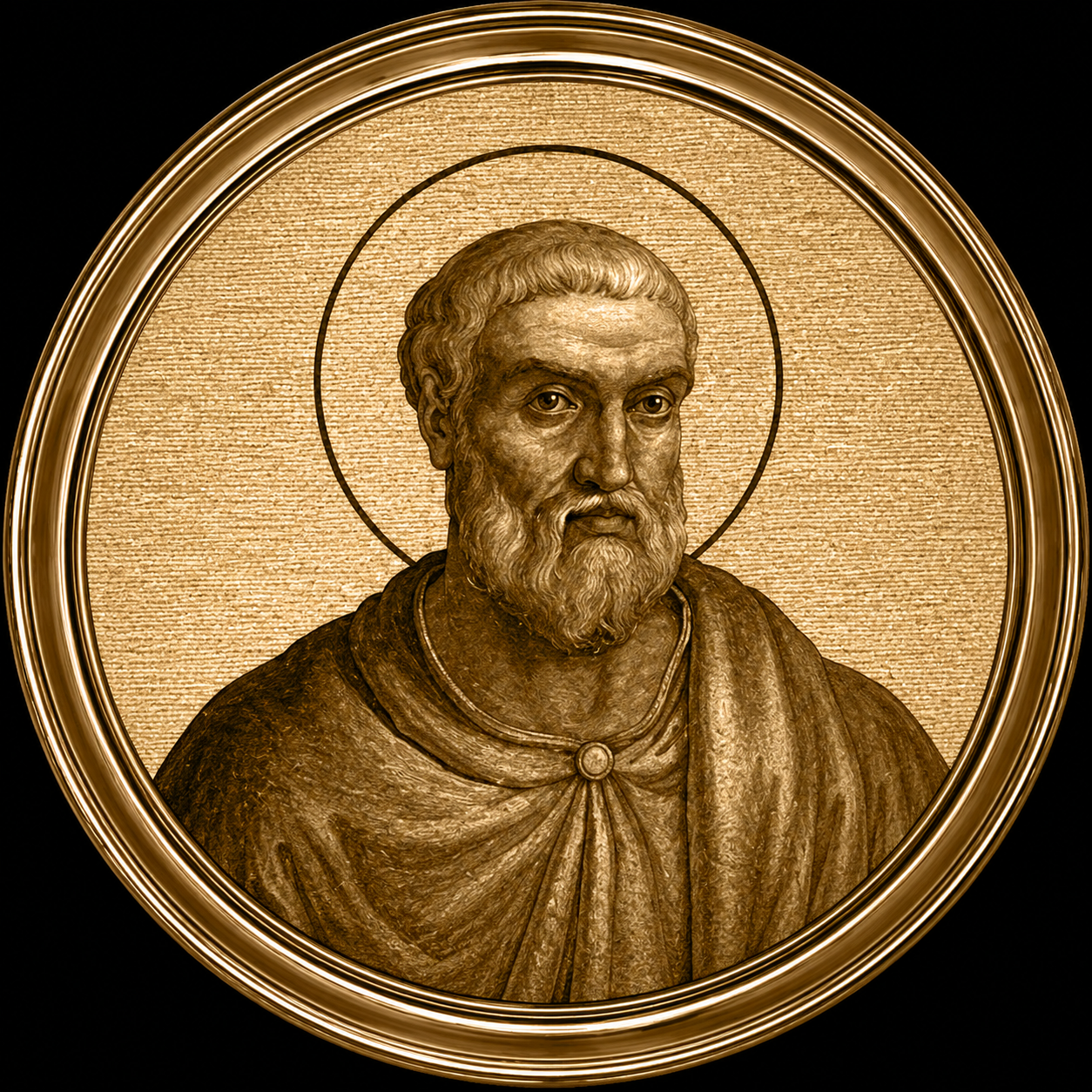
One Pope, Two Ancient Forms of the Name
St. Anacletus, also called Cletus, is the third pope in the official Vatican sequence. The two names do not identify two different legitimate popes; they are ancient forms associated with the same successor of St. Linus.
His biography is a model of careful early-Church history: the succession itself is well attested, while most personal and administrative details come from later tradition.
“Feed the flock of God which is among you… being made a pattern of the flock from the heart.”
Explore This Pope
Quick Facts
Overview
The historical core of Anacletus’s life is simple. He was remembered by the Roman Church as the successor of Linus and the predecessor of Clement. St. Irenaeus gives this order in the second century, and later writers preserve it.
Confusion arose because ancient authors and manuscripts used related forms of his name. Some later lists separated Cletus and Anacletus and consequently altered the numbering of the early popes. The modern official Vatican list resolves the matter by presenting “Anacletus or Cletus” as one pontiff.
The lack of contemporary biography should lead to precision, not skepticism. We know more securely where Anacletus stands in succession than we know the exact events of his pontificate.
Anacletus and Cletus: Why the Names Differ
The Greek name Anenkletos can be rendered in several Latinized forms. Copyists, calendars, and martyrologies transmitted Anacletus, Anencletus, and the shortened Cletus. Once the forms were treated as separate names, some medieval lists created an additional pope.
CatholicG33k follows the official Vatican list: one man, one biography, one canonical URL. The combined page title preserves the forms readers will encounter in older books and liturgical references without multiplying the person.
This correction is also important for every later papal number. A reliable Every Pope A-Z library must explain why older books may number certain popes differently.
The Earliest Historical Witnesses
St. Irenaeus
Irenaeus names Anacletus after Linus and before Clement. Writing against Gnostic claims, he appeals to a public succession that any Christian could investigate.
Eusebius and Later Catalogues
Eusebius transmits the same basic order and assigns a reign to Anacletus. Later catalogues add dates and deeds, but their proximity to the first century is much weaker.
What the Sources Do Not Give
No surviving letter, decree, sermon, or contemporary narrative can be securely attributed to Anacletus. Claims about his family, social condition, number of ordinations, or exact manner of death must therefore be labeled as tradition rather than demonstrated fact.
The Church of Rome during His Pontificate
Anacletus governed when the Roman Church was still a network of communities meeting in homes. It possessed no public legal status and no monumental basilicas. Its strength lay in the apostolic Gospel, Eucharistic communion, authorized ministers, care for the poor, and the witness of believers who knew that fidelity could carry social or political cost.
The reign of Emperor Domitian occupies much of the traditional chronology. Ancient Christian writers remember suffering under Domitian, though historians debate its extent and whether there was a single empire-wide persecution. The responsible description is that Christians could face serious hostility and punishment without imagining a modern centralized persecution system operating continuously in every province.
Traditions about Roman Organization
The Liber Pontificalis credits Anacletus with ordaining priests and arranging ecclesiastical ministry in Rome. Some versions connect him with twenty-five priests or with divisions that resemble later Roman titles.
The growth of the Roman Church certainly required ministers and local organization. What cannot be proved is that later parish structures existed in their mature form during his pontificate. The tradition may preserve a true memory of institutional growth while describing it through later vocabulary.
A 10/10 historical page neither discards the tradition nor repeats it as an eyewitness report. It identifies the source, the probable historical background, and the limit of certainty.
Death, Burial, and Veneration
Later tradition calls Anacletus a martyr and places his burial near St. Peter on Vatican Hill. No contemporary martyrdom account survives. His death is placed in AD 92 by the official Vatican chronology.
His feast is kept on April 26. Older calendars sometimes commemorated Cletus and Anacletus separately because of the name confusion. Modern treatment recognizes one saint and one pope.
Historical Context
- Christian communities were spreading across the Mediterranean world.
- The last surviving members of the apostolic generation were passing from the scene.
- The written Gospels and apostolic letters were increasingly central to the Church’s life while the New Testament canon had not yet been formally listed as it would be in later centuries.
- The succession of bishops served as a public guarantee of continuity with apostolic teaching.
Common Misconceptions
“Cletus and Anacletus were definitely two different popes.”
That view appeared in older lists, but the official Vatican sequence and modern historical treatment identify the names with one person.
“Because his deeds are uncertain, the succession is uncertain.”
The order Linus-Anacletus-Clement is attested earlier than the detailed medieval biography. The strength of one claim must not be confused with the weakness of another.
“Domitian conducted an identical empire-wide persecution everywhere.”
Christian suffering under Domitian is part of ancient memory, but its form and extent require nuance. Local accusations, imperial policy, and later interpretation must be distinguished.
Why Pope St. Anacletus Matters
Anacletus matters because the apostolic succession continued through a period from which few documents survive. His place in the Roman line shows that the Church’s continuity did not depend upon every pastor becoming a famous writer.
He also teaches historical humility. Early Catholic history is strongest when it does not confuse devotion with exaggeration. The truth is sufficient: a real successor, a real Roman Church, a real handing on of the apostolic faith.
Prayer through the Intercession of St. Anacletus
Lord Jesus Christ, who didst preserve Thy Church through hidden and faithful shepherds, grant us love for apostolic truth, patience when evidence is limited, and courage to remain united with the Church founded upon the Apostles. Through the intercession of St. Anacletus, strengthen the successor of Peter and all who serve Thy flock. Amen.
Sources and Further Study
- St. Irenaeus of Lyons, Against Heresies III.3.3.
- Eusebius of Caesarea, Ecclesiastical History III.13 and related chronological notices.
- The Holy See, official list of Supreme Pontiffs.
- Liber Pontificalis, used with historical caution.
- Early Roman calendars and martyrologies, used with attention to the Cletus-Anacletus name problem.
- Rupert Matthews, The Popes: Every Question Answered, used as a comparative secondary source.
Timeline
Beginning of the pontificate in the official Vatican chronology.
Domitian becomes emperor.
End of the pontificate and death in the official Vatican chronology.
Feast of St. Anacletus or Cletus.