

Church Documents · Doctrine · The Profession of Faith
CREEDS AND PROFESSIONS OF FAITH
The Church’s Common Language for Confessing the One Apostolic Faith
Creeds and Professions of Faith Library
Start Here
A creed is a concise profession of the faith received from the Apostles. It gathers the principal truths Christians believe, gives the Church a common language of confession, and serves Baptism, catechesis, worship, and the defense of doctrine.
The word creed comes from the Latin credo, “I believe.” The Church also calls creeds “symbols of faith.” A symbol is a sign of recognition and communion: believers confess the same faith because they belong to the one Body of Christ.
The Apostles’ Creed and the Nicene-Constantinopolitan Creed occupy a special place in the Church’s life. The Athanasian Creed gives an especially exact Western summary of the Trinity and Incarnation. Later professions of faith address new controversies without replacing the ancient symbols.
What a Creed Is
The Creed is not a list of private opinions. It is the Church’s public confession of the truth revealed by God and handed on in Sacred Scripture and Apostolic Tradition.
The apostolic Church used brief formulas from the beginning. The New Testament preserves confessions such as “Jesus is Lord,” Trinitarian baptismal language, summaries of Christ’s Death and Resurrection, and hymnic or catechetical passages that present the rule of Christian faith.
As catechumens prepared for Baptism, local Churches formed ordered summaries of belief. These baptismal symbols were not arbitrary inventions. They gathered the apostolic proclamation into a form that could be taught, memorized, professed, and guarded.
A creed does not contain every doctrine with equal detail. It identifies the central mysteries and provides the framework within which the rest of Catholic doctrine is understood.
Creed, Profession, Symbol, and Rule of Faith
Creed
A stable summary of Christian belief, normally beginning with “I believe” or “We believe.”
Profession of Faith
The act or text by which a person or community publicly confesses the faith.
Symbol of Faith
A sign of recognition and communion that gathers the principal truths of the faith.
Rule of Faith
The apostolic pattern of belief by which Scripture is received and doctrine is judged.
These expressions overlap, but they are not always interchangeable. Every creed is a profession of faith, while not every historical profession became a universal liturgical creed.
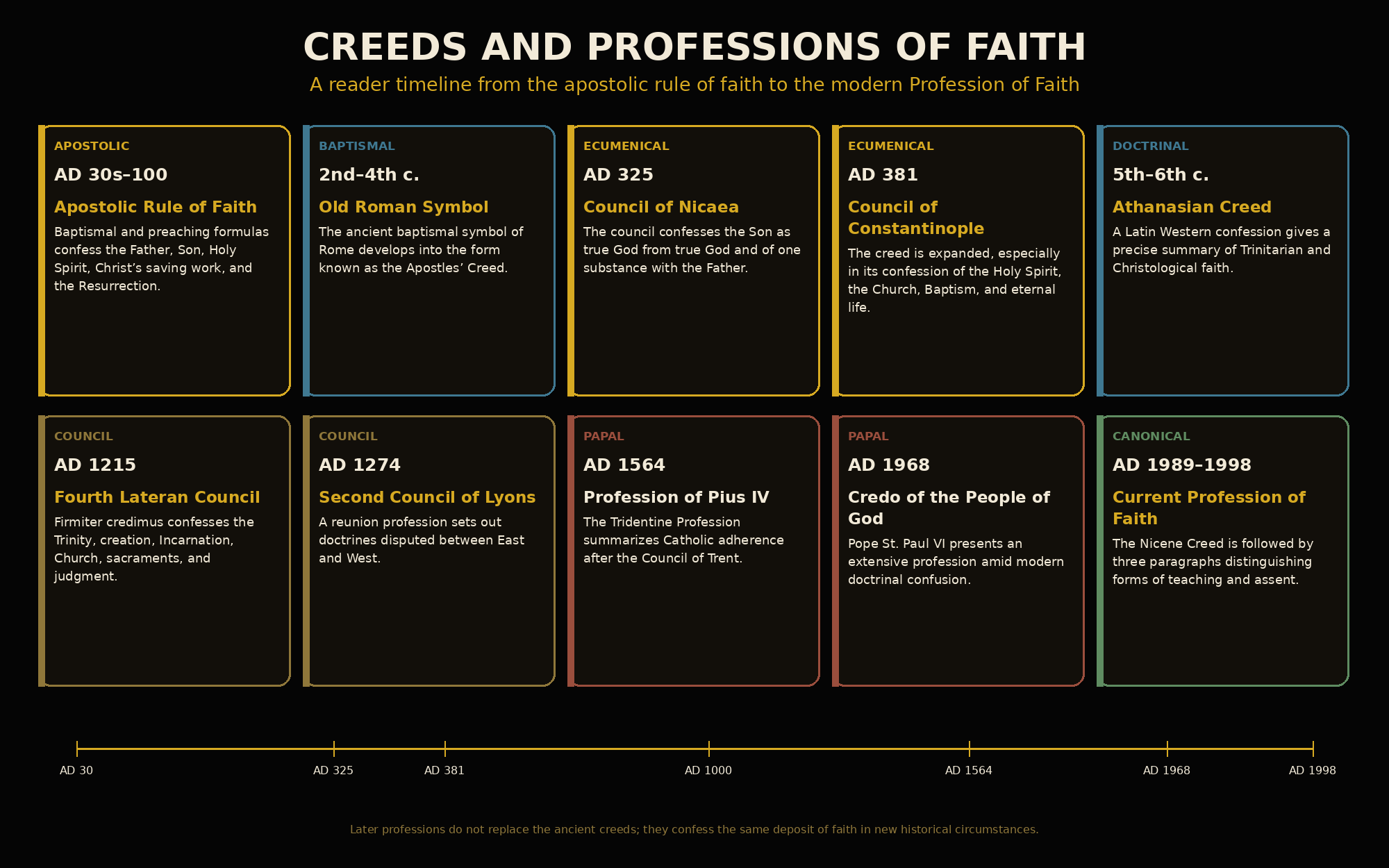
The History at a Glance
Why the Creed Is Trinitarian
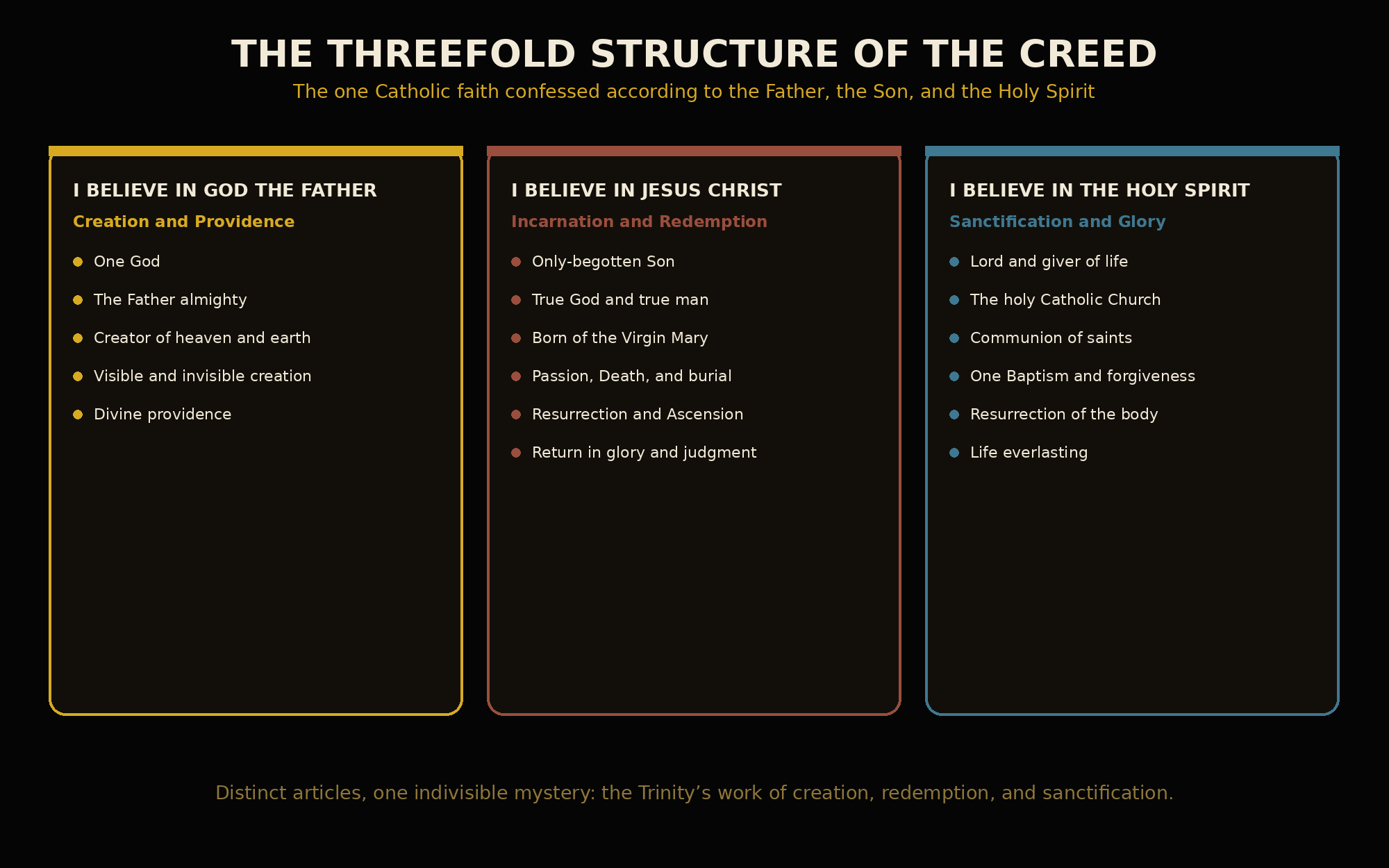
The first profession of faith is made in Baptism, which is administered in the name of the Father and of the Son and of the Holy Spirit. The Creed therefore follows the mystery of the Most Holy Trinity.
The first part confesses the Father and the work of creation. The second confesses the Son and the mystery of redemption. The third confesses the Holy Spirit, sanctification, the Church, forgiveness, resurrection, and eternal life.
The Two Principal Creeds
The Apostles’ Creed is the ancient baptismal symbol of the Church of Rome and a faithful summary of the apostles’ faith. Its concise twelve-article form makes it especially useful for Baptism, catechesis, personal prayer, and the Rosary.
The Nicene-Constantinopolitan Creed draws its authority from the first two Ecumenical Councils, held at Nicaea in AD 325 and Constantinople in AD 381. It is more explicit about the divinity of the Son, the Holy Spirit, the Church, Baptism, resurrection, and the world to come.
These creeds do not teach different faiths. The Nicene Creed explains certain mysteries more fully because the Church had to answer errors concerning the Trinity and the Incarnation.
The Athanasian Creed
The Athanasian Creed is also known by its Latin opening, Quicumque vult. It was not written by St. Athanasius, but it bears his name because its doctrine strongly reflects the orthodox faith he defended against Arianism.
This Latin Western creed carefully distinguishes the three divine Persons without dividing the one divine substance. It then confesses that Jesus Christ is perfect God and perfect man, one divine Person in two natures.
Its strong salvation clauses should be read according to the Church’s complete doctrine about faith, culpability, the necessity of grace and the Church, and those who through no fault of their own do not know the Gospel.
Historical Professions of Faith
Councils and popes have issued other professions when doctrinal disputes required a fuller confession. The Church’s history includes the Faith of Damasus, the Formula of Hormisdas, professions associated with Lateran and Lyons, the Tridentine Profession of Faith, the Credo of the People of God, and the modern Profession of Faith required for certain ecclesiastical offices.
These texts differ in origin, purpose, authority, and current use. They should not be treated as though every profession possessed the same liturgical status. Their value lies in showing how the Church protects the same revelation while answering the questions of different ages.
Creeds and Doctrinal Development
A later creed may use words not found verbatim in Scripture, such as consubstantial, because the Church sometimes needs precise language to protect the meaning of Scripture against false interpretations.
Doctrinal development does not mean that revelation changes from one truth into its opposite. It means that the Church, guided by the Holy Spirit, understands and expresses the apostolic deposit more explicitly.
Nicaea did not make Christ divine. It rejected an interpretation that treated the eternal Son as a creature. Chalcedon did not invent the Incarnation. It clarified how Christ is one divine Person in two complete natures.
Creed and Catechesis
The Creed is the first fundamental reference point for catechesis. The Catechism follows the Apostles’ Creed article by article and continually compares it with the more detailed Nicene Creed.
This structure prevents Catholic doctrine from becoming a loose collection of topics. Creation, Christology, the Church, the sacraments, morality, prayer, resurrection, and eternal life belong to one divine plan.
Memorization is valuable when joined to understanding. A memorized creed gives the mind a stable framework, while study opens the meaning of each article.
How to Study a Creed
- Read the creed slowly and identify each article.
- Notice the Trinitarian structure.
- Connect every article with Sacred Scripture.
- Use the Catechism to study the doctrine behind the words.
- Distinguish the original historical text from later liturgical forms.
- Learn why disputed words such as consubstantial and Filioque matter.
- Pray the creed as a personal act of faith, not merely as historical information.
Common Mistakes to Avoid
- Do not claim the Church invented the Trinity at Nicaea.
- Do not assume the Apostles personally composed the later wording line by line.
- Do not confuse doctrinal development with contradiction.
- Do not treat the Apostles’ and Nicene Creeds as rival confessions.
- Do not read “catholic” as merely a modern denominational label.
- Do not interpret the Athanasian salvation clauses apart from the Church’s full doctrine.
- Do not assume every historical profession is used liturgically today.
Key Takeaways
- Creeds summarize the apostolic faith and unite believers in one confession.
- The Creed is fundamentally baptismal and Trinitarian.
- The Apostles’ Creed is the ancient Roman baptismal symbol.
- The Nicene-Constantinopolitan Creed comes from the first two Ecumenical Councils.
- The Athanasian Creed precisely teaches the Trinity and Incarnation.
- Later professions explain the same faith in response to new controversies.
- Creeds should be studied with Scripture, Tradition, the liturgy, and the Catechism.
- To profess the Creed faithfully is to pledge oneself to the faith of the Church.
Sources and Further Reading
- Holy Bible, Douay-Rheims: Matthew 28:19; John 1:1–18; Romans 10:9; First Corinthians 15:1–8; Philippians 2:5–11; First Timothy 3:16.
- Catechism of the Catholic Church, 166–197.
- First Council of Nicaea, Symbol of Faith, AD 325.
- First Council of Constantinople, Symbol of Faith, AD 381.
- Council of Chalcedon, Definition of Faith, AD 451.
- Athanasian Creed, Quicumque vult.
- Pope St. Paul VI, Credo of the People of God, 30 June 1968.
- Congregation for the Doctrine of the Faith, Profession of Faith and Oath of Fidelity, 1989.
- Pope St. John Paul II, Ad Tuendam Fidem, 1998.