

Resources · Catholic Doctrine · Primary Sources
CHURCH DOCUMENTS
Creeds, Councils, Papal Teaching, Canon Law, and the Church’s Official Texts
Discover the Church’s official texts through a structured library that explains each document’s purpose, authority, historical setting, legal status, and place within the Catholic faith.
“The church of the living God, the pillar and ground of the truth.”
Recent Official Catholic Documents
These current primary sources are already cited by CatholicG33k formation pages. Each link opens the official Holy See edition.
- Mater Populi fidelis ↗ — Dicastery for the Doctrine of the Faith, doctrinal note, 4 November 2025.
- Dilexi te ↗ — Pope Leo XIV, apostolic exhortation on love for the poor, 4 October 2025.
- Magnifica Humanitas ↗ — Pope Leo XIV, encyclical on safeguarding the human person in the time of artificial intelligence, 15 May 2026.
What You Will Learn
This hub introduces the principal families of Catholic Church documents and gives you a reliable method for reading them within Scripture, Tradition, the Magisterium, and the Church’s juridical life.
- How creeds, councils, papal documents, canon law, and dicastery texts differ.
- Why a document’s title alone does not settle its authority or legal force.
- How doctrine, discipline, pastoral application, and juridical norms relate.
- How Sacred Scripture, Apostolic Tradition, and the Magisterium belong together.
- How to distinguish official Church documents from important historical witnesses.
- How forms of assent differ according to the teaching proposed.
- How translations, official editions, amendments, and later texts affect interpretation.
- How to identify superseded law without dismissing a document’s historical value.
- How to cite and study Church documents responsibly.
On This Page
Start Here
Church documents preserve, explain, govern, and apply the Catholic faith. They include creeds, professions of faith, documents of Ecumenical Councils, papal teaching, canon law, liturgical and disciplinary texts, and documents issued by offices of the Holy See.
Not every document has the same purpose or authority. A creed confesses the faith. A council may define doctrine, issue pastoral teaching, or establish discipline. A pope may teach through an encyclical, legislate through an apostolic constitution, or address a particular circumstance through another form. Canon law governs the Church’s visible life. A dicastery may issue a declaration, instruction, note, response, or disciplinary act within its competence.
This library helps readers identify what a document is, who issued it, what it intends to teach or regulate, whether it remains in force, and how it belongs within Sacred Scripture, Apostolic Tradition, and the Church’s living Magisterium.
Begin with the Creed
Readers new to Church documents should ordinarily begin with the Creeds and Professions of Faith. The Creed supplies the doctrinal framework within which later documents are understood.
The Apostles’ Creed presents the ancient Roman baptismal faith. The Nicene-Constantinopolitan Creed confesses the Trinity, Incarnation, Church, Baptism, resurrection, and eternal life with greater conciliar precision. The Athanasian Creed offers a detailed Western confession of the Trinity and the two natures of Christ.
Historical professions show how the Church responded to later controversies without creating a new deposit of revelation. They include early baptismal symbols, conciliar professions, reunion formulas, the Tridentine Profession, Pope St. Paul VI’s Credo of the People of God, and the modern Profession of Faith and Oath of Fidelity.
Related Primary Sources
These historical and theological witnesses illuminate Catholic doctrine and practice, but they are not presented as official Church-document categories merely because they are ancient or influential.
Early Christian Writings
Early post-apostolic texts, witnesses, letters, and church orders studied in their historical and theological setting.
Church Fathers Documents
Patristic sources connected to the Church Documents library, clearly distinguished from official magisterial acts.
Church Father Writings
The broader CatholicG33k patristic manuscript library and its author and corpus indexes.
Saints
Historical lives and witnesses from across the communion of saints.
How to Read a Church Document
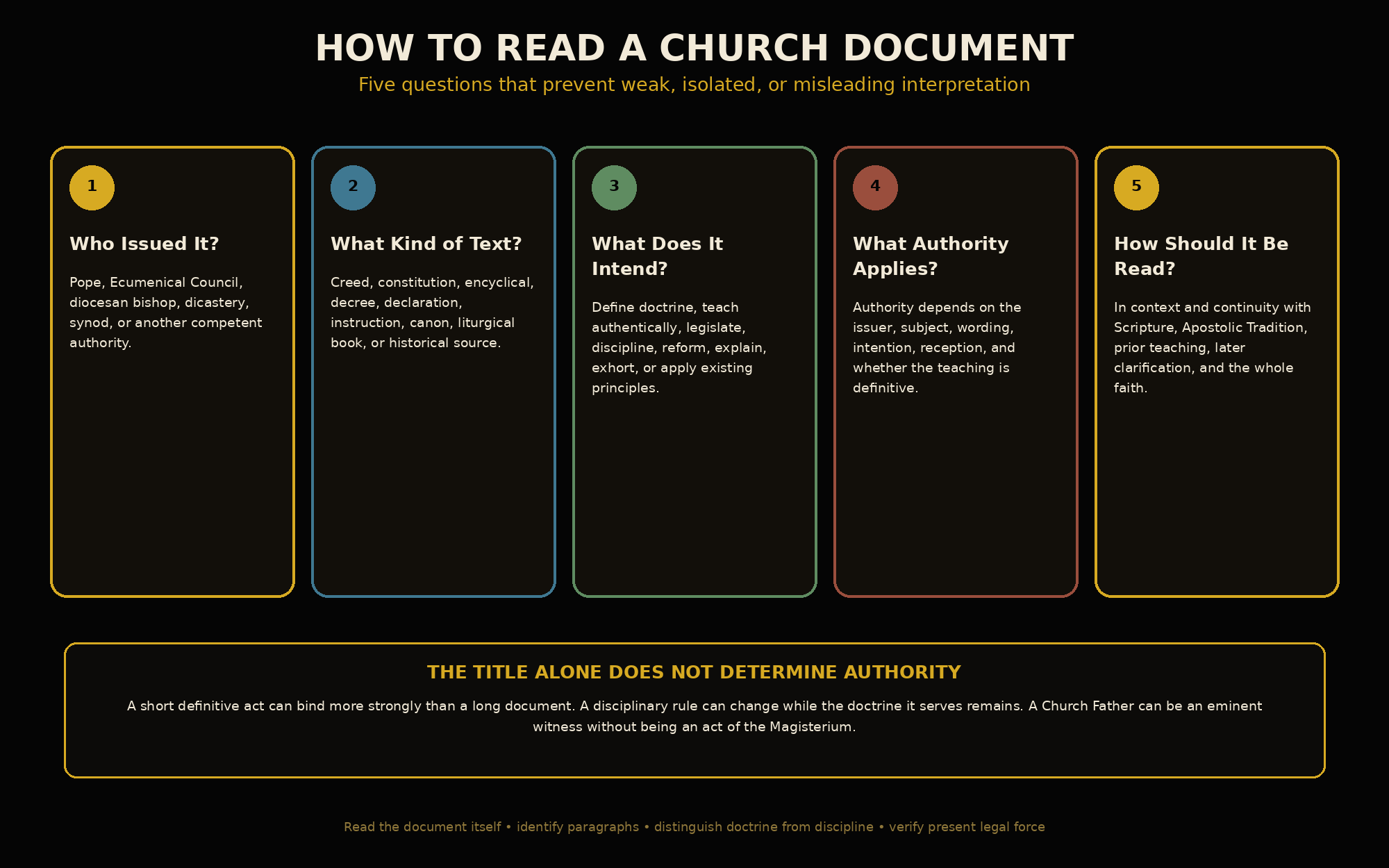
Authority Is Not Determined by the Title Alone
Document titles are helpful, but they do not function as a simple ranking chart. An apostolic constitution is normally a solemn papal form, yet one constitution may primarily promulgate disciplinary law while another contains important doctrinal teaching. An encyclical is ordinarily an authoritative papal teaching document, but the precise assent owed depends upon the doctrine proposed, the Pope’s manifest intention, continuity with prior teaching, and whether the matter has been taught definitively.
Ecumenical Councils also produce different kinds of texts. A dogmatic constitution, pastoral constitution, decree, declaration, canon, disciplinary measure, and solemn definition do not all perform the same act.
The faithful should therefore ask what proposition is being taught, how it is proposed, whether it concerns faith or morals, whether it is definitive, and whether the document establishes a changeable discipline or law.
Scripture, Tradition, and the Magisterium
Sacred Scripture and Apostolic Tradition form one sacred deposit of the word of God entrusted to the Church. The Magisterium does not stand above that word. It serves revelation by listening to it, guarding it, explaining it faithfully, and proposing what the Church must believe or hold.
Church documents are therefore not a replacement Bible. They are among the principal ways the Church’s pastors confess, interpret, teach, regulate, and apply the apostolic faith.
The strongest reading is neither “the document says it, so context does not matter” nor “the document arose in history, so it can be ignored.” Catholic interpretation joins the text, its authority, its historical setting, the prior tradition, and later clarification.
Doctrine, Discipline, and Pastoral Application
Doctrine
Truth concerning faith or morals. Some doctrine is divinely revealed; some is definitively connected with revelation; some is taught authentically without a definitive act.
Discipline
Rules governing ecclesial life. Discipline can be authoritative and binding while still being capable of lawful change.
Pastoral Application
Application of enduring principles to people, cultures, institutions, or historical circumstances.
Juridical Force
A law or norm must be read according to promulgation, competent authority, scope, later amendment, and whether it remains in force.
A single document can contain more than one of these elements. Readers should not assume that a change in discipline reverses doctrine, or that a doctrinal principle settles every prudential application without further judgment.
Official Documents and Related Historical Sources
Official Church documents are acts issued or received through competent ecclesiastical authority. Church Fathers, saints, theologians, historians, and private correspondence can be indispensable witnesses without becoming acts of the Magisterium merely because their authors are holy or influential.
Patristic writings reveal how early Christians interpreted Scripture, celebrated the sacraments, defended doctrine, and governed communities. They deserve a major place in Catholic study, but they should be labeled as patristic sources rather than placed indiscriminately among official documents.
Current and Historical Legal Force
Historical documents may remain doctrinally valuable even when their disciplinary provisions have been replaced. A former law can illuminate the Church’s history without governing present cases.
Readers should verify whether a constitution, canon, instruction, or office structure remains current. For example, a later apostolic constitution can abrogate and replace an earlier law while leaving the earlier document important for historical study.
Canon-law questions involving marriage, sacraments, penalties, offices, tribunals, or the rights of the faithful should be checked against the current Latin Code, the Eastern Code where applicable, later amendments, authentic interpretations, and competent pastoral or canonical guidance.
How Forms of Assent Differ
The Catholic response to a teaching is proportionate to the way the Church proposes it. Truths contained in Sacred Scripture or Apostolic Tradition and proposed as divinely revealed require divine and Catholic faith. Teachings definitively proposed as necessary for guarding and explaining revelation require firm and definitive acceptance. Other teachings of the authentic Magisterium require religious submission of will and intellect even when they are not proposed by a definitive act.
These distinctions do not create a menu from which Catholics select preferred doctrines. They identify the ground and form of assent. A revealed dogma is believed because God reveals. A definitively held teaching is accepted because the Church has conclusively judged its necessary connection with the deposit. Authentic non-definitive teaching is received with docility because Christ entrusted a real teaching office to the Pope and bishops.
The degree of authority should be judged from the actual teaching, not from online labels such as “infallible” or “pastoral.” A pastoral document can contain binding doctrine, while a highly solemn legal form can principally establish changeable discipline.
Original Texts, Translations, and Official Editions
Many Church documents were written in Latin, Greek, Italian, or another language before receiving translations. A translation can be accurate while still requiring comparison with the official text when a disputed word carries doctrinal or legal importance.
Conciliar documents are best cited by document title and paragraph or canon number. Canon law should be cited by canon and section. Papal documents usually have numbered paragraphs or articles. This method remains stable across print editions, screen sizes, and translations.
Older documents may survive in manuscript traditions rather than one modern official webpage. In those cases, responsible study identifies the critical edition, the language of the surviving witnesses, and any uncertainty about authorship or redaction.
Modern official texts may appear in the Acta Apostolicae Sedis, Vatican collections, promulgating constitutions, or approved liturgical and canonical editions. A popular quotation site can help locate a passage but should not replace verification against the document itself.
Documents Must Be Read Across Time
A Church document enters a history of teaching before and after its publication. Earlier councils, Fathers, liturgy, canonical practice, and papal teaching provide the background. Later definitions, authentic interpretations, revisions, and disciplinary changes clarify how the document is received.
This does not give later readers permission to explain away a text. It protects the text from anachronism. A medieval council should not be forced into modern canonical categories it did not use, and a modern pastoral application should not be projected backward as though it were the only possible expression of an ancient doctrine.
Continuity is not mere repetition of identical vocabulary. The Church can preserve the same truth while developing terminology, correcting misunderstandings, or changing disciplinary structures. The words consubstantial, transubstantiation, and the modern distinctions of doctrinal assent illustrate increased precision rather than a change of religion.
When a Document Is No Longer Current Law
Historical law remains valuable even after abrogation. It can explain how institutions developed, why a reform occurred, and which principles continued into the replacement legislation.
However, a superseded constitution or canon cannot be used as though it still governs present cases. The reader must identify the promulgation date, effective date, territory, persons bound, later amendments, authentic interpretations, and any clause explicitly abrogating prior law.
This is especially important for structures of the Roman Curia, papal elections, penal law, marriage procedure, liturgical discipline, and offices whose names or competencies have changed. A historically important document may remain worth studying while no longer being the operative legal norm.
The library will therefore label documents as current, amended, superseded, abrogated, historical, or disputed whenever that status materially affects interpretation.
A Reliable Reading Method
- Identify the issuing authority, exact title, date, and original language.
- Identify the document type and intended audience.
- Read the whole relevant section rather than an isolated quotation.
- Distinguish doctrine, discipline, law, historical judgment, and pastoral application.
- Check whether the text has been amended, abrogated, or clarified.
- Compare the text with Scripture, earlier teaching, and later Magisterial interpretation.
- Use paragraph, canon, article, or section numbers when citing it.
- Consult competent pastoral or canonical guidance for personal legal cases.
Common Mistakes to Avoid
- Do not assume every document carries the same authority.
- Do not rank documents only by their titles.
- Do not confuse Church Fathers’ writings with official Magisterial acts.
- Do not treat a disciplinary change as automatic doctrinal reversal.
- Do not use obsolete law as though it still governs current cases.
- Do not quote one sentence without its paragraph and historical context.
- Do not oppose Vatican II to the rest of the Catholic tradition.
- Do not rely only on unofficial summaries when the actual document is available.
Key Takeaways
- Church documents differ in genre, purpose, authority, and legal force.
- The Creeds provide the best doctrinal starting point.
- The Magisterium serves the word of God rather than standing above it.
- Doctrine, discipline, pastoral application, and law must be distinguished.
- The title of a document does not by itself determine the required assent.
- Patristic sources are essential witnesses but are not automatically official Church documents.
- Historical texts should be checked for later amendment or replacement.
- Documents should be read in continuity with the whole Catholic faith.
Sources and Further Reading
- Holy Bible, Douay-Rheims: Matthew 16:16–19; Matthew 18:18; Matthew 28:18–20; John 16:13; First Timothy 3:15; Second Thessalonians 2:14.
- Catechism of the Catholic Church, 74–100, 166–197, and 888–892.
- Second Vatican Council, Dei Verbum, 7–10.
- Second Vatican Council, Lumen Gentium, 18–27.
- Code of Canon Law, canons 7–22, 29–34, 749–754, and 1752.
- Congregation for the Doctrine of the Faith, Donum Veritatis.
- Congregation for the Doctrine of the Faith, Doctrinal Commentary on the Concluding Formula of the Professio Fidei.
- Pope Francis, Praedicate Evangelium, 19 March 2022.