

Church Documents · Apostolic Fathers · Early Christian Witnesses
APOSTOLIC AND EARLY CHRISTIAN DOCUMENTS
Extra-Canonical Witnesses from the First Generations after the Apostles
Apostolic and Early Christian Documents Library
Start Here
This library presents eight major early Christian writings from the late first and early second centuries. They stand close to the apostolic age and preserve valuable evidence about Christian worship, discipline, ministry, martyrdom, moral teaching, biblical interpretation, and public defense of the faith.
These writings are not books of the New Testament. They are not inspired Scripture, and they do not all possess equal authorship, historical certainty, or doctrinal authority. Some are letters from recognized bishops and saints. Others are anonymous church orders, apologies, allegorical treatises, or visionary exhortations.
The pages use New Advent and other historical collections for research, but they do not reproduce those web pages. Every page contains an original CatholicG33k summary, controlled short excerpts, chapter references, plain-text sources, and no outbound body links.
The Documents at a Glance
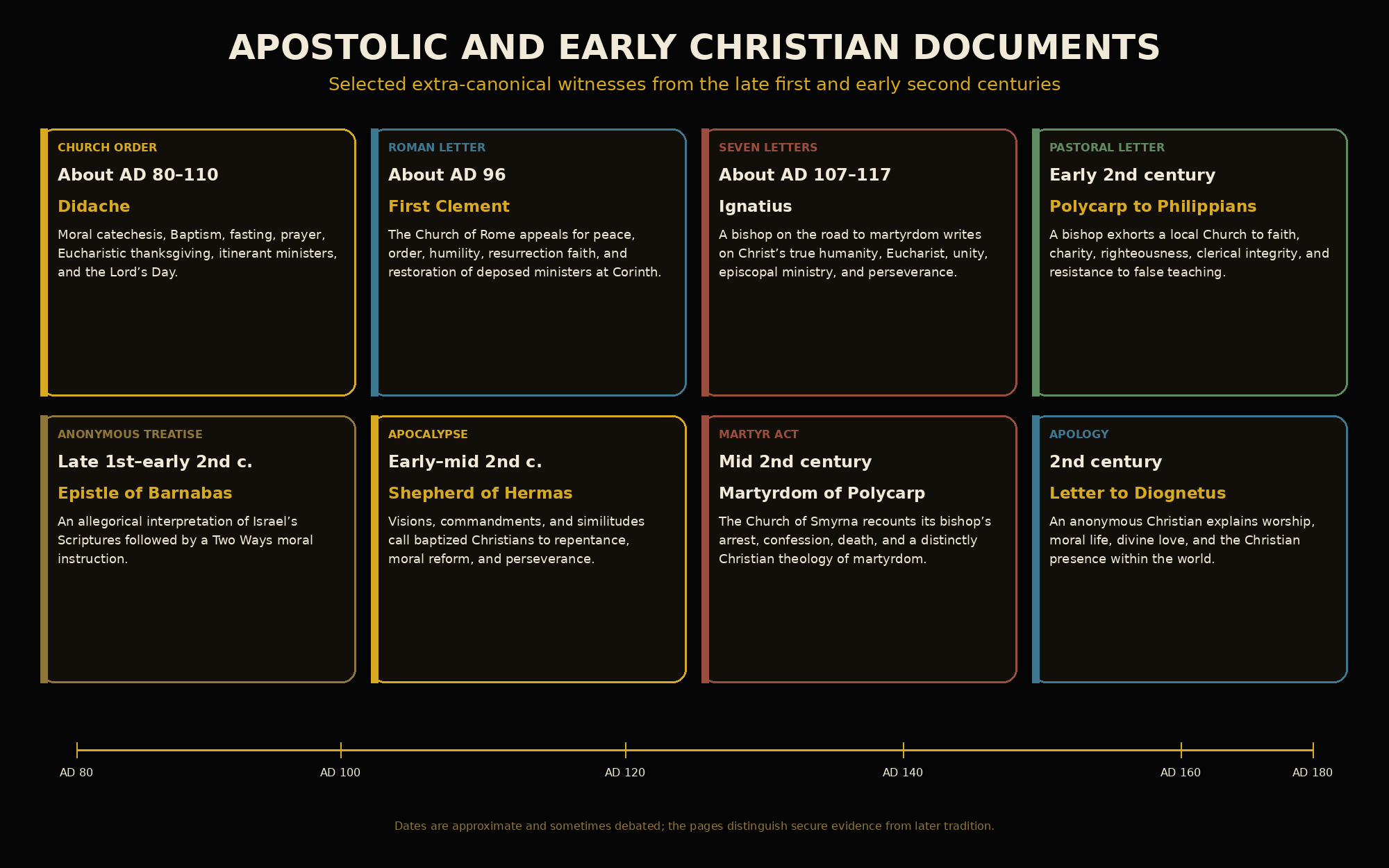
Why These Writings Matter
The New Testament gives inspired apostolic testimony. These later documents show how Christians immediately after the Apostles received that faith in local communities.
The Didache preserves moral catechesis, baptismal instructions, fasting, prayer, Eucharistic thanksgiving, itinerant ministry, and the Lord’s Day assembly. First Clement shows the Church of Rome intervening in a grave Corinthian conflict and appealing to apostolic order. St. Ignatius writes as a condemned bishop about Christ, Eucharist, episcopal unity, and martyrdom. St. Polycarp exhorts the Philippians to faith, charity, righteousness, and clerical integrity.
The Martyrdom of St. Polycarp demonstrates how an early Church distinguished faithful martyrdom from reckless self-destruction and honored a martyr without worshiping him. Barnabas preserves an intense early Christian interpretation of Israel’s Scriptures. Hermas uses visions and parables to preach repentance after Baptism. Diognetus explains Christian life to an educated outsider.
Together, these texts provide historical evidence of continuity while also revealing diversity in genre, vocabulary, pastoral need, and theological maturity.
Baptize in the name of the Father, and of the Son, and of the Holy Spirit, in living water.
Short public-domain English rendering; translations differ slightly.
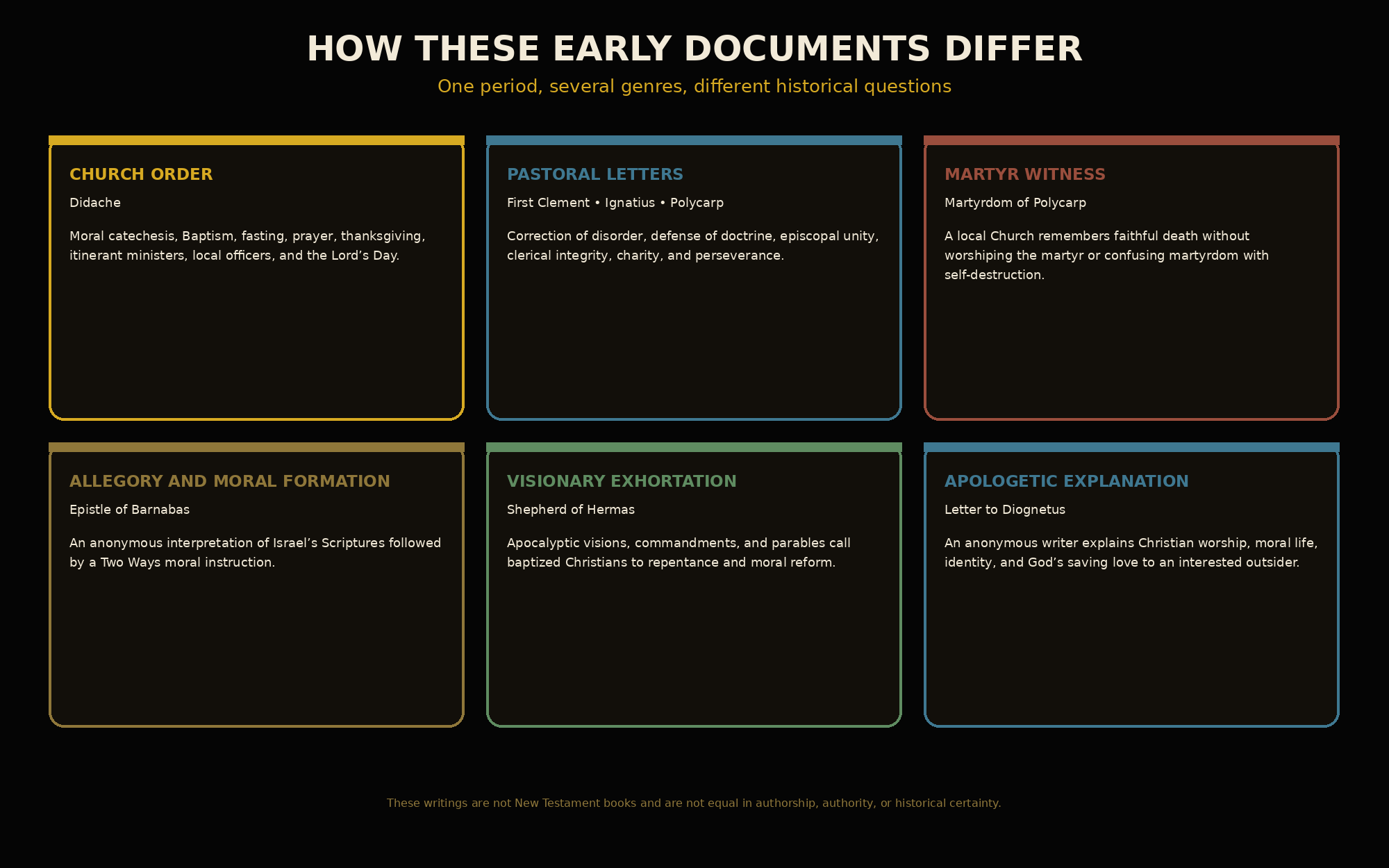
Different Genres, Different Questions
The Apostolic Fathers
The expression “Apostolic Fathers” is a later scholarly label for early Christian writers and documents believed to stand near the Apostles in time, contact, or influence. The traditional core includes St. Clement of Rome, St. Ignatius of Antioch, and St. Polycarp of Smyrna.
The category commonly extends to the Didache, the Epistle of Barnabas, the Shepherd of Hermas, and the Letter to Diognetus. The boundaries are not a canon defined by the Church. They are a useful historical grouping.
The title “apostolic” does not make every work inspired, infallible, or personally written by an Apostle. It identifies proximity to the apostolic and sub-apostolic age.
Because the documents are early, their testimony is highly valuable. Because they are uninspired and historically diverse, each claim must still be weighed according to author, date, genre, manuscript evidence, and reception.
Scripture and Extra-Canonical Witness
The Church distinguishes the inspired canon from other useful Christian writings. Several of these works were read publicly, copied beside biblical books, or treated with extraordinary reverence in some regions. That historical honor did not make them part of the universal New Testament canon.
First Clement appears in Codex Alexandrinus after the New Testament. Barnabas and Hermas appear in Codex Sinaiticus. Some ancient writers used the language of “Scripture” broadly when citing respected ecclesiastical works. Other Fathers explicitly placed these writings among disputed or useful but non-canonical books.
This history does not show that the canon was arbitrary. It shows that the Church discerned the canon over time while continuing to preserve other valuable witnesses.
The Apostles appointed the first-fruits of their labors, having first proved them by the Spirit, to be bishops and deacons of those who should afterwards believe.
Public-domain English wording from the Ante-Nicene Fathers tradition; translations differ.
CatholicG33k pages will therefore label each document’s canonical status plainly: respected early Christian writing, not inspired Scripture.
A Recommended Reading Order
- Didache: begin with moral formation, Baptism, prayer, and early community order.
- First Clement: study apostolic succession, Roman intervention, and ecclesial peace.
- Ignatius: examine Eucharist, Christology, bishop-presbyter-deacon order, and martyrdom.
- Polycarp: read a sober pastoral exhortation shaped by Scripture and Ignatian memory.
- Martyrdom of Polycarp: see how martyrdom was narrated and the saints were honored.
- Diognetus: read a concise early apology addressed to an interested non-Christian.
- Hermas: approach the long visionary work with attention to penance and ecclesiology.
- Barnabas: read last, with strong historical controls regarding authorship and anti-Jewish rhetoric.
This order moves from accessible church life and pastoral letters toward more difficult visionary and polemical texts.
How to Read the Texts Responsibly
- Identify the document’s genre before interpreting a sentence.
- Distinguish traditional attribution from historically secure authorship.
- Use chapter numbers when citing the work.
- Compare short passages with the document’s complete argument.
- Distinguish local discipline from universal doctrine.
- Do not treat every early custom as permanently binding.
- Do not use one Father against the whole Catholic tradition.
- Consult Scripture, the Catechism, councils, and later Fathers when doctrine is disputed.
- Recognize rhetorical and polemical language without repeating it carelessly.
The Question of Dating
Early Christian documents are often dated by a combination of internal evidence, quotations, manuscript history, ecclesiastical structures, references to persecution, and testimony from later writers.
Dates are therefore commonly expressed as ranges. A page may say “about AD 96,” “early second century,” or “before the middle of the second century.” This is not evasiveness. It reflects the nature of historical evidence.
A precise traditional date can still be reported when clearly labeled. The martyrdom of St. Polycarp, for example, has been placed in AD 155 or 156 by many scholars, while another chronology places it later. The page explains the dispute rather than hiding it.
Textual Transmission and Translation
These works survive through manuscripts copied centuries after composition, ancient translations, quotations, and excerpts. Some texts are complete; others contain damaged passages, later additions, or competing recensions.
The Ignatian letters are a major example. The shorter or middle recension of seven letters is generally treated as authentic, while a longer recension contains expansions and additional letters regarded as spurious.
The Letter to Diognetus survives through a difficult manuscript history, and its final chapters are often considered a separate homiletic addition. Polycarp’s letter may also preserve more than one stage of correspondence.
Translations can differ because editors reconstruct Greek or Latin wording differently. These pages summarize the teaching rather than pretending that one online English wording is itself the original document.
Early Christianity Was Sacramental and Ecclesial
The documents repeatedly connect faith with visible Christian life. Baptism is administered with Trinitarian language. Christians fast and pray together. Eucharistic thanksgiving belongs to the assembled community. Bishops, presbyters, and deacons serve local Churches. Discipline protects unity. Martyrs die in communion with Christ and the Church.
This evidence does not mean every second-century practice was identical in every city. It does make a purely invisible, anti-sacramental, or radically individualistic account of early Christianity historically difficult to sustain.
Where Jesus Christ is, there is the Catholic Church.
This is the earliest surviving uncontested use of the expression “Catholic Church” in Christian literature.
The same texts also reveal transition. Itinerant apostles and prophets appear in the Didache, while Ignatius presents a strongly centered local episcopate. The proper conclusion is development within apostolic faith, not a simplistic claim that one page alone settles every institutional question.
Common Mistakes to Avoid
- Do not call these works part of the New Testament.
- Do not claim every traditional author attribution is certain.
- Do not copy a modern edited website as though it were the ancient manuscript.
- Do not treat public reading in one Church as proof of universal canonicity.
- Do not flatten letters, church orders, apologies, and visions into one genre.
- Do not repeat anti-Jewish rhetoric without Catholic correction and historical context.
- Do not use martyrdom texts to glorify self-harm or voluntary provocation.
- Do not assume silence about a doctrine proves its absence from the Church.
Key Takeaways
- This branch contains one hub and eight focused document pages.
- The writings belong mainly to the late first and early second centuries.
- They are extra-canonical and uninspired, though historically important.
- Clement, Ignatius, and Polycarp are central Apostolic Fathers.
- The documents preserve early evidence for worship, ministry, morality, and martyrdom.
- Authorship, dating, genre, and manuscript history must be distinguished.
- New Advent can support research without becoming an outbound-link directory.
- Every page is an original reader guide rather than a copied web translation.
Sources and Further Reading
- Holy Bible, Douay-Rheims: Matthew 5–7 and 28:19; Acts 2 and 20; First Corinthians 10–15; Philippians; First Timothy; Titus; Apocalypse 2–3.
- Catechism of the Catholic Church, 74–100, 857–896, 946–962, and 1322–1419.
- Eusebius of Caesarea, Ecclesiastical History, Books III–V.
- St. Irenaeus of Lyons, Against Heresies, Book III.
- St. Jerome, On Illustrious Men.
- J. B. Lightfoot and J. R. Harmer, The Apostolic Fathers.
- Michael W. Holmes, The Apostolic Fathers: Greek Texts and English Translations.
- Bart D. Ehrman, ed. and trans., The Apostolic Fathers, Loeb Classical Library.
- Ante-Nicene Fathers, volume 1.