

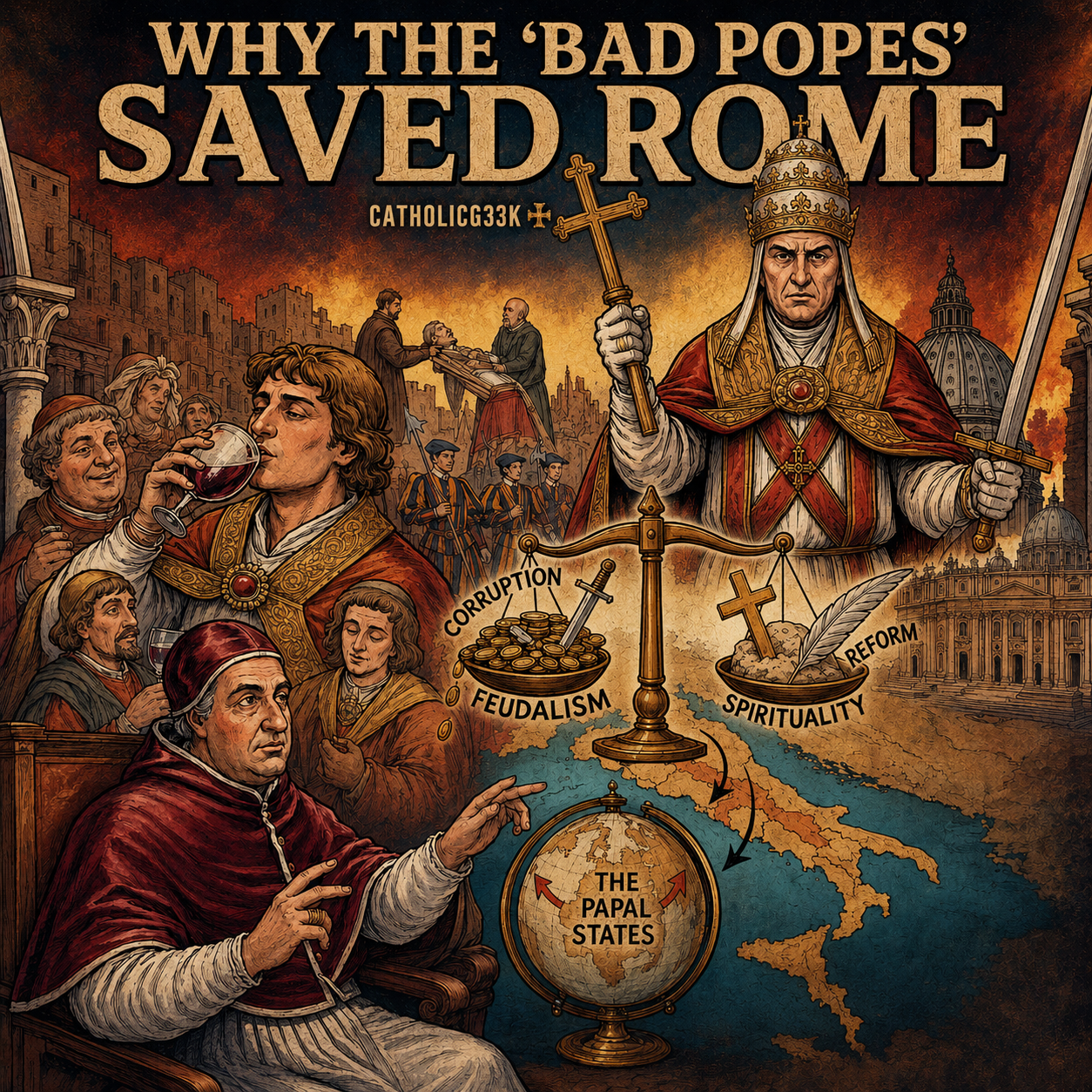
When we think of the Papacy, we often imagine an unbroken line of venerable leaders. History, however, tells a much more complex—and often scandalous—story.
How could the Church endure, let alone solidify its power, through periods governed by what E.R. Chamberlin, in The Bad Popes, calls some of the most corrupt men ever to sit on the See of Peter?
It’s a fascinating paradox that Chamberlin explores.
He covers some six hundred years leading up to the Reformation, revealing popes who led armies, made love and war, and even conspired using techniques of assassination and seduction. Yet, despite all of this, the institution survived.
The Forgery That Changed History
Consider the very foundation of much of the Papacy’s temporal power: the so-called Donation of Constantine.
Chamberlin points out that it was actually a forgery, created by a papal official named Christophorous.
A forgery?
So the very idea of the Pope having temporal dominion—of ruling cities and territories—was built on a lie. That sounds like the kind of internal rot that should have crumbled the Church from its foundations, not solidified it.
It certainly started that way.
Christophorous’s forgery in the eighth century, based on the legendary life of St. Sylvester, conveniently “transferred the temporal crown from the emperor to the pope.” This document was then used by Pope Stephen to convince Pepin, King of the Franks, to grant lands to “St. Peter himself,” creating the Papal States.
This immediately turned the Papacy into a feudal lordship and a prize for powerful Roman families. It led directly to brutal factionalism.
The Synod of Horrors
The factionalism turned violent very quickly.
Chamberlin describes the Synod Horrenda, where the dead Pope Formosus was dug up and put on trial. This is a level of depravity that seems almost unimaginable today.
The corpse of Formosus was dressed in sacerdotal robes, propped upon a throne, and “tried” by Pope Stephen VII. They condemned him, hacked off the fingers of benediction, and threw the body into the Tiber.
This act of “sympathetic magic,” as Chamberlin calls it, was meant to degrade Formosus’s faction.
Ironically, such extremes often provoked an equal and opposite reaction.
Cardinal Baronius, one of the first great papal historians, looking back centuries later, concluded that “no other structure could have resisted such an onslaught from within,” implying the Church’s supernatural strength.
It’s almost as if the very wickedness of these acts proved the divine resilience of the institution.
The Pornocracy
After that came the infamous “pornocracy” of Marozia and Theodora.
These powerful women used influence and intrigue to control the Papacy, eventually installing Marozia’s son, Octavian, as Pope John XII.
Marozia, as senatrix and mistress of Rome, effectively made the Papacy an appanage of her family.
Her son combined the roles of prince and pope.
Chamberlin paints a vivid picture of John XII as dissolute—turning the Lateran into a brothel, gambling, and even selling Church lands to his mistresses. He was an adolescent who lacked “book learning” and was “derided for his elementary ignorance of Latin.”
This was a pope.
A man who supposedly represented spiritual authority on earth.
He sounded utterly incompetent and morally bankrupt.
How could that possibly strengthen the Church?
It sounds like an open invitation for complete collapse.
Yet John XII’s desperate appeal to Otto of Saxony for protection against Berengar unintentionally created another lasting institution.
Otto came to Rome, was crowned emperor, and despite expressing sincere regret over John’s behavior, entered into a compact to defend the Church.
The result was the Holy Roman Empire.
Italy and Germany became bound together in what Chamberlin called a “bitter marriage” lasting nearly nine hundred years.
Even Otto seemed to understand that the office of the Papacy remained indispensable, no matter how flawed the man occupying it.
Selling the Papacy
The cycle of corruption continued.
Benedict IX was elected while only fourteen years old, came from the House of Theophylact, and eventually sold the papacy itself.
It seems almost unbelievable.
Yet this shocking act became the catalyst for reform.
Giovanni Gratiano, believing he was rescuing the Church from greater evil, purchased the office from Benedict.
Even more importantly, men like Hildebrand—later Pope Gregory VII—emerged from a growing movement of reform inspired precisely by the corruption surrounding them.
Extreme corruption produced an extreme reaction.
Eventually the Papacy was refashioned under imperial influence.
The Romans lost their ancient right to elect the pope, and that authority became invested in the College of Cardinals.
Boniface VIII and the Limits of Papal Power
Boniface VIII represented another turning point.
He was not merely personally corrupt.
He claimed universal temporal authority, famously declaring:
“I—I am the emperor.”
He believed the Pope possessed both the spiritual and temporal swords.
His conflict with Philip IV of France became one of the greatest clashes between Church and State in medieval history.
Philip’s forces eventually attacked Boniface at Anagni, capturing and humiliating him.
According to Chamberlin, Boniface’s power was utterly broken, and he died in despair.
Yet something remarkable happened.
Even Dante, who despised Boniface personally and placed him in Hell, condemned the outrage committed at Anagni.
Why?
Because the attack was against the Vicar of Christ, regardless of Boniface’s personal failings.
The office remained sacred, even when the man occupying it did not.
The Great Western Schism
Then came perhaps the greatest institutional crisis of all.
Urban VI, described by Chamberlin as a raging tyrant, drove cardinals away through paranoia and violence.
Those cardinals elected an antipope.
Christendom split.
Multiple men claimed to be the legitimate successor of Peter.
Surely this should have destroyed the Church’s unity forever.
Instead, the Council of Constance eventually restored unity by deposing the competing claimants and electing Martin V.
The solution was messy.
The wounds were deep.
Yet Europe demonstrated an overwhelming desire for one united Church.
The Papacy emerged battered—but intact.
The Renaissance Popes
Then came the Renaissance.
Alexander VI, the infamous Borgia pope, won election through what Chamberlin calls a “foul and shameful” display of simony.
His reign became synonymous with nepotism.
He elevated his children, especially Cesare Borgia and Lucrezia Borgia, using the Church’s power for family ambition.
Leo X, the Medici pope, famously declared:
“God has given us the Papacy—let us enjoy it.”
Lavish spending, indulgence campaigns, and worldly excess flourished.
The sale of indulgences to finance the rebuilding of St. Peter’s Basilica became one of the sparks that ignited Martin Luther’s Ninety-Five Theses.
The Reformation permanently fractured Western Christianity.
So how can anyone argue that these “bad popes” strengthened the Church?
Because the Reformation forced the Catholic Church into one of the greatest periods of renewal in its history.
The Council of Trent addressed widespread abuses, clarified Catholic doctrine, strengthened priestly formation, and revitalized Catholic spiritual life.
As Chamberlin observes, extreme corruption produced extreme reform.
In this sense, the failures of these popes unintentionally created the conditions that compelled the Church to purify herself.
Just as Judas’s betrayal, though evil, ultimately served God’s plan of redemption, the sins of these popes became occasions through which divine providence brought renewal.
The Sack of Rome
Finally came Clement VII.
Timid.
Indecisive.
Unable to navigate the rivalry between Charles V and Francis I.
His pontificate culminated in one of the darkest moments in Church history:
The Sack of Rome in 1527.
Rome itself—the city of Peter—was devastated by armies that included both Catholics and Protestants.
It marked the collapse of the Papacy’s dreams of temporal greatness.
Yet Chamberlin argues this catastrophe taught the Church one final lesson.
It stripped the Papacy of its illusions about political power.
The Venetian ambassador Gaspar Contarini told Clement:
“Your Holiness must not imagine that the welfare of the Church of Christ rests in this little State of the Church: on the contrary, the Church existed before she possessed the State, and was the better for it.”
Those words changed everything.
The Papacy gradually returned its focus to its true mission—not ruling kingdoms, but shepherding souls.
The institution had been humbled.
It had been wounded.
But it endured.
And in enduring, it rediscovered its spiritual identity.
Final Thoughts
It is remarkable to consider how the flaws and excesses of these so-called “bad popes” ultimately contributed to the Church’s long-term endurance and spiritual renewal.
E.R. Chamberlin’s The Bad Popes offers a nuanced understanding of one of the most turbulent periods in Catholic history.
The lesson is not that corruption is good.
Rather, it is that Christ’s promise to His Church proved stronger than the failures of even her worst leaders.
The gates of hell did not prevail.
If this exploration of power, corruption, and faith during some of the darkest centuries of Church history resonated with you, share it with a friend.
This is One Church.
This is Unity.
This is The Catholic Truth.
May the peace of Christ be upon you.
Leave a Reply