

When the angel Gabriel announced that Mary would conceive the Son of God, he told her:
“The Holy Ghost shall come upon thee, and the power of the most High shall overshadow thee. And therefore also the Holy which shall be born of thee shall be called the Son of God.”
—Luke 1:35, Douay-Rheims
The eternal Son of God did not merely appear to be human. He truly became man.
He developed within the womb of the Blessed Virgin Mary, received His human nature from her, was nourished through her body, and was born as her true Son.
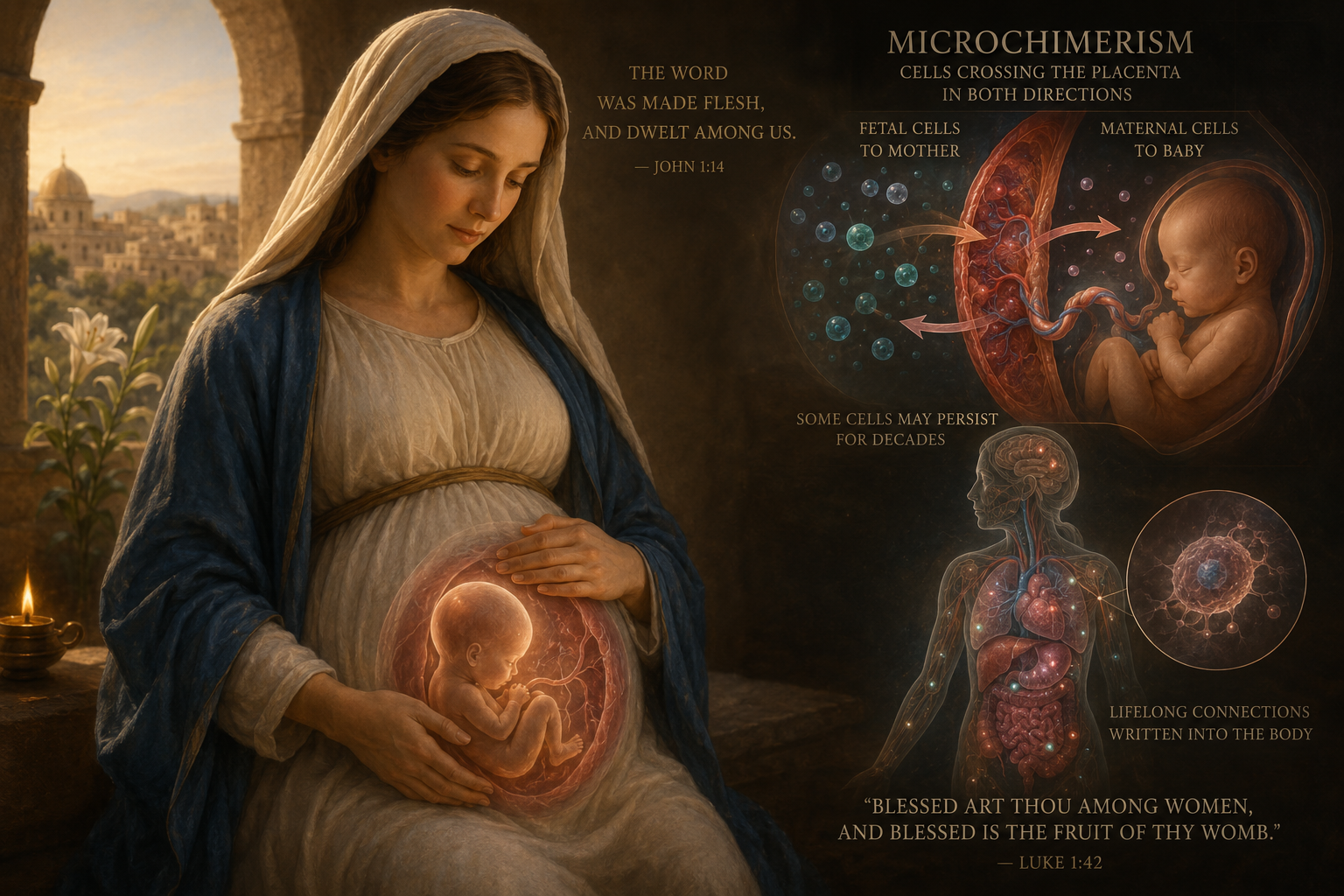
Modern science has discovered an extraordinary feature of pregnancy that can help us appreciate the physical depth of this mystery.
During pregnancy, living cells pass across the placenta in both directions. Cells originating from the child enter the mother, while cells originating from the mother enter the child.
Some of these cells may remain for decades.
This phenomenon is called maternal–fetal microchimerism.
Microchimerism does not prove a Marian dogma. The Catholic faith does not depend upon it, and the Church has never taught that Mary certainly retained cells from Jesus.
Yet the science provides a remarkable natural perspective from which to contemplate the reality of the Incarnation.
Mary did not merely stand near Jesus.
She carried Him within her body.
What Is Microchimerism?
Microchimerism is the presence within one person of a very small number of cells that originated from another genetically distinct person.
During pregnancy, the placenta forms an interface between mother and child.
Maternal and fetal blood do not ordinarily flow together as though mother and child shared one bloodstream. Nevertheless, oxygen, nutrients, antibodies, hormones, waste products, cells, and genetic material can cross the placental interface.
This cellular movement occurs in both directions.
When cells from the child enter the mother, it is called fetal microchimerism.
When cells from the mother enter the child, it is called maternal microchimerism.
The child remains a distinct human organism with his own genetic identity. He is not an organ or biological part of the mother.
Yet pregnancy creates an extraordinarily intimate relationship between two distinct human lives.
Cell-Free Fetal DNA Is Not the Same Thing
Microchimeric cells should not be confused with cell-free fetal DNA.
During pregnancy, fragments of DNA associated with the developing child circulate in the mother’s blood. Most of this material comes from placental cells.
These fragments form the biological basis of noninvasive prenatal screening.
The proportion of cell-free DNA attributed to the pregnancy is commonly called the fetal fraction. Depending upon gestational age and other factors, it may reach or exceed approximately 10 percent of the cell-free DNA present in maternal plasma.
This does not mean that 10 percent of the mother’s blood consists of intact fetal cells.
Intact microchimeric cells are much rarer.
Their importance lies not in their quantity, but in their ability to travel through the body, settle within tissues, and sometimes remain for many years.
The Child’s Cells Within the Mother
Cells originating from the developing child can enter the maternal body during pregnancy.
Most pregnancy-associated cells disappear from the maternal bloodstream after delivery. A much smaller population may remain within the mother.
Researchers have detected fetal-origin cells or genetic markers in maternal blood, bone marrow, skin, liver, thyroid, lungs, heart, kidneys, breast tissue, and brain.
One landmark study detected male fetal progenitor cells in women as long as twenty-seven years after childbirth.
Later studies confirmed that cells acquired during pregnancy can persist in maternal tissues for decades.
Some of the earliest research used Y-chromosome markers to identify cells likely originating from a male pregnancy. Since a woman ordinarily does not possess a Y chromosome, its presence can provide evidence of male-origin cells.
The interpretation is not always simple.
Male-origin cells in a woman could theoretically have come from a son, an earlier pregnancy, a vanished male twin, an older brother whose cells first entered the woman’s mother, a blood transfusion, or an organ transplant.
Researchers must therefore consider a woman’s complete medical and reproductive history.
Nevertheless, the broader conclusion is well established.
Pregnancy can leave a long-lasting population of fetal-origin cells within the mother.
Can Fetal Cells Become Part of Maternal Tissues?
Some fetal-origin cells have been found expressing characteristics associated with the maternal tissues in which they were located.
Researchers have identified fetal-origin cells bearing markers associated with blood cells, liver cells, thyroid cells, heart muscle, connective tissue, blood vessels, and neural tissue.
This has led researchers to investigate whether some pregnancy-derived cells possess progenitor-like or stem-cell-like properties.
Popular accounts sometimes claim that fetal cells simply transform into whatever maternal organ they enter.
That statement is too broad.
The evidence supports the more careful conclusion that some fetal-origin cells display developmental flexibility and may acquire characteristics associated with surrounding tissues.
It does not follow that every fetal cell becomes a permanent and fully functioning part of a maternal organ.
Microchimerism may involve several different kinds of cells, including immune cells, placental cells, blood-forming cells, and progenitor cells.
Different cells may behave in different ways.
Can a Child’s Cells Help Heal the Mother?
Fetal-origin cells have been detected at sites of maternal injury, inflammation, and tissue repair.
They have been found in or near Caesarean-section scars, damaged liver tissue, injured heart tissue, inflamed thyroid tissue, skin wounds, tumors, and areas of new blood-vessel formation.
In one study of Caesarean-section wounds, fetal microchimeric cells were found within healing maternal tissue and expressed markers associated with angiogenesis, the formation of blood vessels.
Other studies suggest that fetal-origin cells may sometimes participate in tissue maintenance, immune surveillance, or repair.
This raises a remarkable possibility.
Cells from a child may sometimes help repair the body of the mother who carried him.
But the evidence must be interpreted carefully.
Finding fetal cells at an injured site does not prove that they caused the healing.
The cells may actively contribute to repair. They may be attracted by inflammatory signals. They may arrive without having a major effect. They may even behave differently depending upon the tissue and disease involved.
The responsible conclusion is that fetal microchimeric cells may participate in tissue repair under certain conditions, but their precise role remains under investigation.
Microchimerism and Autoimmune Disease
Because fetal-origin cells are genetically distinct from the mother, they may interact with her immune system.
A child inherits genetic material from both mother and father. Some of the child’s antigens are therefore foreign to the mother.
Researchers have investigated possible associations between fetal microchimerism and autoimmune conditions such as systemic sclerosis, autoimmune thyroid disease, rheumatoid arthritis, lupus, primary biliary cholangitis, and Sjögren syndrome.
Some studies have found higher concentrations of fetal-origin cells in diseased tissue.
That does not necessarily mean that the cells caused the disease.
Several explanations are possible.
The cells might contribute to an abnormal immune reaction.
They might be recruited because tissue damage is already present.
They might be attempting to repair injured tissue.
Both the disease and the accumulation of microchimeric cells might result from another biological process.
The relationship between microchimerism and autoimmune disease remains complex.
Microchimerism should not be described as a simple or universal cause of autoimmunity.
Microchimerism and Cancer
Researchers have also examined the possible relationship between fetal microchimerism and cancer.
Some studies have reported lower levels of detectable fetal microchimerism among women with certain forms of breast cancer.
This finding led to the hypothesis that fetal-derived immune cells might sometimes help identify or destroy abnormal maternal cells.
Other studies have found fetal-origin cells in or near tumors.
The cells might participate in immune surveillance, tissue repair, inflammation, or the formation of tumor-associated blood vessels.
Their role may differ according to the kind of cancer, the type of microchimeric cell, and the surrounding immune environment.
It is therefore premature to claim that fetal microchimerism either prevents or promotes cancer in a general way.
Its effects may be protective in some circumstances, harmful in others, and neutral in many cases.
The Mother’s Cells Within the Child
The cellular exchange of pregnancy is not one-sided.
Maternal cells also cross the placenta and enter the developing child.
Maternal-origin cells have been identified in fetal and postnatal blood, bone marrow, lymph nodes, thymus, liver, heart, lungs, pancreas, brain, and immune-cell populations.
These cells are ordinarily present in extremely small numbers.
Some may persist long after birth.
A study published in 1999 detected genetically distinct maternal cells in immunocompetent offspring ranging from nine to forty-nine years of age.
A child may therefore carry a tiny population of his mother’s living cells into adult life.
The biological relationship formed during pregnancy does not necessarily disappear when the umbilical cord is cut.
How Maternal Cells May Educate the Immune System
Maternal microchimerism may influence the child while his immune system is still developing.
Every child inherits only part of his mother’s genetic material.
The mother therefore possesses certain antigens that the child did not inherit. These are called non-inherited maternal antigens.
Exposure to maternal cells and antigens during prenatal development may help teach the child’s immune system to tolerate maternal biological material rather than attack it.
Research has associated maternal microchimerism with regulatory immune cells that restrain unnecessary immune reactions.
The process is not perfectly predictable.
Exposure to maternal antigens may promote tolerance under some circumstances and immune sensitization under others. The outcome may depend upon genetics, timing, cell number, tissue location, and other immune factors.
Still, the general principle is striking.
Before a child can consciously recognize his mother, his developing immune system may already be learning how to live in relationship with her.
Can These Cells Connect Several Generations?
Pregnancy can create cellular relationships more complicated than a single exchange between one mother and one child.
A woman may carry microchimeric cells acquired from her own mother, a twin, an older sibling through her mother, an earlier pregnancy, a blood transfusion, or an organ transplant.
A woman who retains cells from one pregnancy may later conceive another child.
Researchers have therefore considered whether cells associated with an earlier pregnancy could circulate during a later pregnancy or contribute to indirect cellular relationships among siblings.
A woman may also carry cells acquired from her own mother before giving birth to children of her own.
This raises the biological possibility of cellular relationships involving grandmothers, mothers, and grandchildren.
Researchers sometimes refer to the complete collection of microchimeric populations within a person as the microchiome.
Popular accounts sometimes go further and claim that intact cells are routinely transmitted through several generations.
That has not been established.
It is known that maternal and fetal cells cross the placenta.
It is known that some of these cells persist for decades.
It is possible that cells retained from one pregnancy remain present during later pregnancies.
It is also possible for one person to carry microchimeric cells from several sources.
How frequently intact cells are transmitted through multiple human generations, and what biological effects they may have, remain subjects of research.
Scientific wonder does not require scientific exaggeration.
Jesus Truly Received His Humanity From Mary
The theological significance of Mary’s pregnancy begins not with microchimerism, but with divine revelation.
St. Paul writes:
“But when the fulness of the time was come, God sent his Son, made of a woman, made under the law.”
—Galatians 4:4
Jesus was conceived miraculously by the power of the Holy Ghost and without a human father.
Yet His conception was a real human conception.
He truly developed within Mary’s womb.
He received nourishment through her body.
He passed through the genuine stages of prenatal human development.
He was born from her and was truly her Son.
The Council of Chalcedon taught that Jesus Christ is truly God and truly man, consubstantial with the Father according to His divinity and consubstantial with us according to His humanity.
He was born of the Virgin Mary, the Mother of God, according to His humanity.
Jesus did not possess a heavenly body that merely appeared within Mary.
His humanity was truly received from her.
Why Mary Is the Mother of God
The Church calls Mary Theotokos, meaning God-bearer or Mother of God.
This does not mean that Mary created Christ’s divine nature.
The Son is eternal. He has always existed and eternally receives His divine nature from the Father.
Mary is the Mother of God because the Person whom she conceived and bore is God the Son.
Mothers give birth to persons, not isolated natures.
Mary did not give birth to a human person who was later joined to God.
From the first instant of His human conception, the Child within her was the eternal Person of the Son possessing a complete human nature.
The Catechism explains:
“In fact, the One whom she conceived as man by the Holy Spirit, who truly became her Son according to the flesh, was none other than the Father’s eternal Son, the second person of the Holy Trinity. Hence the Church confesses that Mary is truly ‘Mother of God’ (Theotokos).”
—Catechism of the Catholic Church, 495
Christ is one divine Person in two complete natures.
He possesses a divine nature and a human nature without confusion, change, division, or separation.
Mary is therefore not merely the mother of a body considered apart from Christ’s Person.
She is the mother of Jesus Christ.
Jesus Christ is God.
Therefore, Mary is truly the Mother of God.
Jesus Took His Human Flesh From Mary
St. Thomas Aquinas explains that Christ’s human body was formed from the substance of the Virgin Mary.
Mary truly supplied the maternal matter from which His body developed.
She was not merely the place in which an unrelated body appeared.
For this reason, she was His mother in the proper and natural sense.
Jesus received from Mary His human body, human ancestry, membership in the people of Israel, descent from Abraham, descent from David, and genuine biological relationship to the human family.
The Letter to the Hebrews places these words on the lips of the incarnate Son:
“Sacrifice and oblation thou wouldest not: but a body thou hast fitted to me.”
—Hebrews 10:5
The human body prepared for the Son was formed by the power of the Holy Ghost from the substance of the Virgin Mary.
The Incarnation did not make Mary’s motherhood less real.
It made her motherhood unique.
Could Mary Have Carried Cells From Jesus?
Given what is known about human pregnancy, it is biologically reasonable to consider the possibility that cells originating from Jesus crossed the placenta and entered Mary’s body.
Jesus possessed a complete human nature.
His miraculous conception did not make His humanity incomplete or merely apparent.
He genuinely underwent prenatal development within Mary.
It is therefore scientifically plausible that fetal-origin cells from Jesus entered Mary during pregnancy.
Some of those cells might even have remained within her body after His birth, just as pregnancy-derived cells remain in other mothers.
But this must be stated carefully.
We do not possess biological samples from Mary that would allow the hypothesis to be tested.
Sacred Scripture does not reveal whether cells from Jesus persisted in Mary’s tissues.
Apostolic Tradition does not answer the question.
The Magisterium has issued no doctrinal judgment concerning it.
It is biologically plausible that Mary received cells from Jesus during pregnancy.
It is not a revealed doctrine or a scientifically demonstrated historical fact.
A beautiful possibility should not be turned into an article of faith.
Could Jesus Have Carried Cells From Mary?
Because maternal cells naturally cross the placenta, it is likewise biologically plausible that cells originating from Mary entered the developing body of Jesus.
At the Visitation, St. Elizabeth called the unborn Christ her Lord:
“And whence is this to me, that the mother of my Lord should come to me?”
—Luke 1:43
The Child within Mary was already the Lord.
From the first instant of His conception, the human nature developing within her belonged to the eternal Person of the Son.
Nevertheless, careful theological distinctions are necessary.
A cell originating from Mary would remain genetically a cell of Mary.
Its temporary or persistent presence within Christ’s developing body would not necessarily mean that the cell itself became hypostatically united to the Word.
The hypostatic union is the personal union of Christ’s complete human nature with the eternal Person of the Son.
Mere physical presence within Christ’s body does not automatically constitute personal union with the divine Word.
Food within Christ’s digestive system did not become hypostatically united to Him merely because it was present within His body.
Air within His lungs did not enter the hypostatic union.
Microorganisms naturally present upon or within a human body are not united to the human person in the same manner as the person’s own organic body.
The Church has not specifically defined the status of hypothetical maternal microchimeric cells within Christ.
The matter should remain cautious theological speculation.
Would Cells From Jesus Make Mary Divine?
No.
Even supposing that cells from Jesus remained within Mary, they would not communicate Christ’s divine nature to her.
Divinity is not a substance transmitted through DNA, blood, cells, placental exchange, biological inheritance, or physical contact.
Jesus is divine because He is the eternal Son of God.
His human cells belong to the human nature assumed by the divine Person. They are not particles of a transferable material called divinity.
Mary remained completely human and completely a creature.
She is the most exalted of creatures because of God’s grace, her divine maternity, and her unique participation in the mission of Christ.
She is not divine by nature, part of the Trinity, or a goddess.
Her greatness comes entirely from God.
“My soul doth magnify the Lord. And my spirit hath rejoiced in God my Saviour.”
—Luke 1:46–47
Mary needed a Savior.
She was redeemed by Christ in the most perfect manner, preserved from original sin through the anticipated merits of His Passion, Death, and Resurrection.
Microchimerism would not make Mary divine.
It would simply be one possible biological dimension of her authentic motherhood.
Does Microchimerism Explain the Assumption?
Some devotional reflections have suggested that cells from Jesus within Mary might explain why her body was assumed into heaven.
That conclusion goes beyond both science and Catholic doctrine.
Pope Pius XII solemnly defined:
“The Immaculate Mother of God, the ever Virgin Mary, having completed the course of her earthly life, was assumed body and soul into heavenly glory.”
—Pope Pius XII, Munificentissimus Deus, 44
The Assumption was a supernatural act of God.
Mary was assumed because God freely glorified the Mother of His incarnate Son and granted her a unique participation in Christ’s victory over death.
She was not assumed because some of her organs might have contained fetal-origin cells.
Christ did not need to retrieve cells belonging to Him from Mary.
A small population of fetal cells would not determine the destiny of her complete body.
The Assumption concerns the glorification of Mary as a complete human person, body and soul.
It was an act of grace, not an automatic result of biology.
Microchimerism may provide a poetic image of the enduring relationship between Jesus and Mary.
It does not explain the supernatural cause of the Assumption.
Does Microchimerism Prove the Real Presence?
Microchimerism should not be used as scientific proof of Christ’s Real Presence in the Holy Eucharist.
In the Eucharist, the entire substance of bread is changed into the substance of Christ’s Body, and the entire substance of wine is changed into the substance of His Blood.
The Church calls this change transubstantiation.
After consecration, Jesus Christ is truly, really, and substantially present: Body, Blood, Soul, and Divinity.
The appearances of bread and wine remain.
This is a sacramental and substantial change, not an ordinary biological transfer of human tissue.
A consecrated Host ordinarily retains the measurable physical properties of bread. It is not ordinarily transformed at the microscopic level into visible human tissue or detectable human DNA.
Microchimerism concerns the transfer of genetically distinct cells.
Transubstantiation concerns a change of substance under unchanged sacramental appearances.
They belong to different orders of explanation.
Microchimerism may help us contemplate bodily communion.
It neither explains nor proves the Eucharistic mystery.
Mary Was Not Merely a Vessel
Calling Mary a vessel can be appropriate when the word is used in its biblical and liturgical sense.
The Litany of Loreto calls Mary the Spiritual Vessel, Vessel of Honor, and Singular Vessel of Devotion.
But Mary must never be reduced to an inanimate container.
She was a living mother who freely cooperated with God.
“Behold the handmaid of the Lord; be it done to me according to thy word.”
—Luke 1:38
Her consent was real.
Her motherhood was real.
Her contribution to Christ’s human nature was real.
She carried Him, nourished Him, gave birth to Him, cared for Him, and remained with Him even at the foot of the Cross.
The Second Vatican Council taught that Mary received the Word of God in her heart and in her body and gave Life to the world.
Her motherhood involved her complete person.
The Physical Reality of Mary’s Motherhood
Jesus’ human life unfolded within Mary.
Her body provided the maternal environment in which His human body developed.
Through the placenta, Mary supplied the developing Christ Child with oxygen, nutrients, water, electrolytes, antibodies, hormones, and protection within the womb.
Her body removed metabolic waste from His developing body.
Her heartbeat and voice formed part of His earliest human environment.
After birth, she held Him, fed Him, protected Him, and raised Him.
Jesus and Mary were not one person or one organism.
Mother and child are distinct.
Yet their distinction did not eliminate their profound bodily communion.
Pregnancy is a relationship between two distinct human beings whose bodies communicate in extraordinarily intimate ways.
The discovery of microchimerism makes this intimacy even more striking.
A mother may continue to carry a tiny population of her child’s cells years after birth.
A child may carry a tiny population of his mother’s cells into adulthood.
In Mary and Jesus, this natural intimacy existed within the singular mystery of the Incarnation.
Flesh of My Flesh
The science of microchimerism gives unexpected biological depth to the ancient language of human kinship.
Adam said of Eve:
“This now is bone of my bones, and flesh of my flesh.”
—Genesis 2:23
In pregnancy, a mother gives from her own body so that a new human being may develop.
The child is not an organ of his mother. He is a distinct human being with his own genetic identity and continuous organismal development.
Yet he truly receives bodily life through her.
The mother gives without ceasing to be herself.
The child depends upon her without becoming identical to her.
Their bodies communicate while their identities remain distinct.
In the Incarnation, this natural mystery reached an incomparable height.
The flesh of the eternal Word was truly received from Mary.
Jesus is called the fruit of her womb because He truly took His humanity from her.
“Blessed art thou among women, and blessed is the fruit of thy womb.”
—Luke 1:42
Mary as the New Eve
The Church Fathers frequently presented Mary as the New Eve.
Eve listened to the fallen angel and participated in disobedience.
Mary listened to the holy angel and responded with faith.
Through Eve’s disobedience, death entered human history.
Through Mary’s obedient faith, the Author of Life entered the world.
St. Irenaeus taught that the knot of Eve’s disobedience was untied by Mary’s obedience.
Mary did not redeem the world independently of Christ.
Jesus alone is the divine Redeemer. His mediation is unique.
Mary’s participation is completely dependent upon Him.
Yet God chose to bring the Savior into the world through her free maternal cooperation.
The fruit taken in disobedience brought death.
The Fruit of Mary’s womb brings eternal life.
Microchimerism does not prove this theology.
It can, however, help modern readers understand that Mary’s cooperation was not remote or merely symbolic.
She gave herself bodily to the mystery God entrusted to her.
Mary as the Ark of the New Covenant
Sacred Scripture presents striking parallels between Mary and the Ark of the Covenant.
The ancient Ark was overshadowed by the glory of God.
At the Annunciation, the power of the Most High overshadowed Mary.
The Ark remained in the hill country of Judah for three months.
Mary remained with Elizabeth in the hill country for approximately three months.
David asked:
“How shall the ark of the Lord come to me?”
—2 Samuel 6:9
Elizabeth asked:
“And whence is this to me, that the mother of my Lord should come to me?”
—Luke 1:43
David leapt before the Ark.
John the Baptist leapt within Elizabeth’s womb when Mary approached.
The ancient Ark contained the tablets of the Law, the manna, and Aaron’s priestly rod.
Mary carried the eternal Word, the true Bread from heaven, and the eternal High Priest.
But Mary was greater than an inanimate sacred object.
She was a living Ark who believed, consented, loved, conceived, and gave birth.
The discovery that mother and child exchange living cells can serve as a natural reminder of how fully the living Ark participated in the mystery she carried.
Did Mary and Jesus Share the Same Blood?
It is sometimes said that Jesus had Mary’s blood.
The statement requires clarification.
The blood of a mother and the blood of her developing child do not ordinarily mix directly in one shared circulatory system.
The child develops his own blood and possesses his own circulation.
Oxygen, nutrients, waste products, antibodies, cells, and other materials pass between the maternal and fetal circulations across the placenta.
Mary’s blood therefore did not simply flow through the veins of Jesus as though mother and child shared one bloodstream.
Nevertheless, Jesus’ human body, including the tissues that produced His blood, developed from the human nature He received through Mary and was nourished through her body during pregnancy.
His blood was truly human blood.
It belonged to the human nature He received from the Blessed Virgin.
At the Last Supper, Jesus said:
“For this is my blood of the new testament, which shall be shed for many unto remission of sins.”
—Matthew 26:28
The Precious Blood poured out upon Calvary belonged to the Son of God made man.
It was the Blood of the Son who had received His true humanity from Mary.
What Science Can Tell Us
Science can establish that living cells pass between mother and child during pregnancy.
The exchange is bidirectional.
Fetal-origin cells can persist within maternal tissues for decades.
Maternal-origin cells can persist within offspring into adulthood.
Microchimeric cells can be found in numerous organs.
Some possess progenitor-like or tissue-associated characteristics.
They may participate in immune regulation.
They may be recruited to sites of inflammation or injury.
They may have beneficial, harmful, or neutral effects depending upon context.
Maternal microchimerism may help shape the developing immune system.
Multigenerational cellular relationships are biologically possible.
Many of the long-term consequences remain uncertain.
What Science Cannot Tell Us
Science cannot establish that Mary certainly retained cells from Jesus.
It cannot presently establish that Jesus retained cells from Mary.
Microchimerism did not make Mary holy or divine.
It did not cause the Immaculate Conception.
It does not explain the Assumption.
It does not prove the Real Presence.
Not every fetal-origin cell functions as a stem cell.
Fetal microchimerism does not always heal maternal tissue.
It does not always cause disease.
It does not always prevent disease.
The routine transmission of intact cells through several human generations has not been demonstrated.
Questions concerning divine revelation must be answered by revelation and the authoritative teaching of the Church.
Faith and Science in Harmony
Catholic theology does not need to force scientific evidence into the service of doctrine.
The Incarnation and Mary’s divine maternity were revealed by God and taught by the Church long before microchimerism was discovered.
Microchimerism does not make those truths more true.
It provides a new natural perspective from which to contemplate them.
Science studies measurable features of the created order.
Theology considers creation in the light of divine revelation.
Science can study cells acquired during pregnancy.
It cannot place the divine Person of the Son beneath a microscope.
Science can examine placental exchange.
It cannot experimentally measure the hypostatic union.
Science can detect pregnancy-derived DNA.
It cannot determine the supernatural cause of Mary’s Assumption.
When science and theology respect their proper objects and methods, there is no necessary conflict.
Truth cannot contradict truth because God is the author of both creation and revelation.
A Mystery Written Into the Body
The science of microchimerism reveals that pregnancy can leave an enduring cellular legacy within both mother and child.
Cells cross the placenta.
They travel through the body.
Some settle within distant tissues.
Some interact with the immune system.
Some may participate in repair.
Some remain for decades.
A mother may carry within herself a tiny living trace of the child she once carried in her womb.
A child may carry his mother’s cells long after growing into adulthood.
Applied cautiously to the pregnancy of the Blessed Virgin Mary, this science offers a deeply moving contemplation.
Mary did not merely stand near the mystery of the Incarnation.
The mystery unfolded within her.
The Son whom heaven and earth cannot contain lived beneath her heart.
He received His humanity from her.
He was nourished through her.
He entered the visible world through her motherhood.
Whether cells from Jesus remained within Mary is a biologically plausible but unverified possibility.
It is not a dogma and must not be presented as one.
The deeper truth is certain.
Their union was real.
It was bodily.
It was personal.
It was maternal.
It was unique in salvation history.
He was truly her Son.
She was truly His mother.
The fruit of her womb was God incarnate.
“Blessed art thou among women, and blessed is the fruit of thy womb.”
—Luke 1:42
Sources and Further Reading
Sacred Scripture
- Genesis 2:23
- 2 Samuel 6:2–16
- Psalm 131:8
- Matthew 1:16–25
- Matthew 26:26–28
- Luke 1:26–56
- Luke 2:1–20, 34–35
- John 1:1–14
- John 2:1–11
- John 6:48–58
- John 19:25–27
- Galatians 4:4–5
- Philippians 2:5–11
- 1 Timothy 2:5–6
- Hebrews 2:14–18
- Hebrews 4:15
- Hebrews 10:5–10
- Revelation 11:19–12:17
Scripture quotations are from the Douay-Rheims Bible.
Catechism of the Catholic Church
- CCC 456–460 — Why the Word became flesh
- CCC 461–469 — The Incarnation and Christ as true God and true man
- CCC 470–478 — Christ’s complete human nature
- CCC 484–486 — Christ conceived by the Holy Ghost
- CCC 487–493 — Mary’s predestination and Immaculate Conception
- CCC 494 — Mary’s free consent
- CCC 495 — Mary as Mother of God
- CCC 496–507 — The virginal conception and divine motherhood
- CCC 517–518 — Christ’s life as a mystery of redemption
- CCC 618 — Christ’s unique mediation and subordinate participation in it
- CCC 721–726 — Mary and the Holy Ghost
- CCC 963–970 — Mary’s motherhood in the order of grace
- CCC 966 — The Assumption of the Blessed Virgin Mary
- CCC 1373–1377 — Christ’s substantial presence in the Eucharist
- CCC 1376 — Transubstantiation
Ecumenical Councils and Creeds
- Nicene-Constantinopolitan Creed, Councils of Nicaea, AD 325, and Constantinople, AD 381
- Council of Ephesus, AD 431
- Council of Chalcedon, Definition of Faith, AD 451
- Second Council of Constantinople, AD 553
- Third Council of Constantinople, AD 680–681
- Council of Trent, Session XIII, AD 1551
- Second Vatican Council, Lumen Gentium, 52–69
- Second Vatican Council, Gaudium et Spes, 22
Papal and Magisterial Sources
- Pope St. Leo the Great, Tome to Flavian, AD 449
- Pope Pius IX, Ineffabilis Deus, AD 1854
- Pope Pius XII, Mystici Corporis Christi, AD 1943
- Pope Pius XII, Mediator Dei, AD 1947
- Pope Pius XII, Munificentissimus Deus, 44, AD 1950
- Pope St. Paul VI, Marialis Cultus, AD 1974
- Pope St. John Paul II, Redemptoris Mater, AD 1987
- Pope St. John Paul II, Ecclesia de Eucharistia, AD 2003
- Pope Benedict XVI, Deus Caritas Est, AD 2005
- Pope Benedict XVI, Sacramentum Caritatis, AD 2007
Fathers and Doctors of the Church
- St. Ignatius of Antioch, Letter to the Ephesians, 7, 18–19
- St. Justin Martyr, Dialogue with Trypho, 100
- St. Irenaeus of Lyons, Against Heresies, III.22.4 and V.19.1
- St. Athanasius, On the Incarnation
- St. Ephrem the Syrian, Hymns on the Nativity
- St. Cyril of Alexandria, writings associated with the Council of Ephesus
- St. Leo the Great, Sermons on the Nativity
- St. John Damascene, An Exact Exposition of the Orthodox Faith, Book III
- St. Thomas Aquinas, Summa Theologiae, III, q. 2
- St. Thomas Aquinas, Summa Theologiae, III, qq. 5–6
- St. Thomas Aquinas, Summa Theologiae, III, qq. 27–28
- St. Thomas Aquinas, Summa Theologiae, III, q. 31, aa. 2–5
- St. Thomas Aquinas, Summa Theologiae, III, q. 32
- St. Thomas Aquinas, Summa Theologiae, III, q. 35, a. 3
- St. Thomas Aquinas, Summa Theologiae, III, qq. 75–76
Medical and Scientific Sources
- Bianchi, Diana W.; Zickwolf, Gretchen K.; Weil, Gary J.; Sylvester, Sarah; and DeMaria, Mary A. “Male Fetal Progenitor Cells Persist in Maternal Blood for as Long as 27 Years Postpartum.” Proceedings of the National Academy of Sciences 93, no. 2 (1996): 705–708. DOI: 10.1073/pnas.93.2.705.
- Bianchi, Diana W. “Forever Connected: The Lifelong Biological Consequences of Fetomaternal and Maternofetal Microchimerism.” Clinical Chemistry 69, no. 4 (2023): 351–358.
- O’Donoghue, K.; Chan, J.; de la Fuente, J.; and others. “Microchimerism in Female Bone Marrow and Bone Decades after Fetal Mesenchymal Stem-Cell Trafficking in Pregnancy.” The Lancet 364, no. 9429 (2004): 179–182.
- Dawe, Gavin S.; Tan, Xiao Wei; and Xiao, Zhi-Cheng. “Cell Migration from Baby to Mother.” Cell Adhesion & Migration 1, no. 1 (2007): 19–27.
- Khosrotehrani, Kiarash, and Bianchi, Diana W. “Multi-lineage Potential of Fetal Cells in Maternal Tissue: A Legacy in Reverse.” Journal of Cell Science 118, part 8 (2005): 1559–1563.
- Nassar, D.; Droitcourt, C.; Mathieu-d’Argent, E.; and others. “Fetal Progenitor Cells Naturally Transferred through Pregnancy Participate in Inflammation and Angiogenesis during Wound Healing.” FASEB Journal 26, no. 1 (2012): 149–157.
- Nelson, J. Lee. “Microchimerism: Implications for Autoimmune Disease.” Lupus 8, no. 5 (1999): 370–374.
- Gammill, Hilary S., and Nelson, J. Lee. “Naturally Acquired Microchimerism.” International Journal of Developmental Biology 54, nos. 2–3 (2010): 531–543.
- Ando, Takao; Davies, Terry F.; and others. “Postpartum Autoimmune Thyroid Disease: The Potential Role of Fetal Microchimerism.” Journal of Clinical Endocrinology and Metabolism 88, no. 7 (2003): 2965–2971.
- Boddy, Amy M.; Fortunato, Angelo; Wilson Sayres, Melissa A.; and Aktipis, Athena. “Fetal Microchimerism and Maternal Health: A Review and Evolutionary Analysis of Cooperation and Conflict beyond the Womb.” BioEssays 37, no. 10 (2015): 1106–1118.
- Gadi, V. K., and Nelson, J. L. “Fetal Microchimerism in Women with Breast Cancer.” Cancer Research 67, no. 19 (2007): 9035–9038.
- Maloney, Susan; Smith, A.; Furst, Daniel E.; and others. “Microchimerism of Maternal Origin Persists into Adult Life.” Journal of Clinical Investigation 104, no. 1 (1999): 41–47.
- Dutta, P.; Molitor-Dart, M.; Bobadilla, J. L.; and others. “Microchimerism Is Strongly Correlated with Tolerance to Noninherited Maternal Antigens in Mice.” Blood 114, no. 17 (2009): 3578–3587.
- Dutta, P., and Burlingham, W. J. “Microchimerism: Tolerance versus Sensitization.” Current Opinion in Organ Transplantation 16, no. 4 (2011): 359–365.
- Bracamonte-Baran, W., and Burlingham, W. J. “Non-Inherited Maternal Antigens, Pregnancy, and Allotolerance.” American Journal of Transplantation 15, no. 2 (2015): 303–310.
- Stevens, Anne M. “Maternal Microchimerism in Health and Disease.” Best Practice & Research Clinical Obstetrics & Gynaecology 31 (2016): 121–130.
- Kinder, Jeremy M.; Stelzer, Ina A.; Arck, Petra C.; and Way, Sing Sing. “Immunological Implications of Pregnancy-Induced Microchimerism.” Nature Reviews Immunology 17, no. 8 (2017): 483–494.
- Gammill, Hilary S.; Guthrie, Katherine A.; Aydelotte, Tiffany M.; and others. “Effect of Parity on Fetal and Maternal Microchimerism.” American Journal of Obstetrics and Gynecology 222, no. 5 (2020).
- Peterson, Sarah E.; Nelson, J. Lee; and others. “Prospective Assessment of Fetal–Maternal Cell Transfer in Miscarriage and Pregnancy Termination.” Human Reproduction 27, no. 9 (2012): 2607–2612.
- Adams, Kevin M., and Nelson, J. Lee. “Microchimerism: An Investigative Frontier in Autoimmunity and Transplantation.” Madame Curie Bioscience Database, section on bidirectional cell trafficking during pregnancy.
Editorial Qualification
Maternal–fetal microchimerism is established science. Researchers have demonstrated that cells can pass across the placenta in both directions during pregnancy and that some of these cells may remain in the mother or child for decades.
Applying this scientific fact specifically to Mary and Jesus, however, is a theological reflection rather than a teaching of the Catholic Church. The Church has never defined microchimerism as evidence for any Marian dogma, nor does Catholic doctrine depend upon it.
Because Jesus possessed a true human nature and truly developed within the womb of the Blessed Virgin Mary, it is scientifically reasonable to consider that this ordinary biological exchange may also have occurred between them.
That possibility cannot now be directly tested, and it has not been revealed in Sacred Scripture or defined by the Magisterium.
For that reason, this idea should be presented as food for thought: a scientifically plausible reflection that may help us contemplate the bodily reality of the Incarnation and Mary’s true motherhood of Jesus. It may harmonize beautifully with Catholic teaching about Mary, but it should never be treated as proof of doctrine or as an article of faith.