

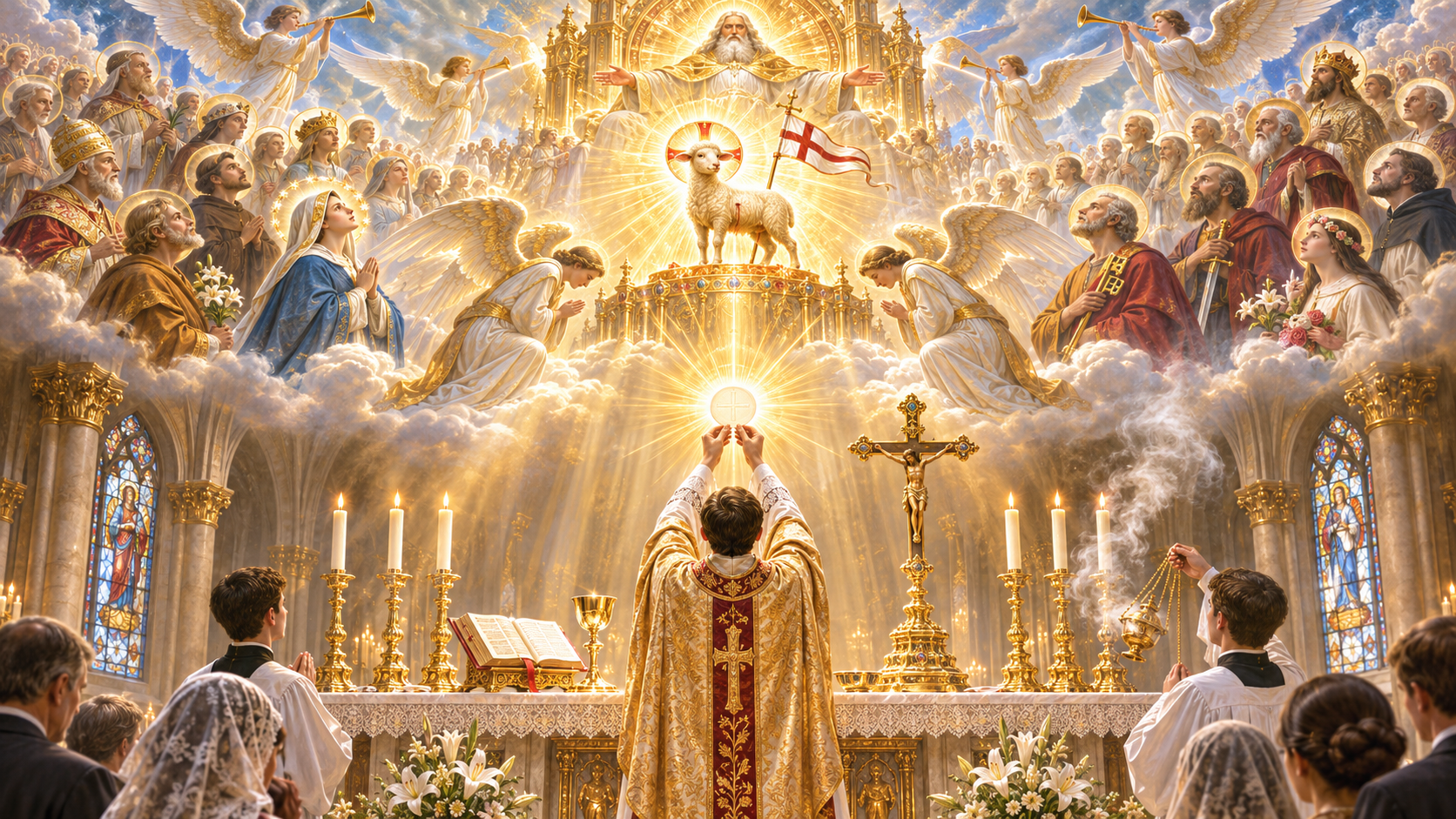
Why the Holy Sacrifice of the Mass is more than an earthly ceremony—and how Sacred Scripture reveals our participation in the worship of Heaven.
By Catholicg33k
A comprehensive Catholic theological and biblical exploration inspired by Scott Hahn’s The Lamb’s Supper: The Mass as Heaven on Earth, drawing upon Sacred Scripture, the Church Fathers, the Catechism, and the Church’s liturgical tradition.
INTRODUCTION: THE MYSTERY HIDDEN IN EVERY CATHOLIC CHURCH
There is something extraordinary happening in every Catholic church during the celebration of Holy Mass.
It is not visible to ordinary human eyes.
It cannot be measured by scientific instruments.
It does not depend upon the beauty of the church building, the quality of the music, or the eloquence of the priest.
Yet it is more significant than anything the world can offer.
When the Church gathers to celebrate the Holy Eucharist, she does not merely conduct a religious ceremony.
She enters sacramentally into the worship of Jesus Christ, the eternal High Priest.
The same Christ who offered Himself upon Calvary makes His one saving sacrifice present upon the altar.
The same Lord who reigns in heavenly glory becomes truly present under the appearances of bread and wine.
And the faithful who gather around that altar participate in a mystery that reaches beyond the boundaries of earthly time.
This is not poetic exaggeration.
It is Catholic doctrine.
The Second Vatican Council teaches in Sacrosanctum Concilium, paragraph 8, that the earthly liturgy gives us a foretaste of the heavenly liturgy celebrated in the New Jerusalem.
The Catechism goes even further in explaining the connection between the worship of Heaven and the worship of the Church.
Paragraph 1139 teaches that the Holy Ghost enables the Church to participate in the eternal heavenly liturgy whenever she celebrates the mystery of salvation in the sacraments.
Consider what that means.
The Mass celebrated in a small rural parish participates in the same saving mystery as the Mass celebrated in St. Peter’s Basilica.
A priest celebrating before a handful of faithful is offering the same Eucharistic sacrifice as one celebrating before thousands.
The external circumstances may differ.
But the essential mystery remains the same.
Jesus Christ is the principal Priest.
Jesus Christ is the sacrificial Victim.
Jesus Christ is the heavenly Bridegroom.
And the Church is His beloved Bride.
This profound understanding stands at the center of Scott Hahn’s influential book, The Lamb’s Supper: The Mass as Heaven on Earth.
Hahn invites readers to approach the Book of Revelation not simply as a mysterious prophecy about the end of the world, but also as a revelation of heavenly worship.
Through this perspective, the familiar prayers and gestures of the Mass begin to take on extraordinary meaning.
The altar.
The incense.
The priestly vestments.
The sacred hymns.
The proclamation of Scripture.
The offering of sacrifice.
The Lamb of God.
The great wedding feast.
All of these belong to the biblical vision of God’s saving plan.
And together they reveal a truth that can transform the way Catholics understand Sunday worship.
The Mass is not simply something we attend. It is the sacramental participation of the Church in the saving worship of Christ.
To understand this mystery, we must begin where St. John begins.
Before the throne of God.
1. THE BOOK OF REVELATION: A WINDOW INTO HEAVENLY WORSHIP
For many Christians, the Apocalypse of St. John is among the most difficult books of Sacred Scripture.
Its pages contain mysterious images.
Seven seals.
Seven trumpets.
A dragon.
Terrifying beasts.
Angels pouring out bowls of judgment.
A woman clothed with the sun.
A heavenly city descending from God.
These visions have inspired centuries of theological reflection.
Unfortunately, they have also encouraged endless speculation about political leaders, secret codes, and predictions concerning the end of the world.
Yet the Book of Revelation begins with something far more fundamental.
It reveals Jesus Christ.
Indeed, the very word apocalypse comes from the Greek apokalypsis, meaning an unveiling or revelation.
Its purpose is not merely to conceal future events beneath difficult symbols.
It is to disclose the ultimate victory of Jesus Christ and the reality of God’s sovereign reign.
And one of the most important realities disclosed by the book is worship.
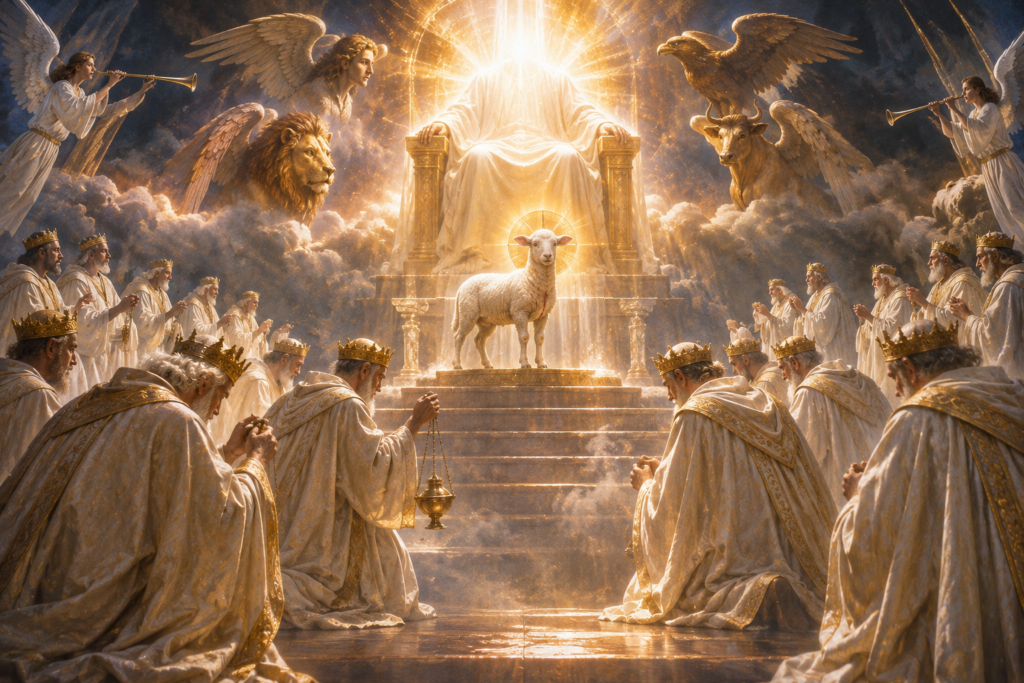
In Apocalypse chapter 4, St. John beholds the throne of God.
Around that throne stand twenty-four elders, clothed in white and wearing golden crowns.
Four living creatures continually proclaim the holiness of God.
In chapter 5, the heavenly scene reaches a remarkable climax.
St. John sees a Lamb.
But this is no ordinary lamb.
It is the Lamb who has been slain and yet stands alive.
The image reveals Jesus Christ in the victory of His Passion and Resurrection.
The Lamb’s sacrifice is not forgotten in Heaven.
It is the foundation of His triumph.
The heavenly assembly responds with adoration.
The elders fall before the Lamb.
The prayers of the saints are represented by golden vessels filled with incense.
Angels proclaim the worthiness of the Lamb.
Creation joins in the praise of God.
This is the heavenly liturgy.
And the Catholic Church teaches that our earthly worship is united to it.
The Catechism’s Interpretation
The Catechism, paragraphs 1136–1139, explicitly connects the Book of Revelation with the heavenly liturgy.
It identifies Christ as the crucified and risen Lamb, the eternal High Priest of the heavenly sanctuary.
It describes the participation of angels, saints, martyrs, the Blessed Virgin Mary, and the people redeemed by Christ.
The final point is especially important.
When the Church celebrates the sacraments, she participates in that eternal liturgy.
This does not mean the earthly Mass is identical in every respect to the perfected worship of Heaven.
Our participation remains sacramental, expressed through visible signs, and sustained by faith.
But the participation is real.
The earthly liturgy is not an imitation of Heaven without substance. It is a genuine sacramental sharing in Christ’s heavenly worship.
This insight is one of the great keys to understanding the Mass.
And it becomes even clearer when we examine the identity of the Lamb.
2. THE LAMB OF GOD: THE MYSTERY THAT BEGINS IN THE OLD TESTAMENT
The title Lamb of God is so familiar to Catholics that its meaning can easily be overlooked.
At every Mass, the faithful hear the invocation of the Lamb who takes away the sins of the world.
Before Holy Communion, the priest presents the Eucharistic Lord to the people.
But why does Scripture describe the Savior of mankind as a lamb?
The answer is found throughout the Old Testament.
Abraham, Isaac, and the Promised Sacrifice
In Genesis 22, God tests Abraham’s faith by commanding him to offer Isaac.
Isaac carries the wood for the sacrifice.
As father and son approach the place of offering, Isaac asks where the sacrificial victim is.
Abraham replies that God will provide the victim.
Christian tradition has long recognized a profound prefiguration of Christ in this account.
Isaac carries the wood.
Jesus carries the Cross.
Isaac is the beloved son.
Jesus is the eternal and beloved Son of the Father.
Yet there is an essential difference.
Isaac is spared.
Jesus willingly offers Himself for the salvation of the world.
The sacrifice of Christ accomplishes what the earlier biblical event could only prefigure.
Melchisedech: The Priest of Bread and Wine
Another important Old Testament figure appears in Genesis 14:18.
Melchisedech, king of Salem and priest of the Most High God, brings forth bread and wine.
His priesthood becomes an important biblical prefiguration of Christ’s eternal priesthood.
Psalm 109:4 declares that the Messiah is a priest forever according to the order of Melchisedech.
The Letter to the Hebrews develops this theology, particularly in chapters 5–7.
The connection matters because Jesus is not merely another priest offering an external sacrifice.
He is the eternal High Priest who offers Himself.
The Eucharistic liturgy preserves the memory of these Old Testament prefigurations.
The Roman Canon, traditionally called Eucharistic Prayer I, explicitly recalls the offerings of Abel, Abraham, and Melchisedech.
The worship of the Old Covenant was preparing humanity to recognize the perfect offering of Christ.
The Passover Lamb
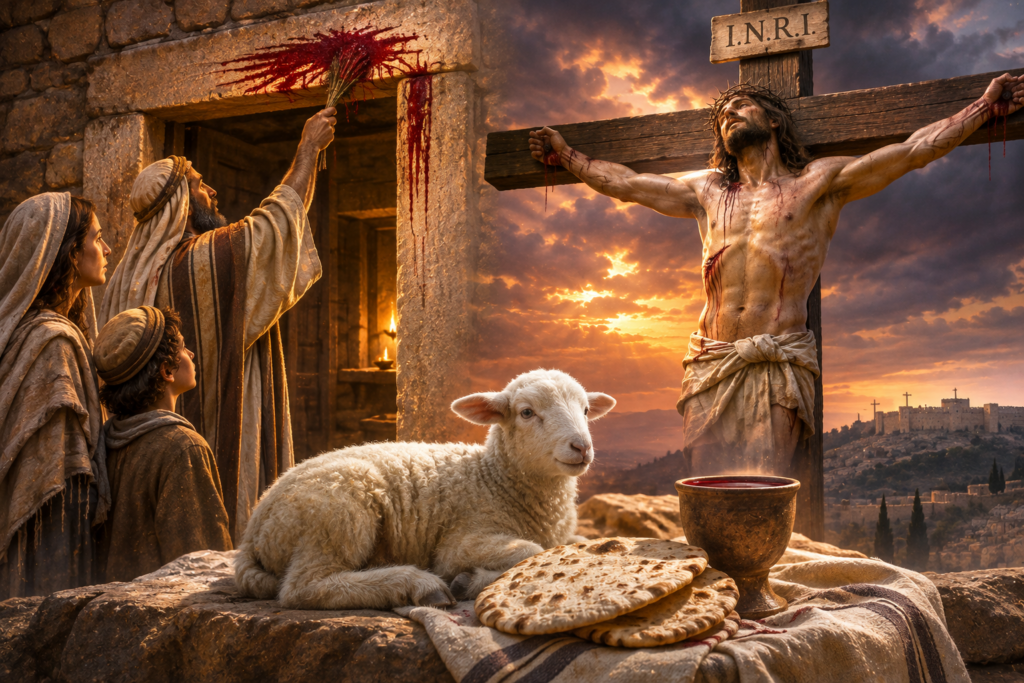
The fullest Old Testament preparation for the Eucharist appears in Exodus 12.
On the night of Israel’s deliverance from Egypt, God commanded each household to take an unblemished lamb.
The lamb was sacrificed.
Its blood marked the homes of the Israelites.
The people consumed the Passover meal in preparation for their departure from slavery.
These events belonged to the liberation of God’s chosen people.
But they also anticipated a much greater deliverance.
Jesus Christ fulfills the Passover through His Passion, Death, and Resurrection.
St. Paul declares:
“For Christ our pasch is sacrificed.”
— 1 Corinthians 5:7, Douay-Rheims
St. John’s Gospel emphasizes the connection between Jesus and the Passover lamb, including the fulfillment associated with the fact that none of His bones was broken (John 19:36; Exodus 12:46).
At Calvary, Christ offers the perfect sacrifice.
His Precious Blood becomes the means of our redemption.
He frees humanity not merely from political slavery, but from the bondage of sin and death.
The Passover of ancient Israel finds its fulfillment in the Paschal Mystery.
And the Eucharist is the sacramental memorial of that saving mystery.
3. THE MASS IS THE SACRIFICE OF CALVARY MADE PRESENT
One of the most persistent misunderstandings about Catholicism concerns the sacrificial nature of the Mass.
Some Christians believe Catholics teach that Jesus is sacrificed repeatedly at every celebration.
But this is not what the Catholic Church teaches.
Jesus Christ died once for all.
His sacrifice is perfect.
His offering is sufficient.
Nothing can be added to the infinite value of His redemptive work.
The Letter to the Hebrews repeatedly emphasizes the unique and definitive character of Christ’s sacrifice (Hebrews 7:27; 9:11–28; 10:10–14).
Catholic theology fully affirms this truth.
The Mass does not create another Calvary.
It does not offer another Savior.
It does not repeat Christ’s bloody death.
Instead, it makes His one sacrifice sacramentally present.
One Priest, One Victim, One Sacrifice
The Catechism states in CCC 1367 that the sacrifice of Christ and the Eucharistic sacrifice are one single sacrifice.
The same Christ who offered Himself upon Calvary now offers Himself through the ministry of His priests.
The difference concerns the manner of offering.
On Calvary, Christ offered Himself through His bloody Passion and Death.
In the Mass, that one saving sacrifice is made present sacramentally in an unbloody manner.
The priest does not replace Christ.
He acts in persona Christi Capitis—in the person of Christ the Head.
Christ remains the principal Priest and the sacrificial Victim.
This is why the Mass possesses an incomparable dignity.
Its value does not come from the personal holiness of the celebrating priest.
It comes from Jesus Christ.
When Catholics participate in Mass, they are united sacramentally to the one saving sacrifice accomplished upon the Cross.
The Mass does not add another sacrifice to Calvary. It brings the saving reality of Calvary into sacramental presence.
This is also why the Eucharist is the greatest act of worship offered by the Church.
It is the offering of Christ Himself.
4. THE EUCHARIST: NOT ONLY A SACRIFICE, BUT A SACRED BANQUET
The Eucharist is both sacrifice and sacred meal.
These two realities cannot be separated.
At the Last Supper, Jesus took bread and wine and gave them to His Apostles.
He identified the bread with His Body and the chalice with His Blood of the New Covenant.
He then commanded His Apostles to perpetuate this memorial.
The Church has obeyed that command throughout the centuries.
But the Eucharist is not an ordinary meal.
It is not simply a religious gathering intended to express community.
It is communion with the living Christ.
The Bread of Life Discourse
In John 6, Jesus describes Himself as the Bread that came down from Heaven.
He teaches that His Flesh is true food and His Blood true drink.
His words provoke controversy because their meaning is extraordinary.
Christ promises a participation in His own life through the gift of His Flesh and Blood.
The Catholic Church understands these words in the light of the Last Supper, the Paschal Mystery, and the Eucharistic faith handed down from the Apostles.
The Catechism teaches that Jesus Christ is truly, really, and substantially present in the Eucharist.
Under the appearances of bread and wine, the communicant receives Christ whole and entire—Body, Blood, Soul, and Divinity.
See CCC 1373–1377.
Transubstantiation
The Church uses the term transubstantiation to describe the change that occurs at the consecration.
The substance of bread becomes the substance of Christ’s Body.
The substance of wine becomes the substance of His Blood.
The appearances of bread and wine remain.
This transformation is accomplished by the power of Christ and the action of the Holy Ghost.
Consequently, the Eucharist is not merely a representation of Christ.
It is Christ Himself, truly present sacramentally.
To receive Holy Communion worthily is to be united to the living Lord in a manner unlike any other ordinary human experience.
This is why Catholics prepare themselves through faith, repentance, prayer, and reverence.
Anyone conscious of grave sin must receive sacramental absolution before approaching Holy Communion, except in the extraordinary circumstances provided by the Church’s law and teaching (CCC 1385; Code of Canon Law, canon 916).
The Eucharist must never be approached casually.
For in this sacrament, the Lord of Heaven and earth gives Himself to His people.
5. THE EARLY CHRISTIANS ALREADY BELIEVED IN THE EUCHARISTIC MYSTERY
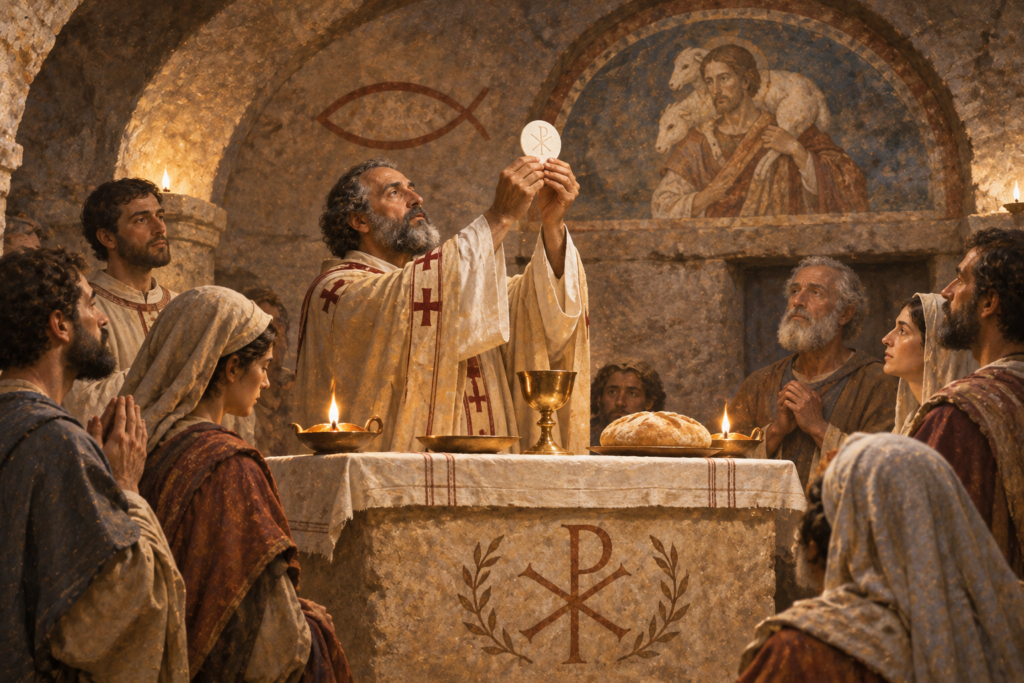
The Catholic understanding of the Eucharist did not suddenly appear in the Middle Ages.
Its essential foundations are found in the New Testament and in the earliest Christian witnesses.
The Apostles and the Breaking of Bread
Acts 2:42 describes the first Christian community as persevering in the teaching of the Apostles, fellowship, the breaking of bread, and prayers.
In Luke 24, the disciples on the road to Emmaus recognize the risen Lord in the breaking of bread.
St. Paul preserves the words of institution in 1 Corinthians 11:23–26.
He also warns that receiving the Eucharist unworthily is a grave matter (1 Corinthians 11:27–29).
These passages establish that Eucharistic worship occupied a central place in apostolic Christianity.
The Didache
The Didache, an early Christian text generally dated to the late first or early second century, contains instructions concerning Christian prayer and Eucharistic gatherings.
Chapter 14 associates the Lord’s Day assembly and the breaking of bread with the language of sacrifice.
It also stresses confession and reconciliation.
This witness demonstrates that the early Christian understanding of worship was already more substantial than an informal commemorative meal.
St. Ignatius of Antioch
Around the beginning of the second century, St. Ignatius of Antioch wrote against those who rejected the true humanity of Jesus Christ.
In his Letter to the Smyrnaeans, chapter 7, he criticizes those who deny that the Eucharist is the Flesh of the Savior who suffered for our sins.
His testimony is remarkably direct.
For Ignatius, Eucharistic faith is inseparable from the Incarnation, Passion, and Resurrection.
St. Justin Martyr
Around AD 155, St. Justin Martyr provided a description of Christian Sunday worship in his First Apology, chapters 65–67.
He describes the reading of Scripture.
The instruction offered by the presider.
The prayers of the faithful.
The presentation of bread and wine.
Thanksgiving over the gifts.
The participation of the congregation.
And the distribution of the Eucharist.
He also explains that Christians do not regard this sacred nourishment as ordinary bread and ordinary drink.
The structure he describes bears a recognizable relationship to the Mass celebrated by the Catholic Church today.
External liturgical forms developed through the centuries.
Different liturgical traditions emerged.
But the essential Eucharistic faith remained.
The early Church did not regard the Eucharist as an empty symbol.
She recognized it as a sacred encounter with Jesus Christ.
6. WHY CATHOLIC WORSHIP IS LITURGICAL
One of the most important insights in Scott Hahn’s work concerns the biblical character of liturgical worship.
Many modern people assume that genuine worship must be spontaneous.
They imagine that prescribed prayers, repeated responses, sacred gestures, and ritual actions somehow interfere with authentic spiritual expression.
But Sacred Scripture does not support the idea that liturgical order and sincere worship are opposed.
Ancient Israel worshipped God through divinely prescribed sacrifices, sacred vessels, vestments, feasts, and prayers.
God gave Moses detailed instructions regarding the construction of the Tabernacle.
The priesthood possessed an ordered ministry.
The Temple possessed a sacred pattern of worship.
The Psalms formed the inspired prayer book of God’s people.
And in Heaven, St. John witnesses ordered and continuous worship.
The angels proclaim divine praise.
The elders bow in adoration.
The saints offer their prayers before God’s throne.
The heavenly assembly responds to the Lamb.
Therefore, structured worship is not necessarily lifeless.
When properly understood and faithfully celebrated, it directs the whole human person toward God.
Worship Involves the Body
Human beings are not disembodied spirits.
We worship with our minds, hearts, voices, and bodies.
This is why the Church’s liturgy employs physical signs.
Standing expresses reverence.
Kneeling expresses adoration.
Making the Sign of the Cross professes faith in the Holy Trinity and the saving Cross of Christ.
Holy water recalls Baptism.
Sacred images direct the mind toward Christ and His saints.
Incense symbolizes honor and prayer ascending toward God.
Sacred music gives voice to the Church’s praise.
These signs are not replacements for interior faith.
They are expressions of it.
And through the sacramental economy established by Christ, visible signs become instruments of divine grace.
The goal of Catholic worship is therefore neither empty ceremonialism nor uncontrolled emotionalism.
It is the worship of God in spirit and truth.
7. THE STRUCTURE OF THE MASS: EARTHLY SIGNS OF HEAVENLY REALITIES
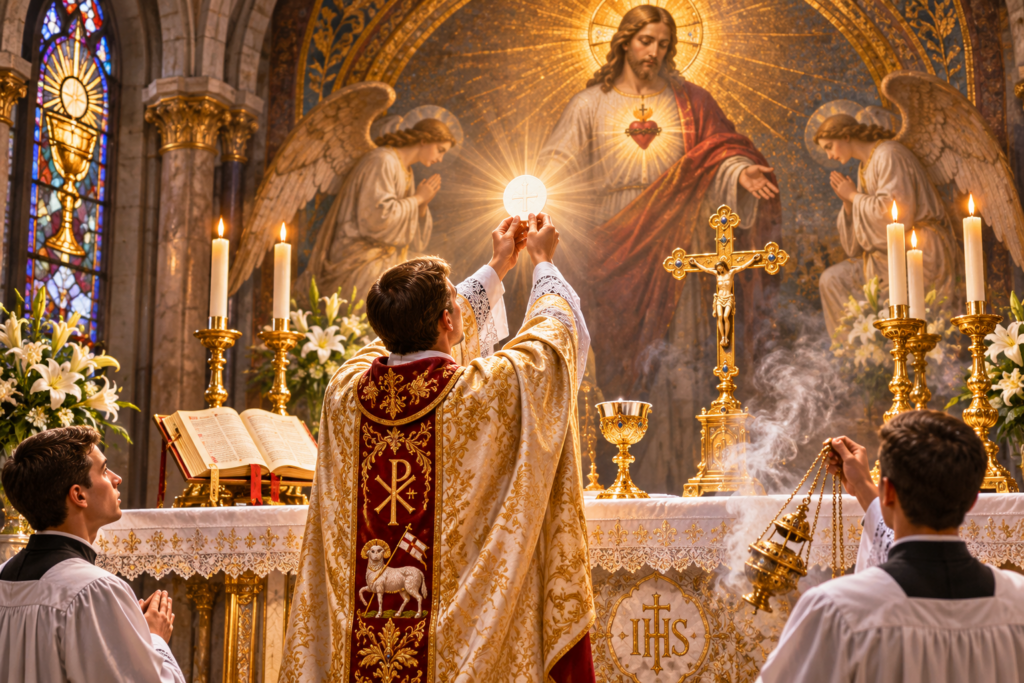
The Mass unfolds through two great movements.
The Liturgy of the Word.
And the Liturgy of the Eucharist.
According to CCC 1346, these two parts form a single act of worship.
Understanding their structure helps reveal the profound biblical meaning of the Mass.
The Sign of the Cross
In the Roman Rite, the celebration begins with the invocation of the Most Holy Trinity.
The faithful mark themselves with the Cross and profess the name of the Father, Son, and Holy Ghost.
This simple action recalls Baptism and the saving sacrifice of Christ.
The Christian enters the liturgy not as a stranger, but as a member of Christ’s Mystical Body.
The Penitential Act
The faithful acknowledge their sins and ask God’s mercy.
Before approaching the sacred mysteries, the Church calls her children to humility and repentance.
This does not replace sacramental Confession when mortal sin must be absolved.
Rather, it helps dispose the faithful to worship God sincerely.
The Gloria
On the days prescribed by the Church’s liturgical calendar, the Gloria proclaims the praise of God.
Its opening recalls the angelic proclamation at Bethlehem (Luke 2:14).
The Church joins her voice to the praise of Heaven.
The Liturgy of the Word
The readings proclaim God’s revelation.
The Responsorial Psalm allows the congregation to pray with inspired biblical words.
The Gospel is received with particular honor because it recounts the words and deeds of Jesus Christ.
The homily explains the sacred texts and applies them to Christian life.
On appointed days, the Creed expresses the faith of the Church.
The faithful then offer intercessions for the needs of the Church and the world.
Through the proclamation of Scripture, Christ continues to speak to His people.
The Presentation of the Gifts
Bread and wine are brought to the altar.
These simple elements will become the sacramental signs through which Christ makes Himself truly present.
The Church also offers to God the work, suffering, thanksgiving, and intentions of her members.
But these human offerings receive their ultimate value through their union with Christ’s perfect sacrifice.
The Sanctus
The Eucharistic Prayer includes the great acclamation of divine holiness.
The Sanctus draws upon the heavenly worship described in Isaiah 6:3 and Apocalypse 4:8.
The earthly congregation joins in praise with the angels.
This is not merely a pleasant comparison.
The Church understands her liturgy as united to the worship of the heavenly hosts.
The Eucharistic Prayer
The Eucharistic Prayer is the center and summit of the celebration.
The priest gives thanks to the Father through Christ in the Holy Ghost.
The Church invokes the divine action by which the gifts become the Body and Blood of Christ.
The words of institution recall the Lord’s command at the Last Supper.
Through the consecration, Christ becomes truly present under the Eucharistic species.
The Church commemorates His Passion, Resurrection, and Ascension.
She offers the spotless Victim to the Father.
She intercedes for the living and the dead.
And she unites herself to the praise of Heaven.
The Great Amen
At the conclusion of the Eucharistic Prayer, the people proclaim their assent.
The Amen expresses their participation in the prayer of the Church.
It should never be treated as an insignificant response.
The faithful are joining their praise and self-offering to the sacrifice of Christ.
The Our Father and Holy Communion
The Church prays the prayer taught by Jesus.
She then prepares to receive the Lamb of God.
Holy Communion is the culmination of the sacramental banquet.
Christ gives Himself to His people as the Bread of Life.
This communion deepens union with Christ and strengthens the unity of His Mystical Body.
The Dismissal
The Mass concludes with a sending forth.
The faithful are commissioned to live what they have celebrated.
The grace received at the altar is meant to shape every part of Christian life.
Worship and mission belong together.
8. THE HEAVENLY TEMPLE AND THE CATHOLIC LITURGY
One of the most illuminating ways to read the Apocalypse is to observe its liturgical imagery.
St. John describes a heavenly sanctuary filled with the language of worship.
The parallels with Catholic liturgy are substantial.
| The Book of Revelation | Catholic Liturgical Connection |
|---|---|
| The heavenly throne (Apocalypse 4:2–3) | Worship directed toward the sovereign God |
| Seven golden lampstands (Apocalypse 1:12) | Sacred light and Temple symbolism |
| The twenty-four elders (Apocalypse 4:4) | Heavenly worship and priestly imagery |
| White garments (Apocalypse 7:9) | Purity, victory, and liturgical vesture |
| Golden vessels of incense (Apocalypse 5:8) | Prayers offered before God |
| The heavenly altar (Apocalypse 8:3) | Sacrificial worship |
| The hymn of holiness (Apocalypse 4:8) | The Sanctus |
| The Lamb who was slain (Apocalypse 5:6) | Jesus Christ, the Eucharistic sacrifice |
| The multitude in white (Apocalypse 7:9–10) | The Communion of Saints |
| The marriage supper (Apocalypse 19:9) | The Eucharist as a foretaste of the heavenly banquet |
These connections are theological correspondences, not claims that every liturgical object was directly copied from a particular passage of Revelation.
The liturgy developed within the living Tradition of the Church.
Yet its biblical foundations are unmistakable.
The worship revealed to St. John is centered on Christ.
The worship of the Church is centered on Christ.
And through the Holy Eucharist, the faithful are united to His saving sacrifice.
9. THE COMMUNION OF SAINTS: WE NEVER WORSHIP ALONE
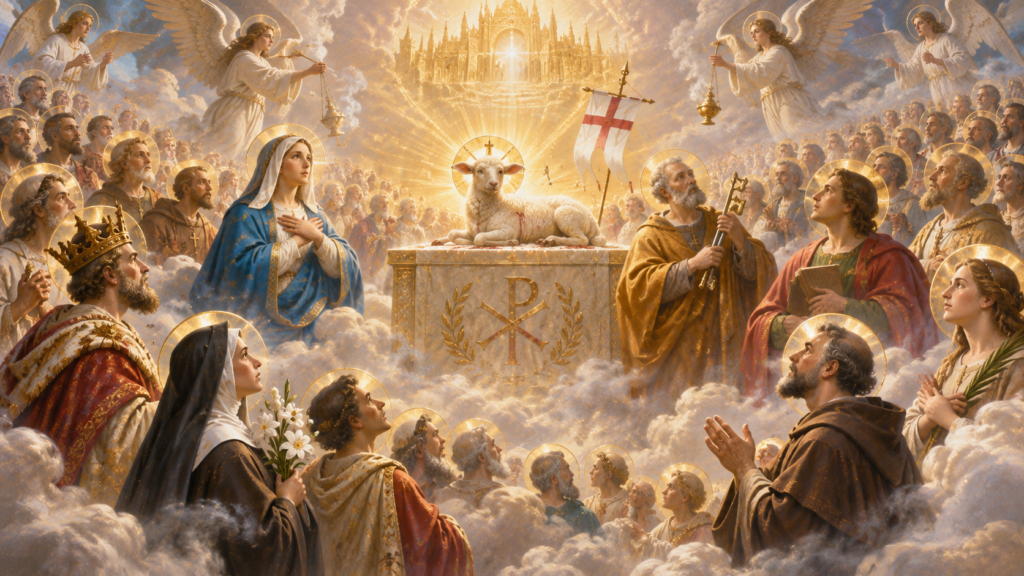
Catholics sometimes approach Sunday Mass as though they were participating in an isolated local event.
We see the priest.
We see the congregation.
We hear the choir.
We notice the altar and the sanctuary.
But the Church teaches that the liturgy embraces a communion far greater than the visible assembly.
The Catechism identifies the angels and saints as participants in the heavenly worship.
The Church on earth is united to the Church in glory.
This is the mystery of the Communion of Saints.
The faithful on earth remain pilgrims.
The souls undergoing purification await the fullness of heavenly glory.
The blessed in Heaven behold God face to face.
Yet all who belong to Christ remain united in His Mystical Body.
See CCC 954–959.
The Angels at Mass
The angels continually worship God.
Their praise appears throughout Scripture.
Isaiah sees the seraphim proclaiming God’s holiness.
St. John beholds the heavenly hosts adoring the Lamb.
In the liturgy, the Church joins their praise.
This is why the Mass cannot be reduced to an ordinary human gathering.
The liturgy belongs to Christ and His entire Church.
The Saints and Their Prayers
Apocalypse 5:8 depicts the prayers of the saints under the symbolism of incense offered before the Lamb.
Apocalypse 8:3–4 also connects incense with the prayers ascending before God.
These passages form part of the biblical context for Catholic teaching concerning heavenly intercession.
The saints do not replace the unique mediation of Jesus Christ.
Their intercession depends entirely upon Him.
As members of His Mystical Body, they participate in His saving work according to His grace.
The Catholic who enters Mass is therefore united to a vast spiritual family.
The worship of Heaven is not a rival to earthly worship.
It is the glorious reality toward which earthly worship is directed.
10. MARY, THE NEW ARK OF THE COVENANT, IN THE HEAVENLY LITURGY
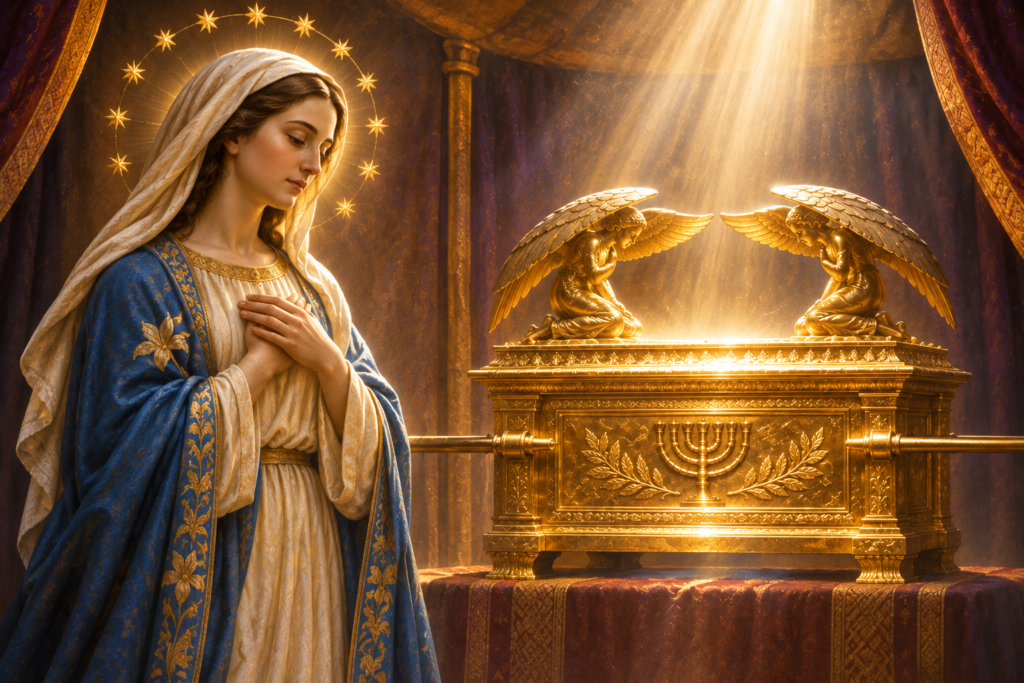
One of the most beautiful connections between the Old Testament and the Apocalypse concerns the Blessed Virgin Mary.
Near the end of Apocalypse chapter 11, St. John beholds the Ark of the Covenant in the heavenly Temple.
Immediately afterward, in chapter 12, he sees a glorious Woman clothed with the sun.
She bears the male Child destined to rule the nations.
Catholic interpretation recognizes a profound Marian meaning in this vision.
The Woman is associated with Mary, the Mother of the Messiah.
She also symbolizes faithful Israel and the Church.
These meanings are complementary rather than necessarily exclusive.
Why Mary Is Called the New Ark
The original Ark of the Covenant was associated with three sacred objects.
The tablets of the Law.
The manna from Heaven.
Aaron’s priestly rod.
Each of these finds fulfillment in Jesus Christ.
The Law points toward the eternal Word.
The manna points toward the true Bread from Heaven.
Aaron’s priesthood points toward Christ, the eternal High Priest.
Mary bore within her womb the Person who fulfilled all three.
The connection becomes even more remarkable in Luke’s account of the Visitation.
David rejoices before the Ark.
John the Baptist leaps for joy in the presence of the unborn Christ.
David asks how the Ark of the Lord can come to him.
Elizabeth asks why the Mother of her Lord should come to her.
The Ark remains in the house of Obededom for three months.
Mary remains with Elizabeth for about three months.
These biblical parallels have long been understood as part of the Church’s Marian typology.
The Overshadowing of God’s Glory
In Exodus 40:34–35, God’s glory overshadows the Tabernacle.
At the Annunciation, Gabriel announces that the power of the Most High will overshadow Mary (Luke 1:35).
The language recalls the divine presence dwelling among God’s people.
But the fulfillment is greater than the preparation.
The ancient sanctuary was a sacred place associated with God’s presence.
In Mary, the eternal Son of God truly assumed human nature.
She became the Mother of God.
Not because she created His divinity.
But because the Person whom she bore is the eternal Son.
The Catechism expressly identifies Mary as the Ark of the Covenant in CCC 2676.
Mary’s Place in Heavenly Worship
Mary’s greatness does not diminish the glory of Jesus Christ.
It comes entirely from Him.
The Mother of God is not the object of divine worship.
She is the most exalted of redeemed creatures.
Her glory reveals the transforming power of divine grace.
In contemplating Mary in the Apocalypse, Catholics are led toward the ultimate victory of Christ over sin, death, and Satan.
She represents the faithful response of humanity to God’s saving plan.
And she remains inseparably connected to the mystery of the Incarnation.
11. THE DRAGON, THE BEASTS, AND THE SPIRITUAL WARFARE OF CHRISTIANS
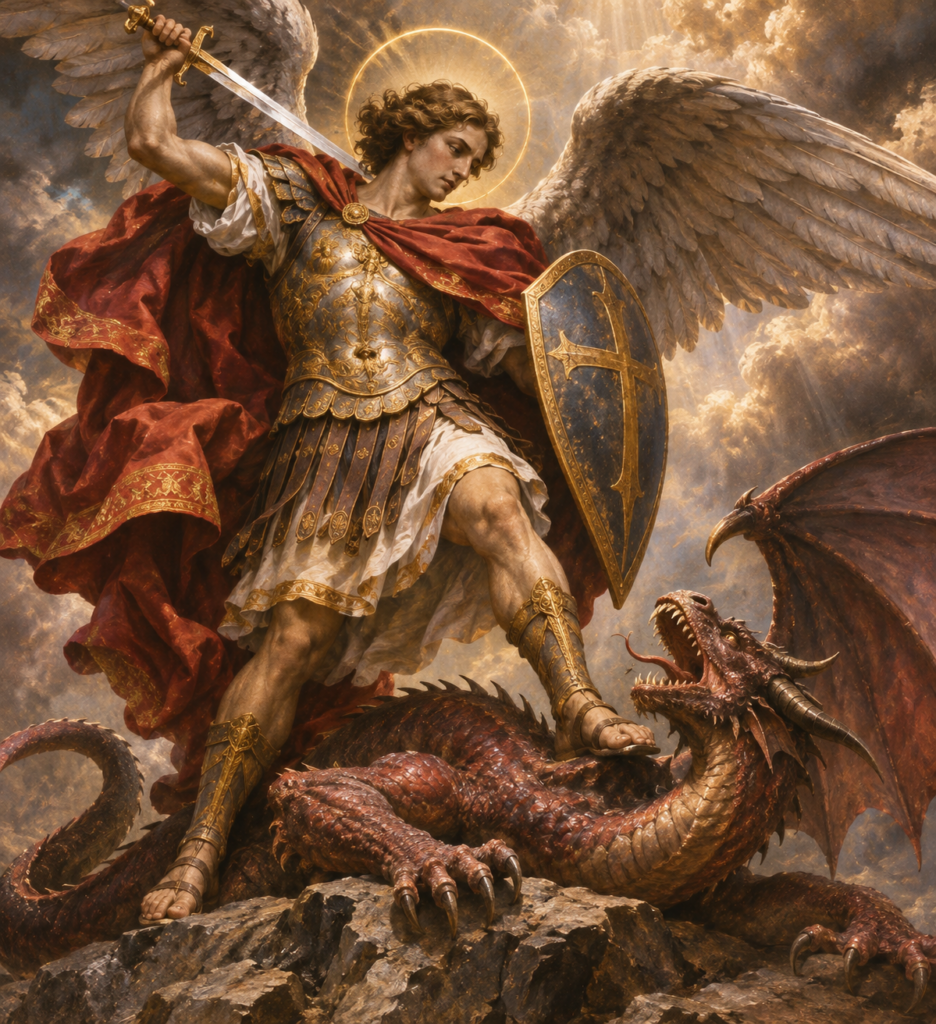
The Book of Revelation does not present heavenly worship as a peaceful spectacle detached from history.
Its visions also describe intense conflict.
The dragon attempts to destroy the Woman and her Child.
He makes war against those who keep God’s commandments and bear witness to Jesus Christ.
The dragon is explicitly identified as the devil and Satan (Apocalypse 12:9).
This reveals that Christian life involves genuine spiritual conflict.
But the decisive victory belongs to Christ.
The First Beast: Corrupt Earthly Power
Apocalypse 13 describes a beast rising from the sea.
Its imagery draws heavily upon the prophet Daniel, especially Daniel 7.
The beast represents power opposed to God’s sovereignty.
Within the historical context of the early Church, Roman imperial power and emperor worship provide important background for understanding the image.
The Roman Empire demanded political loyalty and, in certain contexts, religious honors incompatible with Christian worship.
Christians therefore faced a choice.
Would they worship the true God?
Or would they surrender the worship owed to Him alone?
The symbolism also extends beyond the ancient world.
Whenever political authority claims absolute allegiance or demands actions contrary to divine truth, the Christian encounters a similar spiritual danger.
The Second Beast: Religious Deception
Another beast appears in Apocalypse 13.
It possesses lamb-like features but speaks with the voice of the dragon.
This disturbing contrast reveals the danger of religious deception.
Something may appear innocent or spiritually appealing while directing people away from God.
The image has received several interpretations throughout Christian history.
It can be read against the background of ancient religious propaganda supporting imperial worship.
It also provides a broader warning about false religious authority and deception.
However, the Church has not defined every historical identification of these apocalyptic figures.
Catholics should therefore distinguish biblical doctrine from proposed interpretations of particular symbols.
The Number 666
Few biblical numbers have attracted more speculation than 666.
Apocalypse 13:18 identifies it as the number associated with the beast.
One influential scholarly interpretation associates the number with Nero Caesar through ancient numerical calculations.
Other interpretations understand it more broadly as a symbol of human power exalted against God.
The symbolism of six falling short of seven has also been used in theological reflection to represent incompleteness.
Nevertheless, the precise interpretation of the number remains debated.
Catholics should avoid presenting speculative calculations as though the Church had defined them.
The spiritual warning is clearer than many sensational predictions.
Human beings must never give created powers the worship and absolute allegiance that belong to God alone.
Worship as Spiritual Resistance
The Christian’s ultimate allegiance belongs to Jesus Christ.
This is why true worship is inseparable from spiritual warfare.
When Christians worship God, reject sin, receive the sacraments worthily, and practice charity, they resist the dominion of evil.
The Mass is the sacramental celebration of the victory accomplished by Christ.
It strengthens the faithful to persevere in that victory.
But the Eucharist should not be reduced to a spiritual weapon used mechanically against evil.
Its primary purpose is the worship of God, communion with Christ, and sanctification of His people.
Precisely because it accomplishes these purposes, it strengthens Christians against sin and temptation.
The victory over evil does not originate in human strength. It belongs to the Lamb who was slain and now reigns forever.
12. THE WRATH OF THE LAMB: DIVINE JUSTICE AND DIVINE MERCY
One of the most striking expressions in the Apocalypse is the wrath of the Lamb (Apocalypse 6:16).
The image appears paradoxical.
A lamb ordinarily suggests gentleness.
Wrath suggests judgment.
But Jesus Christ is both the merciful Savior and the just Judge.
Catholic theology refuses to separate divine mercy from divine justice.
God’s mercy does not mean that evil is insignificant.
His justice does not mean that He delights in suffering.
The Cross itself reveals the seriousness of sin and the immensity of divine love.
Christ willingly suffers for sinners.
He offers the perfect sacrifice.
He calls humanity to repentance.
The judgments described in Revelation therefore must be interpreted in the light of God’s holiness, justice, and saving plan.
Some judgments function as warnings that invite conversion.
Others reveal the final defeat of evil.
They cannot all be reduced merely to therapeutic correction.
The Apocalypse teaches that human choices possess eternal significance.
The Lord who comes as Savior is also the Lord before whom every creature must give an account.
This is why Christians should receive God’s mercy with gratitude and respond through repentance and faithful obedience.
The message is neither despair nor presumption.
It is conversion.
13. THE MARRIAGE SUPPER OF THE LAMB: THE GREAT DESTINATION OF SALVATION HISTORY
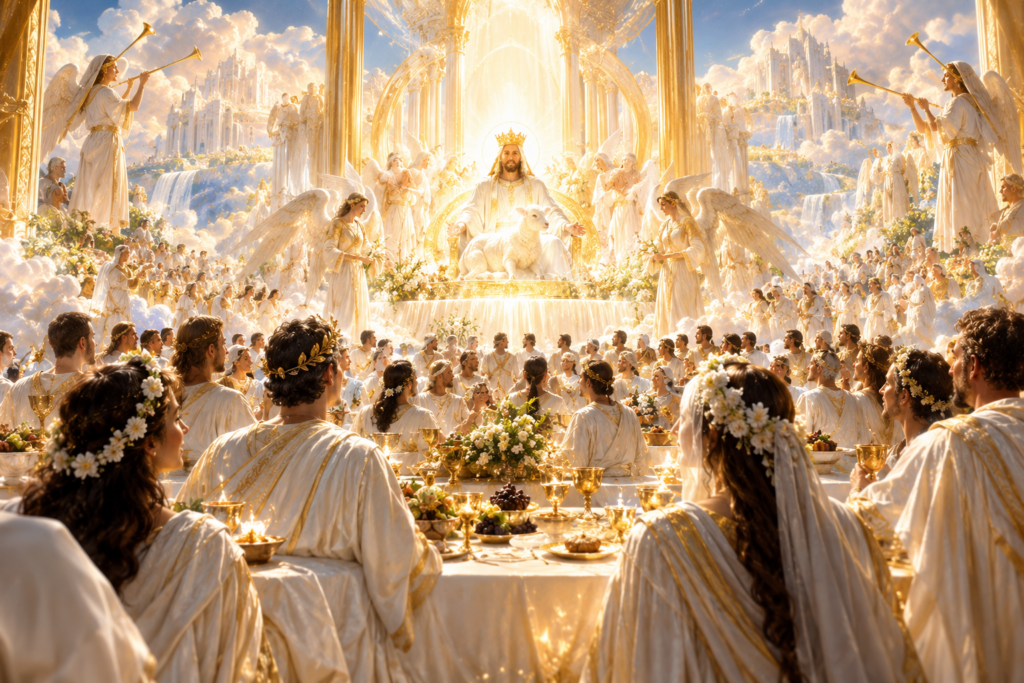
As the Book of Revelation approaches its conclusion, the imagery moves toward the fulfillment of God’s promises.
The powers of evil are defeated.
The heavenly kingdom is revealed.
The New Jerusalem appears.
And the Church is portrayed as a Bride prepared for her Bridegroom.
St. John declares:
“Blessed are they that are called to the marriage supper of the Lamb.”
— Apocalypse 19:9, Douay-Rheims
This is among the most beautiful images in all of Sacred Scripture.
It reveals that the final destiny of the redeemed is not merely the avoidance of punishment.
It is eternal communion with God.
Christ the Bridegroom
Throughout the Old Testament, God describes His covenant relationship with Israel through the imagery of marriage.
The prophets speak of God’s fidelity and Israel’s infidelity.
Idolatry is frequently portrayed as spiritual adultery.
Restoration is described through the renewal of covenant love.
In the New Testament, Jesus identifies Himself as the Bridegroom (Matthew 9:15).
St. Paul describes the union of Christ and the Church through the mystery of marriage (Ephesians 5:25–32).
The Cross is the supreme manifestation of the Bridegroom’s self-giving love.
Christ gives Himself for His Bride.
He sanctifies her.
He prepares her for eternal communion.
The Eucharist and the Heavenly Wedding Feast
The Eucharist is the sacramental banquet of the New Covenant.
It is also a foretaste of the eternal heavenly feast.
At Mass, Christ gives Himself to His Church.
Through Holy Communion, the faithful are united to Him.
Yet this communion remains veiled beneath sacramental appearances.
The blessed in Heaven behold God directly in the beatific vision.
On earth, we walk by faith.
In Heaven, faith reaches its fulfillment in sight.
The Eucharist therefore points beyond itself toward the eternal communion for which humanity was created.
This is why Catholic theology calls the Eucharist a pledge of future glory.
See CCC 1402–1405.
The Mass is not the final wedding feast in its complete heavenly fulfillment.
But it truly anticipates that feast and communicates the life of the Bridegroom to His people.
14. ADOPTED CHILDREN OF GOD: THE DEEPEST MEANING OF COMMUNION
The goal of salvation is even more profound than the forgiveness of sins.
Through Jesus Christ, human beings are invited to become adopted sons and daughters of God.
This is not merely an honorary title.
It is a supernatural transformation accomplished through sanctifying grace.
St. John writes:
“Behold what manner of charity the Father hath bestowed upon us, that we should be called, and should be the sons of God.”
— 1 John 3:1, Douay-Rheims
Through Baptism, Christians are incorporated into Christ.
They receive sanctifying grace.
They become members of His Mystical Body.
They participate in divine life through grace.
See CCC 1265–1266 and 1996–2000.
Sons and Daughters in the Son
Jesus Christ is the eternal Son of God by nature.
Christians become children of God by adoption.
The distinction is essential.
We do not become divine persons.
We do not become equal to God.
Instead, through grace, we receive a created participation in His divine life.
The Eucharist nourishes and deepens that life.
It strengthens our union with Christ.
It increases charity.
It unites the members of His Church.
Consequently, Holy Communion has implications far beyond an individual’s private spiritual experience.
The Church Is a Family
The Church is not merely a religious institution.
She is the People of God.
The Body of Christ.
The Temple of the Holy Ghost.
The Bride of the Lamb.
And the household of God.
Through the Eucharist, her members are united more deeply to Christ and to one another.
This unity requires charity.
It requires forgiveness.
It requires the rejection of pride and factionalism.
St. Paul warns that receiving the Eucharist while disregarding the dignity of fellow Christians contradicts the mystery being celebrated.
The Eucharist calls the Church to become more fully what she already is through grace.
One Body in Christ.
For this reason, the Mass should transform the way Catholics treat one another.
A person cannot sincerely adore Christ in the Eucharist while deliberately refusing the demands of Christian charity.
The love received at the altar must become the love practiced in everyday life.
15. THE MASS DOES NOT END AT THE CHURCH DOORS
A common temptation is to separate Sunday worship from the rest of life.
We attend Mass.
We pray.
We receive Holy Communion.
Then we return to ordinary responsibilities as though nothing extraordinary occurred.
But the Eucharist calls for conversion.
The grace of the sacrament should transform how Christians live.
The Offering of Daily Life
St. Peter teaches that Christians are called to offer spiritual sacrifices acceptable to God through Jesus Christ (1 Peter 2:5).
St. Paul urges believers to present their bodies as a living sacrifice, holy and pleasing to God (Romans 12:1).
This means Christian life can become a continual offering of love.
A parent caring for a sick child.
A worker performing honest labor.
A student pursuing truth.
A husband or wife remaining faithful through difficulties.
A Christian forgiving someone who caused great pain.
A person bearing suffering with trust in God.
All these actions can be united spiritually to the sacrifice of Christ.
They do not replace the Mass.
They flow from the Christian’s participation in the saving grace of Christ.
The Dismissal as a Mission
At the end of Mass, the faithful are sent forth.
The Latin dismissal Ite, missa est belongs to the ancient liturgical tradition.
The Church’s mission continues beyond the church building.
The faithful are called to carry the Gospel into their homes, workplaces, and communities.
This is why the Eucharist cannot remain merely a private devotion.
It forms disciples.
It strengthens charity.
It nourishes holiness.
And it sends Christians into the world as witnesses to Jesus Christ.
The Mass is not an interruption of Christian life.
It is the source from which Christian life receives its greatest nourishment.
16. HOW TO ATTEND MASS WITH THE EYES OF FAITH
Understanding the connection between the Mass and the Apocalypse should change the way we approach the Eucharist.
The Catholic who understands this mystery will no longer regard Sunday Mass as merely another weekly obligation.
He will recognize it as an encounter with the living Christ.
There are practical ways to deepen this awareness.
Prepare Before Entering the Church
Read the Sunday Scripture readings beforehand.
Spend time in prayer.
Examine your conscience.
Approach the sacred mysteries with reverence.
If conscious of mortal sin, seek sacramental Confession before receiving Holy Communion, according to the Church’s discipline.
Recognize Christ in the Liturgy
Listen attentively to Sacred Scripture.
Participate reverently in the prayers and responses.
Remember that Christ is the principal actor in the liturgy.
The Mass is not a performance staged for human approval.
It is worship offered to God.
Contemplate the Heavenly Liturgy
During the Sanctus, remember the angels who continually praise God.
During the Eucharistic Prayer, recall Christ’s one sacrifice upon Calvary.
During the elevation, adore the Lord truly present in the Eucharist.
During Holy Communion, give thanks for the extraordinary gift of union with Jesus Christ.
Remember the Communion of Saints
The Church never worships in isolation from the heavenly assembly.
Remember the Blessed Virgin Mary, St. Joseph, the Apostles, the martyrs, and all the saints.
Pray also for the faithful departed.
The Eucharistic sacrifice unites the Church in charity and intercession.
Live What You Receive
After Mass, practice the faith you have professed.
Love your family.
Forgive your enemies.
Care for the poor.
Defend the truth.
Remain faithful to God’s commandments.
And return to the altar with a heart increasingly prepared for heavenly communion.
The more deeply we understand the Mass, the more seriously we should live the Christian life.
CONCLUSION: THE ALTAR IS A MEETING PLACE OF HEAVEN AND EARTH
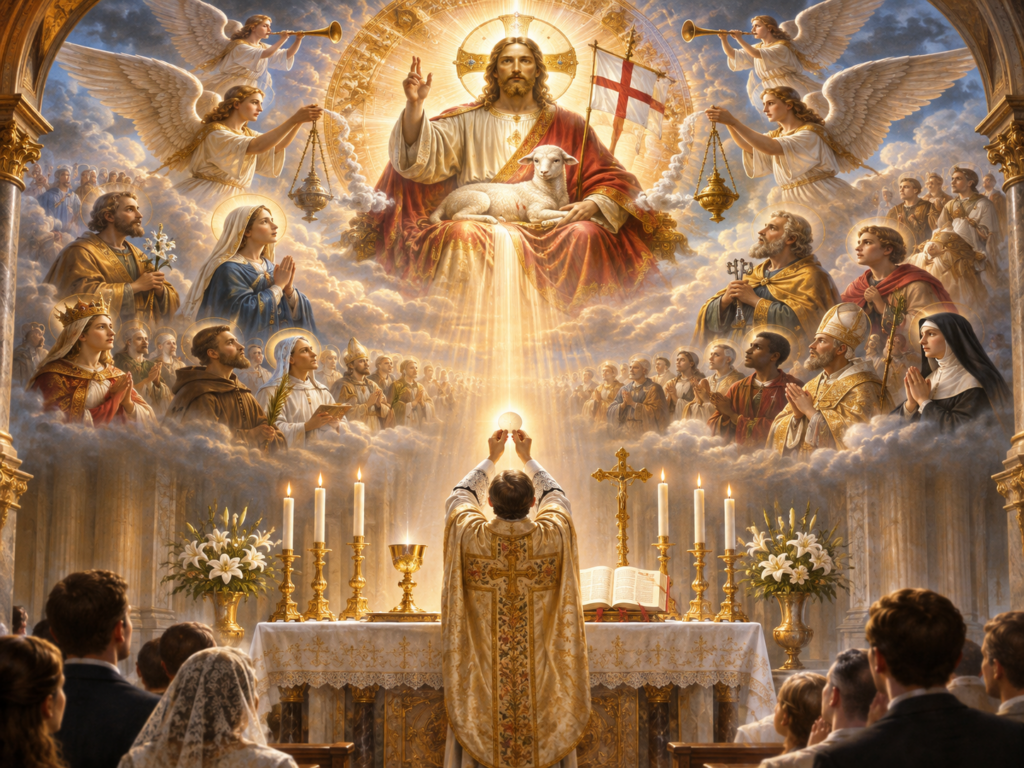
The Book of Revelation concludes with the victory of Jesus Christ.
The dragon is defeated.
The power of evil comes to its end.
The heavenly Jerusalem appears.
God dwells with His people.
The redeemed enter eternal communion with their Creator.
And the Lamb remains at the center of heavenly glory.
This is the destination toward which the entire history of salvation moves.
From the sacrifice of Abel to the offering of Melchisedech.
From Abraham and Isaac to the Passover in Egypt.
From the Tabernacle in the wilderness to the Temple in Jerusalem.
From the Incarnation to Calvary.
From the empty tomb to the heavenly sanctuary.
Every divine promise finds its fulfillment in Jesus Christ.
And the Holy Eucharist makes the saving mystery of Christ present within the life of the Church.
The Mass is not merely a reminder of something that happened long ago.
It is not simply an opportunity for fellowship.
It is not merely a beautiful religious tradition.
It is the sacramental sacrifice of Jesus Christ.
It is the true presence of the Lamb of God.
It is the sacred banquet of the New Covenant.
It is the worship of the pilgrim Church united to the liturgy of Heaven.
And it is a foretaste of the eternal communion awaiting those who persevere in God’s grace.
Scott Hahn’s The Lamb’s Supper encourages Catholics to rediscover this scriptural vision.
Yet the teaching itself is not a modern invention.
It belongs to the ancient faith of the Church.
The Fathers witnessed it.
The liturgy expresses it.
The Catechism teaches it.
The Second Vatican Council solemnly affirmed it.
And Sacred Scripture reveals the heavenly realities toward which it points.
The next time you enter a Catholic church for Holy Mass, remember what is taking place.
The sanctuary before you is more than a gathering place.
The altar is more than a religious table.
The priest is more than a public speaker.
The Eucharist is more than bread and wine.
The Church is participating in the saving worship of Jesus Christ.
The Lamb who was slain is alive.
The sacrifice of Calvary remains eternally effective.
The heavenly liturgy continues.
And Christ gives Himself to His people.
Heaven does not become fully visible at every Mass. But through the sacramental mystery, the Church on earth truly participates in the worship of Heaven.
One day, when our earthly pilgrimage is finished, may we behold the Lord whom we now receive beneath sacramental appearances.
May we stand among the redeemed.
May we join the everlasting praise of the angels and saints.
And may we be welcomed into the eternal marriage supper of the Lamb.
For now, we approach the altar in faith.
But our hope reaches toward the day when faith gives way to sight.
And the Lamb who nourished us along the journey becomes our everlasting joy.
A CLOSING PRAYER BEFORE THE HOLY EUCHARIST
O Lord Jesus Christ,
Eternal High Priest and spotless Lamb of God,
You offered Yourself upon the Cross for the salvation of the world.
In the Most Holy Eucharist, You make Your saving sacrifice present and give Yourself as the Bread of Life.
Open our eyes to the sacred mystery of the Mass.
Teach us to worship with reverence, humility, gratitude, and love.
May we never approach Your altar with indifference.
May we never receive Your Sacred Body and Precious Blood without sincerely seeking to be reconciled to You.
Unite us more deeply to Your Church.
Strengthen us against sin and temptation.
Teach us to love our brothers and sisters as members of Your Mystical Body.
Through the intercession of the Blessed Virgin Mary, the angels, and all the saints, prepare our hearts for the eternal banquet of Heaven.
And when our earthly pilgrimage is complete, grant that we may behold You face to face and join forever in the heavenly praise of the Most Holy Trinity.
For You live and reign with the Father and the Holy Ghost, God, forever and ever.
Amen.
PRINCIPAL SCRIPTURAL, PATRISTIC, AND MAGISTERIAL REFERENCES
Sacred Scripture — Douay-Rheims Bible
Old Testament
- Genesis 14:18–20 — Melchisedech, priest of the Most High God.
- Genesis 22:1–19 — Abraham and Isaac.
- Exodus 12:1–28 — The Passover lamb.
- Exodus 25:10–22 — The Ark of the Covenant.
- Exodus 40:34–35 — The glory of God and the Tabernacle.
- Psalm 109:4 — The priesthood according to Melchisedech.
- Isaiah 6:1–3 — The heavenly proclamation of God’s holiness.
- Daniel 7 — The beasts and the Kingdom of God.
New Testament
- Matthew 9:15 — Christ the Bridegroom.
- Luke 22:14–20 — Institution of the Eucharist.
- Luke 24:13–35 — The road to Emmaus.
- John 1:29 — Jesus, the Lamb of God.
- John 6:22–59 — The Bread of Life discourse.
- John 19:31–37 — Christ and the Passover.
- Acts 2:42 — The worship of the apostolic Church.
- Romans 12:1 — The Christian life as a spiritual offering.
- 1 Corinthians 5:7 — Christ our Pasch.
- 1 Corinthians 10:16–17 — Communion in the Body and Blood of Christ.
- 1 Corinthians 11:23–29 — The Eucharist and worthy reception.
- Ephesians 5:25–32 — Christ and His Bride, the Church.
- Hebrews 7–10 — Christ’s eternal priesthood and definitive sacrifice.
- 1 Peter 2:5 — The spiritual sacrifices of the faithful.
- Apocalypse 4–5 — The heavenly throne and the Lamb.
- Apocalypse 8:3–4 — Incense and the prayers of the saints.
- Apocalypse 11:19–12:17 — The heavenly Ark, the Woman, and the dragon.
- Apocalypse 13 — The beasts and the number 666.
- Apocalypse 19:6–9 — The marriage supper of the Lamb.
- Apocalypse 21–22 — The New Jerusalem and eternal communion with God.
Catechism of the Catholic Church
- CCC 748–810: The mystery of the Church.
- CCC 946–962: The Communion of Saints.
- CCC 1077–1112: Christ’s work in the liturgy.
- CCC 1136–1139: The heavenly liturgy and its participants.
- CCC 1322–1419: The Sacrament of the Eucharist.
- CCC 1345–1355: The celebration of the Mass.
- CCC 1362–1372: The Eucharistic sacrifice.
- CCC 1373–1381: The Real Presence and transubstantiation.
- CCC 1391–1405: The fruits of Holy Communion and the heavenly banquet.
- CCC 1265–1266: Adoptive sonship through Baptism.
- CCC 2675–2676: Marian prayer and Mary as the Ark of the Covenant.
Magisterial Documents
Second Vatican Council: Sacrosanctum Concilium, especially paragraphs 7–10, December 4, 1963.
Second Vatican Council: Lumen Gentium, especially paragraphs 3, 7, 49–51, and 52–69, November 21, 1964.
Council of Trent: Session XIII, Decree Concerning the Most Holy Sacrament of the Eucharist, 1551.
Council of Trent: Session XXII, Doctrine on the Sacrifice of the Mass, 1562.
Pope St. John Paul II: Ecclesia de Eucharistia, April 17, 2003.
Early Christian Witnesses
The Didache: Chapters 9–10 and 14, late first or early second century.
St. Ignatius of Antioch: Letter to the Smyrnaeans, chapters 6–8, early second century.
St. Justin Martyr: First Apology, chapters 65–67, c. AD 155.
Principal Theological Work
Scott Hahn: The Lamb’s Supper: The Mass as Heaven on Earth. Image Books, 1999.
This article is an independent theological synthesis inspired by the themes of Hahn’s work. Interpretations of particular apocalyptic symbols, including the beasts and the number 666, are distinguished from doctrines definitively taught by the Catholic Church.
Catholicg33k | Sacred Scripture • Catholic Theology • The Holy Eucharist • The Mass • Catholic Apologetics
©Catholicg33k — Original Catholic theological reflection and biblical commentary.