

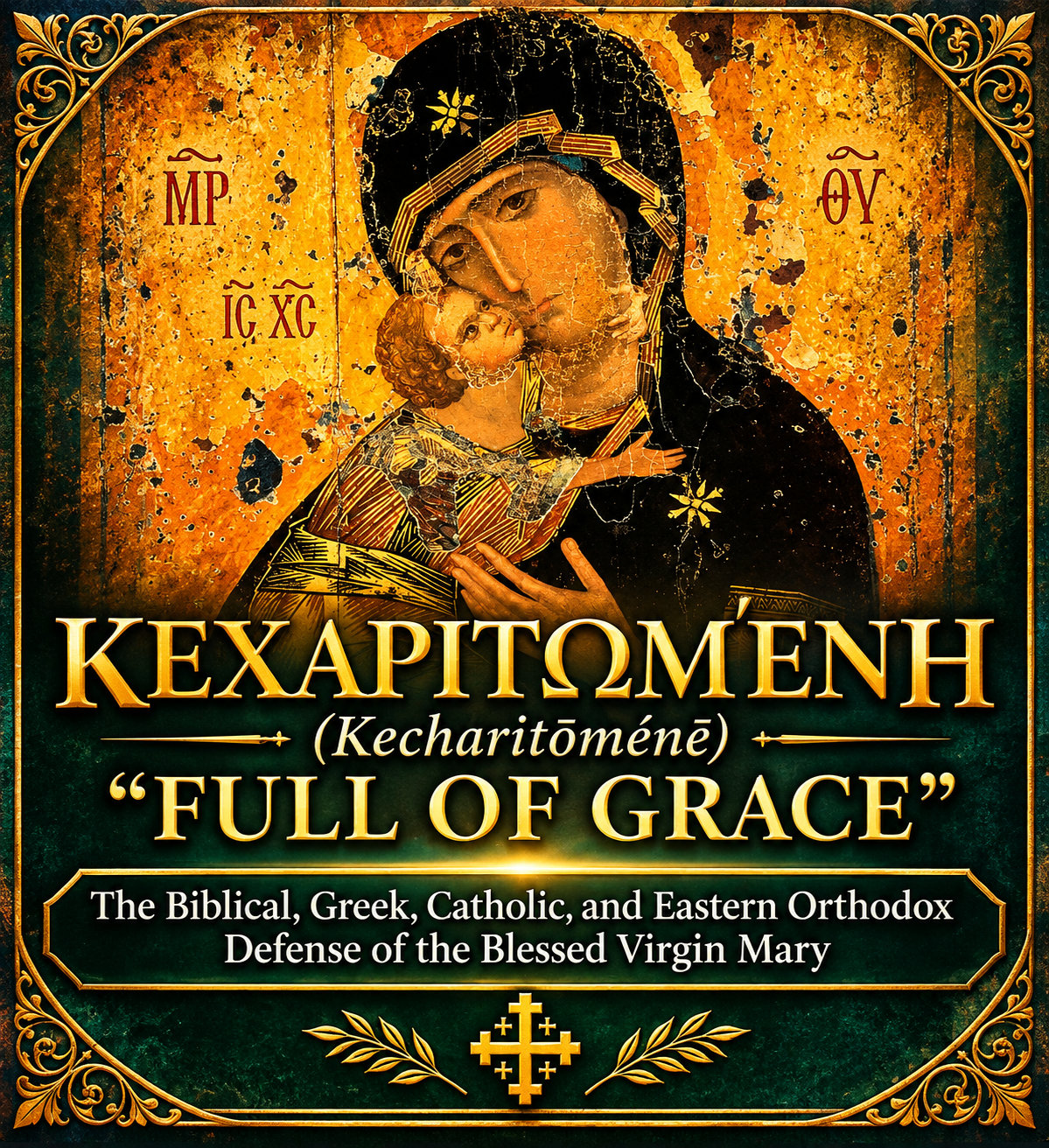
The Biblical, Greek, Catholic, and Eastern Orthodox Defense of the Blessed Virgin Mary
1. The extraordinary greeting of the Archangel Gabriel
One of the most remarkable words in the entire New Testament appears in Luke 1:28, when the Archangel Gabriel greets the Blessed Virgin Mary.
The original Greek reads:
Χαῖρε, κεχαριτωμένη, ὁ Κύριος μετὰ σοῦ.
Chaire, kecharitōménē, ho Kyrios meta sou.
“Hail, full of grace, the Lord is with thee.”
— Luke 1:28, Douay-Rheims Bible
The Greek word κεχαριτωμένη (kecharitōménē), pronounced keh-khah-ree-toh-MEH-neh, is traditionally translated into English as “Full of Grace.”
Its more literal grammatical meaning is “one who has been endowed with grace” or “one who has been graced.”
But there is something particularly significant about Gabriel’s greeting.
Gabriel does not simply address Mary by her personal name. He addresses her as κεχαριτωμένη.
The word functions as a designation identifying Mary by the grace she has received from Almighty God.
This raises an important question:
What exactly does this Greek word reveal about the spiritual condition of the woman chosen to become the Mother of God?
To understand its significance, we must examine the Greek grammar, Sacred Scripture, Catholic doctrine, and the testimony of ancient Eastern Christianity.
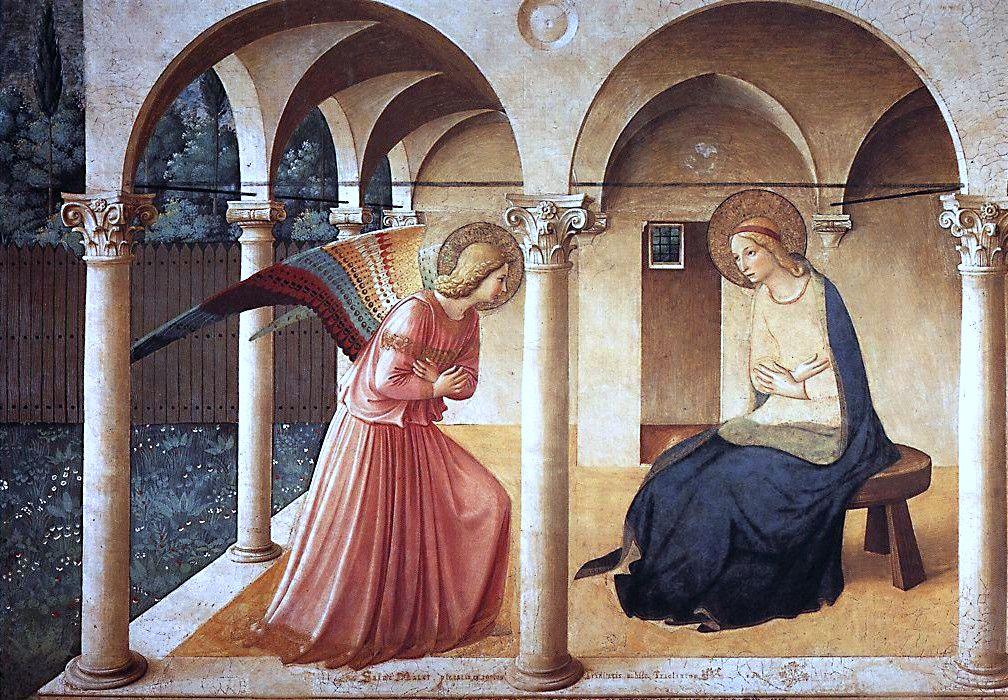
Gabriel greets Mary with the words Χαῖρε, κεχαριτωμένη.
15th-century fresco, San Marco, Florence.
2. Breaking down the Greek word κεχαριτωμένη
The word κεχαριτωμένη comes from the Greek verb:
χαριτόω (charitóō)
Meaning: to bestow grace or favor upon someone.
This verb is related to the Greek noun:
χάρις (cháris)
Meaning: grace, favor, or gracious gift.
The grammatical form used in Luke 1:28 is especially significant.
| Greek feature | Meaning |
|---|---|
| κε- | Reduplication associated with the perfect tense |
| χαριτω- | Verbal stem associated with grace or favor |
| -μένη | Feminine passive participial ending |
| Perfect tense | A prior action with a resulting state |
| Passive voice | Mary receives grace; God bestows it |
| Feminine singular | Refers specifically to Mary |
| Vocative use | Gabriel addresses Mary directly |
κεχαριτωμένη is a perfect passive participle, feminine singular, used vocatively.
Each of these grammatical features contributes to its meaning.
The passive voice indicates that Mary did not produce this grace through her own independent power.
Grace was bestowed upon her. God is the source of her holiness.
This is essential to Catholic teaching because Mary’s holiness never exists independently of Jesus Christ.
3. Why the Greek perfect tense matters
This is one of the most important grammatical features of the passage.
The Greek perfect tense commonly describes a completed action whose resulting state remains relevant.
When Gabriel addresses Mary as κεχαριτωμένη, he speaks of someone who has already been graced by God and stands in that resulting condition.
He is not merely announcing that Mary will someday receive divine grace.
Rather, the greeting recognizes a grace already bestowed upon her.
An explanatory paraphrase would be:
“Hail, O you who have been endowed with grace and remain graced.”
This paraphrase brings out the force of the Greek perfect tense.
However, precision is important.
The Greek perfect tense does not, by itself, specify when Mary first received this grace or prove that she would never lose it.
Nevertheless, the wording emphasizes Mary’s existing state of divine favor at the Annunciation.
This accords with the Catholic understanding that Mary’s unique vocation was accompanied by extraordinary gifts of grace.
Scriptural reference: Luke 1:26–30.
4. Does κεχαριτωμένη support the Immaculate Conception?
Yes, within the Catholic Church’s interpretation of Scripture and Sacred Tradition.
The Catholic Church teaches that the Blessed Virgin Mary was preserved from all stain of original sin from the first instant of her conception.
This extraordinary privilege was granted entirely through the saving merits of Jesus Christ.
Mary was not exempt from needing a Savior.
She was redeemed by Christ in an especially sublime manner: preservatively, through His merits.
The Catechism of the Catholic Church explains:
CCC 490: Mary was enriched by God with gifts appropriate to her unique vocation as Mother of the Savior, and Gabriel greeted her as “full of grace.”
CCC 491: Mary was preserved immune from all stain of original sin from the first moment of her conception, through the merits of Jesus Christ.
CCC 492: Mary’s holiness comes entirely from Christ, who redeemed her in the most exalted manner.
CCC 493: The Church teaches that Mary remained free from personal sin throughout her life.
The biblical greeting kecharitōmenē harmonizes with this teaching because it identifies Mary as someone already extraordinarily endowed with God’s grace.
However, the Greek word alone does not explicitly establish the precise moment of Mary’s conception or independently demonstrate her lifelong sinlessness.
Those teachings are understood through Scripture read within Sacred Tradition and the Church’s authoritative doctrinal judgments.
Catholic sources: Catechism §§490–493; Pius IX, Ineffabilis Deus (1854); Second Vatican Council, Lumen Gentium §56.
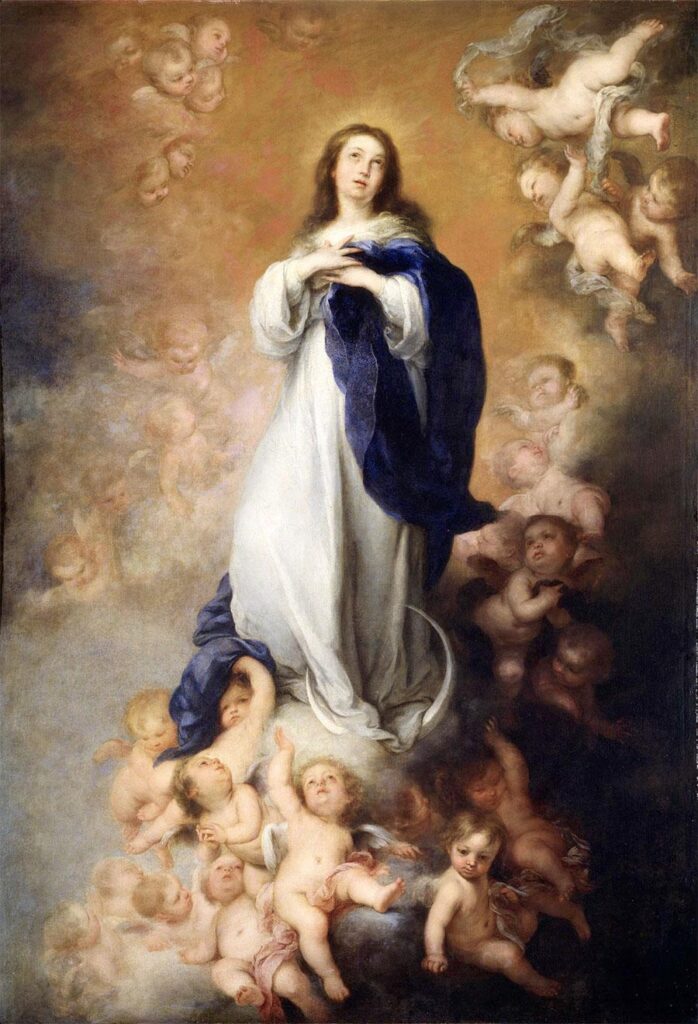
A beautiful representation of Mary’s holiness and the grace of God.
5. Is “Full of Grace” a legitimate English translation?
Yes.
Although the most literal grammatical rendering is closer to “one who has been graced,” the traditional Catholic translation expresses the Church’s theological understanding of the passage.
Consider three ways of expressing the Greek:
- “Having been graced” emphasizes the verbal construction.
- “Highly favored one” emphasizes divine favor.
- “Full of grace” expresses the traditional Catholic interpretation of Mary’s extraordinary spiritual condition.
The Latin Vulgate renders the greeting:
Ave, gratia plena, Dominus tecum.
“Hail, full of grace, the Lord is with thee.”
The Latin expression gratia plena became deeply embedded in Catholic biblical interpretation, theology, and prayer.
It is also the opening of the Hail Mary.
The Catholic Church therefore does not rest its Marian doctrine upon a mistranslation.
Rather, it interprets Gabriel’s greeting within the entire biblical and apostolic understanding of Mary.
Sources: Luke 1:28; St. Jerome’s Latin Vulgate; Catechism §490.
6. A fascinating comparison: Ephesians 1:6
A common Protestant objection concerns the Greek verb χαριτόω.
The same underlying verb appears in Ephesians 1:6.
St. Paul uses:
ἐχαρίτωσεν (echarítōsen)
This describes God’s gracious action toward believers in Christ.
Therefore, Catholics should not claim that the verb itself is found exclusively in reference to Mary.
However, the grammatical forms differ.
Luke 1:28 — κεχαριτωμένη
- Perfect passive participle
- Feminine singular
- Used to address Mary directly
- Describes her as someone already graced by God
Ephesians 1:6 — ἐχαρίτωσεν
- Aorist active indicative
- Third-person singular
- Describes God’s gracious action toward believers in Christ
Both passages affirm the primacy of divine grace.
The difference in grammatical construction is real, but it does not mean that ordinary Christians cannot also possess enduring sanctifying grace.
The Catholic argument is stronger when it recognizes both the grammatical distinction and the shared emphasis upon God’s gracious initiative.
The central point: Mary’s greeting is extraordinary within the narrative of the Annunciation, especially when considered alongside her unique vocation as Mother of the Incarnate Word.
Sources: Luke 1:28; Ephesians 1:6.
7. The Eastern Orthodox witness: Mary is the All-Holy Theotokos
This is where the historical argument becomes especially significant.
The Catholic Church is not alone in preserving profound reverence for the Blessed Virgin Mary.
Eastern Orthodox Christianity also venerates Mary as the All-Holy Mother of God.
Eastern Christians employ several traditional Greek titles expressing her extraordinary dignity.
| Greek title | English meaning |
|---|---|
| Κεχαριτωμένη (Kecharitōménē) | Full of Grace |
| Παναγία (Panagía) | All-Holy |
| Θεοτόκος (Theotókos) | Mother of God, God-bearer |
| Ἀειπάρθενος (Aeipárthenos) | Ever-Virgin |
These titles are not products of the Protestant Reformation or inventions of modern Catholic apologetics.
They belong to the ancient vocabulary of Eastern Christian faith and worship.
Consider the significance of Παναγία — Panagía, meaning All-Holy.
Eastern Orthodox Christians regularly honor Mary under this designation, expressing their conviction that she possesses an extraordinary holiness granted through divine grace.
Likewise, the title Θεοτόκος — Theotokos expresses the truth that the Person born of Mary is truly God incarnate.
Mary is Mother of God not because she originated the divine nature, but because she gave birth to Jesus Christ, who is one divine Person possessing both divine and human natures.
The honor given to Mary protects the truth about Jesus Christ.
Sources: Council of Ephesus (AD 431); Lumen Gentium §§53, 56; Orthodox Church in America, Essential Orthodox Christian Beliefs, “The Theotokos.”
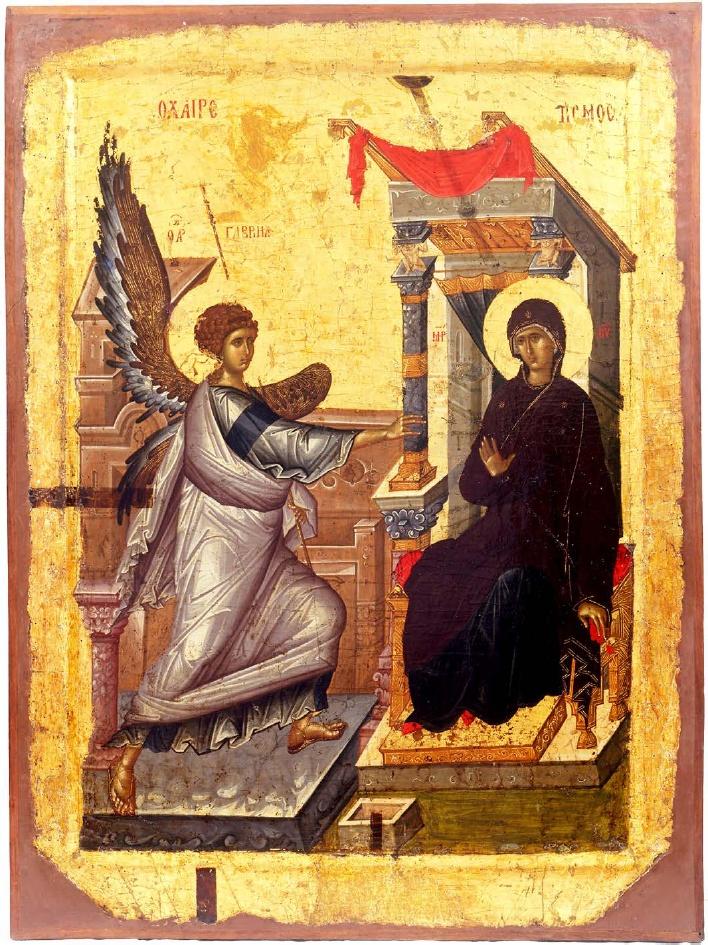
introducing the Eastern Orthodox witness.
An early 14th-century Byzantine depiction of Gabriel and Mary from Ohrid.
8. Catholics and Eastern Orthodox Christians both affirm Mary’s exceptional holiness
The Catholic and Eastern Orthodox Churches disagree on important theological questions.
Nevertheless, both preserve a profound understanding of Mary’s holiness and unique place in salvation history.
The Catholic position
Catholic doctrine teaches that:
- Mary was preserved from original sin from the first instant of her conception.
- This privilege was granted through the merits of Jesus Christ.
- Mary remained free from all personal sin.
- She is the Ever-Virgin Mother of God.
- She is rightly honored above all other saints, while worship belongs to God alone.
The Eastern Orthodox position
Eastern Orthodox Christianity likewise teaches that:
- Mary is the Theotokos, the Mother of God.
- She is the Panagia, the All-Holy.
- She remained ever-virgin.
- Her holiness is entirely dependent upon God’s grace.
- She holds a unique place among the saints and is worthy of exceptional veneration.
A widespread Orthodox teaching also affirms that Mary committed no personal sins, although Orthodox explanations of her sinlessness and sanctification differ.
An important theological distinction
The Eastern Orthodox Churches generally do not accept the Catholic definition of the Immaculate Conception promulgated in AD 1854.
This disagreement is connected, in part, to different theological understandings of ancestral sin, original sin, and Mary’s sanctification.
Consequently, it would be inaccurate to claim that Eastern Orthodox Christianity accepts the Catholic dogma in precisely the same sense.
Nevertheless, the agreement is historically and theologically substantial: both traditions regard Mary as exceptionally holy and uniquely graced by God.
Sources: Catechism §§490–493, 963–971; Ineffabilis Deus; Orthodox Church in America, Essential Orthodox Christian Beliefs, “The Theotokos.”
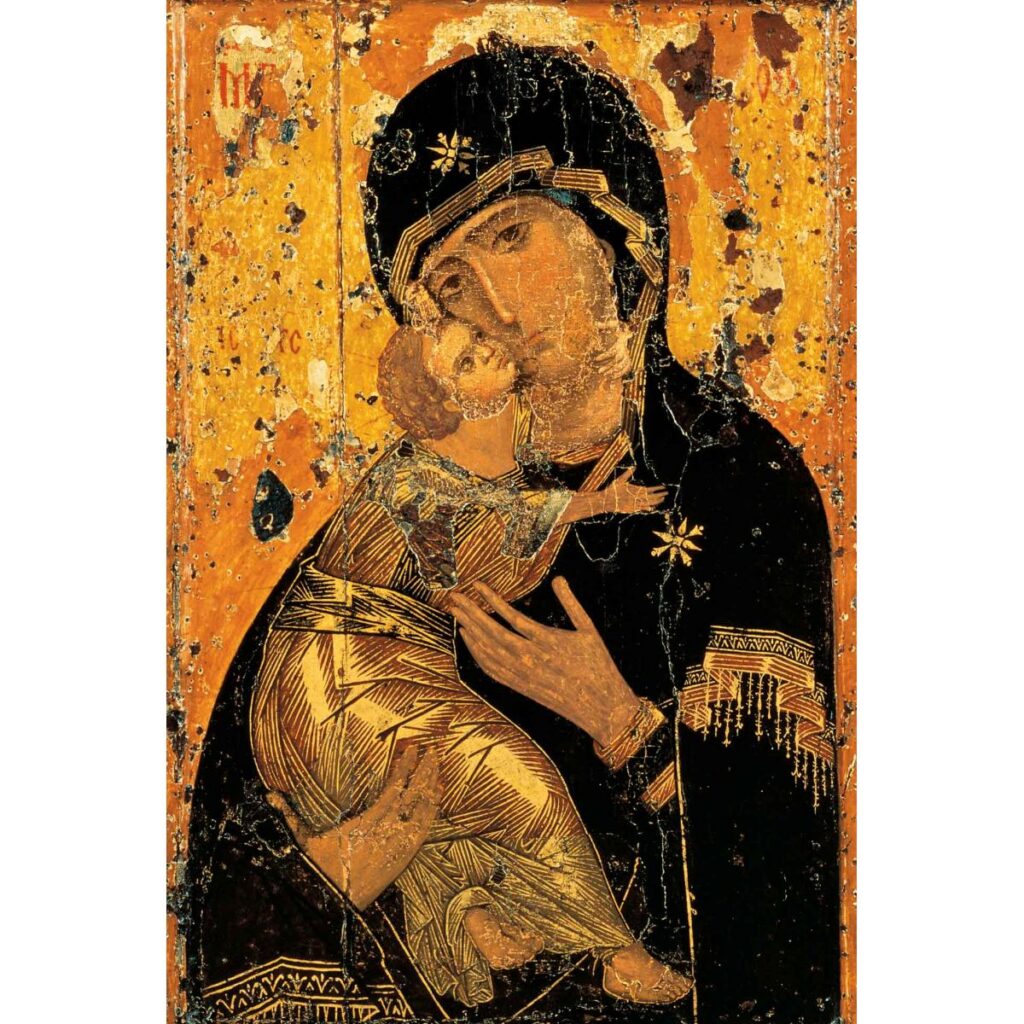
This tender icon of Mary with the Christ Child is an excellent illustration of Eastern Christian veneration.
9. The Council of Ephesus, AD 431: Mary is truly the Mother of God
Long before the Protestant Reformation, the ancient Church solemnly defended Mary’s title Theotokos.
The Council of Ephesus in AD 431 upheld the confession that Mary is the Mother of God because Jesus Christ is one divine Person.
This title was crucial in the controversy concerning Nestorius and the unity of Christ’s Person.
The title does not mean that Mary created God or existed before God.
It means that the one whom Mary bore according to His humanity is the eternal Son of God.
Scripture itself provides the foundation.
In Luke 1:43, St. Elizabeth declares:
“And whence is this to me, that the mother of my Lord should come to me?”
— Luke 1:43, Douay-Rheims
Elizabeth recognizes the extraordinary identity of Mary’s Child.
Similarly, Luke records Mary’s own prophecy:
“Because he hath regarded the humility of his handmaid; for behold from henceforth all generations shall call me blessed.”
— Luke 1:48, Douay-Rheims
The Church’s ancient Marian devotion developed within its confession of Christ’s Incarnation.
To call Mary Theotokos is ultimately to proclaim who Jesus Christ truly is.
Sources: Luke 1:43, 1:48; Council of Ephesus (AD 431); Catechism §495.
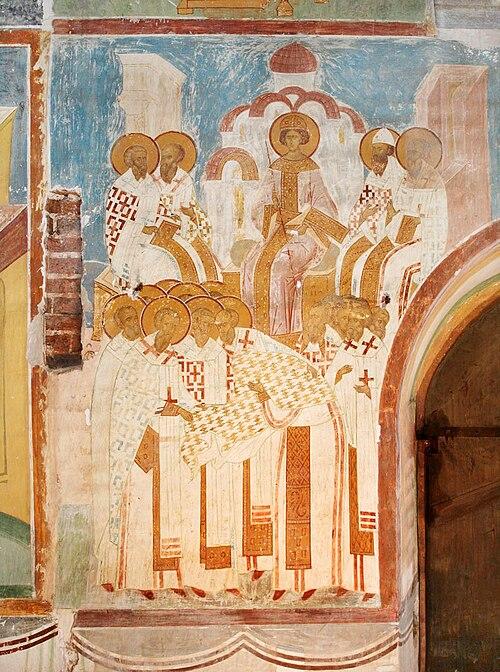
A fresco painted by Dionisius in AD 1502, commemorating the Third Ecumenical Council.
10. The historical challenge to Protestant objections
Now we arrive at the apologetic significance of the Catholic and Eastern Orthodox testimony.
Some Protestant Christians argue that traditional Marian veneration is an unscriptural development introduced by the Roman Catholic Church.
But this explanation encounters a historical difficulty.
Why do both Eastern and Western Christianity preserve profound Marian devotion if it were merely a late Roman Catholic invention?
Consider the cumulative evidence:
First: Sacred Scripture
Gabriel addresses Mary as κεχαριτωμένη.
Elizabeth calls her the Mother of her Lord.
Mary prophesies that all generations will call her blessed.
Second: The ancient Church
The Church defended Mary’s title Theotokos long before the Protestant Reformation.
Third: Eastern Orthodox Christianity
Eastern Christians continue to honor Mary as Panagia, Theotokos, and Aeiparthenos.
Fourth: Catholic Christianity
The Catholic Church preserves these ancient titles while formally defining additional Marian doctrines, including the Immaculate Conception.
Fifth: The historic Christian liturgy
Marian devotion exists deeply within the liturgical and spiritual traditions of both Eastern and Western Christianity.
Taken together, these facts make it difficult to sustain the claim that all traditional Marian honor was simply invented by Rome in a later historical period.
However, precision is essential.
Not all Protestants reject traditional Marian titles or every form of honor given to Mary.
Historic Lutheran confessions, for example, acknowledge Mary as the Mother of God and recognize the honor due to the saints, while disagreeing with Catholics over their invocation.
Therefore, this historical evidence does not, by itself, disprove every form of Protestantism or settle every Marian controversy.
What it powerfully challenges is the assertion that honoring Mary as the exceptionally holy Mother of God is foreign to ancient Christianity.
Sources: Luke 1:28, 1:43, 1:48; Council of Ephesus (AD 431); Apology of the Augsburg Confession, Article XXI; Lumen Gentium §§66–67.
11. Does honoring Mary take glory away from Jesus Christ?
This objection deserves a direct answer.
No. Authentic Marian veneration does not compete with the worship owed to God.
The Catholic Church carefully distinguishes between the worship owed to God alone and the honor given to the saints.
The Blessed Virgin Mary receives a singular form of veneration because of her unique relationship to Jesus Christ.
But she is not worshiped as God.
Every grace she possesses comes from God.
Every privilege she enjoys depends upon Jesus Christ.
Her maternal mission ultimately points souls toward her Son.
At the Wedding Feast of Cana, Mary gives the servants a command that summarizes her role in Christian life:
“Whatsoever he shall say to you, do ye.”
— John 2:5, Douay-Rheims
This is the heart of authentic Marian devotion.
Mary does not replace Christ. Mary leads us to Christ.
The Second Vatican Council teaches that the Church’s devotion to Mary differs essentially from the adoration given to the Incarnate Word, the Father, and the Holy Spirit.
Furthermore, such devotion is intended to foster the adoration of God.
Sources: Lumen Gentium §§60–62, 66–67; Catechism §§970–971; John 2:5.
12. The complete Catholic apologetic argument
When the evidence is assembled, the Catholic defense can be presented as follows:
THE BIBLICAL WITNESS
The Archangel Gabriel addresses the Blessed Virgin Mary as:
Κεχαριτωμένη — Full of Grace.
THE GREEK GRAMMATICAL WITNESS
The perfect passive participle identifies Mary as someone upon whom God has already bestowed grace, with a resulting state of being graced.
THE CATHOLIC DOCTRINAL WITNESS
The Church understands Mary’s extraordinary holiness in connection with the Immaculate Conception, her divine motherhood, and her unique participation in God’s saving plan.
THE ANCIENT CHRISTIAN WITNESS
The Council of Ephesus defended the title:
Θεοτόκος — Mother of God.
THE EASTERN ORTHODOX WITNESS
Eastern Orthodox Christianity continues to honor Mary as:
Παναγία — All-Holy.
Ἀειπάρθενος — Ever-Virgin.
THE HISTORICAL CHALLENGE
Catholics and Orthodox, despite centuries of theological and ecclesiastical separation, retain substantial agreement concerning Mary’s exceptional dignity, holiness, and proper veneration.
This shared witness offers powerful historical evidence against the claim that profound Marian honor is merely a late Catholic invention.
13. Conclusion: Full of Grace, Mother of God, All-Holy
The Blessed Virgin Mary is not an obstacle between humanity and Jesus Christ.
She is the woman whom God chose to become the Mother of His Incarnate Son.
The Archangel Gabriel greeted her as κεχαριτωμένη — Full of Grace.
The ancient Church confessed her as Θεοτόκος — Mother of God.
Eastern Christianity reveres her as Παναγία — All-Holy.
Catholic Christianity proclaims her Immaculate Conception as the supreme manifestation of Christ’s redeeming grace in the life of His Mother.
Her greatness does not diminish God’s glory.
Her greatness reveals what the grace of Almighty God can accomplish in a human creature.
As Mary herself declared:
“My soul doth magnify the Lord. And my spirit hath rejoiced in God my Saviour.”
— Luke 1:46–47, Douay-Rheims
Mary magnifies the Lord because her entire existence is directed toward Him.
Her holiness is Christ-centered.
Her privileges are gifts of Christ.
Her mission is inseparable from Christ.
And her final message to the faithful remains:
“Whatsoever he shall say to you, do ye.” — John 2:5
AVE MARIA, GRATIA PLENA!
SANCTA MARIA, MATER DEI, ORA PRO NOBIS!
Hail Mary, Full of Grace!
Holy Mary, Mother of God, pray for us!
AD MAJOREM DEI GLORIAM — FOR THE GREATER GLORY OF GOD!
Primary references
Sacred Scripture — Douay-Rheims
- Luke 1:26–30 — The Annunciation
- Luke 1:39–45 — The Visitation
- Luke 1:46–49 — The Magnificat
- John 2:1–11 — The Wedding Feast of Cana
- Ephesians 1:3–6 — Grace bestowed through Jesus Christ
Catholic Magisterium
- Catechism of the Catholic Church §§490–495 — Mary’s divine motherhood and Immaculate Conception
- Catechism §§963–971 — Mary and the Church
- Second Vatican Council, Lumen Gentium, Chapter VIII
- Pope Pius IX, Ineffabilis Deus (AD 1854)
Ancient Christianity
- Council of Ephesus (AD 431) — Theotokos
- St. Cyril of Alexandria — Writings defending the unity of Christ’s Person and Mary’s title Theotokos
- St. John of Damascus, An Exact Exposition of the Orthodox Faith, Book IV, Chapter 14
Eastern Orthodox Christianity
- Orthodox Church in America, Essential Orthodox Christian Beliefs, “The Theotokos”
- Traditional Byzantine liturgical titles: Panagia, Theotokos, and Aeiparthenos
Historic Protestant comparison
- Apology of the Augsburg Confession, Article XXI — The Invocation of Saints
CatholicG33k | Defending the Catholic Faith through Sacred Scripture, Sacred Tradition, History, and Reason.