

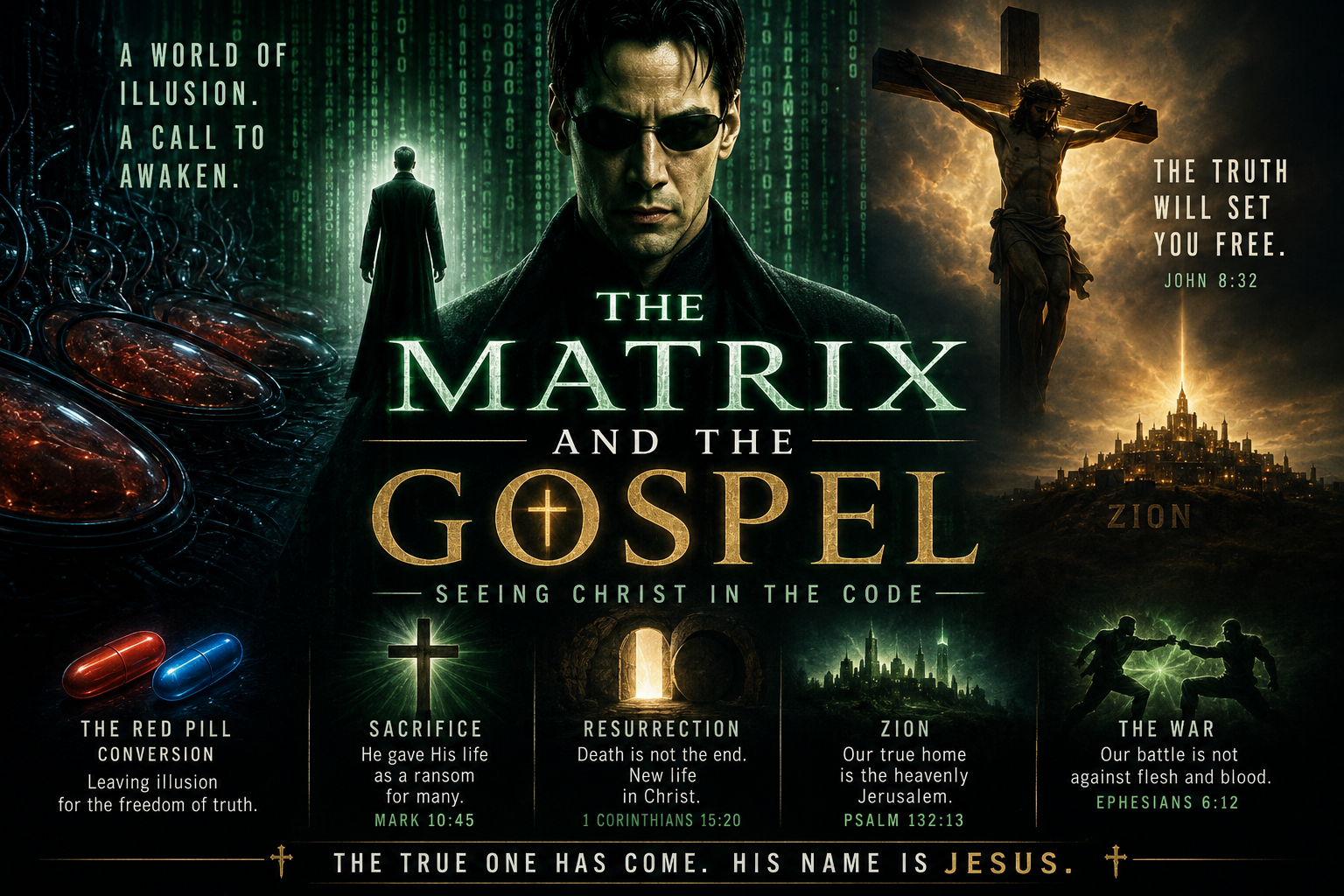
Popular culture often borrows from truths greater than itself. Stories of sacrifice, liberation, death, rebirth, and the triumph of truth continue to move us because they echo the deepest story of all: the Gospel of Jesus Christ.
One striking example is The Matrix. Although the film is a work of science fiction and should not be treated as a Christian allegory in every detail, its story contains themes that can help us reflect upon sin, conversion, freedom, sacrifice, and new life in Christ.
A World of Illusion and Bondage
In The Matrix, humanity lives inside a false reality. Most people believe they are free, yet they are unknowingly enslaved by powers they cannot see.
This offers a vivid image of the bondage of sin.
Jesus says:
“Amen, amen I say unto you: that whosoever committeth sin, is the servant of sin.”
—John 8:34, Douay-Rheims
Sin deceives us. It promises freedom while making us slaves. It tells us that happiness can be found apart from God, even though separation from God can never satisfy the human heart.
Neo’s awakening allows him to see the world as it truly is. In a similar way, Christ calls us to awaken from spiritual sleep:
“Rise thou that sleepest, and arise from the dead: and Christ shall enlighten thee.”
—Ephesians 5:14, Douay-Rheims
The Matrix can therefore be seen as an image of the fallen world: a system shaped by deception, fear, and slavery. True freedom begins when the illusion is exposed and reality is embraced.
Neo as a Christ Figure
Neo is repeatedly called “the One.” He is believed to be the person who will confront the powers enslaving humanity and open the way to freedom.
His name also evokes the Greek word neos, meaning “new.” Through him, the people hope for a new beginning.
Neo’s story includes several elements that resemble the pattern of Christ’s Paschal Mystery. He is chosen for a mission, lays down his life for others, dies, rises again with new power, and departs with the promise that humanity will be liberated.
These parallels do not make Neo equal to Christ. Neo is only a fictional character, while Jesus Christ is the eternal Son of God made man. Nevertheless, fictional heroes often move us precisely because they reflect, however imperfectly, the true Savior.
Christ says of His mission:
“For the Son of man also is not come to be ministered unto, but to minister, and to give his life a redemption for many.”
—Mark 10:45, Douay-Rheims
Neo’s sacrificial death points faintly toward the perfect sacrifice of Jesus, who freely gave His life for the salvation of the world.
The film even presents Neo in poses that visually recall the Crucifixion. Such imagery draws upon a symbol already embedded deeply within Western culture: the innocent one who stretches out his arms and gives his life so that others may live.
Names Filled with Biblical Resonance
Many names in The Matrix carry religious or biblical associations.
Trinity
Trinity is the name of Neo’s companion, whose love and faith in him remain essential to his mission. The name immediately recalls the central mystery of the Christian faith: one God in three divine Persons—Father, Son, and Holy Spirit.
Trinity should not be understood as a direct representation of the Blessed Trinity. Her name functions more as a religious signal, inviting the viewer to think about faith, love, and communion.
Her love for Neo also calls to mind the primacy of charity:
“And now there remain faith, hope, and charity, these three: but the greatest of these is charity.”
—1 Corinthians 13:13, Douay-Rheims
Morpheus
Morpheus is the guide who awakens Neo and prepares him for his mission. He believes that the promised liberator is coming and devotes himself to finding him.
In this respect, Morpheus resembles a prophetic figure. He is especially reminiscent of Saint John the Baptist, who prepared the way for Christ and called others to recognize Him.
Morpheus does not save Neo. Instead, he points beyond himself toward the one in whom he has placed his hope.
Zion
Zion is the last refuge of free humanity.
In Sacred Scripture, Zion is associated with Jerusalem, the holy mountain, and the dwelling place of God among His people:
“For the Lord hath chosen Sion: he hath chosen it for his dwelling.”
—Psalm 131:13, Douay-Rheims
In Christian theology, Zion can also direct our thoughts toward the heavenly Jerusalem, the final home of the redeemed.
The Zion of The Matrix is not heaven, but the name gives the human city a sense of sacred hope. It is the place where those freed from slavery gather, resist evil, and await deliverance.
The Nebuchadnezzar
Morpheus’s ship is named the Nebuchadnezzar.
In Scripture, Nebuchadnezzar was the Babylonian king associated with the conquest of Jerusalem and the exile of God’s people. The name therefore carries the memory of captivity.
In the film, however, the ship bearing that name helps awaken people and carry them out of bondage. The symbolism appears almost reversed: the name associated with exile becomes attached to a vessel of liberation.
Cypher
Cypher betrays Neo and his companions in exchange for comfort, pleasure, and a return to illusion.
His betrayal clearly recalls Judas Iscariot, who handed Christ over to His enemies. Like Judas, Cypher abandons fellowship for personal gain.
Cypher also represents a temptation present in every age: the desire to exchange truth for comfort.
He knows that the Matrix is false, yet he prefers the pleasant illusion to a difficult reality. His choice reveals that knowledge alone is not enough. A person must also love the truth.
The Red Pill and Conversion
The choice between the red pill and the blue pill is one of the best-known moments in modern cinema.
The blue pill offers comfort, forgetfulness, and a return to illusion. The red pill offers truth, but also suffering, uncertainty, and responsibility.
This choice can serve as an analogy for conversion.
Conversion requires us to reject comforting lies and surrender ourselves to the truth revealed by God. It demands that we allow Christ to expose our sins, reorder our desires, and lead us along the way of the Cross.
Jesus says:
“If any man will come after me, let him deny himself, and take up his cross daily, and follow me.”
—Luke 9:23, Douay-Rheims
Conversion is not merely a change of opinion. It is a turning of the whole person toward God.
The Catechism describes interior conversion as a radical reorientation of life, a return to God with the whole heart, and a rejection of sin (Catechism of the Catholic Church, 1431).
The red pill is not a sacrament, and it should not be identified literally with Baptism. Baptism does infinitely more than reveal hidden information. It frees us from sin, gives us new birth in Christ, and makes us members of His Body.
Still, the red-pill scene can remind us that grace calls for a real response. God offers truth and freedom, but we must be willing to leave behind the illusion that life can be lived apart from Him.
Christ promises:
“You shall know the truth, and the truth shall make you free.”
—John 8:32, Douay-Rheims
Training and Discipleship
After Neo awakens, he must be trained.
He has left the false world, but he still thinks according to its rules. His mind must be renewed. He must learn to see differently, act differently, and trust truths that he once believed impossible.
This resembles the Christian life after conversion.
Baptism truly gives new life, but the baptized Christian must still grow in holiness. Old habits must be overcome. The mind must be formed by truth. The will must be strengthened by grace.
Saint Paul writes:
“And be not conformed to this world; but be reformed in the newness of your mind.”
—Romans 12:2, Douay-Rheims
Discipleship is spiritual training. Through prayer, the sacraments, Sacred Scripture, works of mercy, self-denial, and obedience to God, the Christian gradually learns to live according to the freedom of Christ.
The War Is Spiritual
The conflict in The Matrix is not merely physical. It is a struggle over truth, freedom, and the destiny of the human race.
The Christian life also involves spiritual combat.
Saint Paul warns:
“For our wrestling is not against flesh and blood; but against principalities and powers, against the rulers of the world of this darkness, against the spirits of wickedness in the high places.”
—Ephesians 6:12, Douay-Rheims
Our enemies are not other human beings. Our true enemies are sin, falsehood, temptation, the devil, and all that draws us away from God.
Christ has already won the decisive victory through His Cross and Resurrection. Yet each Christian must still remain watchful, resist temptation, and persevere in grace.
Why Stories Like The Matrix Resonate
Stories like The Matrix resonate because they borrow from the shape of the Gospel.
Humanity is captive.
The world is wounded.
Appearances are deceptive.
A liberator comes.
The liberator sacrifices himself.
Death is overcome.
The captives are offered freedom.
This pattern moves us because it reflects the true drama of salvation.
We are born into a fallen world and wounded by original sin. We are often deceived by appearances and enslaved by our disordered desires. Yet Christ enters our condition, reveals the truth, breaks the power of sin, and leads us toward the heavenly Jerusalem.
Jesus is not simply one heroic figure among many. He is the source from whom every true image of heroism receives its meaning.
The Catechism teaches:
“By his death, Christ liberates us from sin; by his Resurrection, he opens for us the way to a new life.”
—Catechism of the Catholic Church, 654
Neo may resemble “the One,” but Christ truly is the One: the only-begotten Son of the Father, the Savior of the world, and the way to eternal life.
See Beyond the Science Fiction
When you watch The Matrix, look beyond the action scenes, the philosophy, and the science-fiction setting.
Notice the longing for liberation.
Notice the conflict between truth and illusion.
Notice the language of prophecy, sacrifice, death, and rebirth.
Notice how even a fictional world can contain shadows of the Gospel.
But remember: Christ is not a symbol, myth, or cinematic archetype. He is the eternal Word made flesh. He truly died. He truly rose again. He truly frees us from sin.
The echoes are fictional.
The Gospel is real.
The true Savior has already come, and His name is Jesus Christ.
“I am the way, and the truth, and the life. No man cometh to the Father, but by me.”
—John 14:6, Douay-Rheims