

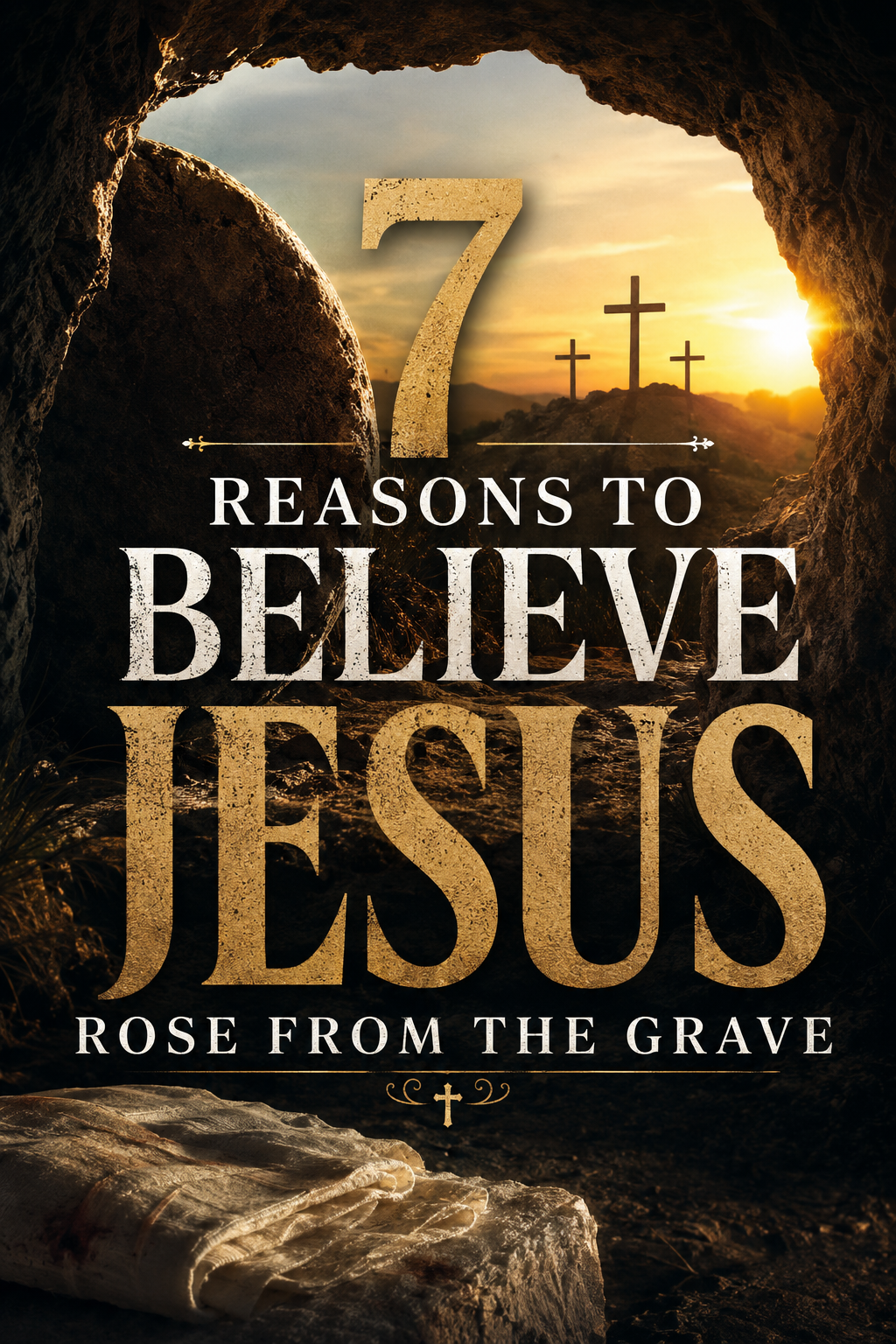
The Resurrection is not a minor detail of Christianity. It is the center of the Gospel.
If Christ remained in the tomb, suffering is meaningless, death has the final word, and our faith is empty. But if Christ rose, then suffering can be redeemed, sin can be forgiven, and death is not the end.
“For I reckon that the sufferings of this time are not worthy to be compared with the glory to come.”
— Romans 8:18
The case for the Resurrection does not rest upon one isolated argument. It is the cumulative force of Christ’s prophecies, His identity, His miracles, the empty tomb, His appearances, the eyewitness testimony, and the transformation that followed.
1. Jesus repeatedly predicted His death and Resurrection
Jesus did not stumble unknowingly into the Cross. He freely walked toward it.
He told His disciples that He would be rejected, killed, and raised again on the third day:
“From that time Jesus began to shew to his disciples, that he must go to Jerusalem, and suffer many things…and be put to death, and the third day rise again.”
— Matthew 16:21
See also Matthew 17:22–23; 20:18–19; Mark 8:31; Luke 9:22.
His enemies even remembered this prediction after His death and asked Pilate to secure the tomb:
“We have remembered, that that seducer said, while he was yet alive: After three days I will rise again.”
— Matthew 27:63
The Resurrection was not an explanation invented after Jesus died. Jesus had already announced it beforehand.
2. Jesus identified Himself as the divine “Son of man”
Jesus frequently called Himself “the Son of man.” This was not merely a humble way of saying “human being.” It pointed back to Daniel’s vision of a heavenly King:
“Behold one like the Son of man came with the clouds of heaven…And he gave him power, and glory, and a kingdom: and all peoples, tribes, and tongues shall serve him.”
— Daniel 7:13–14
When the high priest asked Jesus whether He was the Christ, Jesus applied this prophecy to Himself:
“You shall see the Son of man sitting on the right hand of the power of God, and coming with the clouds of heaven.”
— Mark 14:62
Jesus claimed the authority to forgive sins, judge the world, conquer death, and reign forever.
His Resurrection vindicated His claim.
“He was predestinated the Son of God in power…by the resurrection of our Lord Jesus Christ from the dead.”
— Romans 1:4
3. His miracles revealed His authority over death
Before His own Resurrection, Jesus repeatedly demonstrated that death obeyed Him.
He raised the daughter of Jairus:
“Taking the damsel by the hand, he saith to her: Talitha cumi…Damsel, I say to thee, arise.”
— Mark 5:41
He raised the widow’s son at Nain:
“Young man, I say to thee, arise.”
— Luke 7:14
He called Lazarus out of the tomb after four days:
“Lazarus, come forth.”
— John 11:43
These miracles were signs pointing toward something greater. Jesus did not merely claim to know the way to eternal life. He claimed to be Life itself:
“I am the resurrection and the life: he that believeth in me, although he be dead, shall live.”
— John 11:25
Lazarus was restored to ordinary mortal life and would eventually die again. Christ rose to a glorified and incorruptible life, never to die again.
“Christ rising again from the dead, dieth now no more, death shall no more have dominion over him.”
— Romans 6:9
4. The tomb was found empty
Jesus was publicly executed, buried in a known tomb, and the entrance was sealed.
Yet on the first day of the week, the tomb was empty.
“He is not here, for he is risen, as he said.”
— Matthew 28:6
The empty tomb was first discovered by women who had come to anoint His body. They were expecting to find a corpse—not a risen Messiah.
Mary Magdalen initially believed that someone had taken His body:
“They have taken away the Lord out of the sepulchre, and we know not where they have laid him.”
— John 20:2
Peter and John then ran to the tomb and found the burial cloths lying there, but the body of Jesus was gone.
— John 20:3–9
The disciples did not begin by expecting a Resurrection. The evidence forced them to confront something they had not understood before.
5. Jesus appeared alive in a real, physical body
The Resurrection was not merely symbolic. It was not the survival of an idea, a spiritual feeling, or a vision produced by grief.
The same Jesus who had been crucified appeared alive.
He invited the disciples to touch Him:
“See my hands and feet, that it is I myself; handle, and see: for a spirit hath not flesh and bones, as you see me to have.”
— Luke 24:39
He ate food in their presence:
“And when he had eaten before them, taking the remains, he gave to them.”
— Luke 24:43
He showed Thomas the wounds of His Crucifixion:
“Put in thy finger hither, and see my hands; and bring hither thy hand, and put it into my side.”
— John 20:27
The risen body of Christ was truly His body, yet it had been glorified. His wounds remained, not as signs of defeat, but as trophies of His victory.
“My Lord, and my God.”
— John 20:28
6. The risen Christ appeared to many eyewitnesses
The Resurrection was not based on the testimony of one person.
Saint Paul preserves an early summary of the Gospel handed down within the Church:
“Christ died for our sins, according to the scriptures: And…he was buried, and…he rose again the third day, according to the scriptures: And…he was seen by Cephas; and after that by the eleven. Then he was seen by more than five hundred brethren at once.”
— 1 Corinthians 15:3–6
Jesus appeared to:
Mary Magdalen — John 20:11–18
The women returning from the tomb — Matthew 28:8–10
The disciples on the road to Emmaus — Luke 24:13–35
Peter — Luke 24:34
The Apostles — Luke 24:36–49
Thomas — John 20:24–29
More than five hundred people — 1 Corinthians 15:6
James — 1 Corinthians 15:7
Saint Paul — 1 Corinthians 15:8
Christianity was not founded upon an anonymous rumor. It was founded upon the public testimony of witnesses who proclaimed that they had seen Jesus alive.
“That which we have heard, which we have seen with our eyes, which we have looked upon, and our hands have handled…we declare unto you.”
— 1 John 1:1–3
7. The Resurrection transformed the disciples—and the world
Before the Resurrection, the disciples were confused, frightened, and scattered.
Peter denied Jesus. The Apostles abandoned Him. After the Crucifixion, they hid behind locked doors “for fear of the Jews.”
— Matthew 26:56; John 20:19
But after encountering the risen Christ, they publicly proclaimed Him in the very city where He had been executed:
“This Jesus hath God raised again, whereof all we are witnesses.”
— Acts 2:32
The Cross had appeared to be a complete defeat. The Resurrection revealed it as Christ’s victory over sin and death.
The Apostles did not preach that Jesus had merely inspired them. They preached that the crucified Jesus was physically alive and reigning as Lord.
Their message was not:
“Remember the teachings of a dead man.”
Their message was:
“He is risen.”
The Resurrection changed terrified disciples into courageous witnesses, turned the Cross into the sign of salvation, and launched the Gospel throughout the world.
Why the Resurrection matters
Jesus did not rise merely to prove that He was right.
He rose to conquer death.
He rose to confirm His divinity.
He rose to complete our redemption.
He rose so that our sins could be forgiven.
He rose so that suffering could be united to His Cross and transformed.
He rose so that those who die in Him may rise with Him.
“And if Christ be not risen again, your faith is vain, for you are yet in your sins.”
— 1 Corinthians 15:17
“But now Christ is risen from the dead, the firstfruits of them that sleep.”
— 1 Corinthians 15:20
Because Christ rose, suffering does not have the final word.
Because Christ rose, the grave is not our destination.
Because Christ rose, every cross carried in faith can lead to glory.
“We are buried together with him by baptism into death; that as Christ is risen from the dead by the glory of the Father, so we also may walk in newness of life.”
— Romans 6:4
The tomb is empty.
Christ is risen.
Death has been defeated.
“As it was impossible that he should be holden by it.”
— Acts 2:24