

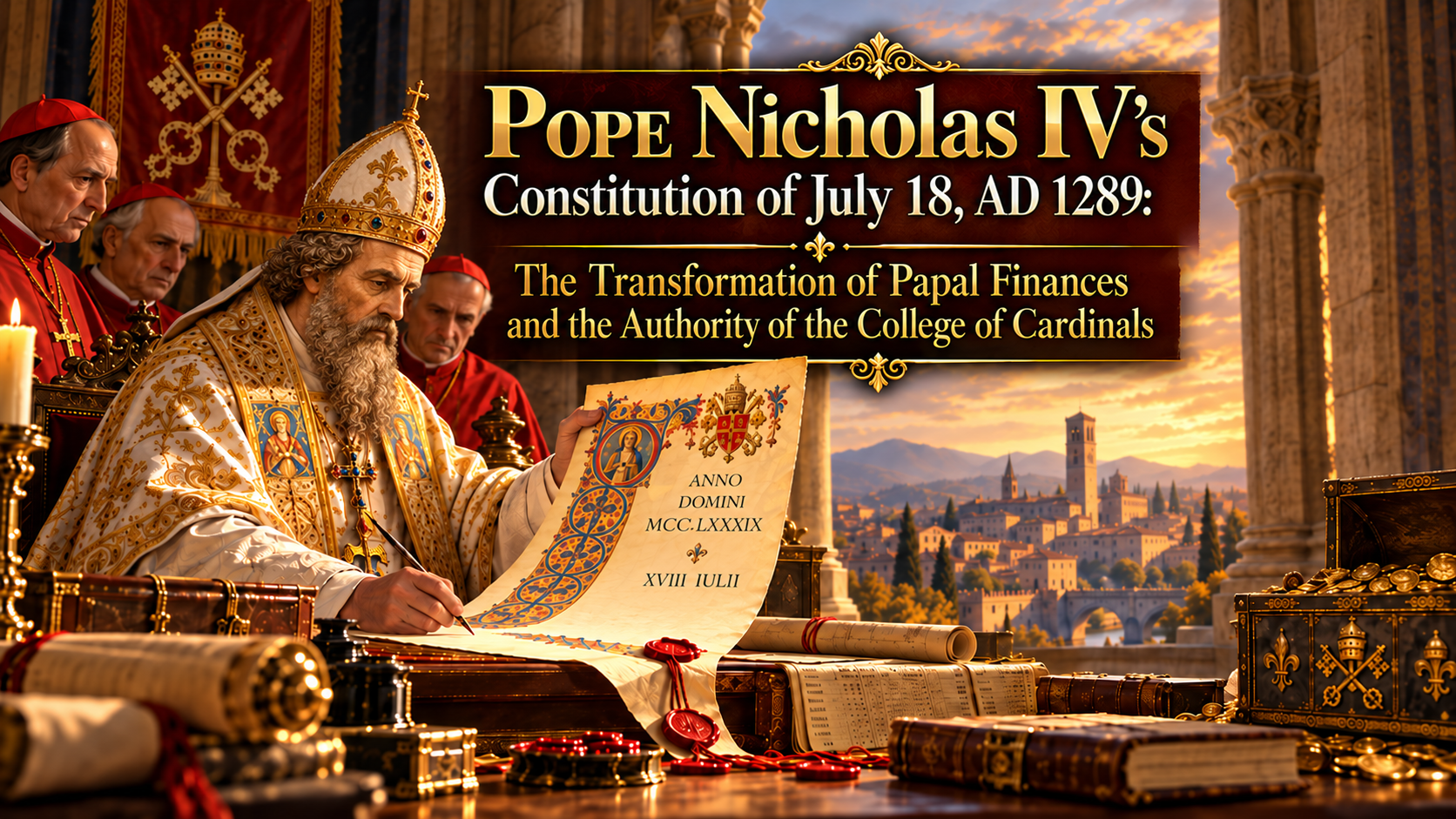
An Examination of Medieval Church Government, Ecclesiastical Revenue, Financial Administration, and the Historical Development of the College of Cardinals
Introduction
On July 18, AD 1289, Pope Nicholas IV issued an important papal constitution known by its opening Latin words, Celestis altitudo potentie. Promulgated at Rieti, Italy, this decree marked a significant development in the financial administration of the medieval Catholic Church and in the institutional authority of the College of Cardinals.
The constitution formally granted the College of Cardinals one-half of specified revenues belonging to the Apostolic See. It also strengthened the cardinals’ participation in the administration of Church finances and reinforced their position within the government of the Papal States.
This legislation did not establish ecclesiastical taxation, create the College of Cardinals, or introduce the first system of papal financial administration. Rather, it expanded and formalized financial arrangements that had developed during the preceding decades.
The constitution must therefore be understood within the broader history of the medieval papacy, including the relationship between spiritual authority, temporal government, ecclesiastical property, and institutional responsibility.
It is also important to distinguish this legislation from the Church’s theological teaching concerning lending, interest, and usury.
An accurate examination of Celestis altitudo potentie reveals a significant episode in the development of ecclesiastical financial government rather than the creation of an entirely new economic system.
I. Historical Background: The Papacy in the Thirteenth Century
Pope Nicholas IV, born Girolamo Masci in AD 1227, was elected to the papacy in February AD 1288 and began his pontificate on February 22 of that year. He governed the Catholic Church until his death on April 4, AD 1292.
He belonged to the Order of Friars Minor, commonly known as the Franciscans, and was the first Franciscan to become pope.
Before his election, he had served as Minister General of the Franciscan Order and subsequently as a cardinal of the Roman Church.
His pontificate occurred during a period in which the papacy exercised extensive religious, diplomatic, and territorial responsibilities.
As Supreme Pontiff, Nicholas IV held the highest spiritual office in the Catholic Church. As temporal sovereign of the Papal States, he also possessed governmental responsibilities over territories in central Italy.
These temporal responsibilities included administration, law, diplomacy, territorial governance, and the management of financial resources.
The papacy required income to maintain its institutions, support its officials, administer its territories, and fulfill its responsibilities throughout Latin Christendom.
Papal revenues were derived from several sources, including ecclesiastical dues, tribute, feudal obligations, and income associated with papal territorial government.
The College of Cardinals occupied an increasingly important position within this system.
Cardinals served as the pope’s principal advisers, participated in important matters of ecclesiastical government, and possessed the responsibility of electing a new Roman Pontiff according to the applicable law.
Their growing institutional importance was accompanied by the development of financial arrangements supporting the college as a corporate body.
By the late thirteenth century, the financial relationship between the papacy and the cardinals had already acquired considerable complexity.
It was within this setting that Nicholas IV promulgated his constitution of July 18, AD 1289.
Historical references: N. A. Weber, “Pope Nicholas IV,” Catholic Encyclopedia (1911); William Edward Lunt, Papal Revenues in the Middle Ages, Vol. I (1934), pp. 26–27.
II. The Constitution Celestis altitudo potentie
The constitution Celestis altitudo potentie was issued at Rieti on July 18, AD 1289.
The document is preserved in the historical record of papal legislation and is identified in August Potthast’s Regesta Pontificum Romanorum as no. 23010.
Its date is confirmed by the Latin dating formula:
XV kalendas augusti, indictione II, MCCLXXXIX, anno secundo.
The expression XV kalendas augusti, calculated according to Roman inclusive reckoning, identifies July 18.
The principal financial provision of the constitution assigned to the College of Cardinals one-half of the revenues covered by the decree.
These included substantial income associated with ecclesiastical administration, tribute, territorial rights, and other recognized sources of papal revenue.
The legislation also enhanced the cardinals’ participation in financial administration.
This allocation strengthened the College of Cardinals by establishing a formal claim to substantial revenues received by the Roman Church.
Nevertheless, an essential qualification must be made.
The constitution did not establish an unrestricted, permanent entitlement to one-half of every source of papal income, including all revenues created in subsequent centuries.
Historian William Edward Lunt explains that Nicholas IV granted the cardinals a half-share in revenues possessed by the Roman Church at the time.
When additional forms of taxation were instituted later, the cardinals did not automatically receive an equivalent share.
This distinction is essential to understanding the actual scope of the constitution.
It was a substantial grant of financial rights, but not a permanent division of all present and future papal income into two equal treasuries.
The constitution therefore represented an important development in existing ecclesiastical financial arrangements rather than an unlimited transfer of financial authority.
Primary source: Nicholas IV, Celestis altitudo potentie, July 18, AD 1289, Rieti; Bullarium Romanum, Turin edition, Vol. IV, p. 88, no. 3; Potthast, Regesta Pontificum Romanorum, no. 23010, p. 1855.
III. The Financial Rights of the Cardinals Before AD 1289
Nicholas IV’s constitution did not create the financial organization of the College of Cardinals from nothing.
The college had already acquired collective financial rights during the twelfth and thirteenth centuries.
William Edward Lunt documents several important developments.
By AD 1235, if not earlier, the cardinals possessed a recognized share of tribute paid by the king of England.
In AD 1272, Pope Gregory X granted the cardinals one-half of the tribute owed by the king of Sicily.
During the second half of the thirteenth century, the college also acquired rights to portions of certain ecclesiastical payments known as common services.
The cardinals had begun appointing one of their own members as camerarius, or chamberlain, to administer their common revenues by AD 1272.
By AD 1295, the financial administration associated with the college had developed a regular system of accounts.
These facts demonstrate that the financial position of the College of Cardinals evolved gradually.
The constitution of Nicholas IV represented a major stage in that development because it extended and formalized the college’s claims to recognized papal revenues.
It is therefore more accurate to describe the constitution as a consolidation and expansion of established financial privileges than as the beginning of the cardinals’ financial administration.
Historical reference: William Edward Lunt, Papal Revenues in the Middle Ages, Vol. I, pp. 26–27.
IV. The Sources of Papal Revenue
The revenues relevant to Nicholas IV’s constitution reflected the diverse financial obligations and territorial arrangements of medieval Christendom.
They included several distinct categories.
1. Common Services (Servitia Communia)
Common services were financial payments associated with certain ecclesiastical appointments and confirmations.
These payments formed part of the administrative system through which the Roman Curia received revenue from ecclesiastical institutions and officeholders.
The College of Cardinals possessed a recognized interest in portions of these payments.
They should not be confused with ordinary parish collections or modern personal income taxes.
2. Pallium-Related Dues
The pallium is a distinctive ecclesiastical vestment associated particularly with metropolitan archbishops and their communion with the Roman Pontiff.
In medieval administration, certain payments were associated with its conferral.
These payments constituted one of the historically recognized sources of papal revenue in which the College of Cardinals participated.
3. Peter’s Pence
Peter’s Pence was a longstanding source of support for the Apostolic See.
Its historical form varied according to time and place.
In medieval England, for example, it became associated with an established annual payment connected with the Roman Church.
This medieval arrangement should not be treated as identical in legal character or collection method to the modern voluntary Peter’s Pence contribution.
Its inclusion among papal revenues illustrates the historical financial relationships between the Holy See and Christian territories.
4. Tribute and Census Payments
The term census referred to recognized payments or tribute arising from particular relationships with the Roman Church.
These obligations could be associated with territories, kingdoms, or other political entities acknowledging specified rights of the Holy See.
Such payments reflected the political and legal conditions of medieval Europe.
Not every payment was imposed directly upon an individual taxpayer.
5. Visitation Dues
Certain ecclesiastical revenues were associated with visits to Rome by bishops, archbishops, and other prelates.
These obligations were connected with the historical practice of visiting the Apostolic See, commonly referred to as visitatio liminum apostolorum.
Such payments formed another component of the broader financial system of the Roman Curia.
6. Revenues From the Papal States
The constitution also identified revenues associated with territories under papal authority.
Its register includes territories such as the March of Ancona, Romagna, the Duchy of Spoleto, the Patrimony of St. Peter in Tuscany, and other regions connected with papal government.
The papacy derived income from various territorial rights, obligations, and administrative arrangements.
These revenues were especially important because the pope exercised temporal as well as spiritual responsibilities.
7. Fines and Judicial Proceeds
Other revenues included certain fines, financial penalties, and proceeds associated with the exercise of jurisdiction.
The historical register of the constitution expressly refers to fines, condemnations, and census payments among the revenues included in the grant.
These categories demonstrate the complexity of the medieval papal financial system.
They also show why it is historically misleading to equate all papal revenue with modern taxation.
The revenues of the Apostolic See included ecclesiastical payments, feudal obligations, territorial income, judicial proceeds, and other forms of financial entitlement.
Historical references: Nicholas IV, Celestis altitudo potentie; Catholic Encyclopedia, “Cardinal”; William Edward Lunt, Papal Revenues in the Middle Ages, Vol. I, pp. 26–27.
V. The Apostolic Camera and the Financial Administration of the Cardinals
An important distinction must be made between the Apostolic Camera and the financial administration of the College of Cardinals.
The Apostolic Camera, or Camera Apostolica, served as a principal financial institution of the papal government.
It was responsible for important aspects of the collection, accounting, and administration of papal revenues.
The College of Cardinals developed a separate financial administration for the income belonging to it corporately.
This administration was associated with its own chamberlain, the camerarius.
However, the existence of the cardinals’ financial organization did not mean that they exercised equal control over the entire papal treasury.
William Edward Lunt explains that the financial administration of the cardinals remained secondary to that of the Apostolic Camera.
The cardinals’ chamber did not maintain a separate network of financial collection agents outside the papal court.
Instead, revenues collected through papal agents were administered through the Apostolic Camera, which transferred the appropriate share to the college.
The collectors remained responsible to the papal financial administration.
Thus, the constitution strengthened the financial position of the cardinals without eliminating the central administrative role of the Apostolic Camera.
This distinction is critical.
The legislation concerned the allocation of revenues and participation in administration, not the replacement of papal financial government with an independent system controlled by the cardinals.
Historical reference: William Edward Lunt, Papal Revenues in the Middle Ages, Vol. I, pp. 26–27.
VI. The Growing Authority of the College of Cardinals
The constitution had significance beyond the immediate distribution of money.
It contributed to the institutional development of the College of Cardinals and affected the relationship between the pope and his principal advisers.
By receiving an expanded and formally recognized share of papal revenues, the college acquired greater financial security as a corporate body.
This strengthened its capacity to maintain its own administrative functions and support its institutional responsibilities.
The constitution also increased the involvement of cardinals in financial matters connected with the government of the Papal States.
Historical scholarship indicates that Nicholas IV allowed the cardinals to participate in certain appointments to territorial offices, including rectorates, with papal agreement.
These arrangements reflected the increasingly important position of the college within the Roman Curia.
However, financial participation must not be confused with equality of supreme ecclesiastical authority.
The College of Cardinals did not become a second papacy.
Nor did the constitution establish that the cardinals collectively possessed the same supreme governing authority as the Roman Pontiff.
Their participation remained part of the ecclesiastical structure over which the pope presided.
The constitution must therefore be understood as a development in institutional administration rather than as a doctrinal redefinition of papal primacy.
At the same time, financial rights could have political consequences.
An institution possessing substantial and continuing sources of income was better positioned to exercise influence within the government of the Church.
The constitution thus contributed to the broader medieval development of the College of Cardinals as an increasingly established and influential body.
Historical references: Sophia Menache, “Nicholas IV, Pope,” New Catholic Encyclopedia; William Edward Lunt, Papal Revenues in the Middle Ages, Vol. I.
VII. Did Pope Nicholas IV Authorize Interest or Usury?
The constitution of July 18, AD 1289, concerned the allocation and administration of ecclesiastical revenues.
It did not establish a general authorization to charge interest on loans.
Nor did it overturn the Catholic Church’s condemnation of usury.
This distinction is particularly important because discussions of medieval finance sometimes confuse taxes, tribute, fees, and interest-bearing loans.
These are different economic and legal arrangements.
A payment required under a territorial obligation is not necessarily interest on a loan.
A fee connected with an ecclesiastical administrative process is likewise not automatically equivalent to usury.
To understand the distinction, it is useful to consider the teaching of St. Thomas Aquinas.
St. Thomas Aquinas on Usury
St. Thomas Aquinas, who died in AD 1274, addressed usury in the Summa Theologiae, Second Part of the Second Part, Question 78.
Aquinas examined whether a lender could justly require payment for the use of money lent under a contract in which ownership of the money passed to the borrower.
His reasoning distinguished the principal sum from an additional charge imposed solely for its use.
He argued that demanding such a charge constituted injustice because the borrower would effectively be required to pay for something beyond what was legitimately owed under that kind of loan.
Aquinas also examined other questions concerning financial agreements, compensation, and the ownership of goods.
His treatment formed part of the larger Catholic moral tradition concerning commutative justice, property, and economic obligations.
Later Catholic theology further developed distinctions concerning legitimate compensation, contractual arrangements, and unjust profit from lending.
These theological matters must be examined within their own doctrinal and historical context.
The constitution of Nicholas IV concerned a different subject.
It regulated the distribution of revenues belonging to the Roman Church.
There is no basis in the constitution for interpreting it as an authorization of usury or as the foundation of modern interest-bearing banking.
The historical distinction between ecclesiastical revenue administration and the moral evaluation of lending must be preserved.
Theological reference: St. Thomas Aquinas, Summa Theologiae, II-II, q. 78, aa. 1–4.
VIII. The Constitution and the Development of Ecclesiastical Financial Government
The constitution represents an important stage in the institutional development of medieval papal financial administration.
Its significance lies partly in the formal recognition of financial rights belonging to a corporate ecclesiastical institution.
Such rights required systems for identifying revenues, collecting income, recording payments, and distributing funds according to established obligations.
The cardinals’ financial administration functioned within this broader system.
By the late thirteenth century, the financial organization of the Roman Church involved multiple institutions and officials with distinct responsibilities.
These arrangements reflected the increasing complexity of Church government.
They also illustrate a broader feature of medieval society: religious and political institutions often exercised authority within overlapping legal and territorial systems.
The pope governed the universal Church spiritually while also possessing temporal responsibilities within territories subject to papal rule.
Consequently, papal financial administration dealt with obligations that arose from both ecclesiastical governance and territorial government.
The constitution of AD 1289 did not create this dual responsibility.
Rather, it regulated a portion of the financial arrangements already operating within it.
The measure also helps explain why the history of the College of Cardinals cannot be understood exclusively through its role in papal elections.
The college developed responsibilities, privileges, and financial institutions that affected its position within the government of the Church.
Its financial history is therefore an important part of the institutional history of the medieval papacy.
IX. Did the Constitution Influence Modern Taxation?
The financial provisions of Celestis altitudo potentie concern revenue allocation, tribute, and ecclesiastical administration.
They provide valuable evidence of how a major medieval institution organized its financial affairs.
Nevertheless, there is no established historical basis for claiming that the constitution directly created the taxation system of the United States.
The American system developed through a different constitutional and historical process, including English legal traditions, colonial taxation, and the establishment of the federal government under the United States Constitution.
Although medieval papal revenues and modern governmental taxes may share certain broad administrative characteristics, such similarities do not demonstrate direct historical dependence.
Taxes, tribute, customs payments, property revenues, and administrative dues existed in different civilizations long before AD 1289.
It would therefore be inaccurate to attribute the origin of taxation generally, or American taxation specifically, to Nicholas IV’s constitution.
The document is most appropriately understood as a measure concerning ecclesiastical financial administration within the political and institutional conditions of thirteenth-century Europe.
X. A Catholic Understanding of Financial Stewardship
The Catholic Church’s possession of temporal goods must always be considered in relation to her supernatural mission.
The Church exists to proclaim the Gospel, administer the sacraments, worship God, teach the faith, and assist those in spiritual and material need.
Financial resources serve these purposes.
They are not ends in themselves.
Sacred Scripture establishes the importance of fidelity in administering responsibilities entrusted to human persons.
St. Paul teaches:
“Here now it is required among the dispensers, that a man be found faithful.”
— 1 Corinthians 4:2, Douay-Rheims Bible
This principle applies broadly to the responsible administration of property and financial resources.
The same fundamental understanding is reflected in the Church’s contemporary canonical legislation.
The Purpose of Ecclesiastical Property
The 1983 Code of Canon Law, canon 1254 §2, identifies the principal purposes for which the Church possesses temporal goods:
- The ordering and support of divine worship.
- The proper support of clergy and other ministers.
- Works of the sacred apostolate.
- Works of charity, especially for those in need.
Canon 1284 further requires administrators of ecclesiastical goods to exercise appropriate diligence and care in fulfilling their responsibilities.
These provisions belong to modern canon law and were not the legislation governing the Church in AD 1289.
Nevertheless, they provide a useful expression of enduring Catholic principles concerning the responsible administration of ecclesiastical property.
Such principles help explain why the Church has historically required organized financial institutions.
Without material resources, the Church’s temporal responsibilities cannot be adequately fulfilled.
Yet the acquisition and administration of money must remain subordinate to the Church’s spiritual mission.
Was Nicholas IV’s Constitution an Infallible Teaching?
The constitution was a measure of ecclesiastical government concerning financial rights and administration.
It was not a solemn definition of a doctrine of faith or morals.
Its provisions should therefore be distinguished from teachings proposed infallibly by the Church’s Magisterium.
A papal constitution can exercise genuine ecclesiastical legislative authority without constituting an infallible doctrinal pronouncement.
This distinction is essential when interpreting medieval papal documents.
The historical importance of Celestis altitudo potentie rests in its administrative provisions and their institutional consequences.
It should not be understood as establishing a new Catholic doctrine concerning taxation, lending, or the nature of spiritual authority.
References: 1 Corinthians 4:2, Douay-Rheims Bible; Code of Canon Law (1983), canons 1254 and 1284.
XI. The Historical Significance of July 18, AD 1289
The constitution of Nicholas IV deserves attention for several reasons.
First, it documents the development of institutional financial rights within the medieval Catholic Church.
Second, it demonstrates the increasing corporate importance of the College of Cardinals.
Third, it illustrates the relationship between the Apostolic See’s spiritual responsibilities and the temporal administration of the Papal States.
Fourth, it provides evidence of the financial organization of the Roman Curia during the later thirteenth century.
Finally, it shows that the development of ecclesiastical government involved not only theological and canonical questions but also the practical responsibilities of managing extensive institutions and territorial obligations.
The constitution did not eliminate the primacy of the Roman Pontiff.
It did not transform the cardinals into an independent supreme authority.
Nor did it create a new system of universal taxation.
Its actual significance is more specific and historically substantial: it formally recognized and expanded the College of Cardinals’ entitlement to important categories of papal revenue within an already developing administrative system.
This change contributed to the institutional history of the college and the broader development of papal financial government.
Conclusion
The constitution Celestis altitudo potentie, issued by Pope Nicholas IV at Rieti on July 18, AD 1289, was an important measure in the financial and institutional history of the medieval Catholic Church.
By assigning the College of Cardinals one-half of the revenues covered by the decree and strengthening its participation in financial administration, Nicholas IV expanded the college’s recognized position within papal government.
The constitution developed arrangements already present during the preceding decades, including the cardinals’ financial privileges, common revenues, and administrative organization.
It did not, however, create an unlimited claim to one-half of all future papal income.
Nor did it displace the Apostolic Camera as the principal institution responsible for directing papal finances.
Its provisions must also be distinguished from Catholic moral theology concerning interest and usury.
The document did not establish a general authorization to charge interest on loans, nor did it serve as the historical foundation of modern taxation.
Instead, its enduring importance lies in the institutional development of ecclesiastical financial government.
The constitution illustrates how the medieval papacy sought to organize the distribution of revenues within an increasingly complex administrative structure.
It also demonstrates that the College of Cardinals developed as more than an electoral body, acquiring financial rights and responsibilities that contributed to its enduring importance in the government of the Catholic Church.
Pope Nicholas IV’s constitution of July 18, AD 1289, therefore stands as an important historical witness to the relationship between financial administration, institutional authority, and ecclesiastical government in the medieval Church.
Historical Dating Note
The date of the constitution deserves particular attention because some modern secondary references contain a discrepancy.
The papal act is identified in the historical register with the dating formula XV kalendas augusti, corresponding to July 18 according to Roman inclusive reckoning.
The CNRS Aposcripta database records the date as July 18, AD 1289, and identifies the location as Rieti.
August Potthast’s Regesta Pontificum Romanorum, no. 23010, provides the corresponding historical reference.
The Catholic Encyclopedia likewise gives July 18, AD 1289.
However, Sophia Menache’s article “Nicholas IV, Pope,” in the New Catholic Encyclopedia, gives June 18, AD 1289.
For this article, July 18, AD 1289, has been retained because it is supported by the dating formula recorded in the papal register.
Historical Sources and References
Primary Historical Sources
1. Pope Nicholas IV. Celestis altitudo potentie. Papal constitution issued at Rieti, July 18, AD 1289. Published in Bullarium Romanum, Turin edition, Vol. IV, p. 88, no. 3.
The document is also catalogued in the CNRS historical papal-letter database, Telma–Aposcripta, record no. 14131.
Consult the historical archival record
2. Potthast, August. Regesta Pontificum Romanorum, Vol. II. Berlin, 1875, no. 23010, p. 1855.
A historical register providing identification and documentary information concerning the constitution.
Scholarly Historical Studies
3. Lunt, William Edward. Papal Revenues in the Middle Ages. Vol. I. New York: Columbia University Press, 1934, pp. 26–27.
A major historical study of medieval papal finance, including the financial organization of the College of Cardinals and its relationship with the Apostolic Camera.
4. Kirsch, J. P. Die Finanzverwaltung des Kardinalkollegiums im 13. und 14. Jahrhundert. Münster, 1895.
A specialized historical study concerning the financial administration of the College of Cardinals during the thirteenth and fourteenth centuries.
5. Weber, N. A. “Pope Nicholas IV.” The Catholic Encyclopedia. Vol. 11. New York: Robert Appleton Company, 1911.
A historical account of the pontificate of Nicholas IV, including his constitution of July 18, AD 1289.
6. “Cardinal.” The Catholic Encyclopedia. Vol. 3. New York: Robert Appleton Company, 1908.
Provides historical information about the College of Cardinals, its financial privileges, the cardinal chamberlain, and sources of medieval papal revenue.
7. Menache, Sophia. “Nicholas IV, Pope.” New Catholic Encyclopedia.
A historical study of Nicholas IV’s pontificate, the growth of the College of Cardinals, and the financial and administrative effects of his constitution.
This source gives June 18 rather than July 18 for the constitution; the discrepancy is addressed in the dating note above.
Theological and Canonical Sources
8. St. Thomas Aquinas. Summa Theologiae, Secunda Secundae, Question 78, Articles 1–4, “The Sin of Usury.”
A principal theological treatment of the morality of lending and usury.
9. Catholic Church. Code of Canon Law (1983), Book V, “The Temporal Goods of the Church,” particularly canons 1254 and 1284.
Provides the contemporary canonical principles governing the purposes and administration of ecclesiastical property.
Read Book V of the Code of Canon Law
10. The Holy Bible. Douay-Rheims Version, 1 Corinthians 4:2.
A scriptural foundation for faithful stewardship and responsibility.
Editorial note: This article distinguishes the historical financial legislation of Pope Nicholas IV from the Church’s doctrinal teaching on usury and from modern systems of taxation. It is based on the identified papal register, historical scholarship, Catholic theological sources, and ecclesiastical legislation.