

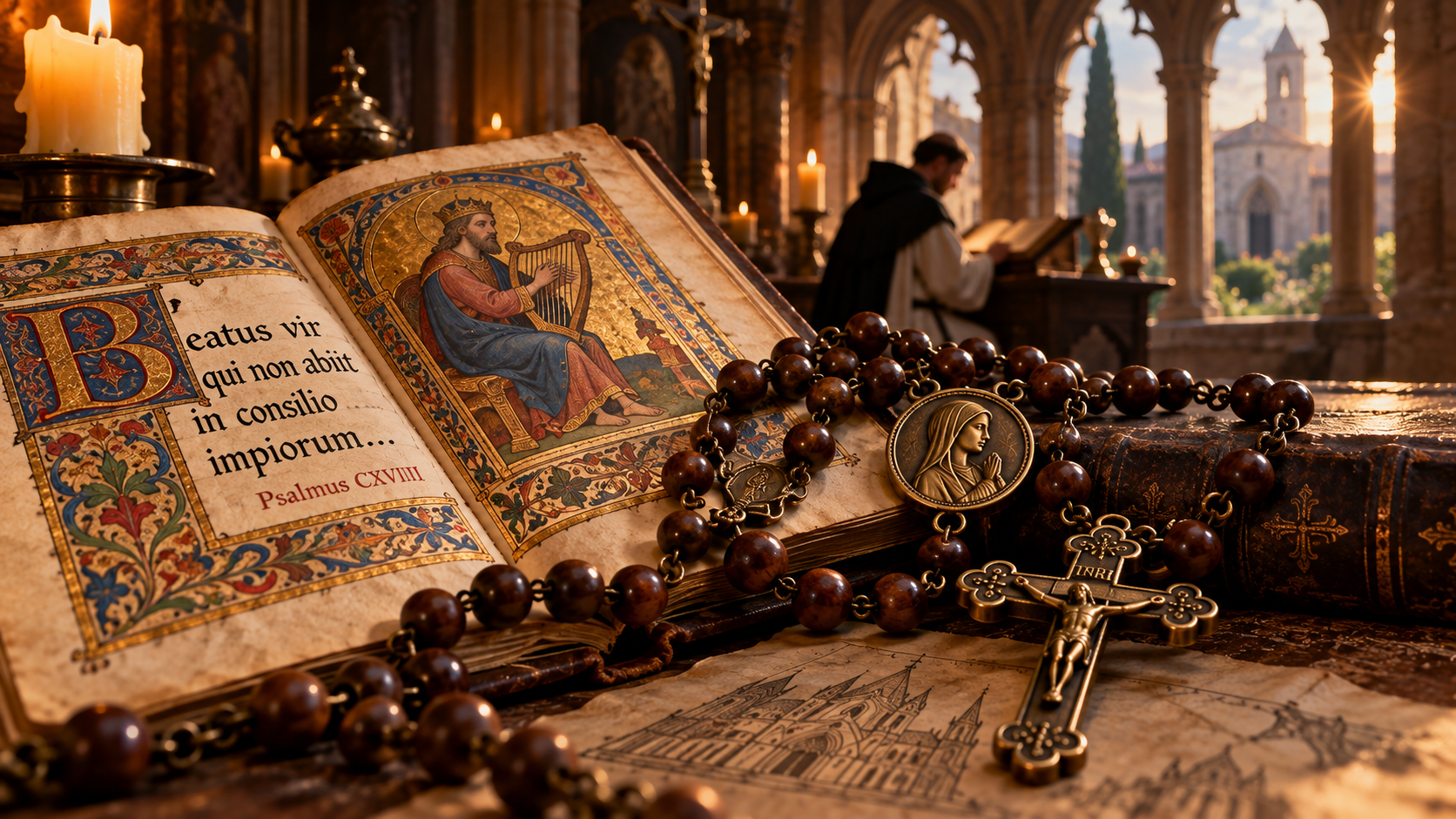
The Rosary, Rediscovered — Article 6 of 12
Discover how the Rosary developed through centuries of Catholic prayer, its connection to the biblical Psalms, the influence of St. Dominic and the Dominican Order, and why its history reveals the living spiritual tradition of the Catholic Church.
Scripture for Meditation: Psalm 118:1–16 (Psalm 119 in many modern Bibles); Luke 1:26–55; 1 Thessalonians 5:17
Where did the Rosary come from?
Was it given directly to St. Dominic by the Blessed Virgin Mary? Did the earliest Christians pray it? Why do its traditional mysteries contain 150 Hail Marys, and how did the Church arrive at the form Catholics recognize today?
These questions lead us into a fascinating part of Catholic history.
The Rosary is among the most beloved devotions in the Catholic Church. Its familiar prayers have accompanied generations of believers through times of peace, persecution, conversion, suffering, and joy.
Yet its history is more complex, and more interesting, than many Catholics realize.
The Rosary did not appear in its complete modern form at the beginning of Christianity. Its familiar structure developed gradually, drawing upon Sacred Scripture, the Church’s liturgical prayer, medieval devotional practices, and the spiritual wisdom of generations of Catholics.
Understanding that development does not weaken the Rosary’s Catholic identity.
It helps us understand what a living tradition truly is.
Ancient Faith Develops Living Forms of Prayer
The Rosary’s deepest spiritual roots reach into the biblical tradition of prayer.
Long before the Christian Church existed, the people of Israel prayed and sang the Psalms.
The Psalter provided words of praise, thanksgiving, repentance, lamentation, and trust in God.
These inspired prayers gave expression to nearly every circumstance of human life.
The Psalms were not simply religious poetry.
They formed a school of prayer.
The faithful learned to praise God in prosperity, seek His mercy after sin, trust Him amid suffering, and remember His mighty works throughout history.
The Church inherited this treasury of prayer from Israel.
Christ Himself prayed the Psalms, and the earliest Christians continued to use them in their worship.
Over time, the chanting and recitation of the Psalter became central to the daily prayer of monks, clergy, and religious communities.
The Church’s Liturgy of the Hours developed as a structured form of prayer that sanctifies the hours of the day through the Psalms, readings, hymns, and intercessions.
But there was a practical difficulty.
Many ordinary Christians could not read.
Books were expensive and often inaccessible.
Those who worked long hours in fields, workshops, or households frequently lacked the education, resources, or opportunity to participate in the full cycle of psalmody practiced in monastic communities.
Yet their desire to pray was no less sincere.
They, too, wished to praise God, remember His saving works, and maintain a regular rhythm of devotion.
One response was the repetition of familiar prayers.
The Our Father held a privileged place because it had been taught by Jesus Christ Himself.
Christians sometimes counted repeated prayers using pebbles, knotted cords, or strings of beads.
Such practices offered a simple and practical means of maintaining attention and counting prayers.
The physical objects were not the source of spiritual power.
They were aids to devotion.
What mattered was the prayer being offered and the disposition of the person praying.
Over the centuries, these devotional practices contributed to the development of what would eventually become the Rosary.
The Catechism of the Catholic Church recognizes this historical relationship in CCC 2678, explaining that medieval Western devotion developed the Rosary as a popular counterpart or substitute for the Liturgy of the Hours.
This is an important connection.
The Rosary did not emerge from a desire to replace biblical prayer.
It developed within a Christian culture already deeply shaped by the Psalms.
The Marian Psalter: Why 150 Hail Marys?
The connection between the Psalter and the Rosary becomes especially clear when we consider the number 150.
The biblical Book of Psalms contains 150 Psalms.
In medieval Christian devotion, the repetition of 150 prayers came to reflect this biblical pattern.
Earlier devotional practices sometimes involved repeated Our Fathers, often called Paternosters.
Over time, the Hail Mary assumed a growing role in Western Catholic spirituality.
The prayer itself developed historically.
Its opening words came from Sacred Scripture, particularly the angel Gabriel’s greeting at the Annunciation and Elizabeth’s blessing at the Visitation.
The familiar petition asking the Blessed Virgin to pray for sinners became established in the Church’s devotional life over time.
As Marian prayer developed, groups of Hail Marys came to be associated with contemplation of the mysteries of Jesus Christ.
The practice of praying 150 Hail Marys became known as a Marian Psalter.
The relationship was intentional.
Just as the biblical Psalter offered repeated praise to God, the Marian Psalter provided a structured form of prayer in which the faithful could contemplate the saving mysteries of Christ in the company of His Mother.
Pope St. Paul VI acknowledges the relationship between the traditional 150 Hail Marys and the biblical Psalter in Marialis Cultus, paragraph 49.
The traditional complete Rosary eventually came to contain fifteen decades, divided into three sets of mysteries:
- The Joyful Mysteries, contemplating the Incarnation and the early life of Christ.
- The Sorrowful Mysteries, contemplating the Passion and Death of the Lord.
- The Glorious Mysteries, contemplating the Resurrection, Ascension, and heavenly glory.
Each set contained five decades.
Together, the fifteen decades comprised 150 Hail Marys, along with the Our Fathers, Glory Bes, and other customary prayers.
This structure connected the devotion symbolically to the 150 Psalms.
But the numerical relationship was not the most important feature.
Its purpose was to form the Christian heart through sustained meditation upon the Gospel.
The Rosary became a practical means by which Christians could pray regularly, even without possessing a book or having extensive theological education.
Its simplicity made it accessible.
Its mysteries gave that simplicity extraordinary depth.
What About St. Dominic and the Origin of the Rosary?
One of the most familiar traditions surrounding the Rosary concerns St. Dominic, who lived from approximately AD 1170 to 1221.
According to a longstanding devotional tradition, the Blessed Virgin Mary appeared to St. Dominic and entrusted the Rosary to him as a means of promoting conversion and defending the faith.
This account has profoundly influenced Catholic art, preaching, and devotion.
Numerous paintings portray Our Lady handing a rosary to St. Dominic.
The Dominican Order has played an enormous role in promoting the Rosary throughout the Church.
Popes have also spoken favorably of the traditional association between St. Dominic and the devotion.
Pope Leo XIII, for example, emphasized St. Dominic’s role in spreading the Rosary in his encyclical Supremi Apostolatus Officio (1883).
These facts belong to the history of Catholic devotion.
Yet historical precision requires an important distinction.
The claim that the Blessed Virgin personally gave St. Dominic the entire Rosary in precisely its later, fully developed form is not established by the earliest surviving historical documents.
The familiar structure of the Rosary developed over several centuries.
Different elements of the devotion existed independently before becoming united in a recognizable form.
The more elaborate accounts connecting St. Dominic to the origin of the complete Rosary became especially prominent through the preaching of Blessed Alan de la Roche, a Dominican priest of the fifteenth century.
Blessed Alan was an influential promoter of Marian prayer and helped spread Rosary devotion throughout parts of Europe.
His work contributed significantly to the popularity of the devotion and the growth of Rosary confraternities.
However, historical scholarship has questioned the documentary basis of some accounts concerning the Rosary’s origin.
The Catholic Encyclopedia, in its articles on the Rosary and Blessed Alan de la Roche, discusses these historical difficulties.
A Catholic need not dismiss the devotional significance of the Dominican tradition in order to recognize these limitations.
Nor must we treat every detail of a traditional devotional account as a historically demonstrated fact.
There is a difference between honoring a longstanding tradition and claiming certainty beyond what the surviving evidence supports.
The Church’s love for the Rosary does not depend upon proving that every component of its modern structure was given in a single moment.
Its spiritual value rests upon its fidelity to the Gospel and its capacity to lead souls toward Jesus Christ.
The Dominican contribution remains historically significant regardless of how one evaluates particular accounts of the devotion’s earliest origins.
And St. Dominic’s own dedication to preaching, prayer, and the salvation of souls remains an enduring example for Catholics today.
The Church Receives, Tests, and Commends Devotion
The gradual development of the Rosary raises a larger question.
If a devotion develops over time, how does the Church determine whether it is authentically Catholic?
The answer begins with the distinction between public revelation and popular devotion.
The Catholic Church teaches that God’s definitive public revelation has been given in Jesus Christ and transmitted through Sacred Scripture and Sacred Tradition.
Private revelations and devotional practices do not add new doctrines to the deposit of faith.
Nor do they possess the same authority as divine revelation.
Popular devotions belong to the lived prayer of the Church.
They can enrich the spiritual lives of the faithful, encourage conversion, and deepen devotion to Christ.
But they must remain faithful to Catholic doctrine and properly ordered toward the sacred liturgy.
The Catechism of the Catholic Church addresses this relationship in CCC 1674–1676.
It recognizes the spiritual value of popular piety, including the Rosary, while teaching that such practices should harmonize with the liturgical life of the Church.
They are intended to lead believers toward the liturgy, not replace it.
This distinction is essential.
The Holy Mass is the sacramental celebration of Christ’s saving sacrifice.
The Rosary is a devotional prayer through which we contemplate His saving mysteries.
The two are not competitors.
Properly understood, they support one another.
A Catholic who meditates upon the Institution of the Eucharist during the Rosary should grow in appreciation for the Holy Mass.
Someone who contemplates the Crucifixion should participate more reverently in the sacramental memorial of Christ’s sacrifice.
Someone who meditates upon the Resurrection should approach Christian worship with greater hope.
The Church commends the Rosary because it helps form these dispositions.
Its value is not based upon treating every detail of its historical arrangement as an unchangeable dogma.
It is based upon the prayer’s capacity to deepen the Christian life.
The Popes and the Growth of Rosary Devotion
Throughout the centuries, the Church has repeatedly encouraged the faithful to pray the Rosary.
The papal teaching surrounding this devotion is especially rich.
Pope St. Pius V helped establish and promote the traditional form of the Rosary in the sixteenth century.
Pope Leo XIII became so closely associated with its promotion that he is often remembered as the Pope of the Rosary.
His encyclical Supremi Apostolatus Officio, published in AD 1883, encouraged the Rosary as a powerful means of prayer during a period of difficulty for the Church.
Pope St. Paul VI later provided an important theological and pastoral explanation of Marian devotion in his apostolic exhortation Marialis Cultus (1974).
He emphasized the Rosary’s evangelical character, its connection with the mysteries of Christ, and the importance of contemplation.
Pope St. John Paul II offered another major contribution through his apostolic letter Rosarium Virginis Mariae (2002).
He presented the Rosary as a deeply Christ-centered prayer.
For him, the Rosary was not simply a traditional practice to preserve.
It was a means of contemplating the face of Christ and entering more deeply into the mystery of His saving life.
These papal teachings demonstrate that the Church’s encouragement of the Rosary has never rested merely upon nostalgia.
The Rosary remains valuable because the mysteries it places before us remain central to Christian faith.
Its purpose is to lead us to Jesus Christ.
The Luminous Mysteries: An Example of Living Development
One of the clearest modern examples of the Rosary’s development came in AD 2002.
In Rosarium Virginis Mariae, Pope St. John Paul II proposed the addition of five Luminous Mysteries, also called the Mysteries of Light.
These mysteries focus upon important events in the public ministry of Jesus Christ.
They are:
The Baptism of Jesus in the Jordan
Christ is revealed as the beloved Son of the Father as the Holy Spirit descends upon Him.
The Wedding at Cana
Jesus performs His first public sign, revealing His glory and inviting faith in Him.
The Proclamation of the Kingdom of God
Christ announces the Kingdom, calls sinners to repentance, and offers God’s mercy.
The Transfiguration
The glory of Christ is manifested before Peter, James, and John, preparing them for the mystery of His Passion.
The Institution of the Holy Eucharist
Jesus gives Himself to His Church under the appearances of bread and wine.
These mysteries fill an important contemplative space between the events of Christ’s early life and His Passion.
They invite the faithful to meditate more extensively upon His public ministry.
Yet St. John Paul II did not present the additional mysteries as a new dogma or as the rejection of the traditional fifteen mysteries.
In paragraph 19 of Rosarium Virginis Mariae, he explicitly describes the proposal as one left to the freedom of individuals and communities.
This is important.
The traditional fifteen-mystery Rosary remains a venerable Catholic devotion.
The four sets of five mysteries are also widely prayed throughout the Church.
The addition of the Luminous Mysteries did not change the truths of the Gospel.
It provided another means of contemplating those truths.
The distinction illustrates how a devotional practice can develop while preserving its essential theological purpose.
The form can receive new emphasis.
The faith it expresses remains the same.
Tradition Is Not the Same as Immobility
Catholics sometimes fear that admitting historical development somehow threatens the authenticity of a religious practice.
But this concern often arises from confusing two different things.
The unchanging deposit of faith is not identical to every historical expression of Catholic devotion.
The Church cannot change the truth that Jesus Christ is the eternal Son of God made man.
She cannot replace the Gospel with another message.
She cannot invent a different Savior.
But the Church can develop and refine the ways in which the faithful express, celebrate, and contemplate the truths they have received.
The Rosary offers a clear example.
Its arrangement developed over time.
Its prayers became more firmly established.
Its mysteries were organized into familiar patterns.
Yet the central events contemplated in those mysteries are not inventions of medieval devotion.
They belong to the Gospel and the faith of the Church.
The Incarnation is not a medieval doctrine.
The Passion of Christ is not a late devotional innovation.
The Resurrection was proclaimed by the Apostles.
The Rosary provides a practical structure through which believers repeatedly contemplate these foundational truths.
Authentic Catholic Tradition is not the preservation of every historical custom in an unchanging external form.
It is the faithful transmission of the apostolic faith under the guidance of the Holy Spirit.
St. Paul commands Christians:
“Pray without ceasing.”
— 1 Thessalonians 5:17, Douay-Rheims
The Rosary offers one practical response to that command.
It helps Christians establish a rhythm of regular prayer rooted in the mysteries of salvation.
Its development does not make it less Catholic.
Its fidelity to the Gospel is what makes it spiritually valuable.
Historical honesty and Catholic faithfulness are not enemies.
They belong together.
Why the History of the Rosary Matters Today
Understanding the Rosary’s history has practical value for modern Catholics.
First, it helps us explain the devotion accurately.
We do not need to claim that the Apostles carried modern Rosary beads or recited the exact arrangement familiar to Catholics today.
There is no need to invent historical certainty where the evidence does not support it.
We can present a more accurate and compelling explanation.
For centuries, Christians sought ways to remain faithful to prayer, meditate upon Sacred Scripture, and remember the saving mysteries of Jesus Christ.
Through the prayer of monasteries, the devotion of ordinary believers, and the pastoral encouragement of the Church, the Rosary gradually developed into its familiar form.
That history is neither embarrassing nor unimportant.
It reveals how Christian faith becomes embedded in the ordinary lives of believers.
Second, the history of the Rosary helps us appreciate the role of ordinary Catholics in handing on the faith.
The spiritual life of the Church has never belonged exclusively to theologians, bishops, monks, or priests.
Parents teach their children to pray.
Grandparents pass on treasured devotions.
Catechists introduce young people to the mysteries of Christ.
Families gather to pray together.
Religious communities preserve habits of prayer across centuries.
The Rosary has flourished partly because it can be learned and practiced by people in nearly every circumstance of life.
A person does not need an advanced theological education to contemplate the Nativity.
A grieving parent can pray the Sorrowful Mysteries.
A child can learn the Hail Mary.
An elderly Catholic can hold a rosary and continue praying even when physical limitations make other practices difficult.
The Rosary’s accessibility is one of its greatest strengths.
Third, history protects us from turning a beautiful devotion into an unnecessary test of Catholic identity.
The Rosary is strongly recommended by the Church.
It is spiritually fruitful and deeply rooted in Catholic devotional life.
But it is not a universal obligation comparable to the duty to participate in Mass on Sundays and holy days of obligation.
A Catholic who does not regularly pray the Rosary is not, for that reason alone, an unfaithful Catholic.
The Church offers many authentic forms of prayer.
Love for the Rosary should inspire us to invite others into its mysteries.
It should never become an excuse for belittling Catholics whose devotional practices differ from our own.
The purpose of the Rosary is to deepen charity, not to create rivalry.
The CatholicG33k Practice: A Century-Spanning Decade
This Week’s Spiritual Practice: Remembering Those Who Handed On the Faith
Scripture: Psalm 118:1–16; Luke 1:46–55; 1 Thessalonians 5:17
Grace to Seek: Gratitude for Catholic Tradition and fidelity in passing on the faith.
For this week’s spiritual practice, pray one decade of the Rosary in thanksgiving for the Christians who helped bring the Catholic faith into your life.
Begin by remembering those who taught you to pray.
Perhaps it was a parent or grandparent.
Perhaps a godparent, priest, religious sister, catechist, teacher, or friend.
Perhaps you came to the Catholic faith as an adult through the witness of someone whose name is known only to God.
Bring these individuals before the Lord.
Thank Him for the grace He gave through their example.
Then pray one decade of the Rosary for their intentions and, where appropriate, for the repose of their souls.
Choose a mystery that helps you reflect upon the transmission of faith.
The Visitation is especially suitable because Mary carries Christ to Elizabeth, bringing joy through her faithful response to God.
After completing the decade, choose one saint associated with Marian devotion and learn more about that person’s spiritual teaching.
You might begin with St. Dominic, St. Louis de Montfort, or Pope St. John Paul II.
Rather than relying only upon brief summaries or popular quotations, seek out a primary work or documented teaching.
For example:
- Read selections from St. Louis de Montfort’s The Secret of the Rosary.
- Read Pope St. John Paul II’s Rosarium Virginis Mariae.
- Study the life and apostolic mission of St. Dominic.
If you possess a rosary inherited from a family member, take a moment to hold it and remember the faith that has been handed down to you.
The beads themselves do not possess magical power.
But they may serve as a tangible reminder of someone who prayed before you.
Perhaps those beads were held during illness.
Perhaps they accompanied prayers for children and grandchildren.
Perhaps they were carried through moments of grief or uncertainty.
Their spiritual significance lies not in superstition, but in the prayers, memories, and acts of faith associated with them.
Finally, consider how you can help hand on the faith to someone else.
Teach a child a prayer.
Explain one mystery of the Rosary.
Invite someone to pray a decade with you.
Share an authentic Catholic source with a friend who wants to learn more.
The faith we have received is not meant to remain with us alone.
We are called to pass it on.
Questions for Reflection
1. History and Catholic Tradition
Can I appreciate a beloved devotional tradition without claiming more historical certainty than the available evidence permits?
2. Gratitude for the Faith
Who helped bring the Catholic faith into my life, and have I thanked God for their witness?
3. Passing On the Gospel
Am I helping the next generation understand why Catholics pray, rather than teaching only the words and external practices?
These questions invite us to recognize that Catholic devotion is part of a much larger story.
We did not invent the faith we profess.
We received it.
And we have a responsibility to hand it on faithfully.
A Prayer of Thanksgiving for Catholic Tradition
Lord God, Father of all mercies,
You have preserved Your Church through the centuries and nourished Your people through Your holy Word and the sacraments.
We thank You for the countless faithful who have gone before us.
For the Apostles who proclaimed the Gospel.
For the saints who defended the faith.
For the monks and religious who preserved the Church’s life of prayer.
For the priests and catechists who taught generations to know and love You.
And for the parents, grandparents, and ordinary believers who quietly handed on the treasures of Catholic devotion.
Grant us gratitude for their witness.
Give us discernment to distinguish authentic Catholic teaching from historical uncertainty and human exaggeration.
Strengthen our fidelity to the Gospel entrusted to Your Church.
Through the intercession of the Blessed Virgin Mary, teach us to contemplate the mysteries of Your Son with humility, perseverance, and love.
May the Rosary deepen our faith, increase our charity, and strengthen our desire to live according to Your will.
And may we faithfully hand on to future generations the truth we have received.
Through Jesus Christ our Lord.
Amen.
Conclusion: The Rosary and the Living Faith of the Church
The Rosary did not emerge in isolation.
It developed within the prayer of the Church, drawing upon Sacred Scripture, the biblical Psalter, the spiritual practices of Christian communities, and the faithful devotion of generations of Catholics.
Its history includes monks chanting the Psalms, ordinary believers repeating familiar prayers, medieval Christians organizing Marian devotions, Dominican preachers spreading the practice, and popes encouraging the faithful to contemplate the mysteries of Christ.
Some details of that history remain debated.
Others are well established.
But the larger picture is clear.
The Rosary is the fruit of a living Catholic spiritual tradition.
It shows how the Church has sought, across centuries, to place the Gospel at the center of everyday life.
The structure of the Rosary developed.
The mysteries it contemplates lead us back to the saving work of Jesus Christ.
The Church has refined and encouraged the devotion because it helps the faithful meditate upon those mysteries and respond to them with love.
This is what makes the Rosary spiritually enduring.
It is simple enough for a child to learn and profound enough to occupy a lifetime of contemplation.
It can be prayed alone or with others.
It can accompany joy or sorrow.
It can unite generations who never lived in the same century but share the same Catholic faith.
When we hold a Rosary, we participate in a devotional tradition that has helped countless Christians turn their hearts toward God.
We join our prayers to those of believers who prayed before us.
And we prepare to hand on that same practice to those who come after us.
The Rosary’s history reminds us that the Catholic faith is not merely a collection of ideas preserved in books.
It is a living faith, received, professed, celebrated, and practiced within the Church.
Tradition does not mean that nothing ever develops.
It means that what is truly essential is faithfully handed on.
The Rosary stands as a beautiful example of that reality.
Its form has developed through history.
Its heart remains the contemplation of Jesus Christ.
And its invitation remains as relevant today as it was for the generations who helped shape it:
Pray faithfully.
Contemplate the Gospel.
Remain united to Christ.
And pass on the faith.
Sources and Further Reading
Sacred Scripture
- Psalm 118:1–16 (Psalm 119 in many modern Bibles) — Love for God’s law and meditation upon His Word.
- Luke 1:26–38 — The Annunciation.
- Luke 1:39–55 — The Visitation and the Magnificat.
- 1 Thessalonians 5:17 — St. Paul’s command to pray without ceasing.
Catechism of the Catholic Church
- CCC 83 — Apostolic Tradition and the distinction between Sacred Tradition and other traditions.
- CCC 1674 — Popular piety and devotional practices within the Church.
- CCC 1675 — The relationship between popular devotions and the sacred liturgy.
- CCC 1676 — The importance of pastoral discernment in popular devotion.
- CCC 2678 — The historical development of the Rosary in medieval Western Christianity.
Papal Documents
- Pope Leo XIII, Supremi Apostolatus Officio (1883) — The promotion of the Rosary and the traditional association with St. Dominic.
- Pope St. Paul VI, Marialis Cultus (1974), paragraphs 42–50 — The evangelical character, structure, and devotional significance of the Rosary.
- Pope St. John Paul II, Rosarium Virginis Mariae (2002), paragraphs 1 and 17–21 — The Christ-centered character of the Rosary and the proposal of the Luminous Mysteries.
Historical and Spiritual Sources
- Catholic Encyclopedia, “The Rosary” — Historical study of the Rosary’s development and its association with St. Dominic.
- Catholic Encyclopedia, “Alanus de Rupe (Alanus de la Roche)” — The life and role of Blessed Alan in spreading Rosary devotion.
- St. Louis de Montfort, The Secret of the Rosary — Traditional Catholic spiritual teaching on the Rosary.
- Council of Trent, Session IV (AD 1546) — Sacred Scripture and apostolic traditions in the life of the Church.
The Rosary, Rediscovered — Article 6 of 12
CatholicG33k — Faith. Truth. Reason.