

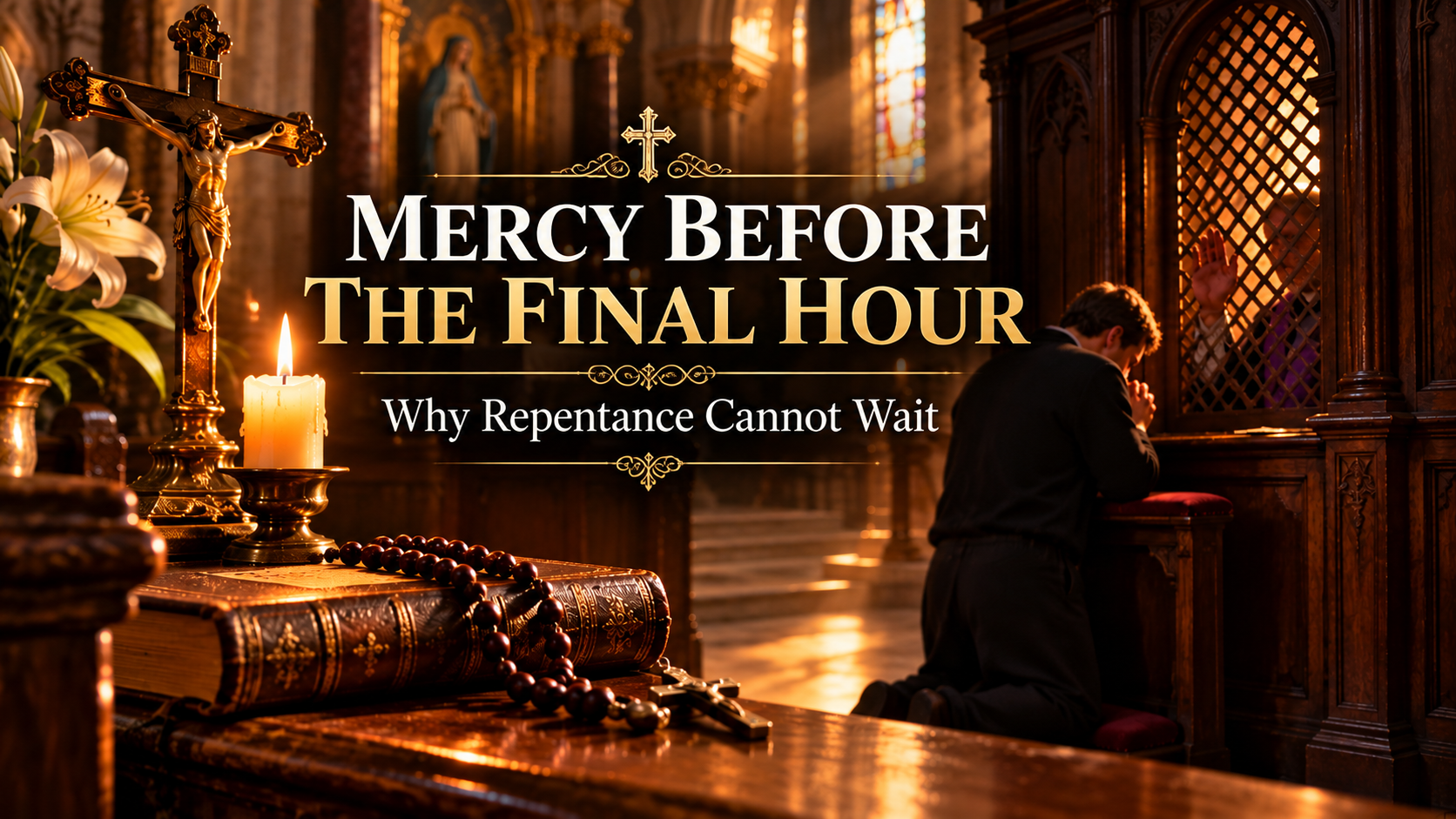
Remember Your Last End — Article 4 of 7
God’s mercy is greater than our sins. Why, then, does the Gospel warn us against postponing repentance?
Scripture for Meditation: Luke 13:6–9; Luke 15:11–32; Mark 1:14–15; John 20:19–23
The quiet lie of “later”
Few people wake up intending to reject God forever. Far more often, spiritual distance grows through a series of small postponements. We will pray when the schedule clears. We will confess our sins when shame becomes less painful. We will break with a destructive habit once life becomes less stressful. We will make restitution when the cost feels manageable.
The promise of “later” can sound reasonable. Yet it can become a way of avoiding the conversion that grace is offering now.
In the supplied Preparation for Death excerpt, St. Alphonsus Liguori repeatedly emphasizes the shortness of life and the need to act while time remains. His meditation is not directed toward making the penitent feel hopeless. The prayer at the end of his first chapter entrusts a sinful soul to the mercy and love of Jesus. The warning and the prayer must be read together.
God’s patience is not the absence of a call. It is often the space in which that call can be answered.
A gardener pleading for the barren tree
Jesus tells the parable of a fig tree that has failed to bear fruit (Luke 13:6–9). The owner questions its continued barrenness. The gardener asks for further care and another season.
The image is one of mercy without indifference. The tree is not dismissed without concern; neither is its lack of fruit treated as the ideal state. Time is granted for a purpose.
This is one of the most useful biblical images for understanding delayed conversion. God does not desire the sinner’s destruction. He calls us to repentance and gives grace. But the gift of additional time should move us toward fruit, not deepen our attachment to excuses.
A Christian may be tempted to measure spiritual health entirely by intentions. “I want to become patient.” “I plan to reconcile.” “I hope to return to the Church.” These desires may be beginnings of grace. Yet they must be permitted to mature into concrete action.
The first fruit of repentance may be very small: a confession scheduled, an apology begun, an occasion of sin deliberately avoided, a prayer offered from the heart. The point is not to manufacture perfection overnight. It is to stop refusing the next faithful step.
What repentance actually means
The Gospel begins Christ’s public proclamation with the call to repent and believe (Mark 1:14–15). Catholic teaching understands conversion as a movement of the heart toward God, a turning away from sin and toward divine mercy.
The Catechism explains that Jesus’ call to conversion is directed first to the heart, not merely to outward religious performance (CCC 1430–1431). Fasting, almsgiving, and prayer matter because they express an interior return.
Repentance is not self-hatred. God does not call us to deny the dignity He has bestowed upon us. Nor is repentance mere embarrassment at having been discovered. A person can regret consequences while still loving the sin.
Authentic contrition grieves sin because it offends God and damages the order of love. Imperfect contrition, motivated by fear of punishment or recognition of sin’s ugliness, can also be a gift of grace, disposing us toward sacramental forgiveness under the conditions the Church teaches (CCC 1451–1453).
The beginning may be fragile. We may arrive at Confession with mixed feelings and an imperfectly formed heart. We should not mistake weakness for a reason to remain away. God’s grace heals sinners who come to Him sincerely.
The prodigal son and the mercy that meets him
The parable of the prodigal son in Luke 15:11–32 stands as one of the Gospel’s great revelations of mercy. The younger son claims an inheritance, leaves home, and wastes what he has received. Hunger and humiliation awaken him to the truth. He resolves to return.
The father does not wait with cold delight in punishment. He sees his son from afar and runs to meet him. Mercy does not pretend that the departure was good. It welcomes the sinner who has turned back.
But observe what the son must do. He rises and goes to his father. He does not merely remain in the distant country imagining future reconciliation. Grace gives rise to a concrete return.
This matters especially for Catholics estranged from the Church or burdened by habitual sin. The path home is not closed because you have fallen. Christ calls you to rise, repent, and receive His mercy. The length of your absence does not make God’s invitation unreal.
There is also a lesson for those who identify with the older brother. A heart that resents mercy extended to others has not yet learned the Father’s joy. We should rejoice when sinners return, remembering our own need for forgiveness.
Confession is not a humiliation to avoid
After His Resurrection, Jesus sends the Apostles and gives them authority concerning the forgiveness of sins (John 20:19–23). The Church understands the Sacrament of Penance within this mission of reconciliation.
For a Catholic conscious of mortal sin, sacramental confession is ordinarily necessary before receiving Holy Communion, subject to the Church’s precise sacramental norms (CCC 1457). We should not treat this as a punishment imposed upon the penitent. It is the ordinary path of forgiveness Christ has entrusted to His Church.
Confession asks for honest acknowledgment. A person must not intentionally conceal mortal sins in confession. But neither must the penitent possess perfect eloquence or a flawless emotional state. The essential acts include contrition, confession, and satisfaction, together with the priest’s absolution.
A person who has been away for years can tell the priest simply that it has been a long time and ask for guidance. A compassionate confessor can help the penitent proceed.
When abuse, severe trauma, or scrupulosity complicates spiritual life, appropriate pastoral care and qualified professional support may also be important. The Gospel’s call to reconciliation should never be twisted into a demand that victims abandon justice or safety.
Presumption and despair: two forms of refusing grace
There are two opposite errors that can prevent conversion.
Presumption claims that divine mercy makes repentance unnecessary. “God forgives, so I can remain deliberately attached to sin.” This mistakes mercy for permission. Scripture never treats God’s forgiveness as the cancellation of His call to holiness.
Despair claims that one’s sins are beyond forgiveness. “I have fallen too far; there is no point returning.” This denies the sufficiency of Christ’s saving sacrifice and the mercy He offers the repentant.
Both errors turn the soul away from trustful conversion. Hope rejects them both (CCC 2091–2092).
The humble penitent says something different: “I have sinned, but Christ is merciful. By His grace I can repent, receive forgiveness, and begin again.”
That beginning may need to occur repeatedly. Confession does not guarantee freedom from all temptation. A person may still require patience, accountability, and practical changes. Persevering conversion is a lifelong work of grace.
The urgency of reconciliation with other people
Repentance is not exclusively interior. It concerns our neighbors. We may need to confess dishonesty, restore what we have taken, apologize for harm, or cease conduct that endangers others.
The Catechism identifies the obligation of reparation as far as possible for harm caused by sin (CCC 1459–1460). This expresses justice, not mere emotional relief.
Forgiveness of another person is also part of Christian life. Yet forgiveness is distinct from immediately restoring trust, withdrawing a legitimate complaint, or remaining in danger. Charity requires truth and prudence. In serious situations, reconciliation may be limited or inappropriate until safety and accountability are established.
The central point remains: where a faithful next step is possible, we should not eternally postpone it.
The CatholicG33k Practice: A path home this week
First, spend fifteen minutes with Luke 15:11–32. Ask where you resemble the younger son, the older brother, or both.
Second, make an examination of conscience guided by the Ten Commandments and the duties of your state in life. Identify a sin you have been rationalizing.
Third, if you need Confession, choose a specific opportunity and arrange to go. If uncertain about the sacrament, ask a priest for help.
Fourth, remove one avoidable occasion of sin or establish a practical boundary that supports conversion.
Fifth, make one concrete act of restitution or reconciliation where justice and safety permit.
Finish each day with a short act of contrition and thanksgiving for God’s mercy.
Questions for reflection
1. What spiritual responsibility have I hidden behind the comforting word “later”?
2. Do I struggle more with presumption that conversion is unnecessary, or despair that God’s mercy cannot reach me?
3. What tangible fruit of repentance can I begin to bear within the next twenty-four hours?
Prayer of return
Merciful Father, I have received more time, more grace, and more invitations than I can count. Forgive the ways I have turned these gifts into excuses for delay. Through the saving merits of Jesus Christ, grant me honest contrition, courage to confess my sins, and a heart ready to make amends. Keep me from presumption and despair. When I am tempted to hide from You, remind me of the father who welcomes the returning son. Give me the grace to rise and come home. Amen.
Conclusion: Mercy calls us today
The central tragedy of postponement is that we treat the love of God as something we may answer only when it is convenient. Yet the present moment belongs to grace. The Lord has not commanded us to invent an impressive spiritual transformation. He has called us to repent and believe.
Do not delay the return that God’s mercy makes possible today.
Sources and further reading
Primary spiritual source: St. Alphonsus Liguori, Preparation for Death: Prayers and Consolations for the Final Journey, ed. Norman J. Muckerman, C.Ss.R. (1998), Part I, chapters 1–2. The fig tree and the urgency of conversion are explicit themes in the supplied excerpt.
Sacred Scripture (Douay-Rheims): Mark 1:14–15; Luke 13:6–9; 15:11–32; John 20:19–23; Matthew 5:23–24.
Catechism of the Catholic Church: CCC 1422–1498 (Penance); 1430–1433 (interior conversion); 1451–1457 (contrition and confession); 1459–1460 (satisfaction and reparation); 2091–2092 (despair and presumption).
Magisterium: Council of Trent, Session XIV, Doctrine on the Sacrament of Penance.
CatholicG33k — Faith. Truth. Reason.