

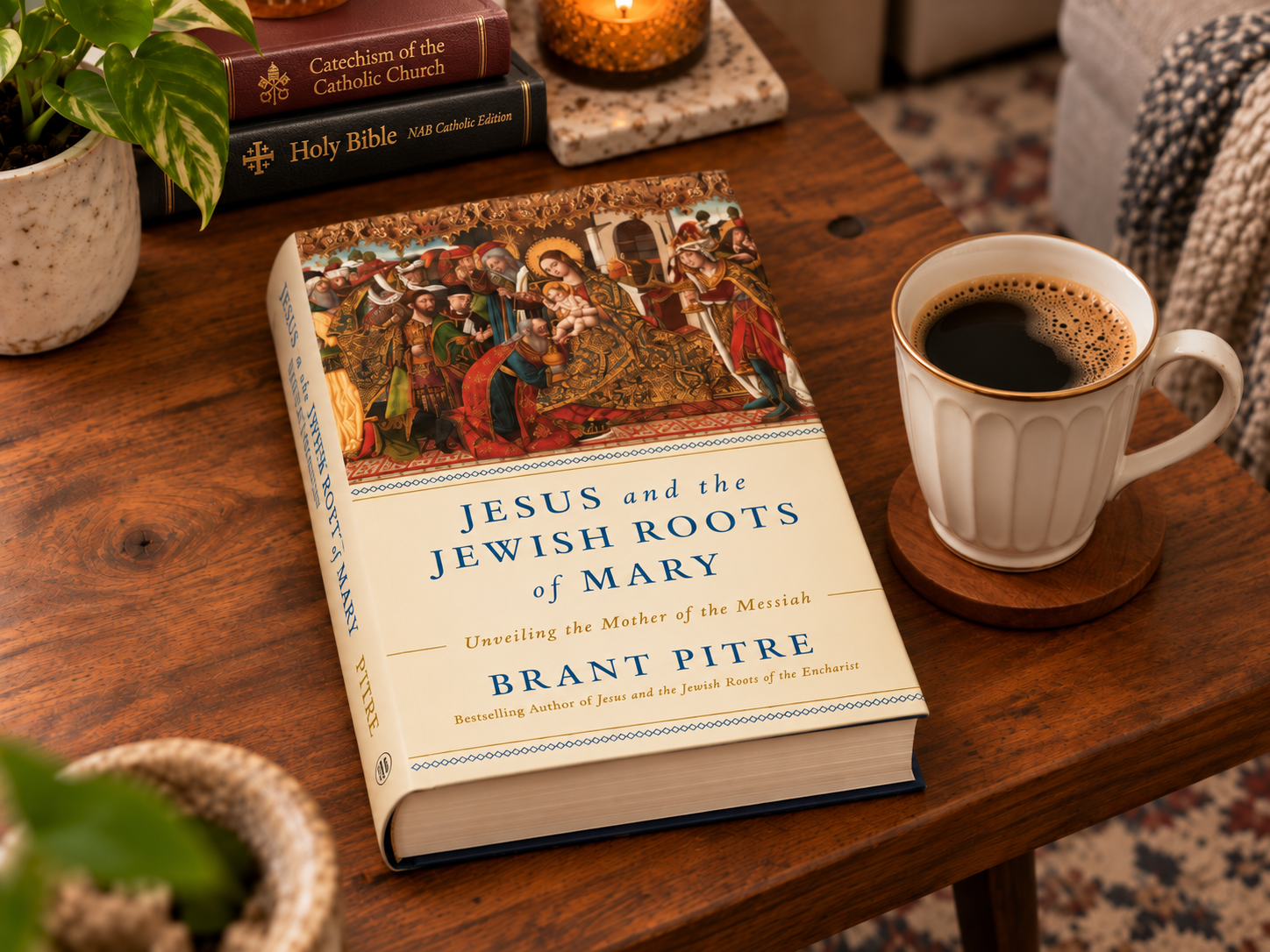
Why the Blessed Virgin Mary cannot be understood apart from Israel, the fulfillment of the Old Testament, and the saving mission of Jesus Christ.
There is a strange contradiction at the heart of modern Christianity.
We profess that Jesus Christ is the fulfillment of the Old Testament. We proclaim Him the new Adam, the new Moses, the Son of David, the true Lamb of God, and the fulfillment of the promises made to Abraham. We recognize that the institutions, prophecies, sacrifices, and sacred figures of ancient Israel find their ultimate meaning in Him.
Yet when we turn to Mary, the woman through whom the Eternal Word entered human history, this same biblical understanding is often abandoned.
Suddenly, the mother of Jesus becomes an isolated figure. Her significance is reduced to the biological necessity of the Incarnation. Her place in salvation history becomes an uncomfortable question rather than a theological mystery worthy of contemplation.
Some Christians fear that giving Mary too much attention somehow diminishes Christ. Others accept Catholic teachings about her without fully understanding their biblical foundations. Still others view Marian doctrines as later religious developments, disconnected from the faith of ancient Israel.
But what if the problem is not that Christianity has said too much about Mary?
What if the problem is that we have forgotten how to read the Scriptures that reveal who she is?
This is the central question raised by Brant Pitre, Jesus and the Jewish Roots of Mary: Unveiling the Mother of the Messiah. His work challenges the modern assumption that Marian theology can be evaluated adequately through isolated New Testament passages without considering the Jewish world from which Christianity emerged.
And this question deserves serious reflection.
Because when we begin to understand Mary through the history, symbols, promises, and sacred institutions of Israel, something extraordinary happens.
We do not discover a goddess competing with Christ.
We discover how profoundly the mystery of Mary is bound to the mystery of Jesus Christ.
1. Christianity Did Not Begin in a Theological Vacuum
One of the greatest mistakes we can make when reading the New Testament is to imagine that Christianity appeared suddenly, detached from everything that preceded it.
Jesus was born into Israel. His mother was Jewish. His Apostles were Jewish. The language of covenant, sacrifice, kingship, priesthood, redemption, and divine presence belonged to a religious world shaped by centuries of revelation.
The earliest Christians did not understand Jesus by discarding Israel’s sacred history. They recognized Him as its fulfillment.
St. Paul explicitly describes Christ as the new Adam whose obedience overcomes the disobedience of the first Adam (Romans 5:12–19; 1 Corinthians 15:45).
The Gospel of Matthew presents Jesus as the Son of David and the fulfillment of Israel’s prophetic expectations.
The Letter to the Hebrews interprets Christ’s priesthood and sacrifice through the institutions of the Old Covenant.
The New Testament is filled with these connections.
Yet Mary is frequently excluded from this same method of interpretation.
This exclusion is difficult to justify.
If Christ is the new Adam, is it unreasonable to ask whether there is a new Eve?
If Christ inaugurates a new covenant, might there also be a new Ark?
If Christ is the promised Davidic King, should we not examine the position of the king’s mother in the kingdom of Israel?
These questions are not attempts to invent new doctrines. They arise naturally from the structure of biblical revelation.
They also introduce an important principle of Catholic interpretation: God prepares the fulfillment of His promises through real persons, events, and institutions that anticipate greater realities in Christ.
The Church calls this typology.
Typology does not mean that every Old Testament detail is secretly a prediction of some future event. Rather, it recognizes that the same God who governed Israel’s history also brought that history to fulfillment in Jesus Christ.
The Old Testament is not a discarded religious artifact. It is part of the history of salvation.
And Mary belongs within that history.
2. The New Eve: Where Disobedience Began, Obedience Responded
The story of redemption begins long before Bethlehem.
It begins in Eden.
In Genesis, humanity is created for communion with God. Adam and Eve receive existence as a gift, together with the freedom to obey or reject their Creator.
Through disobedience, sin enters human history. The harmony between God and humanity is wounded, and death becomes part of the human condition.
Yet even in the aftermath of the Fall, God announces the coming struggle between the serpent and the woman, between the serpent’s offspring and hers (Genesis 3:15).
Christian tradition has long recognized this passage as containing the first announcement of the Gospel, the Protoevangelium.
The promised victory belongs ultimately to Jesus Christ.
But this raises an important question.
Why does Genesis place such emphasis upon the woman?
And why does St. John repeatedly describe Mary in language that recalls this ancient biblical figure?
At the wedding feast of Cana, Jesus addresses His mother as “Woman” (John 2:4). He uses the same form of address at the Cross (John 19:26).
Within John’s Gospel, which deliberately echoes the language of creation, this is theologically significant.
Jesus is not merely performing miracles. He is inaugurating a new creation.
And Mary appears at the beginning and the climax of His public mission.
The early Church recognized the significance of this relationship.
St. Justin Martyr, writing in the second century, contrasted Eve’s reception of the serpent’s word with Mary’s faithful reception of God’s message (Dialogue with Trypho, 100).
St. Irenaeus developed the same parallel, explaining that Mary’s obedience answered the disobedience of Eve (Against Heresies, III, 22, 4).
The contrast is profound.
Eve listened to the serpent.
Mary listened to the angel.
Eve responded through disobedience.
Mary responded through faith.
Through the first woman’s disobedience, humanity became entangled in sin. Through the obedience of the new Eve, the Redeemer entered human history.
But we must be precise.
Mary does not redeem humanity independently of Christ. Christ alone is the Redeemer.
Mary’s role is entirely dependent upon His saving mission and the grace of God.
This is precisely what makes her obedience so beautiful.
At the Annunciation, the salvation of humanity is not presented as a triumph of human autonomy. It unfolds through divine initiative and the free cooperation of a creature.
Mary declares:
“Behold the handmaid of the Lord; be it done to me according to thy word.” (Luke 1:38, Douay-Rheims)
Here we encounter one of Christianity’s deepest paradoxes.
The Almighty does not need human strength to accomplish His purposes.
Yet He chooses to associate a humble woman with the coming of His Son into the world.
Mary’s greatness is not found in independence from God.
It is found in her complete surrender to Him.
And perhaps this is the first lesson modern Christianity needs to recover.
We live in a world that equates greatness with self-assertion.
Mary reveals greatness through obedience.
The world celebrates the person who insists upon his own will.
Mary reveals the glory of the creature who says yes to God’s will.
3. The New Ark: When God’s Presence Entered a Human Womb
In ancient Israel, the Ark of the Covenant was no ordinary object.
It was the sacred vessel associated with God’s dwelling among His people.
It belonged at the center of Israel’s worship, within the Holy of Holies, where the divine presence was uniquely manifested.
The Ark was treated with extraordinary reverence, not because wood and gold possessed divinity, but because of the holy presence with which it was associated.
Now consider the Annunciation.
The angel Gabriel tells Mary that the Holy Ghost will come upon her and the power of the Most High will overshadow her (Luke 1:35).
This language recalls the divine cloud overshadowing the Tabernacle in Exodus 40:34–35.
The parallel becomes even more striking in the Visitation.
In 2 Kings 6:9 (2 Samuel 6:9 in many modern editions), David marvels at the approach of the Ark of the Lord.
In Luke 1:43, Elizabeth marvels that the mother of her Lord has come to her.
The Ark remains for three months in the house of Obededom (2 Kings 6:11).
Mary remains with Elizabeth for about three months (Luke 1:56).
David leaps and dances before the Ark.
John the Baptist leaps in his mother’s womb at Mary’s arrival.
These parallels form one of the most compelling typological arguments in Pitre’s book.
They invite us to see the Visitation not merely as a beautiful meeting between two expectant mothers, but as a revelation of something astonishing.
The divine presence associated with the sacred dwelling of Israel has now entered the world in the flesh of Jesus Christ, carried within Mary’s womb.
The old Ark contained sacred signs of God’s covenant.
Mary bore the incarnate Word Himself.
And this changes the way we understand Catholic reverence for the Blessed Virgin.
Catholics do not honor Mary because they imagine her to be divine.
They honor her because God Himself chose her to bear the divine Person of His Son.
Her holiness points beyond herself.
It directs us toward the mystery of the Incarnation.
The title Mother of God, solemnly affirmed at the Council of Ephesus in AD 431, protects this very truth.
It does not mean that Mary created the divine nature or existed before God.
It means that the Person she conceived and gave birth to is truly God the Son made man.
To deny this title because it seems too exalted for Mary risks misunderstanding who Jesus Christ actually is.
The issue is ultimately Christological.
Who is the child born of Mary?
If He is merely a human person associated with God, then the title becomes problematic.
But if He is the eternal Son of God who assumed a true human nature, then Mary is rightly called the Mother of God.
She is the mother of the divine Person according to His humanity.
The dignity of Mary flows from the identity of Christ.
4. The Queen Mother: Why Mary’s Queenship Is Not Paganism
Few Marian titles provoke more misunderstanding than Queen of Heaven.
Some critics immediately associate the phrase with the pagan goddess condemned in Jeremiah 7:18 and 44:17–19.
But similarity of titles does not establish identity of religious meaning.
The decisive question is whether Mary’s queenship is rooted in pagan mythology or in the biblical understanding of the Davidic kingdom.
In the royal tradition of ancient Israel, the king’s mother occupied a distinctive position of honor.
This is particularly evident in the reign of Solomon.
When Bathsheba approaches her son, Solomon rises to greet her, bows before her, and provides a seat for her at his right hand (3 Kings 2:19 in the Douay-Rheims).
The queen mother possesses a recognized royal dignity.
She is also approached as someone who can intercede with the king, although the biblical account does not suggest that every request she makes must be granted.
Now consider the identity of Jesus.
The angel Gabriel announces that God will give Him the throne of David, that He will reign forever, and that His kingdom will have no end (Luke 1:32–33).
Jesus is not merely another descendant of David.
He is the promised King whose reign fulfills the divine covenant.
If Jesus is the Davidic King, then the place of His mother deserves serious consideration.
Mary’s queenship, properly understood, does not compete with His kingship.
It depends entirely upon it.
She does not possess an independent kingdom.
Her royal dignity is derivative, received through her relationship to Christ.
The same is true of her intercession.
At Cana, Mary brings a human need before Jesus.
And then she gives the servants an instruction that should govern every authentic Marian devotion:
“Whatsoever he shall say to you, do ye.” (John 2:5)
This may be the most important sentence Mary speaks in the public ministry of Christ.
She does not call attention to herself as the final authority.
She directs others toward obedience to her Son.
The authentic purpose of Marian devotion is not to replace Christ with Mary, but to lead the faithful more deeply into obedience to Christ.
The Catholic Church makes this distinction explicit.
The Catechism teaches that Marian devotion differs essentially from the adoration offered to the Father, Son, and Holy Ghost (CCC 971).
Worship belongs to God alone.
Mary receives honor as a redeemed creature uniquely blessed by Him.
Her intercession is subordinate to the one mediation of Jesus Christ (1 Timothy 2:5; CCC 970).
This is not a minor technical distinction.
It is essential to understanding Catholic theology.
5. The Immaculate Conception: Not Freedom from Needing Salvation, but the Triumph of Grace
The doctrine of the Immaculate Conception is often misunderstood.
Some imagine that Catholics teach Mary had no need of a Savior because she was preserved from original sin.
But the Church teaches precisely the opposite.
Mary was preserved from original sin by a singular grace of God, in view of the merits of Jesus Christ (CCC 491–492).
She was redeemed through Christ.
Her redemption was unique in its application, not independent in its source.
This distinction reveals something beautiful about salvation.
We normally imagine redemption as the rescue of someone who has already fallen.
But God’s grace is not limited to healing after the fact.
It can also preserve.
In Mary’s case, the Church teaches that the merits of Christ were applied in a singular way from the first moment of her conception.
Her sinlessness is therefore not evidence of her independence from Christ.
It is evidence of the extraordinary power of Christ’s redemption.
And there is another dimension worth contemplating.
Mary’s holiness is not merely a private spiritual achievement.
It belongs to the preparation of the new creation.
If Christ is the new Adam who restores what was lost through sin, then Mary, the new Eve, stands as a sign of what grace intends to accomplish in redeemed humanity.
God does not save us so that we may remain eternally enslaved to sin.
He saves us to make us holy.
Mary reveals the transforming power of that grace.
She shows us, in a unique and anticipatory way, what humanity is meant to become through union with Christ.
6. Perpetual Virginity: A Sign of the World to Come
Mary’s perpetual virginity can also seem difficult to understand within the assumptions of modern culture.
Why should it matter that Mary remained a virgin?
Why would the Church regard this as an enduring aspect of her vocation?
Pitre examines the biblical evidence, including Mary’s response to Gabriel, Jewish practices concerning vows, and the interpretation of the references to Jesus’ brothers.
Some of these historical and exegetical arguments are debated, and it is important to distinguish the Church’s doctrine from every proposed explanation of the biblical evidence.
The doctrine itself is clear: Mary is Ever-Virgin (CCC 499).
But its theological significance reaches beyond historical questions about her household.
Jesus teaches that the resurrected life will differ radically from earthly marriage (Matthew 22:30).
Marriage is holy. It belongs to God’s good creation.
Yet Christian revelation also teaches that our final destiny transcends the present conditions of earthly existence.
Consecrated virginity can therefore serve as a sign of the kingdom to come.
Mary’s perpetual virginity points toward this eschatological reality.
Her life is wholly consecrated to the mystery of Christ.
She also becomes an image of the Church herself: virginal in fidelity to Christ, yet fruitful as mother through the life of grace.
Here Catholic theology does not diminish marriage or motherhood.
It reveals that biological fruitfulness is not the only form of fruitfulness.
A life wholly surrendered to God can become spiritually fruitful beyond anything the world can measure.
7. The Mother of Sorrows: The Woman Who Stood at the Cross
The greatest misunderstanding of Mary may be the belief that her privileges somehow separated her from suffering.
Nothing could be further from the truth.
The Gospel does not present Mary as a woman sheltered from every human sorrow.
Simeon tells her that a sword will pierce her own soul (Luke 2:35).
She experiences the anxieties surrounding her Son’s childhood, the mystery of His public mission, and ultimately the terrible suffering of Calvary.
Pitre develops a striking connection between the biblical imagery of childbirth and Mary’s sorrow at the Passion.
This is a theological interpretation of the biblical patterns, not a claim that Scripture explicitly narrates every detail of Mary’s interior experience.
Nevertheless, the image is powerful.
At Bethlehem, Mary gives birth to the Savior.
At Calvary, she stands beside the Cross as Christ accomplishes the redemption of the world.
There is a profound relationship between these two moments.
The child she carried within her is now the sacrifice offered for mankind.
The mother who once held Him in her arms must now watch Him suffer.
And she cannot take His place.
She cannot remove the nails.
She cannot prevent the sacrifice.
She can only remain faithful.
The Gospel of John records that Mary stood by the Cross (John 19:25).
That detail deserves contemplation.
She stood.
When the mystery of suffering became unbearable, she did not cease to belong to her Son.
Her faith remained.
This is where Marian devotion becomes especially meaningful for Christians who suffer.
We do not approach Mary because she possesses an independent power to save us.
We approach her as a mother who understands suffering and intercedes for her children before the Savior who conquered death.
The Catholic tradition has long recognized this maternal solidarity.
And perhaps there is no more moving expression of it than the title Our Lady of Sorrows.
8. The New Rachel: A Mother Who Mourns for Her Children
Among the more fascinating themes of Pitre’s book is the comparison between Mary and Rachel.
Rachel is one of the great maternal figures of Israel.
In Jeremiah 31:15, she is portrayed weeping for her children.
St. Matthew recalls this passage in his account of the slaughter of the Holy Innocents (Matthew 2:16–18).
Rachel becomes an image of the sorrow of Israel.
Within Jewish tradition, her maternal compassion also becomes associated with intercession for her descendants.
Pitre explores how this tradition helps illuminate Mary’s spiritual motherhood.
The comparison does not mean that Rachel and Mary are identical figures or that Matthew explicitly identifies Mary as Rachel.
Rather, it highlights a recurring biblical reality.
Motherhood is not merely a biological relationship.
It is a bond of love, responsibility, suffering, and concern for the life of another.
Mary is the mother of the Messiah.
But at Calvary, her motherhood takes on a new ecclesial dimension.
The sorrow of the mother of Jesus becomes inseparable from the saving mission of her Son.
And through His words from the Cross, she is entrusted with a maternal relationship to His disciples.
This brings us to the deepest mystery of all.
9. “Behold Thy Mother”: The Gift Christ Gave from the Cross
The Gospel of John records an extraordinary moment.
Jesus, suffering upon the Cross, sees His mother and the disciple whom He loved.
He addresses Mary:
“Woman, behold thy son.” (John 19:26)
Then He addresses the disciple:
“Behold thy mother.” (John 19:27)
On one level, these words express Jesus’ concern for His mother.
But Catholic tradition has long recognized a deeper meaning.
The Beloved Disciple is not merely a private individual receiving a practical responsibility.
He also represents the disciple loved by Christ.
And Mary is entrusted with a spiritual motherhood that extends to the members of Christ’s Body, the Church.
The Second Vatican Council teaches that Mary is mother to us in the order of grace (Lumen Gentium, 61).
This motherhood does not compete with God’s fatherhood.
Nor does it replace Christ’s unique mediation.
It exists entirely within the economy of grace established by Him.
Consider the significance of the moment.
Jesus is accomplishing the redemption of humanity.
He is offering Himself to the Father.
The Church is being born from the mystery of His Passion.
And from the Cross, He gives His mother to the disciple.
The gift of Mary is therefore not an optional decoration added to Christianity centuries later.
Her maternal relationship to the faithful is rooted in the mystery of Christ and His Church.
The same Lord who gives us His Body and Blood for our salvation also entrusts us to the maternal care of His mother.
This does not mean that every Catholic must experience Marian devotion in the same emotional way.
Faith is not measured by sentiment.
But it does mean that Mary’s place in the life of the Church should not be dismissed as though it were unrelated to the Gospel.
To receive what Christ gives is itself an act of discipleship.
10. The Assumption: A Glimpse of Humanity’s Final Destiny
The Assumption of Mary is sometimes treated as an isolated supernatural privilege.
But in the wider context of salvation history, it reveals something about the destiny of the human person.
Catholic doctrine teaches that, having completed the course of her earthly life, Mary was assumed body and soul into heavenly glory (CCC 966).
This doctrine is not identical to the claim that Scripture provides a direct narrative description of her Assumption.
Pitre’s argument is typological, drawing particularly upon Mary’s identity as the new Ark and the imagery of the heavenly sanctuary in Revelation 11:19–12:1.
The Church’s teaching also rests upon the living Tradition of the faith.
The significance extends beyond Mary herself.
Christianity does not teach that the human body is a prison from which the soul must escape.
The body belongs to God’s good creation.
The Incarnation confirms its dignity.
The Resurrection of Christ reveals its ultimate destiny.
We profess in the Creed the resurrection of the body and life everlasting.
Mary’s Assumption anticipates this promise.
Her glory is not the result of an independent divine power.
She is assumed by God.
Christ rises and ascends by His own divine power; Mary is glorified through the saving action of God.
The difference is essential.
Yet the connection is magnificent.
What God has accomplished uniquely in Mary anticipates the glorification He promises to those who belong to Christ.
Her Assumption is therefore not simply about Mary’s exaltation.
It is also about Christian hope.
Death will not have the final word.
The human body is not meaningless.
Creation is not destined merely for abandonment.
Christ has come to make all things new.
11. Why This Matters in an Age That Has Forgotten the Sacred
There is a final implication of these mysteries that deserves attention.
Modern society increasingly struggles to understand holiness.
We have become accustomed to treating every institution, relationship, and tradition as something that can be reduced to individual preference or practical utility.
Nothing is sacred unless we decide it is useful.
Nothing possesses enduring significance unless it serves our immediate interests.
This mentality can even infiltrate religion.
We begin to evaluate faith according to what it offers us, rather than asking what God has revealed.
Mary challenges this worldview.
She is not important because humanity voted to make her important.
She is important because God chose her for a unique place within the history of salvation.
Her dignity is received, not self-created.
Her holiness is grace, not self-invention.
Her greatness is obedience, not domination.
Her motherhood is service, not possession.
Her queenship is participation, not rivalry.
Her glory is the fruit of redemption, not a competing source of divinity.
In a culture obsessed with power, Mary reveals the dignity of humility.
In a culture obsessed with independence, Mary reveals the beauty of surrender to God.
In a culture that often treats suffering as meaningless, Mary reveals the possibility of remaining faithful beneath the Cross.
And in a culture that measures human worth through achievement, Mary reminds us that the highest dignity of a creature is to belong completely to God.
This is not weakness.
It is the freedom of holiness.
12. The Danger of Separating Mary from Christ—and Christ from His History
There are two errors we should avoid.
The first is the error of treating Mary as though she possesses a divine identity or an authority independent of Christ.
Catholic doctrine rejects this.
The Blessed Virgin is a creature, wholly dependent upon the grace of God.
She is not the source of salvation.
She is not another redeemer alongside Christ.
She is not a member of the Holy Trinity.
The second error is treating her as though God’s choice of her has no enduring theological significance.
That, too, fails to respect the structure of salvation history.
The Incarnation was not an abstraction.
The Son of God did not merely appear in human disguise.
He truly became man.
He received His humanity from a real mother, within a real people, in fulfillment of real divine promises.
Mary’s Jewish identity matters.
Her connection to Israel matters.
Her relationship to the covenants matters.
Her response to God’s call matters.
Her presence at the Cross matters.
And her place within the communion of saints matters.
Authentic Marian theology never requires us to look away from Jesus.
Rather, it teaches us to contemplate the depths of the Incarnation more carefully.
The more clearly we understand Christ as the new Adam, the more intelligible Mary becomes as the new Eve.
The more clearly we understand Christ as God dwelling among His people, the more intelligible Mary becomes as the new Ark.
The more clearly we understand Christ as the Davidic King, the more intelligible Mary becomes as the queen mother.
The more clearly we understand Christ as the Redeemer who forms a new family through His sacrifice, the more intelligible Mary becomes as mother of the Church.
Every authentic Marian mystery ultimately leads back to a mystery of Jesus Christ.
That is the foundation upon which Catholic devotion to Mary must stand.
Conclusion: The Mother Who Leads Us to Her Son
Perhaps the deepest lesson of Jesus and the Jewish Roots of Mary is that Christianity cannot be fully understood when severed from the history of Israel.
And Mary cannot be properly understood when severed from Christ.
She stands at the intersection of the Old and New Covenants.
She is a daughter of Israel and the mother of the Messiah.
She is the woman whose obedience answers Eve’s disobedience.
She is the dwelling place of the incarnate Word.
She is the mother of the eternal King.
She is the faithful disciple who stands beneath the Cross.
She is the mother entrusted to the Church.
And in her heavenly glorification, she is a sign of the destiny promised to God’s redeemed children.
None of these mysteries requires us to diminish the unique glory of Jesus Christ.
They exist because of that glory.
Mary’s greatness is the work of God.
Her holiness is the fruit of grace.
Her intercession depends upon Christ.
Her motherhood serves His Body.
Her final destiny reveals the power of His victory over sin and death.
To understand Mary, then, is not to wander away from the Gospel.
It is to enter more deeply into its history, its promises, and its fulfillment.
We should resist the temptation to reduce the mother of Jesus either to an ordinary historical footnote or to a figure detached from the mystery of Christ.
Both approaches fail to do justice to the woman revealed in Scripture and contemplated by the Church across the centuries.
Instead, we should return to the words spoken from Calvary.
Not as an invitation to replace the Savior.
Not as an excuse to confuse veneration with worship.
But as a summons to receive more fully the gifts Christ has given His Church.
“Behold thy mother.”
These words confront us with a deeply personal question.
If Jesus Christ has entrusted Mary with a maternal place in the life of His disciples, what does it mean to receive that gift faithfully?
Perhaps the answer begins with the humility Mary herself demonstrated at the Annunciation.
The willingness to receive what God gives.
The willingness to trust what He reveals.
The willingness to allow His grace to transform our understanding.
And, above all, the willingness to obey the words Mary herself spoke at Cana:
“Whatsoever he shall say to you, do ye.”
For the final purpose of authentic devotion to the Blessed Virgin Mary is not to make us less dependent upon Jesus Christ.
It is to make us more faithful to Him.
Scripture, Tradition, and Further Reading
Principal work: Brant Pitre, Jesus and the Jewish Roots of Mary: Unveiling the Mother of God , especially chapters 2–8.
Sacred Scripture: Genesis 3:15; Exodus 40:34–35; 2 Kings 6:9–11; 3 Kings 2:19; Jeremiah 31:15; Luke 1:26–56; Luke 2:35; John 2:1–11; John 19:25–27; Romans 5:12–19; 1 Corinthians 15:45; Revelation 11:19–12:17.
Catechism of the Catholic Church: §§411, 490–511, 963–975, 2676.
Early Christian witnesses: St. Justin Martyr, Dialogue with Trypho, 100; St. Irenaeus, Against Heresies, III, 22, 4.
Magisterial sources: Council of Ephesus (AD 431); Second Vatican Council, Lumen Gentium, chapter VIII, especially §§60–62, 66–67.
This reflection draws upon themes and biblical arguments developed by Brant Pitre, while offering an original theological meditation. Typological interpretations are distinguished from doctrines definitively taught by the Catholic Church.