

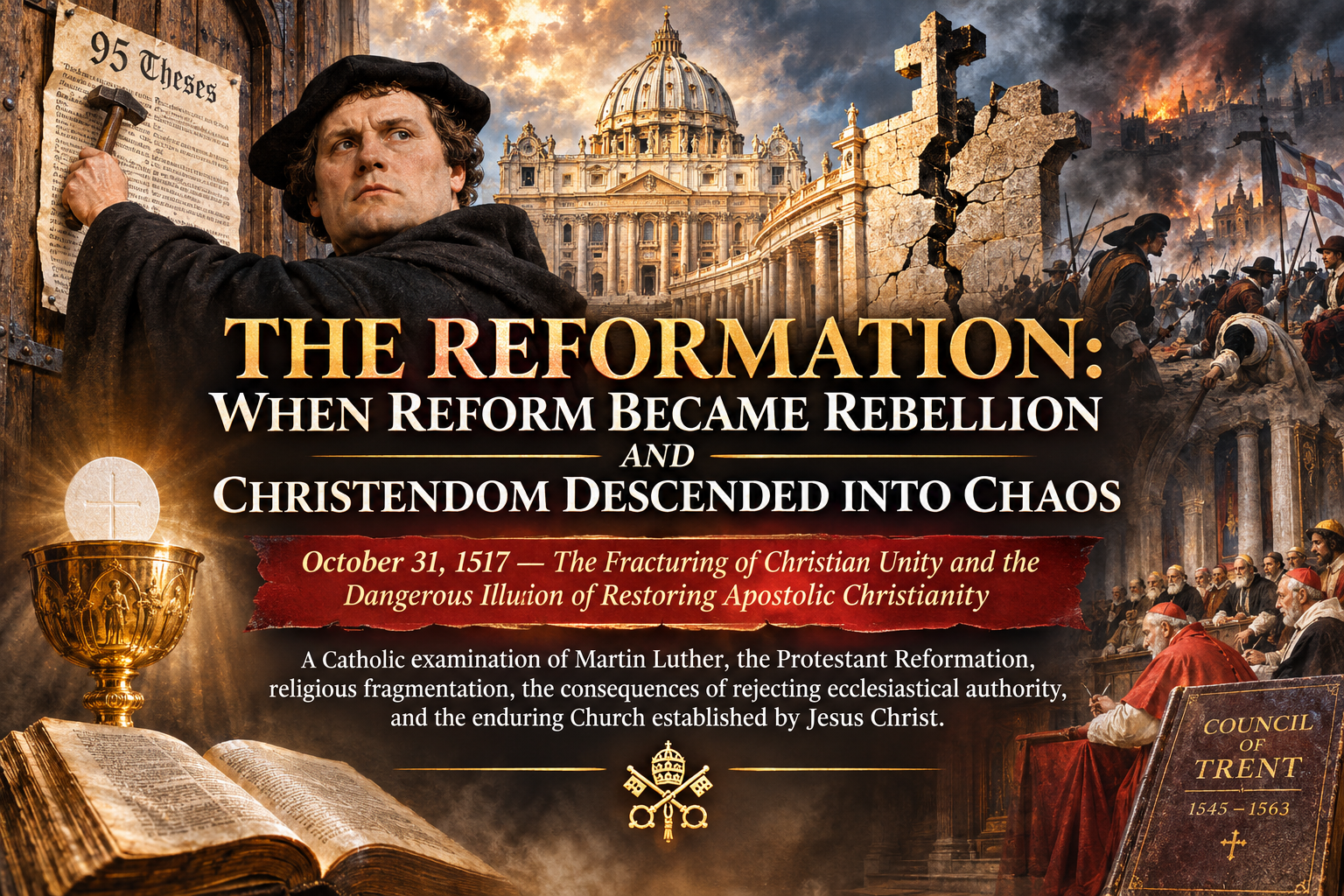
October 31, 1517 — The Fracturing of Christian Unity and the Dangerous Illusion of Restoring Apostolic Christianity
A Catholic examination of Martin Luther, the Protestant Reformation, religious fragmentation, the consequences of rejecting ecclesiastical authority, and the enduring Church established by Jesus Christ.
I. OCTOBER 31: A DAY OF CELEBRATION OR A REMINDER OF TRAGEDY?
Every October 31, many Protestants commemorate what they call Reformation Day, celebrating the events traditionally associated with Martin Luther’s Ninety-Five Theses in Wittenberg, Germany, in AD 1517.
The occasion is frequently presented as a triumphant recovery of biblical Christianity, a liberation of the Gospel from centuries of corruption, and a restoration of the original Christian faith.
But from a Catholic perspective, a profound question must be asked:
How can the fragmentation of the Church Christ established be celebrated as the restoration of the Christianity He intended?
The Reformation did not simply correct abuses or encourage a deeper love for Scripture. It developed into a movement that challenged the Church’s teaching authority, severed ecclesiastical communion, divided nations, disrupted sacramental life, and helped establish rival Christian confessions with incompatible doctrines.
The resulting upheaval extended far beyond theological controversy. It became intertwined with political revolutions, violent uprisings, religious persecution, confiscations of ecclesiastical property, and generations of warfare.
This does not mean every misfortune of sixteenth-century Europe can be blamed on Luther. History is more complicated than that. Nor does it mean every Protestant was responsible for the conduct of the Reformers.
It means that the consequences of the Reformation must be judged against its claims.
A movement advertising itself as the recovery of authentic Christianity must confront the visible religious fragmentation that followed.
The central issue is not whether the Catholic Church needed reform. It did.
The issue is whether reform required a rupture from apostolic authority.
Christ commanded fidelity, repentance, and unity. He did not teach that Christians should resolve disputes by establishing competing churches.
And that difference changes the entire historical and theological conversation.
II. THE CHURCH NEEDED REFORM — BUT NOT ANOTHER FOUNDATION
A serious Catholic examination of the Reformation must begin by acknowledging genuine wrongdoing.
By the early sixteenth century, parts of the Church’s institutional life suffered from significant abuses: clerical absenteeism, poorly educated priests, the accumulation of ecclesiastical offices, political interference in Church affairs, and scandalous financial practices.
The preaching and financing associated with certain indulgence campaigns also caused genuine scandal.
These abuses could damage the spiritual lives of ordinary Christians and weaken confidence in ecclesiastical leadership.
Luther was not wrong to be concerned about everything he witnessed.
But identifying corruption does not establish that the Church’s divinely revealed doctrines are false.
An unworthy priest does not invalidate the priesthood. A sinful bishop does not disprove apostolic succession. A morally compromised pope does not nullify Christ’s promises to His Church.
The distinction is elementary but indispensable.
The Catholic Church has never taught that all her ministers are impeccable. Indeed, her sacramental teaching recognizes that Christ acts through ministers who themselves remain sinners.
The holiness of the Church comes from Christ, not from the personal perfection of her members (Catechism of the Catholic Church, §§823–827).
Likewise, the misuse of indulgences does not prove that indulgences are intrinsically illegitimate.
Catholic doctrine understands an indulgence as the remission of temporal punishment due to sins whose guilt has already been forgiven. It is not permission to sin, nor is it the commercial purchase of divine forgiveness (Catechism, §§1471–1479).
When the administration of a legitimate spiritual practice becomes corrupted, the proper response is to correct the corruption.
The same principle applies to ecclesiastical leadership.
The Church can require discipline, renewal, greater accountability, and profound conversion without abandoning her apostolic constitution.
This is precisely the distinction between reform and rupture.
The great Catholic saints understood it.
Saint Francis of Assisi confronted spiritual worldliness through poverty and evangelical living.
Saint Catherine of Siena challenged ecclesiastical failures while maintaining devotion to the papacy.
Reform means returning the members of Christ’s Church to greater fidelity.
Schism means damaging communion with the Church itself.
The sins of men require repentance, not the reconstruction of Christianity according to a new theological authority.
III. CHRIST ESTABLISHED A CHURCH, NOT A RELIGIOUS FREE-FOR-ALL
The Catholic objection to the Reformation begins with the nature of the Church.
Jesus Christ did not merely deliver religious teachings and leave future believers to determine independently what Christianity ought to become.
He gathered Apostles, conferred authority upon them, commissioned them to teach, and established a visible community.
In Matthew 16:18, Christ declares:
“And I say to thee: That thou art Peter; and upon this rock I will build my church, and the gates of hell shall not prevail against it.”
He does not say that He will establish an indefinite succession of competing churches, each claiming the right to redefine essential Christian doctrine.
He speaks of His Church.
In Matthew 18:17, Christ even directs believers engaged in serious disputes to bring the matter before the Church.
This presupposes an identifiable community capable of exercising real authority.
Similarly, Saint Paul writes:
“One Lord, one faith, one baptism.” — Ephesians 4:5
And he describes the Church as:
“The church of the living God, the pillar and ground of the truth.” — 1 Timothy 3:15
These passages present the Church not as a dispensable human association but as an essential part of God’s plan for preserving and transmitting the Gospel.
The Church is not a rival to Christ.
She is His Body, entrusted with proclaiming His truth.
The Catholic claim is that the same apostolic Church continues through the succession of bishops in communion with the successor of Saint Peter.
Such a claim deserves historical examination, not casual dismissal as a medieval invention.
Around AD 107, Saint Ignatius of Antioch spoke of the Catholic Church, the authority of bishops, and the centrality of the Eucharist (Letter to the Smyrnaeans, 8).
Around AD 180, Saint Irenaeus appealed to the public succession of bishops and specifically to the Church of Rome in defending apostolic teaching against doctrinal innovators (Against Heresies, III, 3).
These witnesses predate Luther by more than thirteen centuries.
The original Christian community was not an invisible collection of believers without sacramental organization or recognized pastors.
It possessed an identifiable ecclesiastical structure.
The Reformation must therefore answer a historical question: If the Catholic understanding of apostolic authority was fundamentally corrupt, when did the Church abandon that authority, and where was the supposedly authentic replacement throughout Christian history?
Assertions about recovering primitive Christianity do not answer that question.
IV. SOLA SCRIPTURA AND THE CRISIS OF FINAL AUTHORITY
Among the most consequential developments of Protestant theology was the principle commonly known as sola Scriptura — Scripture alone as the supreme infallible rule of faith.
Catholics affirm unequivocally that Sacred Scripture is inspired by God and teaches truth for our salvation.
The dispute is not whether the Bible is authoritative.
The dispute concerns whether Christ intended the Bible to function independently of apostolic Tradition and the Church’s living teaching authority.
Saint Paul expressly commands Christians to preserve teachings transmitted orally as well as in writing:
“Therefore, brethren, stand fast; and hold the traditions which you have learned, whether by word, or by our epistle.” — 2 Thessalonians 2:14, Douay-Rheims Challoner edition
This is apostolic Tradition, not an endorsement of every merely human custom.
The Catholic Church teaches that Scripture and Sacred Tradition belong to one divine deposit of faith, authentically interpreted by the Magisterium, which serves the Word of God rather than standing above it (Dei Verbum, 9–10).
The difficulty introduced by the Protestant rejection of that teaching authority is not that Protestants cannot read the Bible intelligently.
Many Protestant scholars have dedicated their lives to serious biblical study. Their confessional communities also possess creeds, ministers, theological institutions, and interpretive traditions.
The deeper problem is the absence of one universally recognized, divinely authorized teaching office among those separated communities.
When rival confessions interpret essential biblical passages differently, who possesses final authority to settle their disagreement?
The Lutheran appeals to Scripture.
The Reformed Christian appeals to Scripture.
The Baptist appeals to Scripture.
The Anglican appeals to Scripture.
Yet their interpretations can differ concerning Baptism, the Eucharist, justification, predestination, ecclesiastical government, and the sacraments.
Their disagreements cannot all be resolved simply by insisting that Scripture is clear.
Each side believes its interpretation is supported by the biblical text.
Consequently, the argument inevitably returns to authority.
A Bible recognized as infallible does not automatically make its individual interpreters infallible.
The Catholic Church does not reject private reading of Scripture. She encourages it.
What she rejects is the idea that private judgment can serve as the final authority against the apostolic faith preserved by the Church.
V. THE REFORMERS COULD NOT EVEN AGREE WITH ONE ANOTHER
One of the earliest demonstrations of Protestant doctrinal division occurred while the Reformation’s principal figures were still alive.
At the Marburg Colloquy in AD 1529, Martin Luther and Huldrych Zwingli attempted to reach agreement on important theological questions.
Their most consequential disagreement concerned the Eucharist.
Luther insisted on a real bodily presence of Christ in the Lord’s Supper.
Zwingli interpreted Christ’s Eucharistic words differently, rejecting the Lutheran account of bodily presence.
Both appealed to Scripture.
Both claimed fidelity to Christ.
Nevertheless, their disagreement prevented full theological unity.
This was not an obscure debate about an inconsequential religious custom.
It concerned the meaning of Christ’s words at the Last Supper and the reality of what Christians receive in Holy Communion.
The division emerged before the Reformation had even completed its first generation.
Further disputes developed among Lutheran, Reformed, Anabaptist, Anglican, and other movements.
Their differences concerned matters that earlier Christians had approached through the Church’s received tradition and sacramental authority.
Not every disagreement became a separate denomination, and Protestant traditions differ considerably in how they understand legitimate ecclesiastical authority.
Nevertheless, the fragmentation was real.
The problem is illustrated by a simple question:
If Luther’s interpretation and Zwingli’s interpretation contradict one another concerning the Eucharist, how can their disagreement be resolved by appealing only to the very biblical passages over which they disagree?
The Catholic answer is that Christ entrusted His revelation to a teaching Church, not to an endlessly contested marketplace of independent theological conclusions.
The Apostles themselves provide an important precedent.
In Acts 15, a major controversy concerning Gentile converts was addressed through an authoritative council of apostolic leadership.
The Church deliberated and pronounced a common judgment.
It did not instruct each congregation to establish its own permanent doctrinal position.
The apostolic pattern was communal discernment under recognized authority, not the institutionalization of doctrinal disagreement.
VI. THE EUCHARIST: THE HEART OF THE DIVISION
The Eucharist exposes the tragedy of the Reformation in a particularly painful way.
Catholic Christianity has historically understood the Holy Eucharist as the true Body and Blood of Jesus Christ, offered sacramentally in the sacrifice of the Mass.
In John 6:54, Christ declares:
“Then Jesus said to them: Amen, amen I say unto you: Except you eat the flesh of the Son of man, and drink his blood, you shall not have life in you.”
Catholic doctrine understands these words in relation to Christ’s institution of the Eucharist and the Church’s sacramental life.
The Eucharist is not merely a reminder of an absent Lord.
It is an encounter with the living Christ.
The Council of Trent defended the Real Presence, transubstantiation, and the sacrificial nature of the Mass (Sessions XIII and XXII).
The Reformers, however, disagreed over Eucharistic doctrine and over the nature of sacramental priesthood.
Luther retained a robust understanding of Christ’s presence, but rejected Catholic teaching on the Mass as sacrifice as understood by the Church.
Other reformers adopted substantially different Eucharistic theologies.
The results changed Christian worship across entire regions.
Altars were altered or removed. Liturgical practices were transformed. Sacramental theology was reinterpreted.
In some territories, traditional Catholic worship was forcibly suppressed.
For Catholics, this was not merely a change in the style of religious gatherings.
It concerned the sacramental life through which generations of Christians had encountered the grace of Christ.
One must therefore ask whether a movement that fundamentally disputes the Eucharist can unproblematically claim to have recovered the unified worship of the earliest Church.
Saint Ignatius of Antioch, for example, already connects the Eucharist with the authority of the bishop and the visible unity of Christians (Letter to the Smyrnaeans, 7–8).
The ancient evidence challenges attempts to reconstruct early Christianity as essentially independent congregations without a binding sacramental communion.
VII. FROM THEOLOGICAL REVOLT TO SOCIAL UPHEAVAL
The Reformation unfolded in a Europe already marked by substantial economic grievances, political rivalries, and disputes over the authority of rulers.
Religious controversy intensified an environment that was far from peaceful.
The German Peasants’ War of AD 1524–1525 illustrates the complexity.
Large numbers of peasants rose against established social and economic arrangements, demanding relief from various feudal burdens and greater influence over local government.
Some participants adopted the biblical language of the reform movements.
Yet historians recognize that the uprising had profound economic, political, and social causes independent of Luther’s theology.
It would therefore be historically inaccurate to claim that Protestant doctrine alone caused the revolt.
Nevertheless, the crisis became entangled with the Reformation.
Luther ultimately condemned the rebellion and, in his 1525 pamphlet Against the Robbing and Murdering Hordes of Peasants, used exceptionally severe language supporting its forcible suppression.
The upheaval exposed a grave contradiction in the developing religious landscape.
A movement challenging established ecclesiastical authority existed alongside princes determined to preserve their own political authority.
Claims of spiritual liberation did not necessarily translate into freedom from coercion.
Indeed, religious allegiance increasingly became a matter of territorial government.
Princes and magistrates shaped the confessional identity of their subjects.
Religious conviction, political obedience, and social order became intertwined.
This development undermines the simplistic narrative that the Reformation merely liberated individual Christians from oppressive religious institutions.
In many territories, one authoritative religious establishment was replaced by another.
The question was no longer simply whether the Church possessed authority.
It became which human ruler, confession, or religious institution would exercise that authority.
The Reformation did not abolish religious authority. It redistributed and contested it, often in the shadow of political power.
VIII. ENGLAND: WHEN A MONARCH BECAME HEAD OF THE CHURCH
The English Reformation reveals another dimension of the chaos.
Unlike the initial German controversy over indulgences and justification, England’s separation from Rome arose principally through royal and political conflict.
King Henry VIII initially opposed Lutheran theology.
Nevertheless, in AD 1534, the English Act of Supremacy recognized the king as supreme head of the Church of England, severing its obedience to papal authority.
This produced an extraordinary transformation.
The monarch now claimed ecclesiastical supremacy in a kingdom that had been part of Western Catholic Christendom.
Saint Thomas More and Saint John Fisher were executed in AD 1535 after refusing to accept the royal supremacy demanded of them.
From AD 1536 to 1540, the English government dissolved religious houses on a massive scale.
Monasteries and convents were suppressed, their property transferred to the Crown and other owners.
Institutions that had supported religious life, charitable assistance, education, and local communities disappeared or were radically reorganized.
The dissolution involved not merely a doctrinal disagreement but an enormous transformation of religious property and social life.
England’s subsequent religious changes continued under different monarchs, sometimes accompanied by persecution and executions.
Catholics suffered under Protestant rulers.
Protestants suffered under Catholic rulers.
The historical record does not permit moral innocence to be claimed automatically by either side.
What it unmistakably demonstrates is that the rupture of Christian communion could become inseparable from the coercive ambitions of the state.
The English example raises a particularly difficult question for the rhetoric of restoration:
How did replacing papal authority with royal supremacy amount to recovering the authority of the Apostles?
The source of ecclesiastical jurisdiction had become a fiercely contested political question.
And the consequences were borne by ordinary Christians.
IX. THE WARS OF RELIGION: WHEN DIVISION TURNED DEADLY
As Christian unity fractured across Western Europe, religious and political tensions contributed to destructive conflicts.
France endured a series of religious wars between Catholic and Huguenot factions during the second half of the sixteenth century.
The violence included the notorious Saint Bartholomew’s Day Massacre of AD 1572, when thousands of French Protestants were killed.
This atrocity must be condemned without qualification.
No Catholic should defend the murder of innocent people as an acceptable expression of Christian faith.
Christ’s commandments do not cease to apply when a conflict is described as religious.
Protestant authorities and movements were also responsible for episodes of religious persecution and coercion.
The wider history of the sixteenth and seventeenth centuries includes suffering on multiple sides.
The Thirty Years’ War, fought from AD 1618 to 1648, brought devastation to extensive regions of Central Europe.
Religious divisions formed an important part of its background, although dynastic ambitions, constitutional disputes, state interests, and military calculations also shaped the conflict.
It cannot responsibly be reduced to a war caused solely by Martin Luther.
Nevertheless, the fractured confessional order of post-Reformation Europe was an essential part of the world in which the conflict developed.
The Catholic theological objection is not that Christian unity would necessarily have prevented every war.
Catholic rulers had fought one another long before AD 1517.
The objection is that an already troubled Christian civilization now faced additional, deeply entrenched divisions over the very nature of Christian truth and religious authority.
The conflicts demonstrate the terrible consequences that can arise when religion becomes entangled with coercive state power.
But violence committed in the name of Christianity, whether by Catholics or Protestants, cannot be equated with obedience to Christ.
The proper Catholic response must combine theological clarity with moral accountability.
Error does not become truth through political victory, and truth does not authorize cruelty.
X. LUTHER’S LEGACY: THE PROBLEM OF HISTORICAL IDEALIZATION
Modern accounts of Luther sometimes portray him as an uncomplicated champion of conscience, liberty, and biblical faith.
The actual historical figure was more complicated.
He possessed enormous intellectual energy, an intense concern for salvation, and considerable gifts as a preacher and biblical commentator.
Pope Benedict XVI himself acknowledged the seriousness of Luther’s religious struggle during his address in Erfurt on September 23, 2011.
Yet Luther also produced polemical writings that cannot be reconciled with a romanticized portrait of a universally tolerant reformer.
His 1543 treatise On the Jews and Their Lies contained shocking anti-Jewish proposals, including calls for the destruction of synagogues.
These statements are morally indefensible.
Their existence does not mean every Protestant shares Luther’s prejudices. Indeed, many Protestant Christians have explicitly repudiated them.
Nor should Catholics pretend that anti-Jewish prejudice was absent from Catholic societies. It was not.
The Catholic Church’s declaration Nostra Aetate, paragraph 4, expressly repudiates antisemitism and hatred directed against Jews.
Historical accountability must be consistent.
Yet these facts matter when people celebrate Luther as though his ideas and conduct were beyond criticism.
The Reformation cannot be understood through heroic mythology.
Neither can the Catholic Church’s historical failures be dismissed.
What matters is the truth about doctrine, history, and the moral conduct of Christians.
The Church’s claim to divine institution does not depend on declaring every Catholic righteous.
Likewise, Luther’s sincerity does not make every one of his theological conclusions correct.
Sincerity is not infallibility. Passion is not proof of divine authority. And rebellion against an abuse is not automatically the restoration of authentic faith.
XI. THE COUNCIL OF TRENT: REFORM WITHOUT ABANDONING THE FAITH
One of the strongest historical responses to the claim that the Catholic Church was incapable of reform is the Council of Trent.
Meeting in stages between AD 1545 and 1563, the Council addressed the theological controversies raised by Protestantism while undertaking substantial internal reform.
It clarified Catholic teaching on Sacred Scripture and Tradition, original sin, justification, the sacraments, the Eucharist, Holy Orders, and the Mass.
It also addressed disciplinary problems.
Its decrees promoted improved clerical formation, required the establishment of seminaries, strengthened episcopal responsibilities, and confronted abuses in ecclesiastical administration.
This is crucial.
The Catholic Church responded not simply by repeating condemnations, but by pursuing major institutional and spiritual renewal.
The Council’s Decree on Justification, issued January 13, 1547, taught that human salvation begins in God’s grace through Jesus Christ.
Trent did not teach that human beings can purchase salvation or earn initial justification through their natural powers.
Indeed, its first canon on justification explicitly rejects the proposition that a person can be justified before God through works without the grace of Christ.
The disagreement with Protestant theology concerned the nature of justification, grace, cooperation, and the transformation of the believer.
It was not a contest between one religion that believed in Jesus and another that believed in human achievement.
This distinction is essential to honest Catholic apologetics.
The Catholic renewal also produced extraordinary witnesses to holiness.
Saint Ignatius of Loyola and the Society of Jesus devoted themselves to education, evangelization, and service to the Church.
Saint Teresa of Ávila promoted a profound renewal of contemplative religious life.
Saint Charles Borromeo labored to strengthen priestly formation and pastoral discipline.
Saint Philip Neri encouraged prayer, charity, and personal conversion.
These Catholics demonstrated that authentic reform did not require abandoning the sacramental and apostolic foundations of Christianity.
They sought to purify the Church’s human members while preserving her divine inheritance.
The Council of Trent illustrates the essential Catholic principle: correct what is corrupt, preserve what is true, and remain faithful to the Church Christ established.
XII. THE DANGEROUS CONFUSION BETWEEN HUMAN TRADITION AND APOSTOLIC TRADITION
A familiar Protestant objection claims that Catholicism is a religion of man-made traditions.
The accusation requires an important distinction.
Jesus condemned human traditions when they were used to undermine the commandments of God (Mark 7:8–13).
Catholics accept that condemnation.
However, Scripture also instructs Christians to hold fast to apostolic traditions received through the preaching and writings of the Apostles (2 Thessalonians 2:14 in the Douay-Rheims Challoner edition).
The distinction is between human practices contrary to revelation and the authentic transmission of divine revelation itself.
Christianity did not begin with a completed New Testament handed to believers in a single volume.
The Apostles preached, governed, worshipped, baptized, and celebrated the Eucharist before the New Testament canon was fully recognized and received throughout the Church.
Sacred Scripture itself arose within the life of the apostolic community.
For Catholics, Tradition is not permission to manufacture new doctrines.
It is the living transmission of the faith originally entrusted to the Apostles.
The Church’s Magisterium does not possess authority to contradict divine revelation.
Its task is to guard, explain, and faithfully transmit that revelation (Dei Verbum, 10).
The accusation that all Catholic tradition is merely man-made fails to distinguish between divine apostolic teaching and changeable ecclesiastical disciplines or customs.
A Christian may legitimately question whether a particular Catholic practice truly belongs to apostolic Tradition.
That is a theological discussion worth having.
But dismissing the entire principle of Tradition ignores the biblical and historical evidence of how Christianity was transmitted from its beginning.
XIII. FIVE CENTURIES LATER: WHAT HAS PROTESTANT FRAGMENTATION ACCOMPLISHED?
The Reformation produced enduring Christian traditions whose adherents often possess genuine faith in Jesus Christ, reverence for Scripture, devotion to prayer, and commitment to charity.
Catholics should acknowledge those realities.
The Catechism of the Catholic Church explicitly recognizes baptized non-Catholic Christians as brothers and sisters in Christ, while affirming that serious divisions remain (§§817–819).
Yet sincere Christian faith does not eliminate the theological consequences of separation.
Today, Protestant Christianity encompasses numerous ecclesial communities with differing interpretations of essential doctrines.
Some baptize infants; others reject infant Baptism.
Some affirm the possibility of losing salvation; others hold to forms of eternal security.
Some recognize a sacramental episcopate; others reject that understanding of Holy Orders.
Some insist upon Christ’s real presence in the Eucharist; others interpret Communion primarily as remembrance.
Some maintain traditional Christian moral teachings; others have altered significant positions.
These differences are not all equally serious, and Protestantism cannot fairly be described as one uniform theological movement.
Nevertheless, conflicting positions cannot all be true in precisely the same sense.
Contradiction does not become truth merely because its proponents quote Scripture.
The central Catholic concern therefore remains unresolved.
If the Reformers recovered the original faith, why did their efforts produce mutually incompatible accounts of what that original faith actually taught?
And when doctrinal contradictions arise, who can authoritatively settle them?
For Catholics, the answer must return to Christ’s original provision for His Church.
Christ entrusted His revelation to the Apostles and their successors, not to an indefinite sequence of competing doctrinal authorities.
The Catholic conviction is that apostolic continuity safeguards the faith against the permanent elevation of private interpretation into final judgment.
The Church must interpret Scripture faithfully. But the Church herself cannot be reconstructed whenever a particular interpreter disagrees with her teaching.
XIV. CATHOLIC TRUTH DOES NOT REQUIRE HATRED OF PROTESTANTS
The Catholic rejection of the Reformation’s doctrinal ruptures must never become hostility toward Protestant Christians.
A distinction must be maintained between evaluating a religious doctrine and judging the personal culpability of those who inherit it.
Most Protestants alive today did not choose the historical separations of the sixteenth century.
Many were baptized, educated, and formed in Christian communities they sincerely believe to be faithful to Christ.
Their love for Jesus should not be mocked.
Their devotion to Scripture should not be dismissed.
Their sincere pursuit of holiness should be respected.
The Second Vatican Council teaches that responsibility for historical divisions cannot simply be placed upon those born into separated communities (Unitatis Redintegratio, 3).
Indeed, the Church recognizes that Catholics themselves bear responsibility for sins and failures that have wounded Christian unity.
This acknowledgment does not require abandoning Catholic doctrine.
Charity and truth are not enemies.
One can recognize genuine Christian faith outside full Catholic communion while maintaining that the fullness of the means of salvation subsists in the Catholic Church (Lumen Gentium, 8).
Catholics therefore seek reconciliation, not humiliation.
The Church’s ecumenical mission is not to pretend that differences over the papacy, Eucharist, sacramental priesthood, or justification are irrelevant.
It is to pursue unity in truth, conversion, and charity.
Jesus did not pray that His disciples would simply tolerate permanent theological contradiction.
He prayed:
“That they all may be one, as thou, Father, in me, and I in thee; that they also may be one in us; that the world may believe that thou hast sent me.” — John 17:21
For Catholics, that prayer remains a solemn obligation.
XV. CONCLUSION: THE CHURCH NEEDED SAINTS, NOT SCHISM
October 31 should invite Christians to examine not only the failings of the late medieval Church but also the tragic consequences of the divisions that followed.
The Protestant Reformation arose amid genuine spiritual and institutional problems.
Its leaders raised questions that deserved serious attention.
Yet the movement also developed into a rejection of essential elements of Catholic apostolic authority, producing divisions that endure centuries later.
Its history cannot be reduced to a triumphant rescue of Christianity from centuries of darkness.
Neither should it be reduced to a simplistic tale in which every Catholic action was righteous and every Protestant action was malicious.
Truth requires a more serious assessment.
The Reformation’s legacy includes religious conviction, intellectual achievement, and renewed attention to Scripture. It also includes doctrinal fragmentation, ecclesiastical rupture, social disruption, and a complex history of political and religious violence.
The Catholic Church’s response was to defend the apostolic faith while undertaking internal reform.
That remains the proper distinction.
Christ does not call His disciples to preserve corruption.
But neither does He authorize them to abandon the Church’s apostolic constitution whenever its ministers fall into sin.
The answer to an unfaithful Christian is greater fidelity to Christ.
The answer to a corrupt practice is repentance and correction.
The answer to an unworthy shepherd is accountability and holiness.
The answer to division is reconciliation in truth.
And the answer to the theological confusion that has followed the Reformation is not to create another competing interpretation.
It is to return to the full Christian inheritance received from the Apostles.
The Catholic Church does not claim to have survived because her members were always righteous.
She claims to endure because Christ remains faithful to His promises.
The failures of men cannot cancel the authority of God.
The corruption of an age cannot erase the apostolic foundation of the Church.
And the sincere desire to reform Christianity cannot, by itself, justify separating from the Church Christ established.
October 31, therefore, is not merely a date to celebrate a protest. It is a date to remember the spiritual cost of Christian division.
The Church needed reform. She did not need to be reinvented.
She needed repentance. She did not need doctrinal fragmentation.
She needed courageous saints. She did not need another rupture in the Body of Christ.
For the Catholic Christian, the final measure of reform is not how successfully it challenges ecclesiastical authority.
It is how faithfully it preserves the truth, holiness, apostolic continuity, and unity entrusted to the Church by her divine Founder.
Christ did not promise that His Church would be free from sinful members.
He promised that the gates of hell would not prevail against her.
And that promise is worth remembering long after the commemorations of October 31 have passed.
PRIMARY SCRIPTURAL AND DOCTRINAL REFERENCES
Sacred Scripture — Douay-Rheims Bible
- Matthew 16:18–19 — Christ’s promise to Peter and His Church.
- Matthew 18:15–18 — Ecclesiastical authority in resolving disputes.
- Luke 22:31–32 — Christ’s prayer for Peter.
- John 6:51–59 — Christ’s Eucharistic teaching.
- John 17:20–23 — Christ’s prayer for Christian unity.
- Acts 15:1–29 — The Council of Jerusalem.
- Ephesians 4:4–6 — One Body, one faith, one baptism.
- 1 Timothy 3:15 — The Church as pillar and ground of truth.
- 2 Thessalonians 2:14 — Preservation of apostolic traditions (Challoner numbering).
- 2 Peter 3:15–16 — The danger of distorting Scripture.
Magisterial Documents
- Council of Trent, Session VI — Decree on Justification (1547).
- Council of Trent, Session XIII — Decree on the Most Holy Eucharist (1551).
- Council of Trent, Session XXII — Doctrine on the Sacrifice of the Mass (1562).
- Council of Trent, Session XXIII — Decree on Reformation, chapter 18 (1563).
- Second Vatican Council — Dei Verbum, 7–10.
- Second Vatican Council — Lumen Gentium, 8, 18–23.
- Second Vatican Council — Unitatis Redintegratio, 3–4.
- Second Vatican Council — Nostra Aetate, 4.
- Catechism of the Catholic Church, §§74–100, 811–827, 1471–1479, 1987–2029.
- Pope Benedict XVI — Address to representatives of the German Evangelical Church Council, Erfurt, September 23, 2011.
Patristic and Historical References
- Saint Ignatius of Antioch, Letter to the Smyrnaeans, chapters 7–8.
- Saint Irenaeus of Lyons, Against Heresies, Book III, chapter 3.
- Martin Luther, Disputation on the Power and Efficacy of Indulgences (1517).
- Martin Luther, Against the Robbing and Murdering Hordes of Peasants (1525).
- Martin Luther, On the Jews and Their Lies (1543).
- Peter Marshall, 1517: Martin Luther and the Invention of the Reformation (2017).
- Peter H. Wilson, The Thirty Years War: Europe’s Tragedy (2009).
- German Historical Institute, German History in Documents and Images, Reformation and Thirty Years’ War collection.
- The National Archives (United Kingdom), records concerning the English Act of Supremacy and Dissolution of the Monasteries.
- CatholicG33k has a 13-part Reformation study series covering
The Reformation
Section II and X
Martin Luther
Section XI
The Council of Trent
Section IX
Wars of Religion
Conclusion
Lasting Effects of the Reformation
Catholic Historical and Theological Commentary
Ad Majorem Dei Gloriam — For the Greater Glory of God.