

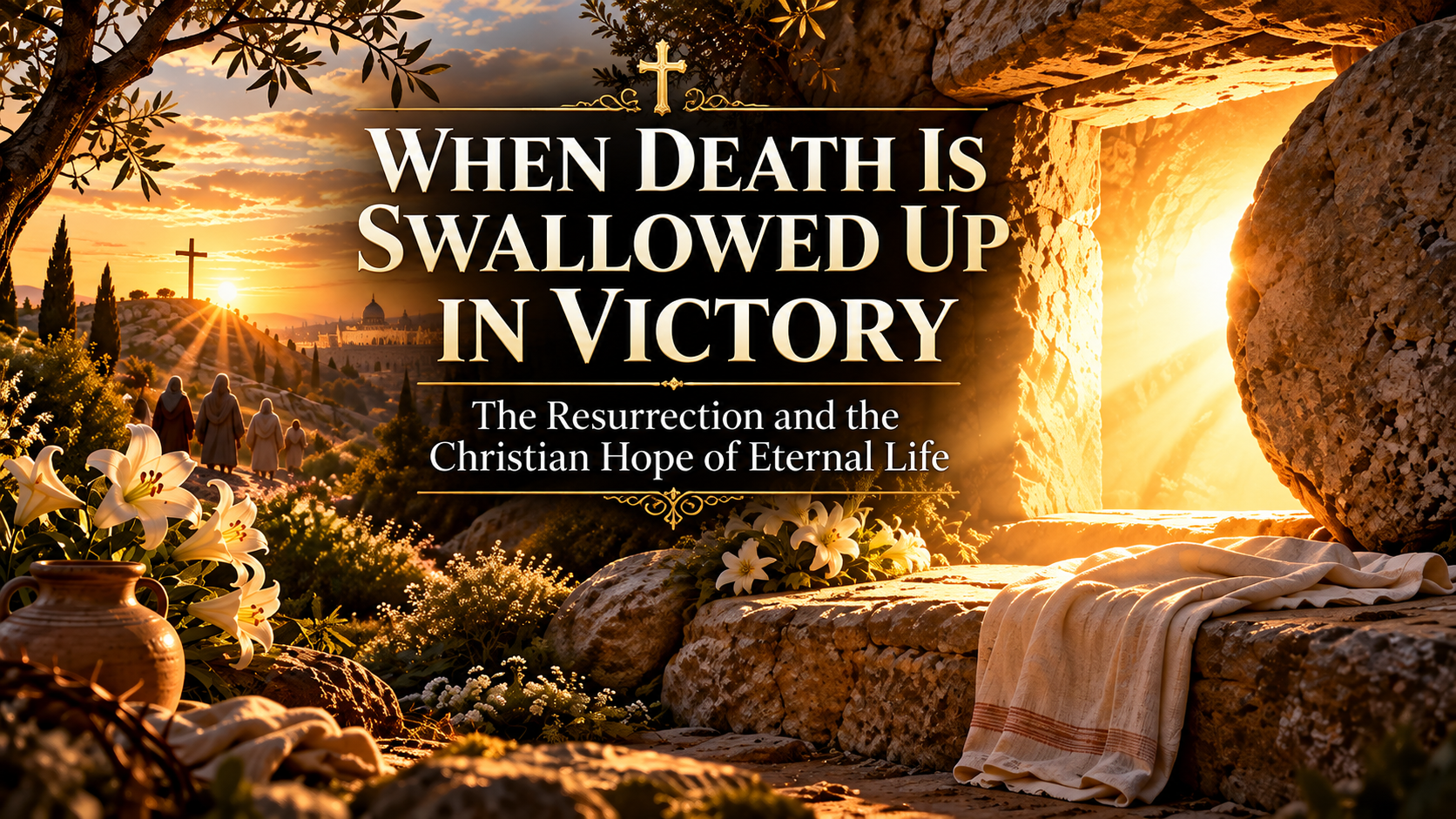
Remember Your Last End — Article 7 of 7
If Christ has truly conquered death, how should that victory transform our fears, our grief, and the way we live today?
Scripture for Meditation: John 11:17–27; 1 Corinthians 15:12–28, 51–58; Luke 24:1–12; Revelation 21:1–5
The final word does not belong to the grave
Imagine standing in a cemetery at sunrise. The stone markers testify to lives once filled with work, friendship, conflict, laughter, disappointment, and love. Every grave is a reminder that earthly life is finite.
What can Christian faith say in such a place? We cannot dismiss grief. We cannot pretend that death is merely another ordinary transition. We cannot offer a sentimental promise that everything painful will automatically resolve on terms of our choosing.
But we can proclaim something astonishing: Jesus Christ has risen from the dead.
That fact transforms the entire Christian understanding of mortality. The Gospel does not ask us merely to accept death with dignity. It announces that the Son of God entered death and overcame it.
In the supplied edited Preparation for Death, St. Alphonsus Liguori insists that our days are limited and calls us to prepare for a good death. The editor’s foreword identifies the saint’s deepest goal: growth in love of God and the grace of final perseverance. Those themes reach their Christian fulfillment when placed beneath the light of the Resurrection.
We remember our last end because Christ has opened the way to a destiny beyond it.
Christ’s Resurrection is history, not merely metaphor
The Resurrection cannot be reduced to the disciples’ renewed courage, an inspiring memory of Jesus, or a poetic way of saying that goodness survives adversity.
The Apostles proclaimed that the crucified Jesus truly lives. The Gospels testify to the empty tomb and the risen Lord’s appearances to His disciples. St. Paul insists that if Christ is not risen, Christian preaching and faith are vain (1 Corinthians 15:14).
The Church teaches the Resurrection as a real event that transcends the ordinary limits of history (CCC 638–655). Christ has not returned merely to the mortal condition from which death might again claim Him. He has entered a glorified life.
This matters because Christian hope rests on what God has done, not simply upon our desire that death be less final than it appears.
If the Resurrection were only a consoling symbol, our ultimate hope would remain uncertain. But because Christ truly rose, we can proclaim the promise of resurrection as part of divine revelation.
The death of Lazarus and the tears of Jesus
Before raising Lazarus, Jesus stands among the grieving. Martha believes in the resurrection at the last day, yet she is devastated by the death of her brother. Christ answers with the declaration, “I am the resurrection and the life” (John 11:25).
Shortly afterward, Jesus weeps (John 11:35).
The conjunction is profound. The One who possesses power over death does not treat human sorrow as foolish. He enters the grief of His friends.
This scene teaches us how to be Christians at the bedside and graveside. We do not need to choose between faith and tears. Belief in the Resurrection does not abolish the pain of separation. The saints grieved; the Church offers funeral rites precisely because death wounds families and communities.
What hope changes is not the reality of grief, but its horizon. We mourn before a Lord who has not remained in the tomb.
A compassionate Christian avoids hurried explanations about why a particular person died. We can speak the truth of Christ’s victory, pray, listen, and accompany those who mourn. Sometimes silence and presence express charity more faithfully than elaborate speeches.
The Cross and Resurrection cannot be separated
The Paschal Mystery unites Christ’s Passion, Death, Resurrection, and glorification. The Cross is not a defeat later corrected by an unrelated miracle. Through His obedient sacrifice, Jesus accomplishes redemption; His Resurrection manifests the victory of divine life and confirms His identity and mission (CCC 651–655).
For this reason, Christian hope is neither denial of suffering nor worship of suffering. Pain and injustice remain evils. We are called to heal, console, and resist wrongdoing. Yet because Christ has entered suffering and death, our burdens can be united to Him through grace.
This union does not complete an insufficient sacrifice. His redemptive offering is unique and perfect. Rather, His grace permits disciples to participate in His Paschal Mystery (CCC 618).
When a person bears unavoidable illness with faith while also seeking appropriate medical care, or when a parent sacrifices comfort for a child’s good, or when the persecuted remain faithful to truth, these struggles can become occasions of charity.
The value lies not in pain as such, but in love joined to Christ.
The resurrection of the body: God’s final answer to death
Christian hope is more than the soul’s survival. We profess the resurrection of the body. St. Paul presents Christ as the firstfruits of those who have died (1 Corinthians 15:20).
Why is this doctrine so important? Because the body belongs to our human identity. We are not pure spirits accidentally inhabiting matter. God made embodied persons, and His saving purpose concerns the whole human being.
The future resurrection is therefore not a return to the vulnerabilities of this present mortal condition. The Church teaches that the risen body will be transformed, sharing in Christ’s victory (CCC 997–1004).
The precise characteristics of the glorified body remain mysterious. We should not replace revelation with speculation. What is certain is the promise: God will raise the dead, and Christ’s kingdom will be consummated.
The Church’s reverence for the bodies of the deceased, her funeral rites, and her teaching about the dignity of the body all express this faith.
The Last Judgment and the restoration of all things
Christian hope also reaches beyond individual destiny toward the renewal of creation. Revelation 21 speaks of a new heaven and a new earth, with God dwelling among His people and wiping away tears (Revelation 21:1–5).
The Last Judgment manifests God’s justice and the full truth of human history (CCC 1038–1041). The renewal of creation fulfills His saving purpose in a manner surpassing our comprehension (CCC 1042–1050).
This future does not make our present work meaningless. It gives deeper significance to the pursuit of justice and charity. The world is not redeemed by our independent power, but acts performed in grace matter before God.
We should reject both despair about history and the illusion that any political, technological, or cultural project can itself establish heaven on earth. The Kingdom’s final fulfillment belongs to Christ.
Christian hope frees us to work responsibly for earthly goods without confusing them with our ultimate homeland.
Remembering death now becomes a school of hope
After meditating on the certainty of death, the judgment, the need for repentance, the last things, and the grace of a holy death, what remains?
Not a permanent mood of dread. Not an obsession with imagined details of eternity. The series should leave us with a sober, liberated conviction: this life is valuable because it is given by God, and it leads toward a destiny that surpasses death.
St. Alphonsus urges readers not to waste the time still offered. We might put his lesson into practice through ordinary fidelity. Love the people before you. Pray. Confess your sins. Receive the Eucharist worthily. Serve the poor. Seek forgiveness. Attend to your vocation. Pray for the dead.
Do not wait for ideal circumstances to begin living for Christ.
The Resurrection makes such life possible without despair, because holiness is not an attempt to earn salvation through isolated human achievement. It is cooperation with the grace that flows from the saving work of Jesus.
Mary, St. Joseph, and the prayer for final perseverance
The last petition of the Hail Mary joins the present moment to the hour of death. Catholics ask the Mother of God to intercede because Christian prayer belongs to the communion of saints and depends wholly on Christ’s mediation (CCC 970; 2677).
St. Joseph is traditionally invoked as patron of a happy death. Such devotion expresses confidence in the prayers of the saints, not an assurance that our last hours will follow a particular script.
Final perseverance is a grace to request humbly. We do not know the conditions under which our earthly lives will end. We can, however, nourish fidelity now.
The Lord who calls us to persevere is the Lord who has already conquered the grave.
The CatholicG33k Practice: An Easter-shaped rule of life
Choose one day this week to read 1 Corinthians 15 slowly, especially Paul’s account of Christ’s Resurrection and his proclamation of victory over death.
Pray a decade of the Glorious Mysteries for someone who is grieving. Offer Mass or a prayer for a deceased loved one. Make a concrete act of mercy that expresses faith in the dignity and eternal calling of another person.
Then establish a sustainable practice for the coming month: regular examination of conscience, Sunday Mass, faithful prayer, and a plan for Confession when needed. If you are caring for someone who is seriously ill, ask how to support spiritual and sacramental care without unnecessary delay.
Finally, end one day with a simple act of hope: “Jesus Christ, risen Lord, into Your hands I entrust my life.”
Questions for reflection
1. Do I believe the Resurrection is an actual victory of Christ over death, or do I treat it mainly as a comforting symbol?
2. How can I accompany grieving people without denying their sorrow or weakening Christian hope?
3. Which habit of prayer, repentance, or charity will I carry forward after this series ends?
A prayer of resurrection hope
Risen Lord Jesus Christ, You entered death for our salvation and rose in glory. When fear of mortality troubles me, anchor my heart in Your victory. When grief weighs upon those I love, teach me to bring Your consolation through patience and presence. Forgive my sins, deepen my faith, and strengthen my desire for the resurrection of the body and the life everlasting. Through the prayers of the Blessed Virgin Mary, St. Joseph, and St. Alphonsus Liguori, grant me final perseverance. May I live in Your grace, serve my neighbor in charity, and await Your coming with confident hope. Amen.
Conclusion: Death has not conquered love
Our earthly lives are finite, and the Gospel asks us to take that truth seriously. But the final Christian proclamation is not simply that all people die. It is that Jesus Christ has risen.
His victory does not erase the need for repentance, judgment, or perseverance. It gives those truths their deepest context. We prepare for death by learning to belong to the Savior who has conquered it.
Remember your last end. Live in Christ today. Hope in His Resurrection forever.
Sources and further reading
Primary spiritual context: St. Alphonsus Liguori, Preparation for Death: Prayers and Consolations for the Final Journey, ed. Norman J. Muckerman, C.Ss.R. (1998), Foreword and Part I, chapters 1–3, especially the emphasis upon a good death, love of God, and final perseverance. This article’s extended theology of the Resurrection is drawn from Scripture and the Catechism, not from chapters unavailable in the uploaded excerpt.
Sacred Scripture (Douay-Rheims): John 11:17–44; Luke 24:1–12; 1 Corinthians 15; Revelation 21:1–5; Romans 5:6–11.
Catechism of the Catholic Church: CCC 618; 638–655; 966–970; 988–1019; 1038–1050; 2677.
Magisterium: Second Vatican Council, Gaudium et Spes, 18, 22; Lumen Gentium, 48–51.
Remember Your Last End — End of Series
CatholicG33k — Faith. Truth. Reason.