

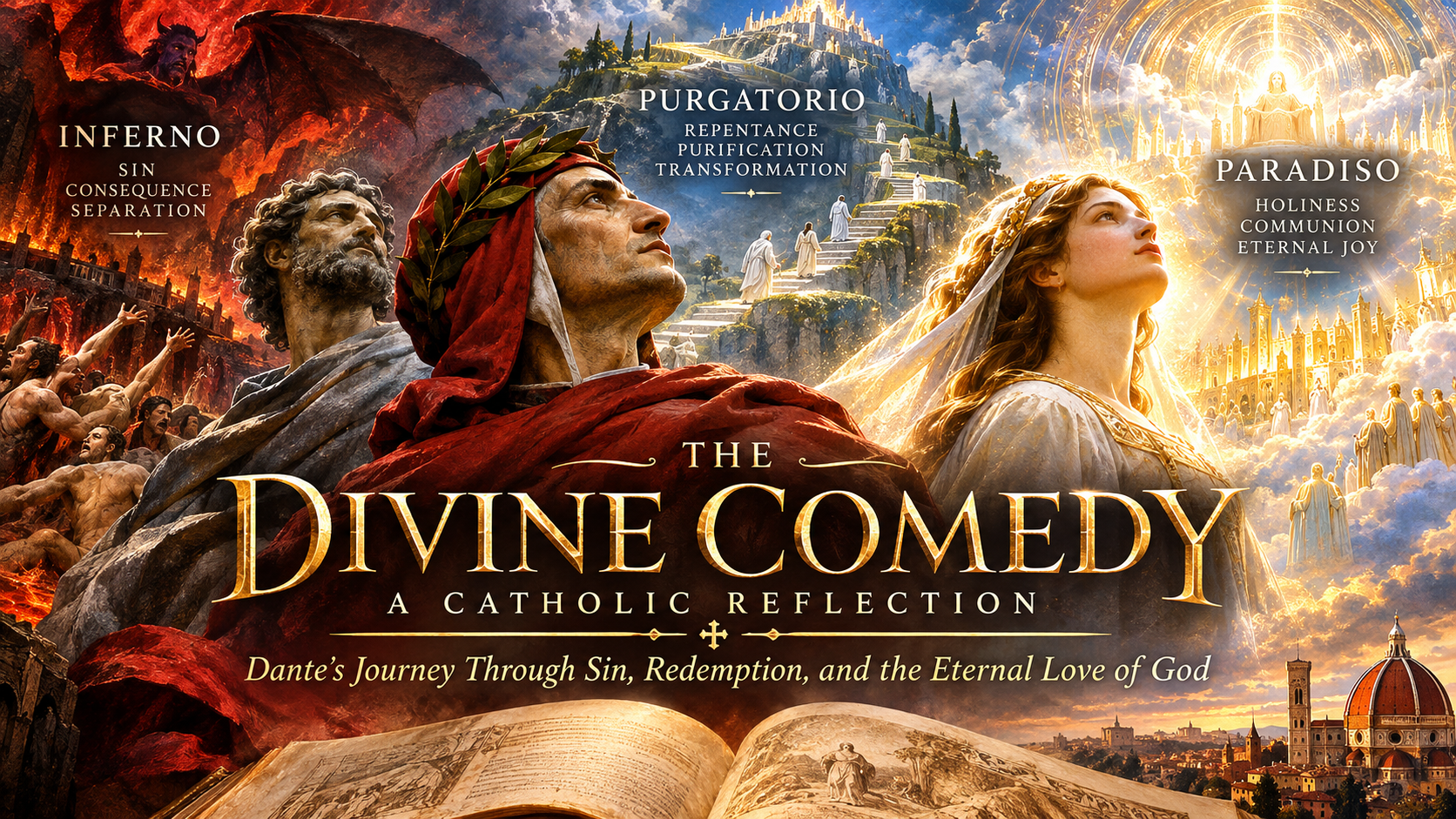
A Catholic Reflection on Dante Alighieri’s Masterpiece — Hell, Purgatory, Paradise, and the Destiny of the Human Soul
For Catholicg33k | Catholic Literature, Theology & Spiritual Reflection
Introduction: What If the Journey Through Hell Was Really a Journey Toward Love?
What if one of the greatest works ever written about Hell was not ultimately about Hell at all?
What if its frightening punishments, tormented souls, towering mountains, angelic encounters, and overwhelming visions of Heaven were part of a much greater story—a story about the human heart, the consequences of sin, the necessity of repentance, and the astonishing mercy of God?
That is precisely what we encounter in The Divine Comedy by Dante Alighieri.
Written in the early fourteenth century, Dante’s masterpiece is among the most remarkable achievements in Christian literature. It is simultaneously a poem, a philosophical investigation, a moral examination, a theological meditation, and an intensely personal journey through the deepest questions of human existence.
Who are we?
Why do we sin?
What happens when we reject God?
Can a person truly change?
What is the purpose of suffering?
Why must love be purified?
And what does it mean to see God face to face?
These are not merely medieval questions. They are the questions every human person eventually confronts.
Dante answers them through an extraordinary imaginative pilgrimage across three realms: Hell, Purgatory, and Paradise.
Yet the most important thing to understand is that Dante is not simply describing three places. He is examining three conditions of the human soul.
Hell reveals love corrupted and definitively turned away from God.
Purgatory reveals love being purified and reordered toward God.
Paradise reveals love brought to perfection in the eternal presence of God.
The entire poem moves from spiritual confusion to clarity, from bondage to freedom, and from disordered desire to the perfect love of the Blessed Trinity.
For Catholic readers, The Divine Comedy provides an extraordinary opportunity to reflect upon Sacred Scripture, the Catechism of the Catholic Church, the reality of spiritual warfare, the gift of free will, and the universal call to holiness.
But we must establish an important distinction from the beginning: Dante’s poem is a literary and theological vision, not Sacred Scripture or an authoritative map of the afterlife.
The Church teaches the reality of Heaven, Hell, and Purgatory. Dante imaginatively portrays these realities using medieval theology, philosophy, classical mythology, history, politics, and poetry. His specific landscapes, punishments, conversations, and assignments of historical individuals are not doctrines of the Catholic faith.
With that distinction understood, the poem becomes an extraordinary companion for spiritual reflection.
And its journey begins in a place many of us know far too well.
It begins with a soul that has lost its way.
1. The Dark Wood: When the Soul Loses Its Direction
Inferno, Canto I
Dante begins his pilgrimage in a dark forest.
In the Henry Francis Cary translation reproduced in the 1909 Harvard Classics edition, Dante describes finding himself midway through life, lost in a gloomy wood after departing from the proper path.
The scene is immediately recognizable.
Dante does not begin with someone who has consciously decided to become evil. He begins with someone who has become spiritually lost.
This distinction matters.
Spiritual destruction often begins gradually. A neglected prayer life, a small compromise with conscience, a resentment carefully preserved, or an attachment that slowly becomes more important than God can lead a person further and further from the right path.
In the poem, Dante does not even clearly understand how he arrived in the forest.
That is one of the most psychologically perceptive aspects of the opening.
Sometimes we recognize that something has gone terribly wrong in our spiritual life before we can identify exactly when we began turning away.
The dark wood represents confusion, fear, sin, and alienation from the true purpose of human existence.
Dante sees a mountain illuminated by the sun and attempts to climb toward it, but three threatening beasts obstruct his way: a leopard, a lion, and a she-wolf.
These animals have received several interpretations. They can evoke different forms of temptation, including lust, pride, greed, and the broader forces of sin that prevent the soul from reaching its proper destination.
The precise identification of each beast remains debated.
What matters is their function: they prevent Dante from ascending.
He cannot simply decide to climb the mountain and thereby overcome the forces that have enslaved him.
He needs help.
The Catholic connection: Sin darkens our understanding
The Catechism teaches that sin is an offense against reason, truth, and right conscience. It is a failure in genuine love for God and neighbor (CCC 1849).
Sin does not simply violate an external commandment. It damages the human person.
Our intellect can become clouded. Our desires can become disordered. Our will can grow weak through repeated moral compromise.
This connects with St. Paul’s description of humanity’s struggle with sin in Romans 7:14–25.
The person may recognize what is good yet experience an internal conflict that makes obedience difficult.
Dante’s forest is therefore more than a picturesque introduction.
It is an image of the soul recognizing its need for salvation.
And the first step toward salvation is acknowledging that we are lost.
Reflection: Have I become so accustomed to certain sins, habits, or attachments that I no longer recognize how far they have led me from God?
2. Virgil: What Human Reason Can Teach Us—and Where It Reaches Its Limit
Dante’s first guide is Virgil, the great Roman poet who lived before Christ.
Virgil represents much more than literary admiration.
He embodies the wisdom of classical antiquity: reason, philosophy, moral understanding, and the human capacity to recognize important truths about the world and ourselves.
Dante does not portray reason as an enemy of faith.
Quite the opposite.
Virgil helps him understand sin, moral responsibility, justice, human freedom, and the consequences of vice.
This reflects a deeply Catholic understanding of the relationship between faith and reason.
The Catechism teaches that faith and reason cannot ultimately contradict one another because both truth and the human intellect have their origin in God (CCC 159).
Reason can recognize moral principles, examine our actions, uncover falsehood, and help us choose what is good.
But reason alone cannot bring us into the supernatural life of the Blessed Trinity.
It cannot produce sanctifying grace.
It cannot, by its own power, grant the beatific vision.
Why Virgil cannot lead Dante into Paradise
Virgil can guide Dante through Hell and much of Purgatory, but he cannot bring him into the final vision of God.
At the appropriate moment, Beatrice takes over.
This change of guides is one of the poem’s greatest theological symbols.
Human reason is genuinely good, but supernatural revelation and grace bring us beyond what unaided reason can accomplish.
The distinction recalls St. Thomas Aquinas’s teaching that human beings are ordered to a supernatural end exceeding the comprehension and natural capacities of reason (Summa Theologiae, I, q. 1, a. 1).
God does not destroy reason through faith.
He elevates our understanding and calls us toward a destiny beyond what nature alone can achieve.
Dante’s lesson is not that intelligence is useless. It is that intelligence is not enough to save us.
We need Christ.
3. Hell: The Terrifying Reality of Love Turned Away from God
Inferno, Cantos III–XXXIV
As Dante descends into Hell, he witnesses increasingly disturbing scenes of punishment and suffering.
Each circle exposes a different dimension of moral disorder.
Some souls are carried helplessly by storms. Others endure burning landscapes, degrading transformations, suffocating darkness, or imprisonment in ice.
These images are often interpreted through the principle known as contrapasso, in which the punishment reflects the character or consequences of the sin.
The punishment is not merely an arbitrary external penalty.
It symbolically reveals what sin does to the soul.
The storm of uncontrolled passion
In Canto V, Dante encounters Francesca da Rimini and Paolo, whose illicit love has become the occasion of their ruin.
They are carried endlessly through a violent storm.
The symbolism is powerful.
During their earthly lives, desire overwhelmed moral judgment. Their punishment depicts the loss of self-mastery that results when passion becomes sovereign.
Yet Dante does not portray Francesca without sympathy.
Her suffering moves him so deeply that he faints.
This raises one of the most important moral questions in the poem: Can something feel profoundly loving while nevertheless being spiritually destructive?
The Catholic answer requires distinguishing authentic charity from disordered passion.
Love is not simply the intensity of an emotion.
True love seeks the genuine good of the other person in accordance with truth and God’s will.
The Catechism teaches that charity is the theological virtue by which we love God above all things for His own sake and our neighbor as ourselves for love of God (CCC 1822).
The tragedy of Francesca and Paolo is not that affection itself is evil.
It is that desire has been separated from moral truth.
When we become slaves to what we desire
Throughout the Inferno, Dante repeatedly shows people whose loves have become distorted.
Greed turns possessions into masters.
Pride exalts the self above truth.
Anger consumes the person who refuses reconciliation.
Fraud corrupts the relationship between intelligence and honesty.
Betrayal destroys the bonds of trust upon which human life depends.
This reveals a central spiritual principle:
Sin frequently begins when something genuinely good is loved in the wrong way, to the wrong degree, or for a morally disordered purpose.
Money is not evil, but greed is.
Human affection is good, but it can become possessive or adulterous.
A desire for justice is good, but it can be corrupted into vengeance.
Reason is good, but it can be misused to deceive and exploit others.
Dante’s Hell forces the reader to confront the terrifying consequences of allowing our desires to escape the governance of truth and charity.
4. The Most Frightening Image of Hell Is Not Fire—It Is Frozen Love
Inferno, Cantos XXXII–XXXIV
One of the most surprising details of Dante’s vision is that the lowest region of Hell is frozen.
At the bottom of the abyss lies Cocytus, a lake of ice containing those guilty of grave betrayal.
At its deepest point, Dante encounters Lucifer.
Contrary to popular images of Satan reigning triumphantly upon a fiery throne, Dante presents him as a monstrous, degraded figure trapped in ice.
His wings beat, but instead of freeing him, their movement contributes to the freezing winds.
The image is a devastating portrayal of evil.
Lucifer is not free.
He is not the victorious ruler of an alternative kingdom.
He is trapped in the consequences of rebellion against God.
Dante associates the deepest region of Hell with betrayal, including betrayal of family, guests, benefactors, and rightful relationships of trust.
The imagery suggests that the ultimate corruption of love is not merely uncontrolled passion.
It is the deliberate destruction of communion.
What does Hell mean in Catholic theology?
The Catechism teaches that Hell is the state of definitive self-exclusion from communion with God and the blessed (CCC 1033).
It teaches the eternity of Hell and the seriousness of freely choosing grave sin without repentance (CCC 1035).
But it also insists that God predestines no one to Hell and desires the salvation of all (CCC 1037).
This is why Dante must be read carefully.
We can learn from his portrayal of judgment without assuming that his placement of identifiable historical people represents actual divine judgments upon their souls.
The Church has not revealed the eternal destiny of those individuals simply because Dante assigned them a place in his poem.
Nor does Dante’s treatment of virtuous pagans or unbaptized persons fully represent the Church’s later and more carefully articulated teaching on the possibility of salvation for those who, through no fault of their own, do not know the Gospel (CCC 847–848).
Dante’s artistic vision reflects medieval assumptions, political conflicts, theological arguments, and personal judgments.
These must be distinguished from Catholic doctrine.
Nevertheless, the warning remains profound.
The greatest spiritual danger is the condition in which the soul no longer desires to turn toward God.
Hell represents the terrible finality of rejecting the love for which we were created.
5. Purgatory: The Extraordinary Hope That a Soul Can Be Changed
Purgatorio, Cantos I–XXXIII
After descending into Hell and passing through its deepest region, Dante begins to ascend the mountain of Purgatory.
The atmosphere changes.
Where Hell is marked by darkness and despair, Purgatory is marked by movement, hope, and transformation.
The souls here suffer, but their suffering has an entirely different meaning.
They are not eternally separated from God.
They are being purified for communion with Him.
This is essential to the Catholic understanding of Purgatory.
The Catechism teaches that those who die in God’s grace and friendship but remain imperfectly purified undergo a final purification, and their salvation is assured (CCC 1030–1031).
Purgatory is not a second opportunity to choose salvation after death.
It is the purification of those who already belong to God.
Why purification matters
Consider a person who sincerely loves God but continues to struggle with pride, selfishness, impatience, resentment, or unhealthy attachments.
Even when sin has been forgiven, the soul may still need purification from disordered attachments and the consequences of sin.
God desires more than our legal acquittal.
He desires our transformation.
Purgatory therefore points toward the perfection of charity.
The beautiful contrast with Hell is that the souls in Purgatory willingly accept their purification.
They desire to become holy.
Their suffering is ordered toward healing.
Hell reveals the tragedy of refusing love. Purgatory reveals the hope of allowing love to change us.
6. The Seven Terraces: How God Heals Disordered Love
Dante organizes the mountain of Purgatory around the seven capital sins.
| Terrace | Disordered tendency | Spiritual healing |
|---|---|---|
| Pride | Exalting ourselves above others | Humility |
| Envy | Resenting another person’s good | Charity and generosity |
| Wrath | Allowing anger to become destructive | Meekness and patience |
| Sloth | Failing to pursue the good with proper zeal | Diligence and spiritual fervor |
| Avarice and prodigality | Disordered attachment to possessions | Generosity and detachment |
| Gluttony | Excessive attachment to bodily satisfaction | Temperance |
| Lust | Sexual desire detached from its proper order | Chastity |
The organization is deeply theological.
In Purgatorio XVII–XVIII, Virgil explains that the human person is naturally inclined toward love, but love can become disordered.
We can love the wrong objects, fail to love properly, or love lesser goods excessively.
Thus, the spiritual life is not simply about suppressing all desire.
It is about rightly ordering desire.
This corresponds to the Catholic moral tradition, particularly the teaching that charity gives life and direction to the virtues (CCC 1827).
God does not want us to become creatures without passion, longing, or affection.
He wants our loves purified so that they lead us toward Him.
The seven marks upon Dante’s forehead
At the entrance to Purgatory, an angel places seven letters upon Dante’s forehead.
These represent the seven capital sins from which he must be purified.
As Dante ascends the mountain, the marks are progressively removed.
The image is unmistakably penitential.
It symbolizes the gradual cleansing of the soul.
In the same episode, the angel holds two keys associated with St. Peter, recalling the Church’s power of the keys and the sacramental life.
The imagery can remind Catholic readers of repentance, confession, absolution, and satisfaction, though Dante’s fictional ceremony is not itself the Church’s literal rite of Reconciliation.
The Catechism describes interior repentance as a radical reorientation of the whole life toward God (CCC 1430–1431).
The seven marks invite us to consider the sins that continue to distort our freedom.
What is God asking to remove from our hearts?
What attachment have we mistaken for happiness?
What vice have we allowed to become part of our identity?
These are the questions Dante’s mountain places before every reader.
7. One of Dante’s Greatest Insights: We Become What We Love
Purgatorio, Canto XVIII
For me, this is one of the most powerful insights of the entire poem.
In his discussion of love and free will, Virgil explains that the human soul is drawn toward what appears good.
But desire does not automatically make an action righteous.
We must examine whether the object of our love is genuinely good and whether we are pursuing it in the proper way.
Dante recognizes a truth that speaks directly to modern life.
Our habits are formed by our repeated choices.
And our repeated choices gradually shape the kind of person we become.
A person who continually chooses resentment may become increasingly bitter.
A person who habitually seeks admiration may grow dependent upon the opinions of others.
A person who continually seeks immediate pleasure may lose the ability to sacrifice for a greater good.
But the opposite is also true.
A person who repeatedly chooses prayer, forgiveness, sacrifice, honesty, and charity can grow in virtue through cooperation with God’s grace.
The Catechism describes virtues as habitual and firm dispositions to do the good (CCC 1803).
The supernatural virtues of faith, hope, and charity are infused by God and enable Christians to participate in His life (CCC 1812–1813).
Dante’s insight is therefore not simply that we must behave better.
It is that the object and order of our love help determine the direction of our souls.
The spiritual life is the lifelong task of learning to love what God loves, in the way God calls us to love.
8. Beatrice: Why the Soul Needs More Than Knowledge
Purgatorio, Cantos XXX–XXXIII
One of the most moving moments in The Divine Comedy comes when Dante finally encounters Beatrice.
Virgil, who has guided him through so much suffering and purification, disappears.
Dante is devastated.
But Beatrice does not simply comfort him.
She confronts him.
She reminds him that he abandoned the higher good and pursued lesser things that could not satisfy him.
The moment is deeply spiritual.
Dante has seen the consequences of sin.
He has witnessed the process of purification.
But now he must confront his own failure to love rightly.
Beatrice represents more than the beloved woman of Dante’s earthly life. Within the poem, she becomes associated with heavenly wisdom, revealed truth, and the grace that draws the soul toward God.
Her rebuke reveals something important about divine mercy.
Mercy does not always make us comfortable. Sometimes mercy tells us the truth we have spent years avoiding.
The Lord corrects those He loves (Hebrews 12:6).
Authentic repentance requires more than intellectual agreement that sin is wrong.
It involves sorrow for sin, rejection of wrongdoing, and a genuine desire for conversion.
The Catechism calls contrition sorrow of the soul and detestation for sin committed, together with the resolution not to sin again (CCC 1451).
Beatrice’s confrontation becomes an image of the moment when a person stops making excuses and allows grace to reveal the truth.
Only after this purification can Dante continue toward Paradise.
9. Paradise: Heaven Is Not an Endless Vacation—It Is Perfect Communion With God
Paradiso, Cantos I–XXXIII
When Dante enters Paradise, the imagery changes dramatically.
The darkness and suffering of the earlier realms give way to light, harmony, music, beauty, intellectual illumination, and overflowing joy.
Dante encounters souls perfected by God’s grace.
Their happiness is not rooted in earthly accomplishments, personal prestige, or superiority over others.
It comes from union with the divine will.
The extraordinary lesson of Piccarda
In Paradiso III, Dante speaks with Piccarda, a blessed soul who explains that the inhabitants of Heaven do not resent differences in their degrees of glory.
Their wills are perfectly united to God’s will.
In Henry Cary’s translation, she expresses the truth beautifully:
“And in His will is our tranquillity.”
This is a remarkable statement about Christian happiness.
On earth, we often imagine that peace comes when everything conforms to our wishes.
We think we will finally be satisfied when we possess enough, accomplish enough, receive enough admiration, or gain enough control.
Dante reveals a different vision.
True peace comes when the human will is perfectly united to the will of God.
This does not destroy freedom.
It perfects freedom.
The Catechism teaches that the more one does what is good, the freer one becomes (CCC 1733).
Freedom is not the unlimited ability to do whatever we happen to desire.
Its highest fulfillment is the capacity to choose and love the good without the bondage of sin.
Heaven is therefore not a place where individual personality disappears.
It is the place where every redeemed person becomes fully alive in God.
10. The Beatific Vision: The Ultimate Purpose of Human Existence
As Dante approaches the conclusion of Paradise, he encounters realities that exceed ordinary human language.
The poet repeatedly struggles to describe what he sees.
This is fitting because the ultimate destiny of the Christian is not merely residence in a beautiful location.
It is the direct vision of God.
The Catechism teaches that the blessed behold the divine essence through a special gift of God (CCC 1023–1029).
This is called the beatific vision.
St. John writes in 1 John 3:2 that the children of God shall see Him as He is.
St. Paul explains that our present knowledge is partial, while the fullness of communion with God will transform our understanding (1 Corinthians 13:12).
The beatific vision is the fulfillment of every rightly ordered human longing.
Everything good in creation is a limited participation in the goodness of God.
Beauty, truth, friendship, love, justice, and joy all find their ultimate source in Him.
Heaven is not the abandonment of these goods.
It is their fulfillment in the God from whom all goodness comes.
The heavenly rose
Near the end of the poem, Dante beholds the blessed gathered in the form of a magnificent heavenly rose.
The imagery communicates both the immense multitude of the redeemed and the unity of their worship.
The saints possess different histories, personalities, and degrees of glory, yet all participate in the one divine life.
This calls to mind Revelation 7:9–14, where St. John sees an innumerable multitude from every nation standing before God and the Lamb.
The heavenly rose is not a literal structure the Church requires us to believe exists in Heaven.
It is Dante’s poetic expression of the communion of saints.
The Church teaches that those who are united to Christ participate in a communion of spiritual goods and remain united across death (CCC 946–962).
In Heaven, this communion is brought to perfection.
The saints do not compete for God’s love.
They rejoice in Him and in one another.
11. St. Bernard and the Blessed Virgin Mary: The Final Preparation for Seeing God
Paradiso, Cantos XXXI–XXXIII
As Dante approaches the final vision, another remarkable transition occurs.
Beatrice returns to her place among the blessed, and St. Bernard of Clairvaux becomes Dante’s final guide.
This is a deeply fitting choice.
Bernard is remembered for his contemplative spirituality, devotion to Christ, and profound love for the Blessed Virgin Mary.
In the poem’s final canto, Bernard offers a magnificent prayer to Mary, asking her intercession so that Dante may receive the grace necessary to contemplate the divine mystery.
The prayer begins by celebrating the paradox of Mary’s relationship to Christ: she is the Mother of the Incarnate Son, yet she herself is a creature redeemed by Him.
Why does Dante end with Marian intercession?
Dante’s final movement is not the triumph of independent human intelligence.
It is an act of humility.
After all his learning, suffering, spiritual examination, and purification, he must still receive grace.
The invocation of Mary expresses the Catholic belief that the saints, particularly the Blessed Virgin, intercede for the faithful in complete dependence upon Christ.
The Catechism teaches that Mary’s maternal intercession neither diminishes nor adds to the unique mediation of Jesus Christ (CCC 970).
This distinction is essential.
Mary is not the source of salvation.
Christ alone is our Redeemer.
Yet God allows the members of His Body to participate in the communion of prayer and intercession.
The moment beautifully illustrates the relationship between grace and humility.
As Dante approaches the highest possible vision, he becomes more—not less—dependent upon divine mercy.
The higher the soul ascends, the more clearly it recognizes that everything good is a gift.
12. The Final Vision: The Trinity, the Incarnation, and Love
Paradiso, Canto XXXIII
The conclusion of The Divine Comedy is among the most profound passages in Christian literature.
Dante is granted an extraordinary vision of divine light.
He struggles to express the mystery of the Trinity through the image of three circles sharing a wondrous unity.
Within this contemplation, he also perceives a human likeness, directing his attention toward the mystery of the Incarnation.
The eternal Son of God became man.
The Creator entered His creation.
The Word became flesh (John 1:14).
Dante’s vision reaches its culmination in the great mystery that Christianity proclaims: the union of divine and human natures in the one Person of Jesus Christ.
The Catechism teaches that Jesus is true God and true man, one divine Person possessing both a complete divine nature and a complete human nature (CCC 464–469).
Here Dante reaches the limit of human understanding.
The mystery cannot be conquered through intellectual effort.
It must be received through grace.
And in the final lines, Dante expresses the harmony of his will with the divine love that moves the universe.
The poem closes with the magnificent image of the Love that moves the sun and all the stars.
This is not simply a sentimental declaration.
It is the final theological answer to the entire journey.
The God who created the universe is Love (1 John 4:8).
The God who calls us to repentance is Love.
The God who purifies the soul is Love.
The God who draws the redeemed into eternal communion is Love.
The destination of the human soul is not merely a kingdom, a reward, or freedom from punishment.
It is the living God Himself.
13. Dante’s Greatest Lesson: Sin Is Disordered Love, and Holiness Is Love Restored
If we step back from the individual scenes, characters, and poetic images, one great theological principle emerges.
The human person is made for love.
But love must be ordered according to truth.
In Hell, love has been corrupted into possessiveness, selfishness, pride, hatred, and rebellion.
In Purgatory, love is being healed through repentance, humility, penance, and purification.
In Paradise, love is perfected in charity and communion with God.
This gives the entire poem an extraordinary unity.
The Inferno is not merely an anatomy of punishment.
The Purgatorio is not merely a description of painful purification.
The Paradiso is not merely an account of heavenly beauty.
Each realm explores the relationship between freedom, love, and the ultimate good.
St. Thomas Aquinas teaches that human actions are directed toward perceived goods and that our final happiness cannot consist in any created good, but only in God (Summa Theologiae, I–II, qq. 1–5).
Dante communicates related truths through unforgettable images and encounters.
Our tragedy is that we frequently seek ultimate happiness in things that cannot provide it.
We expect possessions to give us security.
We expect approval to establish our worth.
We expect pleasure to satisfy our deepest longing.
We expect power to overcome our weakness.
Yet every created good is limited.
Only God can satisfy the human heart completely.
St. Augustine expresses this truth in the opening of his Confessions: our hearts remain restless until they rest in God.
Dante transforms that theological insight into an epic journey.
14. Reading Dante as a Catholic Without Confusing Poetry and Doctrine
A serious Catholic reading of The Divine Comedy must also recognize its historical limitations.
Dante lived within the conflicts of medieval Florence, the rivalries of Italian political factions, and the disputes involving emperors, bishops, and popes.
His political exile beginning in AD 1302 profoundly shaped his writing.
The poem contains sharp criticism of corruption, including corruption among ecclesiastical authorities.
It also incorporates classical mythology, medieval cosmology, legendary narratives, and judgments influenced by the assumptions of Dante’s own society.
A reader should therefore resist treating the work as a supernatural travel report.
Its depictions of the physical geography of the afterlife are poetic.
Its placement of historical persons in Hell, Purgatory, or Heaven represents Dante’s literary and moral judgment, not the Church’s knowledge of their eternal destiny.
Its treatment of some peoples and individuals reflects medieval prejudices that must not be elevated into Christian doctrine.
Even its descriptions of Purgatory are imaginative elaborations upon a doctrine whose essential content is much more restrained.
The Church teaches the reality of final purification, but it does not require belief in Dante’s seven terraces, literal scars upon the forehead, or precise mechanisms of purification.
This distinction does not diminish the poem’s importance.
It allows us to appreciate Dante’s genius responsibly.
The theological value of The Divine Comedy lies not in its supposed authority to disclose the physical architecture of eternity, but in its ability to awaken moral awareness, illuminate the consequences of sin, and direct the imagination toward God’s holiness.
In his 2021 apostolic letter Candor Lucis Aeternae, Pope Francis presented Dante as a witness to hope, conversion, freedom, and the human desire for happiness.
Dante remains valuable precisely because his work challenges readers to examine the direction of their lives.
He does not invite us merely to admire his literary achievement.
He invites us to begin the journey.
15. Why The Divine Comedy Still Matters in Our Modern World
Seven centuries have passed since Dante wrote his masterpiece, yet the condition of the human heart has not fundamentally changed.
We still experience confusion about the meaning of life.
We still pursue temporary goods as though they were ultimate.
We still struggle with envy, greed, pride, lust, anger, and spiritual indifference.
We still resist correction.
We still fear suffering.
We still desire happiness, but frequently misunderstand where it can be found.
Our technological achievements have not eliminated the problem of disordered desire.
If anything, modern life offers new ways to become distracted from the deeper questions of human existence.
The constant pursuit of approval, consumption, stimulation, influence, and personal gratification can leave little room for silence, prayer, repentance, or contemplation.
Dante confronts us with the uncomfortable possibility that our greatest problem may not be a lack of information.
It may be a lack of spiritual direction.
We know an extraordinary amount about the world around us.
But do we know what our lives are ultimately for?
We have developed countless ways to communicate.
But are we becoming more truthful and charitable?
We possess remarkable means of entertainment.
But are we learning how to be happy?
We can measure distant galaxies.
But do we recognize the condition of our own souls?
These are not arguments against science, technology, or progress.
They are reminders that progress must be ordered toward the genuine good of the human person.
Dante’s poem asks whether our lives are moving toward God or away from Him.
And it insists that our choices matter.
16. A Personal Catholic Reflection: Where Am I on Dante’s Journey?
Perhaps the most important way to read The Divine Comedy is to stop treating Dante only as a character from medieval literature.
We should recognize ourselves in his journey.
There are moments when we are lost in the dark wood, uncertain how our lives became so spiritually confused.
There are moments when the voices of reason, conscience, and Scripture show us truths we would rather avoid.
There are moments when we recognize a particular vice in our own hearts and discover how deeply it influences our choices.
There are moments when repentance is painful because we must surrender something we have grown accustomed to loving.
And there are moments when grace gives us a glimpse of the beauty toward which God is drawing us.
The spiritual life involves all of these experiences.
It is not a straight line of uninterrupted emotional consolation.
It often requires struggle, correction, sacrifice, and perseverance.
But Christian hope does not depend upon our ability to achieve holiness by ourselves.
It depends upon the saving grace of Jesus Christ.
Through Baptism, the Lord gives us new life.
Through Reconciliation, He restores those who have fallen into sin.
Through the Eucharist, He nourishes charity and strengthens communion with Him.
Through prayer, Scripture, and the life of the Church, He continues forming us in holiness.
The saints demonstrate what this grace can accomplish.
And the Catechism reminds us that the call to holiness is universal (CCC 2013).
We do not need to become famous theologians or extraordinary mystics.
We need to respond faithfully to God’s grace in the particular circumstances of our lives.
Sometimes the next step toward Heaven is a profound conversion.
Sometimes it is an overdue confession.
Sometimes it is forgiving someone we resent.
Sometimes it is rejecting a persistent temptation.
Sometimes it is caring patiently for a family member.
Sometimes it is simply choosing to pray when we would rather remain distracted.
The journey to God unfolds through countless ordinary decisions made in the presence of His grace.
Conclusion: The Journey Ends Where It Truly Began—with God
At the beginning of The Divine Comedy, Dante finds himself lost.
He is surrounded by darkness, threatened by forces he cannot overcome, and uncertain whether he will ever reach the light.
By the conclusion, he has encountered the consequences of sin, the necessity of purification, the limitations of human reason, the power of grace, and the beauty of the heavenly communion.
Yet his greatest discovery is not the geography of Hell or the structure of Paradise.
It is the truth about love.
He discovers that God is the source of all goodness, the purpose of all rightly ordered desire, and the fulfillment of the human soul.
Everything in the journey leads toward this reality.
The darkness exposes our need for God.
The consequences of sin reveal the tragedy of turning away from Him.
Purgatory shows that His grace heals and transforms.
Paradise reveals the eternal happiness of those who love Him.
The final vision discloses the God who is the source of the universe and the destiny of every redeemed soul.
The Christian message is therefore not primarily that we should be afraid of Hell.
It is that we were created for Heaven.
Hell is terrifying because separation from God is the loss of our ultimate good.
Purgatory is hopeful because God’s healing love prepares the saved for perfect communion.
Heaven is glorious because it is the fulfillment of the relationship for which humanity was created.
Dante’s journey becomes our invitation.
We must recognize our own dark woods.
We must confront the disorders of our hearts.
We must accept the grace of conversion.
We must persevere through purification.
And we must direct our lives toward the One who alone can satisfy every righteous desire.
The greatest question The Divine Comedy leaves us with is not simply what happens after death.
It is something far more immediate.
What am I becoming through the things I choose to love today?
Because every habit shapes the heart.
Every free choice bears moral significance.
Every genuine act of repentance is a movement toward God.
And every act of charity, sustained by grace, prepares us for the love that will one day be perfected in Heaven.
Dante reminds us that the Christian life is not ultimately a journey into darkness.
It is a journey out of darkness and toward the eternal light of God.
The poem begins with a man who has lost his way.
It ends with a soul whose will has been brought into harmony with divine Love.
And that, in the deepest sense, is the hope of every Christian.
We were created by Love, redeemed through Love, and called to dwell eternally in Love.
Questions for Personal Reflection
- What is the dark wood in my own life? Where have I lost spiritual direction?
- Which desires or attachments have I allowed to become more important than God?
- Do I recognize the difference between genuine love and disordered passion?
- When God corrects me through Scripture, conscience, or the Church, do I respond with humility?
- What would it mean for my will to become more fully united to God’s will?
- Am I pursuing Heaven as my ultimate goal, or treating earthly success as the measure of happiness?
- What concrete act of repentance, charity, or prayer can I undertake today?
A Closing Prayer Inspired by Dante’s Journey
Heavenly Father, You created us for truth, goodness, beauty, and eternal communion with You.
When we wander into the darkness of sin, call us back to the path of righteousness.
Lord Jesus Christ, our Redeemer, open our eyes to the emptiness of false happiness. Purify our desires, strengthen our wills, and free us from the attachments that keep us from loving You completely.
Holy Spirit, illuminate our minds with truth and fill our hearts with charity. Give us the humility to repent, the courage to persevere, and the hope that leads us toward Heaven.
Blessed Virgin Mary, Mother of God, pray for us as we continue our earthly pilgrimage. Through your intercession, may we always remain faithful to your Son.
May every step of our lives lead us closer to the eternal Love for whom we were created.
Amen.
Scripture and Catholic References
Sacred Scripture: Genesis 1:26–27; Psalm 51; Ezekiel 18:21–32; Matthew 5:1–12; Luke 15:11–32; John 1:14; Romans 5:5; Romans 7:14–25; 1 Corinthians 13; Galatians 5:16–25; Hebrews 12:6; 1 John 3:2; 1 John 4:8; Revelation 7:9–17; Revelation 21–22.
Catechism of the Catholic Church: CCC 159; 847–848; 946–962; 1023–1037; 1430–1451; 1716–1733; 1803–1829; 1849; 2013.
Theological works: St. Augustine, Confessions, Book I; St. Thomas Aquinas, Summa Theologiae, I, q. 1, a. 1, and I–II, qq. 1–5.
Primary literary source: Dante Alighieri, The Divine Comedy, translated by Henry Francis Cary, with introduction and notes, The Harvard Classics, Volume 20, P. F. Collier & Son, 1909. All references to cantos and translated passages are based on this supplied edition.
Magisterial reflection: Pope Francis, Candor Lucis Aeternae, Apostolic Letter on the Seventh Centenary of the Death of Dante Alighieri, March 25, 2021.
Catholicg33k | Exploring the Catholic Faith Through Scripture, Theology, Philosophy, Literature, and Reason