

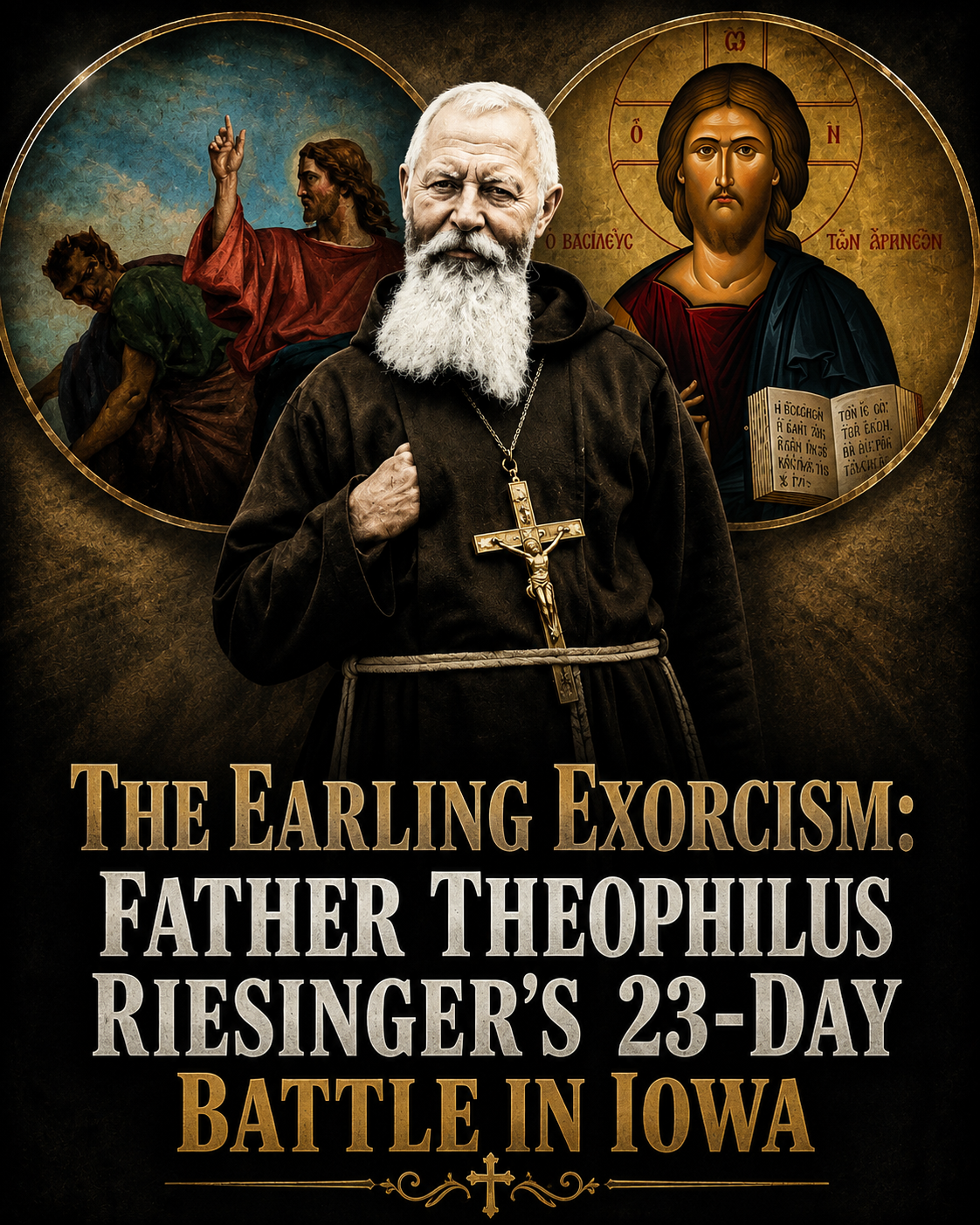
The extraordinary case of Emma Schmidt, the claims preserved by witnesses, and the victory that belongs to Jesus Christ alone.
In 1928, inside a secluded convent near Earling, Iowa, a Capuchin priest began a solemn exorcism that would become one of the most widely discussed cases of alleged demonic possession in American Catholic history.
The priest was Father Theophilus Riesinger, an experienced missionary and exorcist. The afflicted woman’s identity was initially concealed to protect her privacy. She was later publicly identified as Emma Schmidt and is also commonly known by the pseudonym Anna Ecklund.
What reportedly occurred during the exorcism is deeply disturbing. Yet the story should not be treated as entertainment, exaggerated into a horror tale, or repeated without careful qualification. The earliest published account presents the case as a testimony to the authority of Jesus Christ and His Church—not as a celebration of demonic phenomena.
A Woman Tormented Since Her Youth
According to the principal published account, Emma had been a devout and respectable Catholic during her early childhood. Around the age of fourteen, however, she began experiencing an intense interior resistance to prayer and the sacraments.
She reportedly wanted to attend church, pray, and receive Holy Communion, but felt as though an invisible power prevented her. She experienced disturbing interior voices, violent temptations, despair, and impulses directed against sacred persons and objects.
The account states that physicians examined her over a period of years and reportedly found no adequate physical or psychological explanation. However, the published narrative does not reproduce the original medical records or provide enough information for those conclusions to be independently evaluated today. The historically responsible wording is therefore that the author reported medical examinations, not that modern medicine conclusively proved demonic possession.
The same account says that Emma reacted violently to objects that had been secretly blessed. It also claims that she understood blessings spoken in ecclesiastical Latin, although she had not studied the language, while reacting differently when ordinary classical Latin was used. The source describes an apparent understanding of an unfamiliar language; it does not clearly establish the popular claim that she delivered lengthy speeches in numerous unknown languages.
The Church Proceeded With Caution
The Catholic Church does not authorize a solemn exorcism merely because someone behaves strangely or believes himself possessed. Physical illness, psychological illness, trauma, fraud, suggestion, and other natural explanations must be considered.
The Catechism of the Catholic Church teaches that illness—especially psychological illness—is distinct from demonic possession and belongs to the competence of medical science. A major exorcism may be performed only by a priest who has received authorization from his bishop. Canon law requires that such a priest possess piety, knowledge, prudence, and integrity of life.
The 1935 account states that the case was placed in Father Riesinger’s hands by the bishop. Father Riesinger then asked Father Joseph Steiger, pastor of the Earling parish, for permission to use a convent belonging to Franciscan sisters. The location was chosen partly for privacy and to protect the woman from public attention.
The bishop was reportedly consulted again before the rite began. Father Steiger and several religious sisters would become witnesses to what followed.
The Exorcism Begins
The published narrative describes a prolonged struggle reported as lasting twenty-three days.
Emma was placed on an iron bed, and several of the strongest sisters were selected to assist in restraining her if necessary. Father Riesinger then began the prescribed prayers of the Church in the name of the Blessed Trinity and of Jesus Christ crucified.
According to the witnesses cited in the account, Emma suddenly broke free from those holding her. Her body was said to have been carried through the air before coming to rest high above the door, where she appeared to cling to the wall.
This alleged levitation is among the most dramatic claims associated with the case. It comes from the devotional account based substantially on Father Steiger’s testimony; no photographic or scientific documentation is known from the published record. It should therefore be described accurately as something witnesses reported, rather than as an independently verified physical event.
The account also describes:
- Violent movements and extraordinary physical resistance
- Animal-like cries and voices that seemed unlike Emma’s normal voice
- Intense reactions to holy water, relics, the crucifix, and the Blessed Sacrament
- Recognition of blessed objects that had allegedly been concealed
- Knowledge of private matters that those present believed she could not have learned naturally
One episode involved an object that had secretly been blessed with holy water. The account says Emma immediately reacted to it. On another occasion, she allegedly identified a relic of Saint Thérèse of Lisieux hidden in Father Steiger’s pocket. These incidents were interpreted by those present as signs of preternatural knowledge.
The Names Reported During the Rite
Voices emerging from Emma reportedly identified themselves as Beelzebub, Judas Iscariot, Jacob, and Mina. Jacob was said to be Emma’s deceased father, while Mina was described as a woman associated with him.
These statements must be handled carefully. Demons are liars, and the Church does not accept everything said during an exorcism as trustworthy. Even the 1935 account repeatedly warns that deceptive spirits may mix truth with falsehood.
Nor should the alleged presence of Judas or other deceased persons be treated as established Catholic doctrine. The pamphlet itself notes that the Church had issued no judgment concerning some of these assertions.
Did Lucifer Appear on the Final Day?
Many modern retellings claim that the final and greatest manifestation was Lucifer himself. That version is more dramatic than the earliest published account.
The pamphlet does claim that Father Riesinger believed Lucifer was involved in the case. Near its conclusion, it says that Lucifer was present for approximately fourteen days and that Father Riesinger once saw a fiery figure standing before him for about half an hour.
However, the pamphlet does not say that Lucifer first appeared as the final manifestation on the last day. In its description of the demons’ final departure, the names reportedly heard were Beelzebub, Judas, Jacob, and Mina.
Therefore, the accurate statement is:
Father Riesinger reportedly believed that Lucifer was involved and claimed to have seen him during the course of the exorcism—not necessarily as a final manifestation on the last day.
“Begone Satan—the Lion of Juda Reigns”
As the struggle reached its conclusion, Father Riesinger was reportedly almost physically exhausted. Nevertheless, he continued—not through confidence in his own strength, but through the authority of Jesus Christ entrusted to the Church.
The account says that Emma suddenly stood upright with only her heels touching the bed. Father Riesinger raised a relic of the True Cross and commanded:
“Begone Satan, the Lion of Juda reigns!”
Her body then relaxed and fell back upon the bed. Witnesses reportedly heard voices repeating the names Beelzebub, Judas, Jacob, and Mina before fading away.
Emma opened her eyes. For the first time in years, she was said to have spoken the Holy Name with peace and devotion:
“My Jesus! Mercy! Praised be Jesus Christ!”
Those present wept with joy. The account states that Emma subsequently returned peacefully to Holy Mass, Eucharistic adoration, and the reception of Holy Communion.
What the Story Truly Means
The central figure in this story is not Satan.
It is Jesus Christ.
Catholic teaching does not present Satan as an equal opposite to God. Satan is a fallen creature. His power is limited, dependent, and entirely subject to divine providence. The Catechism states plainly that Satan’s power is not infinite and that God has already accomplished a certain victory over the Evil One through Christ.
An exorcist does not command demons by personal force, magical knowledge, or spiritual bravado. He acts as an authorized minister of the Church, invoking the authority of the crucified and risen Lord.
As Sacred Scripture declares:
“For this purpose, the Son of God appeared, that he might destroy the works of the devil.”
—1 John 3:8, Douay-Rheims
The Earling case contains extraordinary claims that cannot now be independently demonstrated in every detail. Catholics are not required to accept every sentence of a private historical account as an article of faith.
But Catholics do believe what the story was intended to proclaim:
Christ has conquered. Satan is not sovereign. The Cross is stronger than hell, and every power of darkness remains subject to Jesus Christ.
Historical Accuracy Note
The principal account, Begone Satan!, received a Nihil Obstat and Imprimatur in 1935. These indicate that the ecclesiastical reviewers found nothing contrary to Catholic faith or morals and permitted publication. They do not constitute an infallible declaration that every historical or supernatural claim in the book was proven. Ecclesiastical approval concerns conformity with faith and morals rather than scientific certification of every reported event.
Sources and Further Reading
- Carl Vogl, Begone Satan! A Soul-Stirring Account of Diabolical Possession, translated by Father Celestine Kapsner, O.S.B., Collegeville, Minnesota, 1935, especially pp. 6–14, 24–28, 34–36, and 45–49.
- Joseph P. Laycock, “The Secret History of the ‘Earling Exorcism,’” in Giuseppe Giordan and Adam Possamai, eds., The Social Scientific Study of Exorcism in Christianity, Springer, 2020, pp. 17–32.
- Joseph P. Laycock, ed., The Penguin Book of Exorcisms, Penguin Classics, 2020.
- Catechism of the Catholic Church, nos. 391–395 and 1673.
- Code of Canon Law, canon 1172 and canon 830.
- Douay-Rheims Bible, 1 John 3:8 and Luke 10:20.