

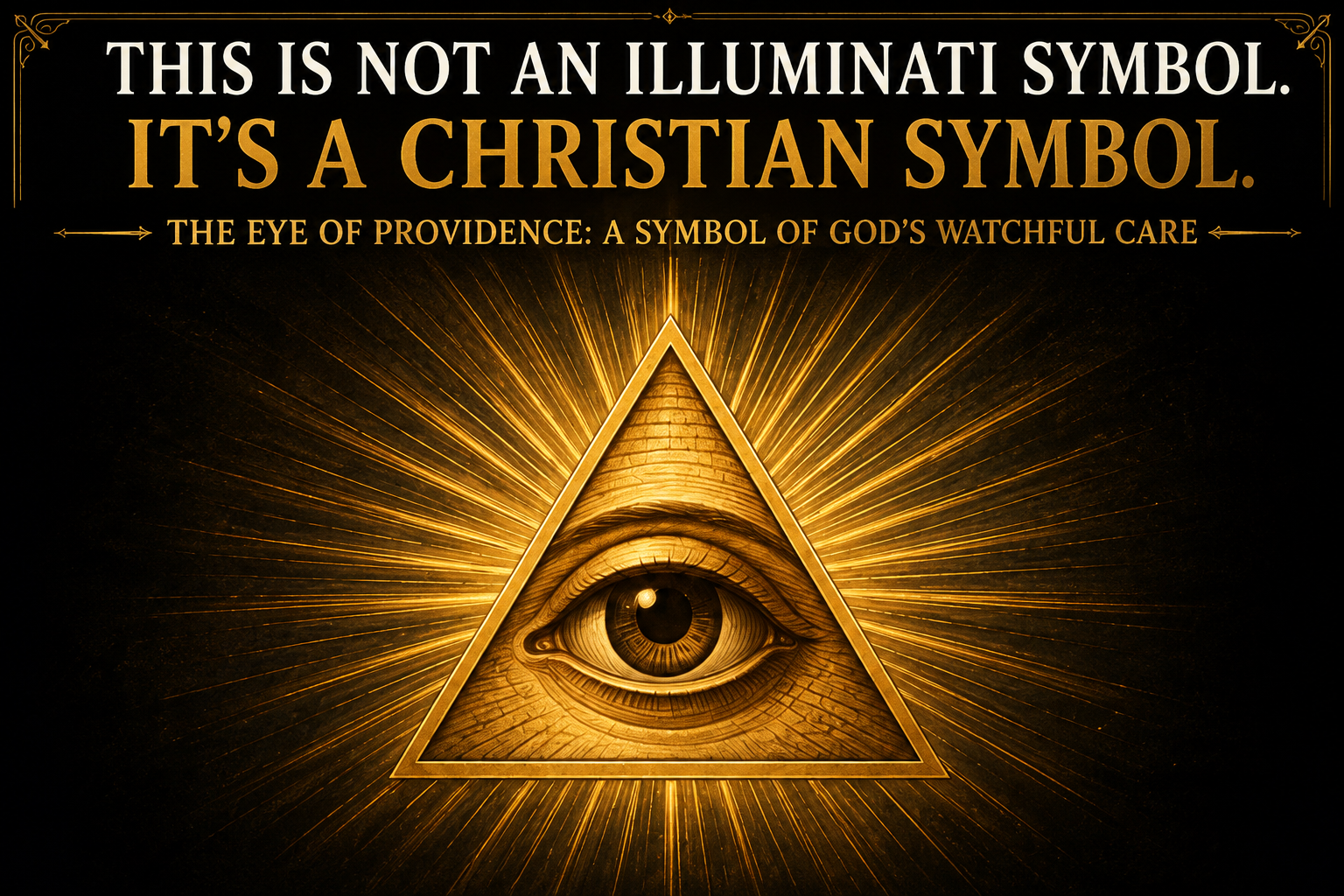
That mysterious eye above the altar has a much more Christian meaning than social media would have you believe.
Walk into an old Catholic church and look up.
You may see an eye enclosed within a triangle, surrounded by clouds or brilliant rays of light. It might appear above the high altar, inside a dome, over a doorway, or in the center of a painted ceiling.
For many modern visitors, the reaction is immediate:
“Why is there an Illuminati symbol in this church?”
The answer is simple:
There probably is not.
In Christian sacred art, this image is commonly called the Eye of Providence or the All-Seeing Eye of God. It represents God’s perfect knowledge, His watchful care, and His providential government of creation.
The symbol’s later appearance in political, Masonic, and popular imagery has caused considerable confusion. But when it appears in a historic Catholic church, its meaning should first be interpreted within the Christian artistic and theological setting in which it was placed.
What Does the Eye Represent?
The eye represents the truth that God sees and knows all things.
God does not possess a material body or bodily eyes. Sacred Scripture uses the language of sight analogically so that the human mind can understand something about His perfect knowledge.
As Proverbs declares:
“The eyes of the Lord in every place behold the good and the evil.”
—Proverbs 15:3, Douay-Rheims
Nothing in creation is hidden from Him:
“Neither is there any creature invisible in his sight: but all things are naked and open to his eyes, to whom our speech is.”
—Hebrews 4:13, Douay-Rheims
This is why the symbol is sometimes called the All-Seeing Eye. It reminds the faithful that God knows every action, every intention, every hidden sin, and every good deed that the world overlooks.
That truth should inspire reverence—but not despair.
The God who sees our sins also sees our suffering.
He sees the prayer whispered in private.
He sees the temptation resisted without recognition.
He sees the sacrifice made in silence.
He sees the tears that no other person notices.
The Psalmist therefore connects the eyes of God not merely with judgment, but also with mercy and hope:
“Behold the eyes of the Lord are on them that fear him: and on them that hope in his mercy.”
—Psalm 32:18, Douay-Rheims
The Eye of Providence does not portray a cold or distant observer.
It represents the God who knows us completely and still calls us to repentance, mercy, and communion with Him.
Why Is the Eye Inside a Triangle?
In Christian art, an equilateral triangle is commonly used as a symbol of the Most Holy Trinity.
The triangle has three distinct sides while remaining one figure. It can therefore serve as a limited visual reminder of the one divine nature possessed wholly and eternally by three distinct divine Persons: the Father, the Son, and the Holy Ghost.
The Father is God.
The Son is God.
The Holy Ghost is God.
Yet there are not three gods, but one God.
The triangle does not explain the mystery of the Trinity completely. No created image could ever contain or adequately represent the infinite mystery of God. It is simply an artistic sign intended to direct the mind toward the truth revealed by Christ.
When the eye appears inside the triangle, the combined image expresses the perfect knowledge and providential care of the one God who is Father, Son, and Holy Ghost.
The surrounding rays commonly signify divine light, holiness, glory, and the presence of God.
The image therefore contains several theological ideas at once:
The eye signifies divine knowledge.
The triangle signifies the Holy Trinity.
The rays signify divine glory and illumination.
Together, they form a visual proclamation of the omniscience and providence of the Triune God.
What Does “Providence” Mean?
Providence does not merely mean that God watches events from a distance.
God is not a passive observer standing outside His creation. He continually sustains all created things in existence and directs them toward the purpose for which He made them.
The Catechism of the Catholic Church explains:
“The witness of Scripture is unanimous that the solicitude of divine providence is concrete and immediate; God cares for all, from the least things to the great events of the world and its history.”
—Catechism of the Catholic Church, no. 303
The Eye of Providence is therefore more than a symbol of observation.
It represents God’s active, wise, and loving care for His creation.
God sees because God knows.
God governs because God is wise.
God provides because God loves.
This does not mean that everything human beings do is good or directly willed by God. Human beings can misuse their freedom, and evil remains truly evil. God is never the author of sin.
Nevertheless, no event escapes His knowledge, no creature exists outside His sustaining power, and no evil can finally defeat His providential plan.
God may permit evil without approving it, and He is powerful enough to bring a greater good even from what His creatures have wickedly chosen.
The Eye of Providence reminds the faithful that history is not abandoned to chaos.
Creation remains in the hands of God.
Is It Really a Christian Symbol?
The human eye has appeared in the art and religion of many cultures. Christians did not invent the eye as a visual image.
The more precise historical claim is that the eye presented within a triangle—and used to signify divine knowledge, providence, and the Trinity—became an established feature of European Christian iconography, particularly during the late Renaissance and the centuries that followed.
Christian artists used the symbol in churches, paintings, altarpieces, architectural decorations, engravings, and devotional objects.
Within that setting, the eye referred to God’s knowledge and providence, while the triangle directed the mind toward the Holy Trinity.
One frequently discussed example is Jacopo Pontormo’s Supper at Emmaus, painted in AD 1525. An Eye of Providence now appears above Christ and the disciples. The Uffizi Galleries explains that the eye was added in a later repainting to cover an earlier three-faced representation of the Trinity that had come to be considered unsuitable.
That detail is important.
It shows that the eye and triangle were already understood within an explicitly Trinitarian Christian setting. They were not inserted into the painting as a reference to an eighteenth-century secret society that did not yet exist.
By the seventeenth and eighteenth centuries, the Eye of Providence had become familiar in European Christian art.
It is therefore historically careless to look at every eye inside a triangle and automatically declare it “Illuminati.”
Symbols must be interpreted according to their date, location, artistic setting, and intended meaning.
What About the Illuminati and Freemasonry?
This is where historical distinctions matter.
The Bavarian Illuminati was founded by Adam Weishaupt in AD 1776. It did not invent the biblical image of the eyes of God. It did not invent the Christian use of the triangle as a Trinitarian symbol. It did not invent the Eye of Providence as an emblem of divine knowledge and care.
Christian use of the image existed before Weishaupt established his organization.
Freemasonry also adopted all-seeing-eye imagery within some of its symbolic systems. In Masonic settings, the eye has commonly been interpreted as representing the watchfulness of the Supreme Being or “Great Architect of the Universe.”
But the adoption of a symbol by a later organization does not prove that every earlier—or every Christian—use of that symbol belongs to the organization.
A symbol can be employed by different communities with different meanings.
Light, water, fire, lambs, doves, anchors, and even crosses have appeared in numerous cultural and religious settings. Their use outside Christianity does not erase their Christian meaning when they appear in Christian worship and sacred art.
The same principle applies to the Eye of Providence.
Nothing in this argument excuses or approves Freemasonry. The Catholic Church has judged Masonic principles irreconcilable with Catholic doctrine.
The point is much narrower:
The later use of an image by Freemasonry does not make every earlier Christian use of that image Masonic.
Was the Symbol “Hijacked” by the Illuminati?
In a limited cultural sense, one might say that the symbol was hijacked—but not in the simplistic way often presented online.
There is insufficient historical reason to claim that the Bavarian Illuminati invented the Eye of Providence, secretly placed it in Catholic churches, or possessed exclusive ownership of it.
What was eventually hijacked was not the original Christian symbol itself so much as its public reputation.
Later Masonic usage, political imagery, conspiracy literature, novels, films, music videos, advertising, and internet culture gradually attached the eye inside a triangle to ideas of secret power, surveillance, occultism, manipulation, and global control.
At the same time, popular culture began treating the word “Illuminati” as a general label for nearly every secret society, elite organization, mysterious symbol, or alleged hidden conspiracy.
The historical distinctions between the Bavarian Illuminati, Freemasonry, political symbolism, occult movements, and Christian sacred art were blurred together.
Eventually, many people came to assume:
Eye plus triangle equals Illuminati.
But that equation is historically false.
This is the sense in which the symbol’s meaning was culturally hijacked: its older Christian significance was overshadowed in the popular imagination by a newer and more sensational interpretation.
That later association does not erase the symbol’s Christian meaning.
Nor does it mean that every modern use of the eye is Christian. Context remains essential.
An Eye of Providence placed above a Catholic altar and surrounded by rays, clouds, angels, biblical scenes, or Trinitarian imagery should ordinarily be interpreted according to Christian theology and sacred art.
The same image used by a fraternal organization, political movement, filmmaker, musician, commercial brand, or modern artist may carry an entirely different intended meaning.
The later appropriation of a symbol does not retroactively corrupt its earlier use.
Christianity did not borrow the Eye of Providence from the Bavarian Illuminati.
Rather, later organizations and modern popular culture borrowed, reinterpreted, and eventually obscured an image that already possessed an established Christian meaning.
Should Catholics Be Afraid of It?
No.
Catholics should reject superstition—the habit of assigning false spiritual power or sinister meaning to created things without sufficient reason.
The Catechism teaches that superstition is a deviation of religious feeling and can affect even the worship offered to the true God when a person attributes magical importance to external signs or actions.
Seeing a geometric shape in a church and immediately assuming occult infiltration is not careful historical analysis.
It is often simply internet mythology.
This does not mean that every use of the eye symbol everywhere is harmless or Christian. A symbol’s meaning can change according to its context and the intention of the person using it.
But the presence of the Eye of Providence in Christian sacred art is not, by itself, evidence of infiltration, occultism, Illuminati control, or secret-society influence.
A Catholic should examine the actual historical and artistic context rather than reacting out of fear.
Who placed the image there?
When was it created?
What surrounds it?
Is it located above an altar, within a church dome, beside angels, or among Trinitarian imagery?
What did the artist and patrons intend it to communicate?
These questions lead toward historical understanding.
Fearful speculation does not.
The Real Message of the Symbol
The Eye of Providence offers a serious spiritual reminder:
God sees us.
He sees the evil we attempt to conceal.
He sees the good that no one rewards.
He sees the person who feels abandoned.
He sees the family struggling in silence.
He sees the sinner beginning to turn back toward Him.
He sees the innocent person falsely accused.
He sees every act of mercy performed without recognition.
His knowledge is perfect, and His providence extends over all creation.
The symbol should therefore lead us not into conspiracy theories, but into an examination of conscience.
Am I living as though God sees me?
Do I trust His providence when I cannot understand what He permits?
Do I remember that His justice will expose what is hidden?
Do I also remember that His mercy is offered to the repentant?
The eye inside the triangle is not automatically an Illuminati symbol.
Within Christian sacred art, it is a visual proclamation that the Triune God knows all things, sustains creation, governs with wisdom, judges with justice, and watches over those who place their hope in His mercy.
Later secret-society usage and modern conspiracy culture may have hijacked the symbol’s public reputation.
But they did not create its Christian meaning.
And they cannot erase it.
Sometimes an eye in a triangle is not a secret code.
Sometimes it is theology painted on a ceiling.
Sources
- Sacred Scripture, Douay-Rheims Bible: Psalm 32:18; Proverbs 15:3; Matthew 6:25–34; John 4:24; Hebrews 4:13.
- Catechism of the Catholic Church, nos. 232–267 on the Most Holy Trinity; nos. 302–314 on divine providence, especially no. 303; no. 2111 on superstition.
- St. Thomas Aquinas, Summa Theologiae, First Part, question 3, article 1, on God’s incorporeality; question 14 on God’s knowledge; question 22 on divine providence.
- Fourth Lateran Council, Firmiter credimus, AD 1215, on the unity of the divine nature and the distinction of the three divine Persons.
- First Vatican Council, Dogmatic Constitution Dei Filius, chapter 1, AD 1870, on God as the creator, ruler, and provident Lord of all things.
- George Ferguson, Signs and Symbols in Christian Art (Oxford University Press, AD 1954), entries concerning the eye, triangle, light, and Trinitarian symbolism.
- Albert M. Potts, The World’s Eye (University Press of Kentucky, AD 1982), on the history and cultural use of eye symbolism.
- Uffizi Galleries, official collection catalogue entry for Jacopo Pontormo’s Supper at Emmaus, AD 1525, explaining the later Trinitarian Eye of Providence painted over the original three-faced representation.
- René Le Forestier, Les Illuminés de Bavière et la franc-maçonnerie allemande (Paris, AD 1914), on the origins and development of the Bavarian Illuminati.
- Hermann Schüttler, Die Mitglieder des Illuminatenordens, 1776–1787/93 (Munich, AD 1991), a historical study of the membership and organization of the Bavarian Illuminati.
- Thomas Smith Webb, The Freemason’s Monitor; or, Illustrations of Masonry (Albany, AD 1797), an early source for the all-seeing eye within developed Masonic symbolism.
- Albert G. Mackey, An Encyclopedia of Freemasonry and Its Kindred Sciences, entry “All-Seeing Eye,” on the Masonic interpretation of the image.
- Michael Barkun, A Culture of Conspiracy: Apocalyptic Visions in Contemporary America, second edition (University of California Press, AD 2013), on the development and spread of modern conspiracy narratives.
- Congregation for the Doctrine of the Faith, Declaration on Masonic Associations, November 26, AD 1983, Acta Apostolicae Sedis 76 (AD 1984), p. 300.