

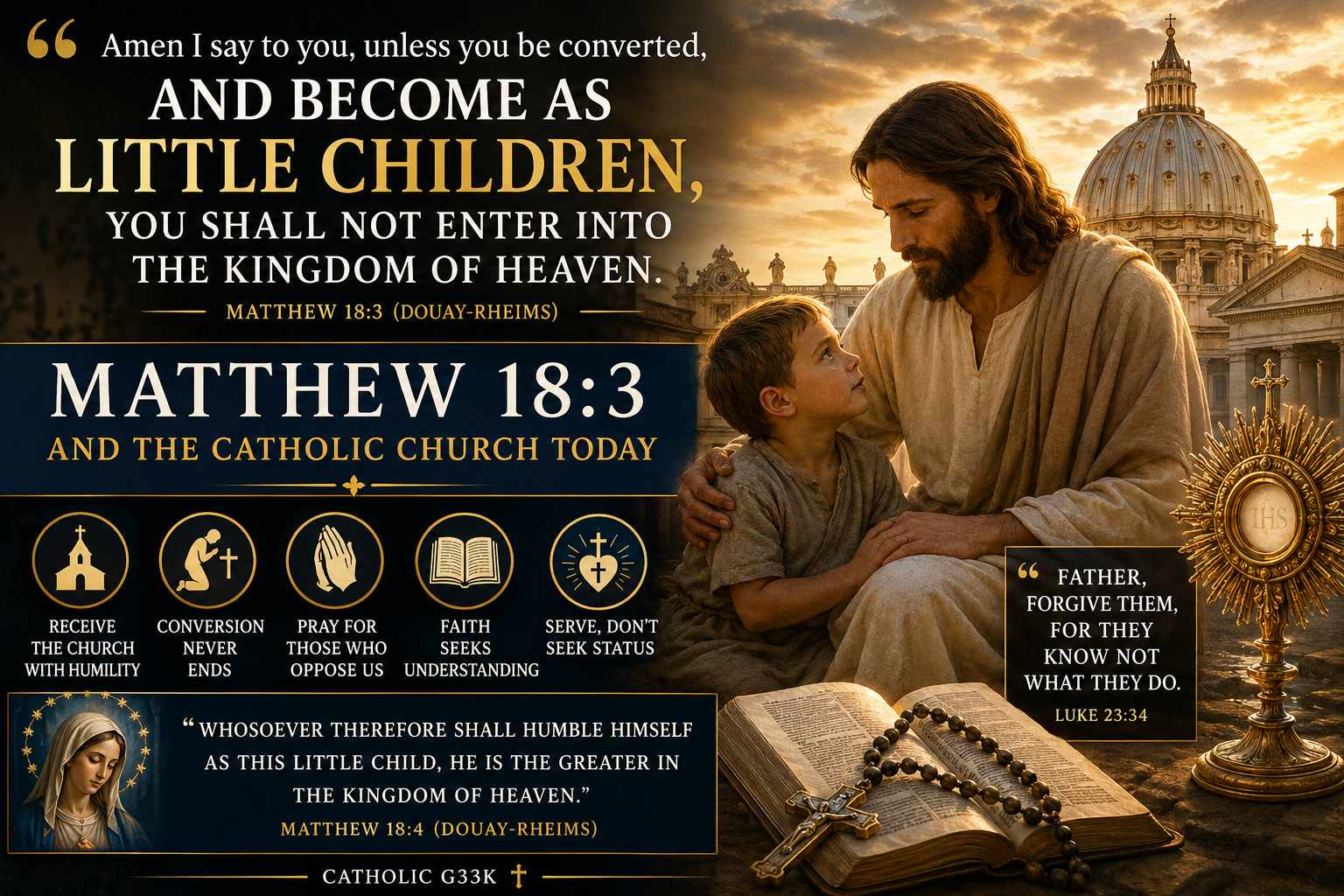
Matthew 18:3 and the Catholic Church Today
“Amen I say to you, unless you be converted, and become as little children, you shall not enter into the kingdom of heaven.”
—Matthew 18:3 (Douay-Rheims)
We live in an age that celebrates self-expression, personal autonomy, and the belief that truth is whatever we decide it to be. Modern culture often encourages us to trust ourselves above all else, to redefine morality according to our preferences, and to view every institution—including the Church—as something to be accepted only if it aligns with our opinions.
Yet Christ presents a radically different path.
He tells us that entry into the Kingdom of Heaven begins not with self-confidence, but with conversion and humility. We must become “as little children.”
At first glance, that may sound strange. Surely Jesus is not calling us to be naïve or intellectually immature. Rather, He is calling us to become childlike—humble, trusting, teachable, and dependent upon God.
Receiving from the Church Like Children from a Mother
One of the greatest challenges facing Catholics today is the temptation to treat the Church like a product instead of our spiritual mother.
Many ask, “What parts of Catholicism do I agree with?” rather than “What has Christ revealed through His Church?”
Catholics believe that Christ entrusted His authority to the Apostles and their successors (Matthew 16:18–19; Luke 10:16). Childlike humility means trusting Christ’s promise to guide His Church rather than attempting to recreate Christianity according to modern preferences.
This is not blind faith.
It is faith rooted in the confidence that Christ keeps His promises.
Conversion Never Ends
Jesus begins His teaching with a command:
“Unless you be converted…”
Conversion is not a one-time event.
It is the lifelong work of every disciple.
It is easy to identify the sins of society while overlooking the pride, anger, impatience, or indifference within our own hearts. Every Catholic, regardless of vocation or age, stands in continual need of God’s mercy.
The Church has always understood herself to be a place where sinners encounter grace.
As St. Augustine beautifully reminds us:
“It is pride that changed angels into devils; it is humility that makes men as angels.”
Holiness begins with repentance.
Responding to Hostility with the Heart of Christ
Catholics today frequently encounter misunderstanding and ridicule.
The Eucharist is dismissed.
Marian devotion is labeled idolatry.
Sacred processions are mocked.
Catholic morality is portrayed as outdated.
Even television and entertainment often treat Catholic beliefs as objects of humor in ways rarely applied to other religions.
These realities can tempt us toward anger.
Yet Christ gives another response.
He teaches us to pray for our persecutors (Matthew 5:44).
From the Cross He prayed:
“Father, forgive them, for they know not what they do.” (Luke 23:34)
Truth does not require hatred to defend it.
It requires courage, charity, and unwavering fidelity.
Childlike Faith Is Not Weak Faith
Some mistakenly assume that becoming like a child means abandoning reason.
Nothing could be further from the truth.
The Catholic Church has given the world philosophers, scientists, theologians, artists, and countless universities. Faith and reason work together because both originate in God.
As St. Anselm expressed so beautifully:
Faith seeks understanding.
Childlike faith is not anti-intellectual.
It is humble enough to recognize that God’s wisdom infinitely surpasses our own.
The Church Must Reflect Christ’s Humility
Jesus continues:
“Whosoever therefore shall humble himself as this little child, he is the greater in the kingdom of heaven.”
—Matthew 18:4 (Douay-Rheims)
This applies to every Catholic—from the Pope to the newest baptized Christian.
Leadership in the Church is never about status.
It is about service.
The saints became great precisely because they became small before God.
Living Matthew 18:3 Today
Living as spiritual children means:
- Receiving the Church’s teachings with humility instead of reshaping them to fit the culture.
- Returning frequently to the Sacrament of Confession.
- Praying for those who mock or oppose the Catholic faith.
- Living the Gospel with charity, courage, and joy.
- Trusting Christ’s promises even when the Church is criticized, misunderstood, or wounded by the sins of her members.
This is especially important when sacred places are vandalized or Catholic beliefs are ridiculed.
Our first response should be sorrow.
Our second should be truth.
Our third should be mercy.
A faithful Catholic grieves these offenses, defends the faith with reason and charity, and still echoes the prayer of Christ:
“Father, forgive them, for they know not what they do.”
That is not weakness.
That is supernatural strength.
Becoming Children of the Father
The Catechism summarizes Christ’s teaching beautifully:
“To become a child in relation to God is the condition for entering the kingdom.” (Catechism of the Catholic Church, 526)
The path to holiness has never changed.
It is not found in pride, self-sufficiency, or worldly approval.
It is found in humility, trust, repentance, and faithful obedience to Christ.
The world tells us to exalt ourselves.
Jesus tells us to become little children.
Only one of those paths leads to Heaven.