

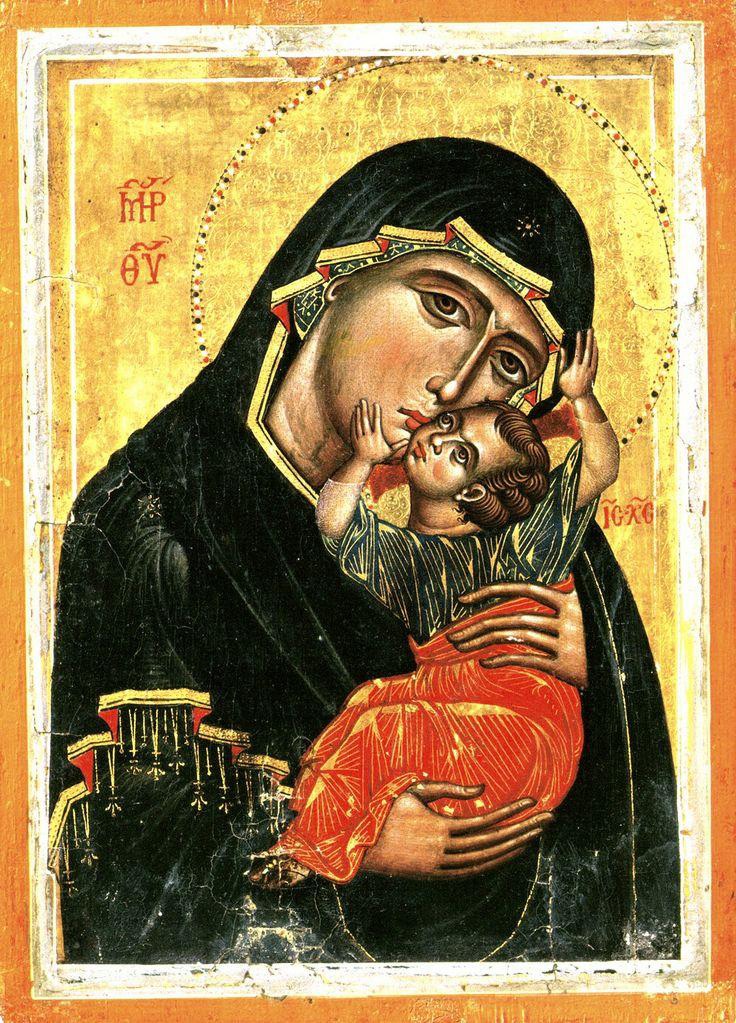
Long before Gothic cathedrals, medieval rosaries, Renaissance Madonnas, or the great Marian shrines of Europe, Christians were already turning to the Blessed Virgin Mary in prayer.
One of the clearest witnesses to this ancient devotion is a short Greek prayer commonly known by its Latin title, Sub Tuum Praesidium—“Under Thy Protection.” Preserved on a damaged Egyptian papyrus, the prayer offers a remarkable glimpse into the faith of Christians living during the centuries of persecution.
Its words are simple. Its theology is profound. Its existence challenges the popular claim that Marian devotion appeared only after Christianity became politically powerful or culturally established.
The prayer shows a suffering Christian community taking refuge beneath the compassion of the Mother of God and asking her help amid danger.
A Fragile Papyrus and an Enduring Faith
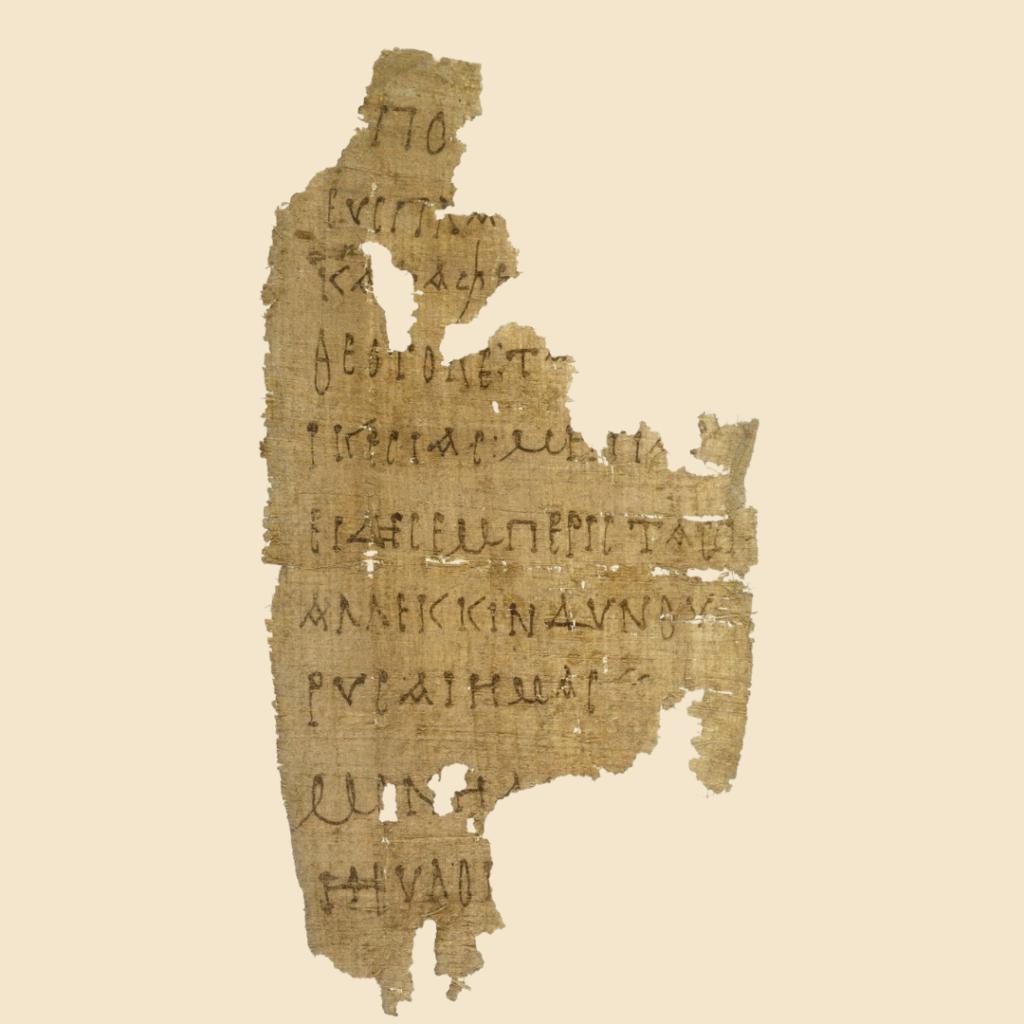
The surviving text is preserved on a small fragment catalogued as Greek Papyrus 470 in the John Rylands Library at the University of Manchester. The library acquired it in 1917, and C. H. Roberts later published it in the third volume of the Catalogue of the Greek and Latin Papyri in the John Rylands Library. (Digital Collections)
The manuscript contains a Greek prayer addressed directly to Mary. Although the papyrus is damaged, enough survives to identify the prayer clearly as an early form of the Sub Tuum Praesidium.
The papyrus has often been assigned to approximately the middle of the third century, around A.D. 250. Modern papyrologists, however, caution that manuscripts dated principally through handwriting analysis cannot always be placed within a narrow range. Some scholars have proposed a somewhat later date, possibly in the fourth century.
This uncertainty should be acknowledged honestly. The strength of the evidence does not depend upon forcing the papyrus into a single exact year. Whether the surviving copy belongs to the third century or the early fourth, it remains an exceptionally early witness to explicit Christian prayer seeking the intercession of Mary.
The manuscript’s date is not necessarily the date when the prayer was first composed. Liturgical prayers frequently circulated orally before being copied onto surviving material. The text may therefore preserve a tradition older than the particular piece of papyrus upon which it was written.
The Prayer of Christians in Danger
The earliest Greek form may be rendered approximately as follows:
Beneath your compassion we take refuge, O Mother of God.
Do not overlook our petitions in adversity,
but deliver us from dangers,
O only pure and only blessed one.
The familiar Latin form developed with slight differences of wording:
We fly to thy protection,
O Holy Mother of God.
Despise not our petitions in our necessities,
but deliver us always from all dangers,
O glorious and blessed Virgin. Amen.
The prayer does not sound like an abstract theological exercise. It sounds like the cry of people facing real distress.
Its vocabulary speaks of necessity, danger, adversity, refuge, compassion, petition, and deliverance. These Christians were not merely discussing Mary. They were entrusting themselves to her maternal care.
This was the age of periodic persecution, political instability, disease, poverty, and social vulnerability. Christians knew that discipleship could involve confiscation, imprisonment, exile, or death. Their invocation of Mary arose not from sentimental excess but from an intensely biblical sense of the communion of God’s people.
They believed that death did not sever the bonds of charity within the Body of Christ.
“We Take Refuge”
The opening image is especially striking: Christians place themselves beneath Mary’s compassion or protection.
This language does not make Mary a rival to God. Scripture itself frequently uses the image of refuge to describe trust in divine protection. The Psalmist prays:
“Under the shadow of thy wings protect me.”
—Psalm 16:8, Douay-Rheims
Mary’s protection is entirely dependent upon God. She possesses no independent divine power. Whatever she does for the faithful comes through grace, prayer, and her unique relationship with her Son.
Catholic devotion does not place Mary beside Christ as another redeemer. It recognizes her as the Mother who intercedes because she belongs completely to Christ.
This pattern already appears at Cana. The wedding feast runs out of wine, and Mary brings the need to Jesus:
“They have no wine.”
—John 2:3, Douay-Rheims
She does not perform the miracle. She does not command divine power. She presents the need to her Son and directs the servants toward obedience:
“Whatsoever he shall say to you, do ye.”
—John 2:5, Douay-Rheims
That is the essential movement of authentic Marian devotion: Mary notices human need, brings it to Christ, and leads souls to obey Him.
The Astonishing Title: Theotokos
The most theologically important word in the ancient prayer is Theotokos.
The Greek term means “God-bearer” or, more naturally in Christian usage, “Mother of God.” The prayer addresses Mary not merely as the mother of Jesus, the mother of the Messiah, or the mother of Christ, but explicitly as the Mother of God.
This title is fundamentally about Jesus.
Mary is called the Mother of God because the Child she conceived, bore, and brought forth is a divine Person. Jesus Christ is not a human person later joined to the Son of God. He is the eternal Son of the Father who truly assumed a human nature.
Mary did not create His divinity. She is not the origin of the Godhead. She did not exist before God. Rather, the Person born from her is God the Son incarnate.
The Catechism explains:
“The One whom she conceived as man by the Holy Spirit, who truly became her Son according to the flesh, was none other than the Father’s eternal Son, the second person of the Holy Trinity. Hence the Church confesses that Mary is truly ‘Mother of God’ (Theotokos).”
—Catechism of the Catholic Church, no. 495. (Vatican)
Mothers give birth to persons, not merely to abstract natures. Mary gave birth to Jesus Christ, and Jesus Christ is God. Therefore, Mary is rightly called the Mother of God.
The title protects the unity of Christ’s Person.
Before the Council of Ephesus
The Third Ecumenical Council met at Ephesus in A.D. 431 during the controversy surrounding Nestorius, the patriarch of Constantinople.
Nestorius objected to the title Theotokos, preferring language that could suggest a separation between Christ’s humanity and divinity. St. Cyril of Alexandria recognized the danger. If Mary could not be called the Mother of God, then the unity of Christ’s Person was being compromised.
The Council affirmed that the eternal Word truly became man and that the one born of Mary was the divine Son Himself. Mary could therefore be confessed as Theotokos. (Papal Encyclicals Online)
The Council did not invent the title.
The Sub Tuum Praesidium demonstrates that Christians were already praying with this language before Ephesus formally defended it. The Council gave authoritative definition to a truth already embedded in the Church’s worship and confession.
This reflects an ancient theological principle: the Church’s prayer reveals the Church’s faith.
What Christians worshipfully confessed, the bishops later defended doctrinally.
Worship, Doctrine, and the Memory of the Church
The ancient prayer is valuable because it preserves lived Christianity rather than merely academic theology.
Councils, creeds, and theological treatises are indispensable, but ordinary Christians often express their faith most directly in prayer. A prayer used by a Christian community reveals whom that community worshipped, what it feared, what it hoped for, and how it understood salvation.
The Sub Tuum Praesidium reveals several convictions.
First, the Christians who used it believed that Mary remained alive in Christ.
Second, they believed that she could receive their petitions.
Third, they believed that her intercession was powerful.
Fourth, they regarded her as uniquely pure and blessed.
Fifth, they confessed her as the Mother of God.
These convictions appear together in a short prayer whose center is still Christ. Mary’s identity, holiness, and intercession all arise from her relationship with Him.
Is This “Praying to Mary”?
Modern English sometimes uses “prayer” as though it meant worship exclusively. Historically, however, the verb “to pray” could also mean to ask or petition.
Catholics worship God alone. The technical theological term for the adoration owed to God is latria. The honor shown to the saints is categorically different because the saints are creatures redeemed by Christ.
When Catholics pray to Mary, they are not treating her as a goddess. They ask her to pray with them and for them.
The biblical foundation is the communion of saints. St. Paul teaches that Christians are members of one Body:
“And if one member suffer any thing, all the members suffer with it; or if one member glory, all the members rejoice with it.”
—1 Corinthians 12:26, Douay-Rheims
The Body of Christ is not destroyed by physical death. Christ says that God “is not the God of the dead, but of the living” (Luke 20:38). Those who die in His friendship remain alive in Him.
The Apocalypse depicts the saints in heaven presenting prayers before God under the imagery of golden vials filled with incense:
“Golden vials full of odours, which are the prayers of saints.”
—Apocalypse 5:8, Douay-Rheims
Catholic invocation of the saints rests upon Christ’s victory over death, not upon any attempt to bypass Him.
Does Asking Mary for Deliverance Go Too Far?
Some readers may be troubled by the prayer’s request that Mary “deliver” or “rescue” Christians from danger.
The difficulty disappears once biblical language is considered carefully.
Scripture often attributes an action both to God as its ultimate source and to human servants as secondary instruments. St. Paul tells St. Timothy:
“For in doing this thou shalt both save thyself and them that hear thee.”
—1 Timothy 4:16, Douay-Rheims
Paul does not mean that Timothy replaces Christ as Savior. He means that Timothy participates instrumentally in God’s saving work through faithful teaching and perseverance.
St. Jude similarly urges Christians:
“And some indeed reprove, being judged: but others save, pulling them out of the fire.”
—Jude 22–23, Douay-Rheims
Only God saves by His own power. Creatures may nevertheless be said to save, help, rescue, heal, or deliver when God works through them.
When Christians ask Mary to deliver them from danger, they are asking for her intercession before the one Savior, Jesus Christ.
Her help is maternal, participatory, and wholly subordinate to grace.
Mary’s Purity and Blessedness
The prayer also calls Mary uniquely pure and uniquely blessed.
This language echoes the Gospel.
The Archangel Gabriel greets her:
“Hail, full of grace, the Lord is with thee: blessed art thou among women.”
—Luke 1:28, Douay-Rheims
St. Elizabeth, filled with the Holy Ghost, proclaims:
“Blessed art thou among women, and blessed is the fruit of thy womb.”
—Luke 1:42, Douay-Rheims
Mary herself foretells:
“For behold from henceforth all generations shall call me blessed.”
—Luke 1:48, Douay-Rheims
The ancient Christians who called her pure and blessed were not departing from Scripture. They were continuing its language.
Mary’s blessedness never terminates in herself. She immediately declares:
“My soul doth magnify the Lord.”
—Luke 1:46, Douay-Rheims
A magnifying glass does not create light; it makes light more visible. Mary magnifies the Lord because everything in her points beyond herself toward Him.
Not a Medieval Invention
The historical importance of the Sub Tuum Praesidium lies partly in what it rules out.
It does not prove that every later Marian devotion existed in fully developed form during the third century. It does not by itself settle every theological dispute concerning Mary. Historical evidence must not be made to carry more weight than it can bear.
It does, however, make one claim extremely difficult to sustain: that Christians had no meaningful devotion to Mary until the Middle Ages.
Here we possess an ancient Greek prayer from Egypt in which Christians address Mary, invoke her compassion, seek her intercession, call her pure and blessed, and confess her as the Mother of God.
This is not twelfth-century France or thirteenth-century Italy. It is Christianity in late antiquity, close to the age of the martyrs.
Marian devotion did not suddenly emerge from medieval imagination. Its roots penetrate deeply into the worship, theology, and spiritual instincts of the early Church.
A Prayer Shared Across Ancient Christianity
The Sub Tuum Praesidium did not remain confined to one place or language.
Versions of it entered Greek, Coptic, Byzantine, Roman, Ambrosian, and other Christian liturgical traditions. It continues to be prayed by Catholics, Eastern Orthodox Christians, Oriental Orthodox Christians, and members of several Eastern Christian communities.
Its widespread reception is significant. The prayer belongs to the common inheritance of ancient Christianity, predating many of the divisions that later separated East and West.
It is therefore not merely a Catholic apologetic artifact. It is a surviving voice from the prayer life of the undivided ancient Church.
The Mother Beneath the Cross
The deepest biblical context for Mary’s spiritual motherhood is found at Calvary.
As Jesus hangs upon the Cross, He says to Mary:
“Woman, behold thy son.”
—John 19:26, Douay-Rheims
Then He says to the beloved disciple:
“Behold thy mother.”
—John 19:27, Douay-Rheims
The immediate event concerns Mary and St. John, but the Church has long perceived a wider spiritual meaning. The beloved disciple represents every disciple whom Jesus loves. From the Cross, Christ gives His Mother to His disciples and His disciples to His Mother.
The ancient Christians who sought refuge beneath Mary’s compassion were living from this mystery.
They did not see themselves as spiritual orphans. Christ had given them a mother.
Why the Prayer Still Matters
The Sub Tuum Praesidium is not merely a museum piece. It remains a prayer for Christians who experience fear, instability, temptation, persecution, illness, or uncertainty.
Its brevity is part of its beauty. It does not attempt to explain suffering. It simply seeks refuge.
Modern Christians often imagine that strength means self-sufficiency. The ancient prayer teaches the opposite. Christian strength begins with humility—the willingness to admit danger, acknowledge need, and ask for help.
We flee first to God, from whom every grace proceeds. Yet we also take our place within the family God has created. We ask fellow Christians on earth to pray for us, and we ask the saints in heaven to do the same.
Among those saints, Mary holds a singular place because she is the Mother of the Redeemer, the first and most perfect disciple, the woman who stood faithfully beside the Cross, and the mother given to the beloved disciple.
An Ancient Voice for the Present Church
A scrap of Egyptian papyrus has survived when palaces, armies, and empires have disappeared.
Its endurance seems fitting.
The Christians who first prayed these words may have been poor, frightened, and politically powerless. Their names have vanished from history. Yet their prayer remains on the lips of the Church.
They knew Jesus Christ as true God and true man. They knew Mary as His Mother. They believed that heaven was not distant and that charity endured beyond the grave.
In their hour of danger, they placed themselves beneath a mother’s compassion.
Christians still do.
The Ancient Prayer
We fly to thy protection,
O Holy Mother of God.
Despise not our petitions in our necessities,
but deliver us always from all dangers,
O glorious and blessed Virgin. Amen.
Sources for Further Study
C. H. Roberts, Catalogue of the Greek and Latin Papyri in the John Rylands Library Manchester, Vol. III: Theological and Literary Texts, Manchester University Press, 1938.
St. Cyril of Alexandria, Second Letter to Nestorius and Third Letter to Nestorius.
Council of Ephesus, A.D. 431.
Catechism of the Catholic Church, nos. 466, 495, 963–975.
Second Vatican Council, Lumen Gentium, Chapter VIII.
St. John Damascene, On the Orthodox Faith, Book III.
Holy Scripture, Douay-Rheims Bible: Psalm 16; Luke 1; Luke 20; John 2; John 19; 1 Corinthians 12; 1 Timothy 4; Jude; Apocalypse 5.