

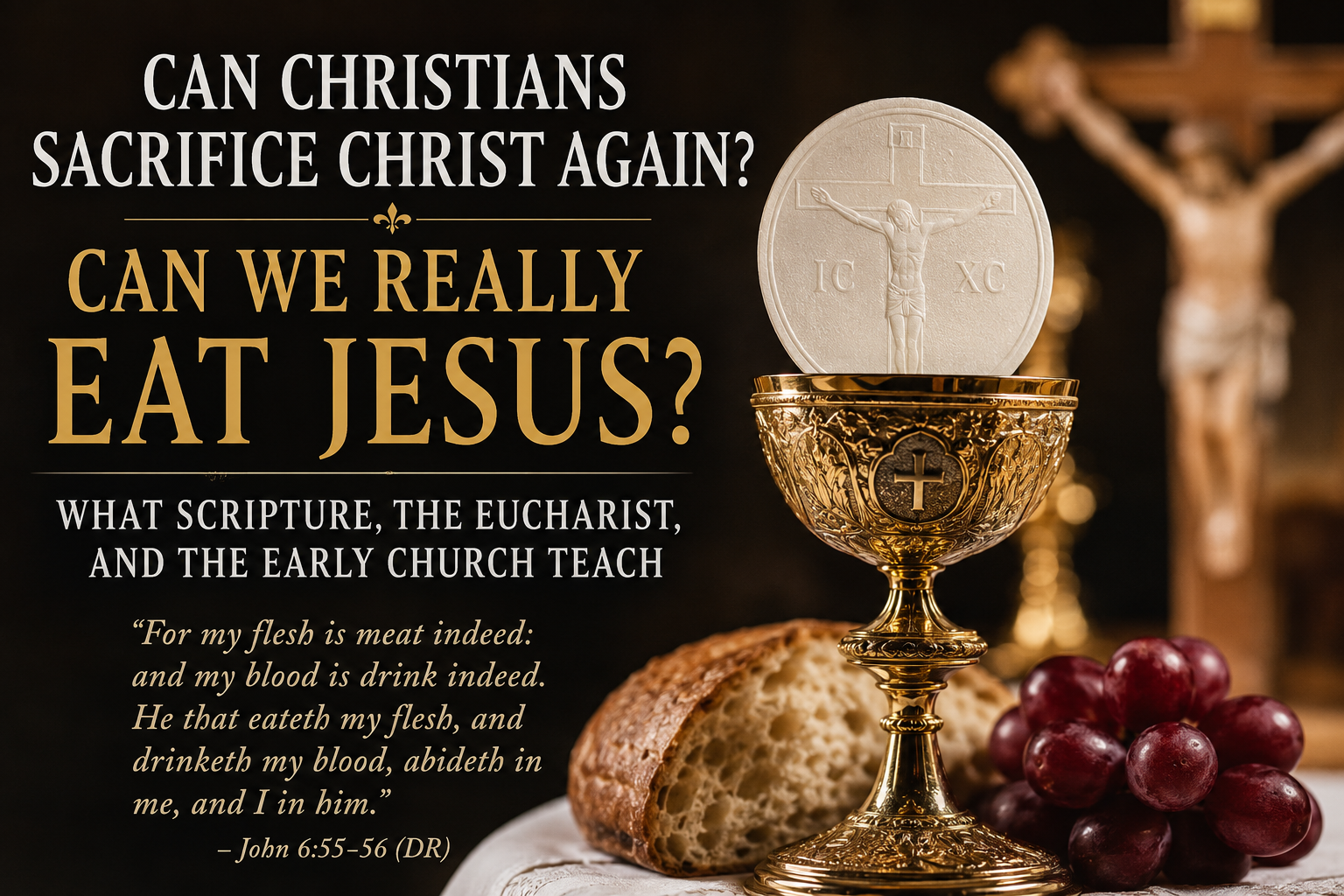
One of the most common objections to the Catholic faith is: “You can’t sacrifice Christ again. You can’t eat Jesus.” Both claims misunderstand what Scripture teaches about the Eucharist.
Christ Is Not Sacrificed Again
Catholics do not believe Christ is sacrificed repeatedly.
Scripture is clear that Christ’s sacrifice on Calvary was offered once for all:
“By the which will, we are sanctified by the oblation of the body of Jesus Christ once.”
— Hebrews 10:10 (Douay-Rheims)
The Holy Sacrifice of the Mass is not a new sacrifice. Rather, it is the same one sacrifice of Calvary made sacramentally present, just as Christ commanded at the Last Supper:
“Do this for a commemoration of me.”
— Luke 22:19
St. Paul repeats this institution of the Eucharist in 1 Corinthians 11:23–26, showing that the Church continued to celebrate what Christ commanded.
Yes, Christians Do Eat Jesus
Jesus could not have spoken more clearly:
“For my flesh is meat indeed: and my blood is drink indeed. He that eateth my flesh, and drinketh my blood, abideth in me, and I in him.”
— John 6:55–56 (Douay-Rheims)
When Jesus said these words, many of His disciples were shocked. They asked:
“How can this man give us his flesh to eat?”
— John 6:52
Rather than correcting their supposed misunderstanding, Jesus intensified His teaching.
The Greek Makes Jesus’ Teaching Even Stronger
The Greek text of John 6 reveals something remarkable. Jesus changes the verb He uses for “eat.”
John 6:50–53 — φάγω (phagō) / ἐσθίω (esthiō)
These are the ordinary Greek verbs meaning “to eat.”
John 6:51
“If any man eat (phagē) of this bread, he shall live forever.”
John 6:53
“Unless you eat (phagēte) the flesh of the Son of man, and drink his blood, you shall not have life in you.”
At this point, Jesus is already speaking literally enough that many object:
“How can this man give us his flesh to eat?”
— John 6:52
If they had misunderstood Him, this would have been the perfect opportunity to explain that He meant His words symbolically.
He does not.
Instead, He becomes even more explicit.
John 6:54–58 — τρώγω (trōgō)
Beginning in verse 54, Jesus switches to the Greek verb τρώγω (trōgō), a much more vivid word.
It literally means:
- to gnaw
- to chew
- to munch
- to crunch
Jesus repeats this stronger verb four times:
John 6:54
“He who eats (trōgōn) my flesh and drinks my blood has eternal life.”
John 6:56
“He who eats (trōgōn) my flesh…”
John 6:57
“He who eats (trōgōn) me…”
John 6:58
“He who eats (trōgōn) this bread shall live forever.”
Rather than softening His teaching, Jesus deliberately intensifies it.
Why This Matters
If Jesus intended His words to be merely symbolic, His response makes little sense.
Instead, He:
- changes to a more graphic verb (trōgō),
- repeats the teaching four more times,
- allows many disciples to leave rather than retract or explain away His words (John 6:60–66).
When many disciples departed, Jesus did not chase after them saying they had misunderstood.
Instead, He turned to the Twelve.
Peter did not respond by saying, “Lord, we know You were only speaking symbolically.”
Instead, he confessed:
“Lord, to whom shall we go? Thou hast the words of eternal life.”
— John 6:68
The Eucharist Is Not Cannibalism
Catholics do not believe we consume Christ in a crude, physical manner.
In the Eucharist, Christ is truly present—Body, Blood, Soul, and Divinity—but He is received sacramentally under the appearances of bread and wine, while remaining glorified and living in heaven.
This mystery is what the Church has always taught, and it is rooted in Christ’s own words at the Last Supper:
“This is my body… This is my blood.”
— Matthew 26:26–28
St. Paul likewise warns that receiving the Eucharist unworthily is a sin against the Body and Blood of the Lord (1 Corinthians 10:16; 11:27–29), language that would make little sense if the Eucharist were only symbolic.
The Catechism of the Catholic Church affirms this constant teaching in §§1322–1419.
The Early Church Believed the Same
The earliest Christians understood Jesus’ words literally—not symbolically.
St. Ignatius of Antioch (AD 107) wrote:
“The Eucharist is the flesh of our Savior Jesus Christ.”
— Letter to the Smyrnaeans, 7
St. Justin Martyr (c. AD 155) likewise taught:
“We do not receive these as common bread or common drink… but as Jesus Christ made flesh.”
— First Apology, 66
These witnesses lived generations before later theological controversies and demonstrate that belief in the Real Presence was not a medieval invention but the faith of the apostolic Church.
Conclusion
The biblical evidence is compelling.
Christ’s sacrifice was offered once for all, and the Mass does not repeat it—it makes that one eternal sacrifice sacramentally present.
Likewise, Jesus did not retreat from His teaching that believers must eat His flesh and drink His blood. Instead, the Greek text shows that He strengthened His language, changing from the ordinary verb for “eat” to the more graphic τρώγω (trōgō), while allowing those who rejected His teaching to walk away.
From Scripture to the earliest Church Fathers, the witness is remarkably consistent: the Eucharist is truly the Body and Blood of Christ, given to us by the Lord Himself for the life of the world.
Sources
Sacred Scripture
All Scripture quotations are taken from the Douay-Rheims Bible.
- Matthew 26:26–28
- Luke 22:19–20
- John 6:50–69
- 1 Corinthians 10:16–17
- 1 Corinthians 11:23–29
- Hebrews 7:24–27
- Hebrews 9:24–28
- Hebrews 10:10–14
Greek New Testament
- Novum Testamentum Graece, 28th Revised Edition. Edited by Barbara Aland, Kurt Aland, Johannes Karavidopoulos, Carlo M. Martini, and Bruce M. Metzger. Stuttgart: Deutsche Bibelgesellschaft, 2012.
- John 6:51–53 uses forms related to φαγεῖν, from ἐσθίω, the ordinary verb “to eat.”
- John 6:54, 56–58 uses forms of τρώγω, a verb meaning “to eat,” which can carry the more vivid sense of chewing or feeding.
Catechism and Church Teaching
- Catechism of the Catholic Church, §§1322–1419, especially §§1362–1372, 1374–1377, and 1382.
- Council of Trent, Session XIII, Decree Concerning the Most Holy Sacrament of the Eucharist, chapters 1–4.
- Council of Trent, Session XXII, Doctrine Concerning the Sacrifice of the Mass, chapters 1–2.
- Second Vatican Council, Sacrosanctum Concilium, §§47–48.
- Pope St. Paul VI, Mysterium Fidei, September 3, 1965.
- Pope St. John Paul II, Ecclesia de Eucharistia, April 17, 2003.
Early Christian Witness
- St. Ignatius of Antioch, Letter to the Smyrnaeans, chapters 6–7, c. AD 107.
- St. Justin Martyr, First Apology, chapters 65–67, c. AD 155.
- St. Irenaeus of Lyons, Against Heresies, Book IV, chapter 18, and Book V, chapter 2, c. AD 180.
- St. Cyril of Jerusalem, Mystagogical Catecheses, Catechesis IV, c. AD 350.
- St. Ambrose of Milan, On the Mysteries, chapters 8–9, c. AD 390.
Recommended Lexicons
- Frederick William Danker, Walter Bauer, William F. Arndt, and F. Wilbur Gingrich, A Greek-English Lexicon of the New Testament and Other Early Christian Literature, 3rd ed. Chicago: University of Chicago Press, 2000.
- Henry George Liddell and Robert Scott, A Greek-English Lexicon. Revised by Henry Stuart Jones. Oxford: Clarendon Press.
- Johannes P. Louw and Eugene A. Nida, Greek-English Lexicon of the New Testament Based on Semantic Domains, 2nd ed. New York: United Bible Societies, 1989.