

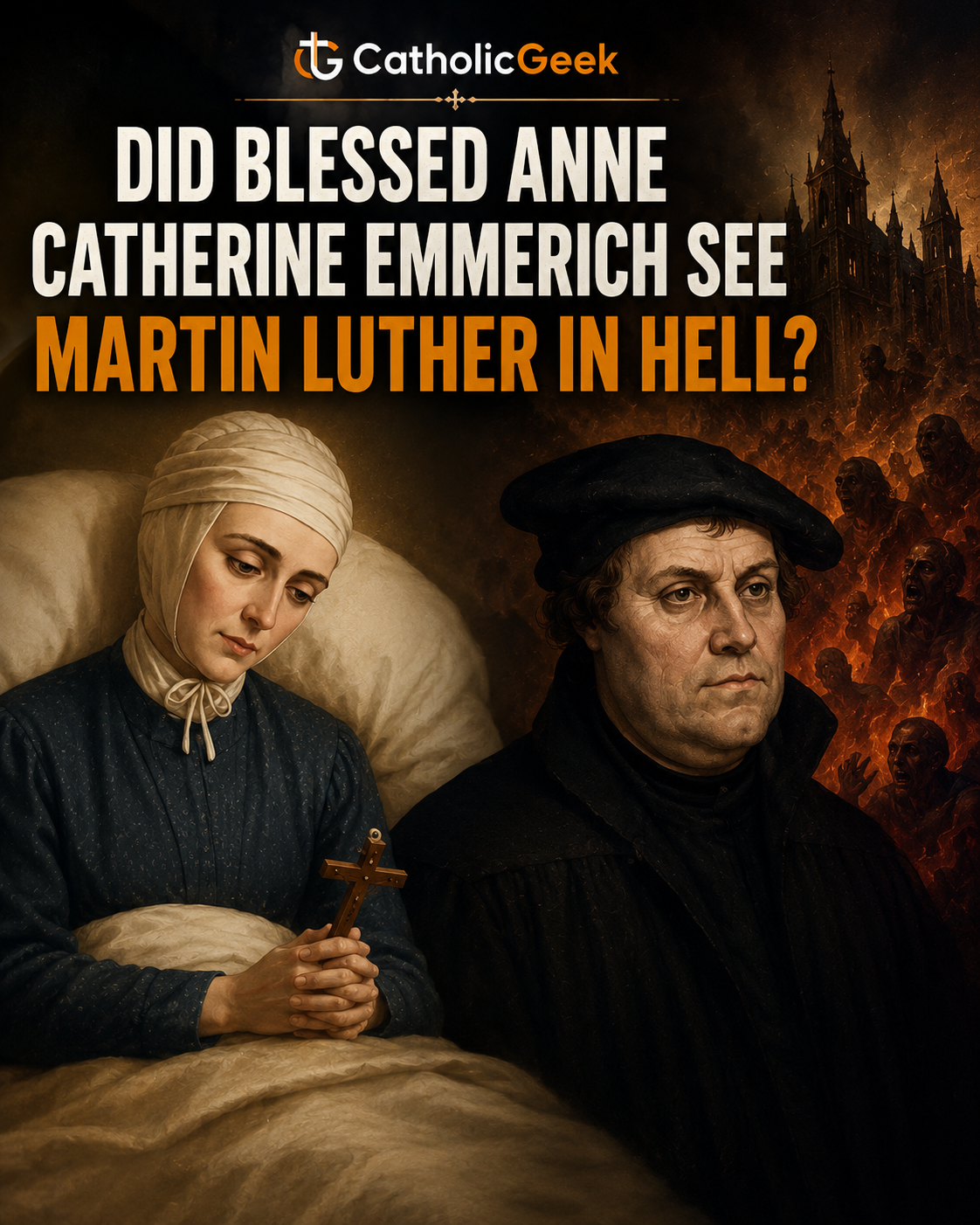
According to some published accounts of the mystical visions attributed to Blessed Anne Catherine Emmerich (1774–1824), she was shown the spiritual consequences of division within Christ’s Church.
In these accounts, Emmerich reportedly saw Martin Luther among the condemned and was shown that his rejection of the unity and authority of the Catholic Church had grave spiritual consequences. The visions also describe the confusion, division, and spread of error that followed the Protestant Reformation, serving as a warning about the dangers of separating oneself from the Church founded by Jesus Christ.
However, these accounts should be understood with appropriate caution. Much of Emmerich’s visions were recorded and edited by the poet Clemens Brentano, and scholars have long debated how closely the published texts reflect her exact words. While the Church has approved Emmerich’s heroic virtue by declaring her Blessed, it has not authenticated every detail contained in the published visions.
Most importantly, this is not Catholic doctrine.
The Catholic Church has never declared that Martin Luther is in hell, nor does it teach that any particular individual—apart from the saints in heaven—has been definitively judged. The eternal destiny of every soul belongs to God alone:
“For we shall all stand before the judgment seat of Christ… every one of us shall render account to God for himself.”
— Romans 14:10–12 (Douay-Rheims)
Catholics are never required to believe private revelations, even those attributed to saints or blesseds. As the Catechism of the Catholic Church teaches (§§66–67), public Revelation ended with the death of the last Apostle, and private revelations do not belong to the deposit of faith. Their role is not to improve or complete Christ’s definitive Revelation, but to help the faithful live it more fully in a particular time and place.
Whether one finds these reported visions compelling or not, they should never be used to pronounce judgment on the eternal fate of any individual. Instead, they remind us of the seriousness of remaining faithful to Christ, preserving the unity of His Church, and entrusting the judgment of every soul to God’s perfect justice and mercy.
Sources: Romans 14:10–12; Catechism of the Catholic Church §§66–67.