

POPE #4
Pope St. Clement I
The Fourth Pope and an Apostolic Father
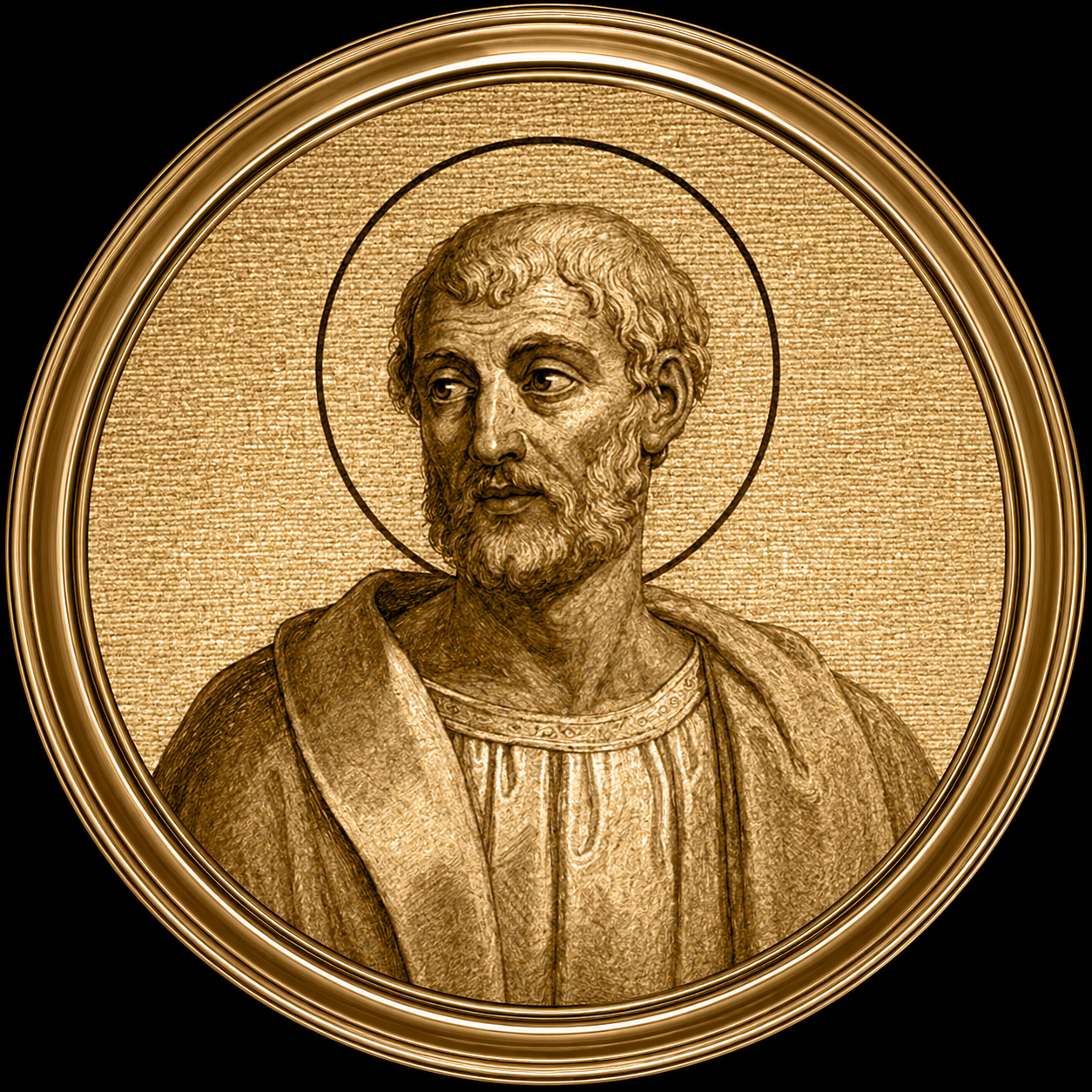
The Earliest Pope Whose Writing Survives
St. Clement I is the first Bishop of Rome whose own surviving work can be read today. His letter to the Corinthians reveals a Church already conscious of apostolic order, lawful ministry, repentance, unity, and the responsibility of the Roman Church toward Christians beyond Rome.
The strongest historical portrait comes from First Clement itself. Later stories about exile, an anchor, and martyrdom are venerable, but they do not possess the same evidentiary weight.
“The Apostles received the Gospel for us from the Lord Jesus Christ; Jesus Christ was sent forth from God.”
Explore This Pope
Quick Facts
Overview
Clement governed the Roman Church near the close of the first century. The official Vatican list places his pontificate from AD 92 to 99. St. Irenaeus says that Clement had seen the blessed Apostles and still had their preaching ringing in his ears.
His importance is not merely that later writers placed him in a list. First Clement is a substantial pastoral intervention from the Church of Rome to the Church of Corinth. It is one of the earliest Christian writings outside the New Testament and a primary source for doctrine, worship, moral formation, ministry, and ecclesial unity.
The letter does not use every later technical term of Catholic theology. It does, however, show the principles from which later articulation grows: Christ sends the Apostles; the Apostles appoint ministers; provision is made for approved successors; unjust rebellion against lawful presbyters is condemned; and the whole Church is called back to peace and order.
Clement and the Apostolic Generation
Ancient tradition associates Clement closely with Peter and Paul. Irenaeus says he knew the Apostles. Origen and later writers identified him with the Clement mentioned in Philippians 4:3, but the New Testament verse alone does not establish that identity.
Some later traditions describe Clement as a noble Roman, a freedman, a convert from Judaism, or a member of the imperial household. These reconstructions cannot all be verified. His surviving letter reveals more than legendary genealogy: a leader steeped in Israel’s Scriptures, apostolic preaching, liturgical prayer, and the moral demands of Christian communion.
The Crisis in Corinth
A serious division had arisen in Corinth. A group had removed presbyters who had served honorably. The Roman Church learned of the disorder and sent a lengthy appeal for repentance and restoration.
Clement does not treat the conflict as a minor personality dispute. Envy, pride, faction, and rebellion wound the Body of Christ. He draws upon Cain and Abel, Joseph, Moses, David, the humility of Christ, the order of creation, military discipline, the human body, and the liturgical order of Israel to show that Christian peace is neither passivity nor disorder.
The letter asks the guilty to submit for the good of the community and commands that the deposed presbyters be restored. Its tone combines authority with patient exhortation and prayer.
Apostolic Succession in First Clement
First Clement 42-44 is one of the foundational extra-biblical witnesses to apostolic succession. God sends Christ; Christ sends the Apostles; the Apostles preach and appoint bishops and deacons; foreseeing disputes, they provide that approved men should succeed in ministry.
The argument is public, historical, and ecclesial. Christian ministry is not self-appointed. Congregational passion cannot simply erase a ministry received and faithfully exercised. Authority exists for service, and service remains accountable to the apostolic order.
This witness does not stand alone. It coheres with Acts, the Pastoral Epistles, the letters of Ignatius, and the later succession argument of Irenaeus.
What First Clement Shows about the Church of Rome
The letter is sent in the name of the Church of God dwelling in Rome to the Church of God dwelling in Corinth. It does not depend upon a request from a civil ruler, and it addresses a local crisis far outside Rome.
Scholars debate how directly the letter should be described as an exercise of later juridical papal primacy. A careful Catholic reading avoids anachronism while refusing to minimize the evidence. The Roman Church speaks with unusual responsibility, expects its admonition to be received, and intervenes while the apostolic generation is only just passing away.
The historical importance is cumulative: Roman apostolic foundation, Clement’s place in succession, the authoritative pastoral intervention, and the letter’s reception in early Christianity.
Theology and Spirituality of First Clement
- God is the Creator who orders the cosmos and calls His people to holiness.
- Jesus Christ is sent by God, sheds His blood for salvation, and gives the pattern of humility.
- The Holy Spirit speaks through Scripture and animates the Church’s prayer.
- Faith, good works, humility, obedience, hospitality, and charity belong together in Christian life.
- The resurrection is proclaimed as the foundation of hope.
- The Church is one body whose members require order, mutual service, and peace.
Prayer and Worship
First Clement contains a magnificent extended prayer for rulers, the afflicted, the hungry, prisoners, the weak, and the nations. It shows a Church that worships in continuity with biblical Israel while confessing Jesus Christ as Lord.
The letter’s language of offerings, appointed times, ordered ministries, and holy service provides an early window into the Church’s liturgical consciousness without requiring readers to pretend that every later ceremonial detail was already fixed.
Martyrdom Traditions and the Anchor
Later accounts say that Clement was exiled to Cherson and cast into the sea with an anchor tied to him. These narratives shaped art, devotion, and the anchor as his emblem.
The surviving first-century and early second-century evidence does not narrate this martyrdom. The safest formulation is that Clement has long been venerated as a martyr and that the detailed anchor story is a later tradition, not a contemporary report.
Common Misconceptions
“First Clement is part of the New Testament.”
Some early communities read it publicly and valued it greatly, but the Church did not receive it into the canon of inspired New Testament books.
“Clement personally invented apostolic succession.”
He describes a structure received from the Apostles; he does not present it as his innovation.
“The letter proves every later papal procedure in finished form.”
It is an early witness to Roman responsibility and apostolic order. Later canonical forms developed historically and should not be projected backward without distinction.
“The anchor martyrdom is as historically secure as First Clement.”
The letter is a primary first-century source. The detailed martyrdom narrative is later tradition.
Why Pope St. Clement I Matters
Clement gives the modern Church something rare: the voice of an early Roman pastor addressing a concrete crisis while the apostolic age is still near. He demonstrates that doctrine, morality, ministry, and unity cannot be separated.
His letter is a bridge between the New Testament and the second-century Fathers. It confirms that the Catholic structure of succession did not appear suddenly in the Middle Ages. It was already being defended when memories of the Apostles were still living.
Prayer through the Intercession of St. Clement I
Almighty God, who didst call Thy Church to peace and preserve apostolic order through St. Clement, deliver us from pride, faction, and contempt for lawful authority. Give pastors humility, give the faithful charity, restore unity where scandal has divided Christians, and make us obedient to Jesus Christ. Amen.
Sources and Further Study
- First Epistle of Clement to the Corinthians, especially chapters 1-6, 20, 36, 40-44, 59-61, and 63.
- St. Irenaeus of Lyons, Against Heresies III.3.3.
- Eusebius of Caesarea, Ecclesiastical History III.15-16 and related passages.
- St. Jerome, On Illustrious Men 15.
- The Holy See, official list of Supreme Pontiffs.
- Liber Pontificalis and later Acts of Clement, used with historical caution.
- Rupert Matthews, The Popes: Every Question Answered, used as a comparative secondary source.
Timeline
Beginning of the pontificate in the official Vatican chronology.
The Roman Church sends First Clement to Corinth.
End of the pontificate and death in the official Vatican chronology.
Feast of St. Clement I.