
Church History · Early Church (AD 30-600) · 34 of 67
The Alexamenos Graffito
Mockery, Crucifixion, and an Early Witness to Christian Worship in Imperial Rome
Early Church Library
Roman Persecution and Christian Witness (AD 64-313) Track
Essential Catholic Synthesis
The Alexamenos Graffito is a scratched drawing from imperial Rome, usually dated to the late second or early third century. It depicts a human figure affixed to a cross with the head of a donkey while another figure raises an arm toward him. The accompanying Greek inscription is commonly understood as, “Alexamenos worships his god.” The image was probably intended to ridicule a Christian named Alexamenos.
This artifact is historically important because it is material evidence that outsiders in pre-Constantinian Rome associated Christians with the worship of a crucified figure. It therefore corroborates what the New Testament and early Christian writers already show: the Cross was not invented at Nicaea, concealed until Constantine, or added to Christianity centuries after Jesus. The proclamation of Christ crucified belonged to Christian identity while crucifixion still carried intense shame in Roman culture.
The graffito must nevertheless be used carefully. It is not an eyewitness portrait of Jesus, an archaeological proof of the Resurrection, or an independent biography of His earthly life. Its force is more precise: by approximately AD 200, Christian worship of the crucified Christ was visible enough in Rome to be recognized, misunderstood, and mocked by someone outside or on the edge of the Christian community.
Key Truths
- The graffito was discovered in 1857 in a building associated with the imperial palace on Rome’s Palatine Hill.
- The official archaeological presentation dates it to the Severan age, broadly the late second to early third century.
- The conventional interpretation is a mockery of a Christian named Alexamenos worshiping a crucified Christ represented with a donkey’s head.
- It is among the earliest surviving representations associated with the Crucifixion.
- It demonstrates that pre-Constantinian outsiders recognized the Cross as central to Christian worship.
- It does not by itself prove every Gospel event, Christ’s Resurrection, or the exact theology of the person who drew it.
- The donkey head reflects an older slander that Jews and Christians worshiped a donkey or donkey-headed deity.
- The artifact is especially valuable when read alongside Scripture, Roman testimony, early Christian apologetics, and the history of persecution.
How to Read This Page
Historical artifacts are strongest when they are allowed to establish what they actually establish. The Alexamenos Graffito is not “proof of Christianity” in isolation. It is a hostile or possibly satirical witness to an already-existing Christian confession: a man named Alexamenos was associated with worship of a crucified divine figure. Because mockery depends upon recognizable beliefs, the insult preserves evidence about the faith it intended to shame.
Modern scholarship continues to examine details of the scene, inscription, date, and authorship. The dominant interpretation remains anti-Christian parody, while alternative readings—including the proposal that it could be Christian self-parody—show why Catholic historical writing should distinguish consensus, probability, and certainty.
In This Article
Introduction
Some historical evidence survives because a ruler ordered it preserved, an author copied it, or a community treasured it. The Alexamenos Graffito survived for almost the opposite reason. Someone scratched a crude insult into plaster on Rome’s Palatine Hill. The artist probably intended to humiliate a Christian. Instead, the mockery became one of the most memorable archaeological witnesses to Christianity before Constantine.
The scene is simple. A human figure stands before a crucified being whose body is human but whose head resembles that of a donkey. Greek letters identify Alexamenos and refer to worship of a god. The insult works only if its audience already understands what is being mocked: Alexamenos belongs to a group that worships someone who was crucified.
For Catholic history, that is the graffito’s central value. It does not create the evidence for the Crucifixion; the earliest Christian writings already proclaim Christ crucified decades after the event, and non-Christian authors also attest Jesus’ execution under Pontius Pilate. Rather, the graffito provides material evidence from Roman social life. Christianity’s devotion to the crucified Christ had become publicly recognizable—and socially ridiculous—to at least some people connected with the imperial environment.
“But we preach Christ crucified, unto the Jews indeed a stumblingblock, and unto the Gentiles foolishness: But unto them that are called, both Jews and Greeks, Christ the power of God, and the wisdom of God.”
St. Paul described the Cross as a stumbling block and foolishness. The Alexamenos Graffito gives that apostolic statement a visual afterlife. What Christians proclaimed as divine wisdom, another Roman hand turned into ridicule.
Discovery on the Palatine
The graffito was discovered in 1857 during excavations on the southwestern side of Rome’s Palatine Hill. It came from a structure traditionally called the Paedagogium, associated with the imperial palace and probably used in some capacity for the training or housing of enslaved or dependent members of the imperial household. The exact institutional function of the building continues to be discussed, but its location places the artifact within the social world of imperial Rome rather than in a later medieval or devotional setting.
The surviving object is a portion of pale wall plaster into which the figures and letters were scratched. It is now preserved in the Palatine Museum. The official archaeological description emphasizes the human-like crucified figure, the donkey head, the short sleeveless garment, the nearby worshiping figure, and the irregular Greek caption. The object’s physical context is crucial: this is not a Renaissance invention or a modern apologetic reconstruction. It is an ancient graffito recovered from a sealed Roman setting.
Graffiti provide a different kind of evidence from imperial decrees, theological treatises, or monumental inscriptions. They preserve jokes, names, taunts, prayers, boasts, crude drawings, and the unofficial speech of ordinary people. Precisely because the Alexamenos image was not produced as Christian propaganda, it offers an external glimpse of how a Christian confession could be perceived by peers.
What the Graffito Shows
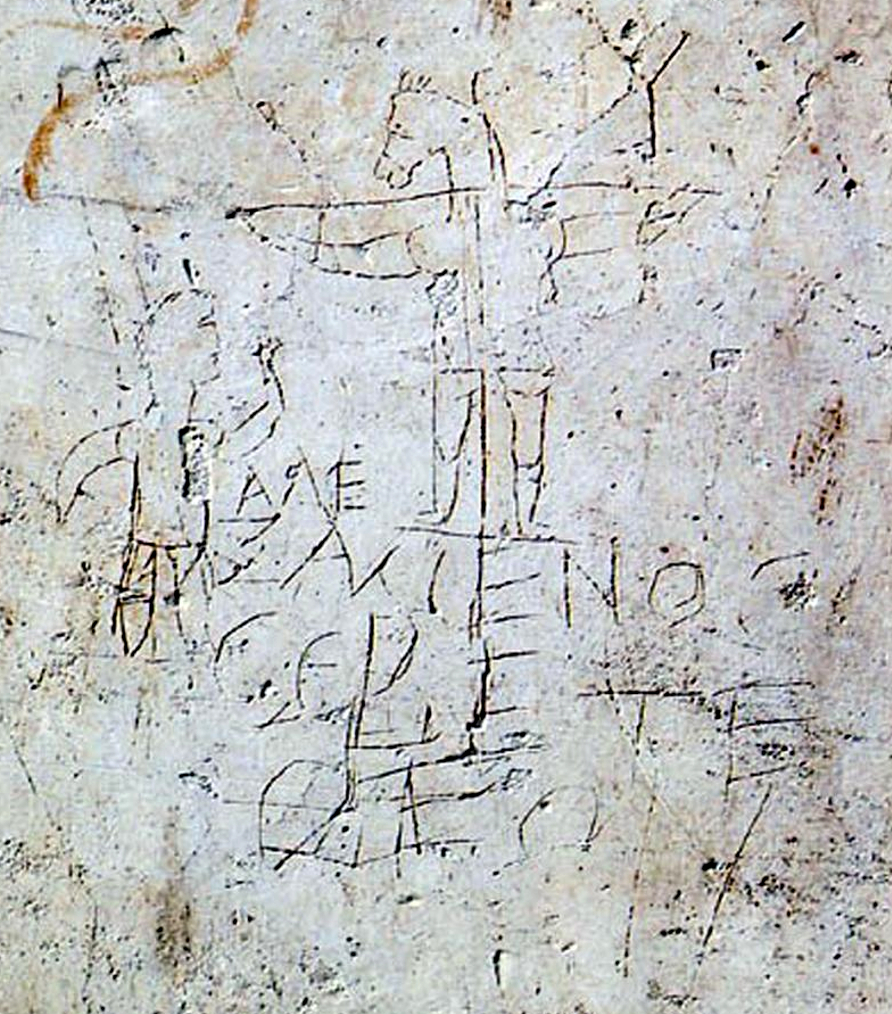
The central figure is affixed to a cross. Its arms extend along the horizontal beam, while the body faces away from the viewer. The figure wears a short tunic or garment and possesses the head of a donkey or mule. To the left stands another human figure, generally identified as Alexamenos, who turns toward the crucified figure and raises one arm in a gesture commonly interpreted as worship, prayer, or salutation.
A Y-shaped mark appears in the upper right. Scholars have proposed several explanations: a cry, a symbol, a pitchfork-like mark, or an unrelated graffito. The safest conclusion is that its meaning remains uncertain. The important point is the unmistakable combination of a cross, a human body, an animal head, an apparent worshiper, and an inscription connecting Alexamenos to the worship of a god.
The picture is deliberately degrading. The creator combines two insults. First, the object of worship is crucified, a punishment associated with slaves, rebels, and the publicly disgraced. Second, the crucified figure bears a donkey’s head, invoking an accusation of foolish or bestial worship. The target is not merely a theological proposition. The target is Alexamenos himself: “This is the kind of god your religion teaches you to worship.”
That personal dimension matters. Early Christian persecution was not always an imperial execution order. It could appear as workplace ridicule, social exclusion, family hostility, denunciation, or mockery among companions. The graffito gives a name to one believer who may have carried the stigma of the Cross in an elite Roman environment.
The Greek Inscription
The inscription is commonly transcribed as Alexamenos sebete theon. The official museum renders the sense as “Alexamenos worships [his] god.” The lettering is irregular, and the form sebete has generated grammatical discussion. It may reflect a misspelling or nonstandard form intended for sebetai, “worships” or “reveres.” Some interpreters have proposed reading it as an imperative, “Worship God,” though the conventional third-person translation remains widespread and fits the mocking caption naturally.
The philological uncertainty does not destroy the historical significance. Under either principal reading, Alexamenos is connected with the worship or reverence of the crucified figure. The wording does not supply a complete creed, but it does use the language of deity. The insult assumes that the crucified one is regarded by Alexamenos as divine or as the object of religious devotion.
This makes careless claims unnecessary. It is sometimes said that the graffito is “the first inscription ever proving Jesus is God.” That statement is too strong. Christian texts calling Jesus Lord, divine, and preexistent are much earlier. The graffito’s importance is different: it is a hostile or satirical material witness showing that a Roman observer associated Christian worship with a crucified divine figure.
Dating the Artifact
The graffito is difficult to date with precision. Proposed dates have ranged from the late first century into the third. The official Parco archeologico del Colosseo presentation assigns it to the Severan age, broadly the late second or early third century. Many modern discussions therefore place it around AD 200, while acknowledging that an exact year cannot be recovered.
The uncertainty should be stated openly. Calling it a first-century artifact as though that were settled overreaches the evidence. Calling it medieval or post-Constantinian would be equally wrong. The historically responsible formulation is that it belongs to the pre-Constantinian Roman world, most probably around the transition from the second to the third century.
That date is still remarkably early for Christian visual history. It precedes Constantine’s victory, the toleration settlement associated with Milan, the Council of Nicaea, the imperial basilicas, and Christianity’s later public artistic culture. The mocker encountered a Christian confession of the Cross before Christian rulers could have imposed it upon Roman society.
The Donkey-Headed Insult
The donkey head belongs to a longer history of anti-Jewish and anti-Christian slander. Ancient polemicists accused Jews of worshiping a donkey or preserving a donkey’s head in the Temple. Josephus directly refuted such claims in Against Apion. Because Christianity emerged from Israel and worshiped the God of Israel, older accusations directed against Jews could be transferred to Christians.
Early Christian apologists show that the charge circulated beyond this one wall. Tertullian describes a caricature displayed in Carthage that portrayed the “god of the Christians” with donkey-like features. Minucius Felix places the accusation of ass-headed worship among the slanders directed against Christians. These literary parallels make the conventional interpretation of the graffito much stronger than an isolated modern guess.
The donkey head therefore should not be treated as a Christian symbol or an authentic attempt to portray Jesus’ appearance. It is a visual slur. The artist’s purpose was to say that Christian worship was absurd, degrading, or intellectually contemptible. The image witnesses not to Christian iconography alone but to pagan misunderstanding and hostility.
The Scandal of Crucifixion
Modern readers are accustomed to crosses on churches, altars, jewelry, cemeteries, and works of art. Ancient Romans did not first encounter the cross as a polished religious emblem. Crucifixion was a brutal and humiliating form of public execution. It exposed the condemned person to pain, helplessness, ridicule, and social erasure. Roman citizens were generally protected from it; slaves and subject peoples were especially vulnerable to it.
That cultural setting explains the graffito’s force. A god associated with crucifixion looked contemptible according to ordinary Roman expectations of divine power and honor. A conquering deity might inspire admiration. A crucified Lord sounded like contradiction. The Christian proclamation inverted the hierarchy of shame: the place of apparent defeat became the throne of sacrificial victory.
“But God forbid that I should glory, save in the cross of our Lord Jesus Christ; by whom the world is crucified to me, and I to the world.”
The anonymous mocker and St. Paul look at the same scandal and judge it differently. The mocker sees stupidity and degradation. Paul sees the love of God, the defeat of sin, and the measure of Christian discipleship. That contrast makes the artifact theologically powerful without turning it into something it is not.
What It Proves Historically
First, the graffito supports the presence of Christians within the social environment of imperial Rome. Alexamenos was known—or portrayed—as a Christian whose devotion was visible enough to invite ridicule. The artifact therefore belongs to the history of Christianity not merely as an abstract doctrine but as a lived identity carried by named people.
Second, it confirms that the Crucifixion stood at the center of recognizable Christian proclamation before Constantine. The artist could mock Alexamenos with a cross because the connection between Christians and a crucified Christ was already intelligible. This directly contradicts theories that the Cross entered Christianity only after the fourth-century imperial conversion.
Third, it witnesses to worship directed toward the crucified figure. The inscription speaks of Alexamenos and “god,” while the gesture points toward the figure on the cross. The artifact does not disclose the complete doctrinal vocabulary of Nicaea, but it shows that reverence for the crucified Christ was not merely remembrance of a dead teacher.
Fourth, the graffito confirms the social credibility of early Christian apologetic writings. When Tertullian, Minucius Felix, Origen, and other writers report mockery and false accusations, they are not inventing an imaginary pagan audience. The wall drawing demonstrates that such ridicule could take concrete visual form.
Fifth, the object contributes to the history of Christian art. It is commonly described as among the earliest surviving representations of the Crucifixion and perhaps among the earliest surviving images intended to represent Christ. The qualification matters because other early objects—especially engraved gems—also compete for chronological priority and because the graffito is hostile rather than devotional art.
What It Does Not Prove
The graffito does not establish the historical existence of Jesus all by itself. The historical case for Jesus rests on earlier and more direct evidence: the Pauline letters, the Gospel traditions, other New Testament writings, and references in non-Christian authors. The graffito is later corroborating evidence for what Christians in Rome were known to believe.
It does not prove the Resurrection. Archaeology can establish the existence, date, material context, and likely social meaning of an object. It cannot force theological faith or reproduce the Easter event in a laboratory. The Resurrection is known through apostolic testimony, the transformed life of the Church, and the judgment of faith supported by historical signs.
It does not prove that early Christians ordinarily used crucifixes in worship. The artist may have created the cross from public knowledge of Christian preaching rather than from seeing an object of devotion. The raised arm may portray worship without documenting the liturgical use of a physical crucifix.
It does not prove that every element has one certain interpretation. The Y-shaped mark, the clothing, the precise gesture, the grammatical form of the inscription, and the identity of the artist remain open to discussion. Strong apologetics does not hide uncertainty. It builds its conclusions according to the actual weight of the evidence.
Before Constantine and Nicaea
The Alexamenos Graffito is especially valuable against a popular historical myth: that Constantine or the Council of Nicaea transformed a merely human Jewish teacher into a divine Christ and then imposed the Cross upon Christianity. The artifact predates both Constantine’s Christian patronage and Nicaea by roughly a century or more.
By the time the graffito was scratched, Christians had already received Paul’s letters, proclaimed the Passion narratives, celebrated the Eucharist, confessed Jesus as Lord, suffered martyrdom, and defended the faith in public writings. The graffito did not cause this theology. It presupposed it. The mocker knew enough to associate Christian worship with a crucified divine figure.
Nicaea in AD 325 did not invent Christ’s divinity. It defended the apostolic faith against Arius by clarifying that the Son is truly God, consubstantial with the Father. Likewise, Constantine did not invent the Cross. His reign changed Christianity’s legal and public circumstances, but the Cross had shaped Christian proclamation from the beginning.
The graffito therefore occupies an important apologetic place. It is not the foundation of Catholic Christology, but it is archaeological confirmation that central Christian claims were publicly recognizable in Rome before the political developments often blamed for creating them.
Alexamenos Fidelis
Another inscription from the wider complex has often been reported as reading Alexamenos fidelis—“Alexamenos is faithful” or “Alexamenos the faithful.” It has sometimes been interpreted as Alexamenos’ own answer, or the defense of a Christian friend: mockery may surround him, but Alexamenos remains faithful.
The possibility is spiritually compelling, but historical caution is required. The inscription is in another hand and its relationship to the blasphemous graffito cannot be demonstrated with certainty. Some scholars consider it a response; others question whether the wording and context permit that confident connection.
CatholicG33k should therefore present it as a possible companion inscription, not as a documented reply written by Alexamenos himself. Even without the second inscription, the first graffito implies that Alexamenos’ Christian identity had become visible. A person cannot be mocked for a hidden allegiance no one recognizes.
Alternative Interpretations
The broad scholarly consensus has understood the image as anti-Christian ridicule. Older proposals identified the animal-headed figure with Anubis, a Gnostic deity, or another religious symbol. These interpretations have generally been considered less persuasive because the combination of crucifixion, worship, the reference to “god,” and known donkey-worship slanders fits Christian parody with unusual precision.
Recent scholarship has reopened the question of authorship by proposing that the graffito could be Christian self-parody rather than an attack produced by a pagan. That proposal does not erase the artifact’s connection with Christianity or the Crucifixion; it challenges the assumption that the artist must have been a hostile outsider. The theory remains a minority reinterpretation, but it demonstrates that even famous artifacts can receive new scholarly readings.
The best Catholic presentation should acknowledge such debate without pretending that every interpretation is equally likely. The official museum description and the dominant historical reading identify the scene as probable mockery of a Christian. Alternative theories deserve mention because historical honesty strengthens rather than weakens apologetics.
Archaeology and Apologetics
Christian apologetics is strongest when it uses cumulative evidence. No single graffito, manuscript, inscription, or archaeological discovery bears the entire case for Christ. The historical picture emerges when independent kinds of evidence converge: apostolic letters, Gospel narratives, Roman testimony, Jewish context, early creeds, martyr accounts, inscriptions, burial practices, worship patterns, and artifacts such as the Alexamenos Graffito.
The graffito contributes one piece to that cumulative case. It shows that Christians in Rome were publicly associated with a crucified object of worship. That fits Paul’s proclamation, the Passion narratives, Tacitus’ reference to Christus’ execution under Pontius Pilate, Pliny’s description of Christians singing to Christ “as to a god,” and the apologetic literature answering Roman contempt.
Its hostile character may increase its evidential value for a limited question. The artist was not attempting to help Christians prove their history. The insult works by exploiting what the audience was expected to recognize. Hostile testimony does not automatically become true in every detail, but it can independently confirm the existence of the belief being attacked.
Catholic historians should resist two opposite errors. Skepticism can dismiss every Christian artifact as propaganda while granting hostile evidence exaggerated authority. Triumphalism can turn an ambiguous object into proof of doctrines it does not directly address. The Catholic intellectual tradition calls for confidence disciplined by truth.
Witness under Ridicule
The artifact also preserves a human story. Whether Alexamenos was enslaved, a servant, a student, a guard, or another dependent person in the imperial household cannot be established. Yet someone knew his name and connected him with Christian worship. His faith had social consequences.
The earliest Christians faced not only spectacular martyrdom but ordinary contempt. They could be called atheists because they rejected the gods, immoral because outsiders misunderstood the Eucharist and Christian brotherhood, irrational because they worshiped a crucified Lord, and disloyal because they refused emperor worship. The apologists answered these accusations with reason, moral witness, prayer for rulers, and fidelity under pressure.
Alexamenos therefore belongs beside the martyrs and apologists even though we know almost nothing else about him. His name survived because someone wanted to ridicule him. The Cross transformed the insult. What the wall intended as shame has become testimony that a Christian in imperial Rome was known for worshiping Christ crucified.
That lesson remains current. Christians should not seek mockery, confuse rudeness with martyrdom, or answer contempt with hatred. They are called to confess Christ without embarrassment, explain the faith intelligently, repent of genuine failures, and bear rejection without surrendering charity.
Primary Evidence and Historical Judgment
The evidence for The Alexamenos Graffito must be read by genre. Narrative histories, letters, laws, inscriptions, archaeology, liturgical texts, theological arguments, and later hagiography answer different questions. A late summary can preserve earlier memory, but it cannot automatically outweigh contemporary evidence.
Chronology controls interpretation. The strongest reconstruction of The Alexamenos Graffito begins with securely dated events and then places later testimony around them. This prevents later institutions, vocabulary, or controversies from being projected backward unchanged.
Interpretive boundaries are essential. A responsible account of The Alexamenos Graffito distinguishes the event or institution itself from later retellings, doctrinal reception, devotional memory, and modern controversy. Conclusions are graded rather than forced into certainty.
Catholic significance follows from truthful history. The study of The Alexamenos Graffito should illuminate apostolic continuity, worship, doctrine, mission, holiness, and human responsibility without allowing later concerns to erase the original chronology and evidence.
Common Misconceptions
“The graffito is direct archaeological proof that every Gospel event happened.”
No. It is material evidence that Christians in pre-Constantinian Rome were associated with worship of a crucified figure. The historical case for Jesus and the Gospel events rests on a much broader body of evidence.
“It proves that Christians worshiped a donkey.”
No. The donkey head is part of the insult. Jewish and Christian writers explicitly rejected the accusation of donkey worship.
“The Council of Nicaea invented the divine Christ.”
No. The graffito predates Nicaea and associates Alexamenos’ worship with a crucified divine figure. Earlier Christian writings provide far fuller evidence that Jesus was confessed as Lord and divine.
“It is certainly the first image of Jesus.”
It is among the earliest surviving images associated with Christ and the Crucifixion, but exact priority remains debated because the date is approximate and other early artifacts exist.
“The nearby ‘Alexamenos fidelis’ inscription is definitely Alexamenos’ answer.”
It may be connected, but that relationship cannot be proven. It should be presented as a possible response rather than a settled fact.
“Because some details are debated, the artifact has no historical value.”
No. Historical evidence often contains uncertain details while still supporting strong conclusions. The basic combination of a crucified figure, religious gesture, Alexamenos’ name, and reference to a god remains significant.
Catechism Highlights
- CCC 440: Jesus accepted Peter’s confession of Him as the Messiah while revealing that His kingship would be manifested through the Cross.
- CCC 571-618: the Paschal Mystery of Christ’s Cross and Resurrection stands at the center of the Gospel.
- CCC 616-617: Christ’s sacrifice is redemptive because the divine Son offers Himself in love for the salvation of humanity.
- CCC 2015: the way of Christian perfection passes by way of the Cross.
- CCC 2471-2474: Christians must confess the faith; martyrdom is the supreme witness to its truth.
- CCC 2500-2503: sacred art serves truth and worship when it evokes and glorifies the mystery of God revealed in Christ.
Reflection Questions
- Why would worship of a crucified Lord have appeared foolish or shameful in Roman society?
- What can hostile evidence reveal that friendly sources cannot reveal in the same way?
- How does the graffito challenge the claim that Constantine or Nicaea invented the Cross or Christ’s divinity?
- Why must Catholics distinguish what an artifact proves from what they wish it proved?
- Am I willing to remain faithful to Christ when belief brings embarrassment, ridicule, or social cost?
- How can I answer mockery with truth and charity rather than fear or bitterness?
Prayer for Courage beneath the Cross
Lord Jesus Christ, crucified and risen, the wisdom of God appeared as foolishness to the world, and the throne of Your victory appeared as a place of shame.
We thank You for the forgotten believers of the early Church whose fidelity was known even to those who mocked them. Remember Alexamenos and every Christian whose name was ridiculed because of devotion to You. Grant us the same courage to confess Your holy Name without arrogance, fear, or hatred.
Teach us to study history truthfully, never exaggerating evidence and never hiding the signs of Your work. Give us minds disciplined by reason, hearts formed by charity, and lives that make the Gospel credible.
When the Cross is mocked, keep us faithful. When believers are misunderstood, make us patient. When we are tempted to seek approval at the cost of truth, remind us that our glory is in Your saving Cross.
Through the intercession of the martyrs and all the saints of the early Church, bring us at last from the suffering of this world into the joy of Your Resurrection.
Through Christ our Lord.
Final Reflection
The Alexamenos Graffito is powerful precisely because it is not a Christian masterpiece. It is a crude wound scratched into a wall. Someone meant the image to turn the Cross into a joke and a believer into an object of contempt. Yet the insult preserved what the mocker could not erase: Christians in imperial Rome worshiped Christ crucified.
The artifact does not replace Scripture, apostolic testimony, or the broader historical evidence for Jesus. It stands beside them as material corroboration. Before Constantine, before Nicaea, and before the Cross became a public emblem of Christian civilization, the crucified Lord was already recognized as the center of Christian devotion.
The world saw a defeated criminal and an absurd god. Alexamenos saw the One worthy of worship. The wall still asks every generation which judgment it will make.
Selected Catholic Sources and Further Reading
- Sacred Scripture passages directly relevant to The Alexamenos Graffito, read in literary and historical context.
- Catechism of the Catholic Church, especially the paragraphs identified in this article.
- Parco archeologico del Colosseo, Palatine Museum: official object description, “Scratched Graffito with Blasphemous Crucifix.”
- Graffiti del Palatino I: Paedagogium, the formal publication of the Palatine graffiti.
- Josephus, Against Apion II, responding to ancient donkey-worship accusations against the Jewish people.
- Tertullian, Apology, especially his discussion of false accusations and the donkey-headed caricature of the Christians’ God.
- Minucius Felix, Octavius, on pagan slanders concerning Christian worship.
- Felicity Harley-McGowan and subsequent scholarship on the Alexamenos Graffito and early Crucifixion imagery.
- Brent Nongbri, “The Palatine Alexamenos Graffito,” for the archaeological setting and modern display.
- Recent scholarly reassessments of the graffito’s authorship and alternative interpretations.
Historical method: Evidence for The Alexamenos Graffito must be weighed according to date, genre, authorship, purpose, geography, and independence. The Catechism supplies doctrinal synthesis; it does not replace ancient historical evidence. Later memory should be identified as secure, probable, traditional, disputed, or unknown.