

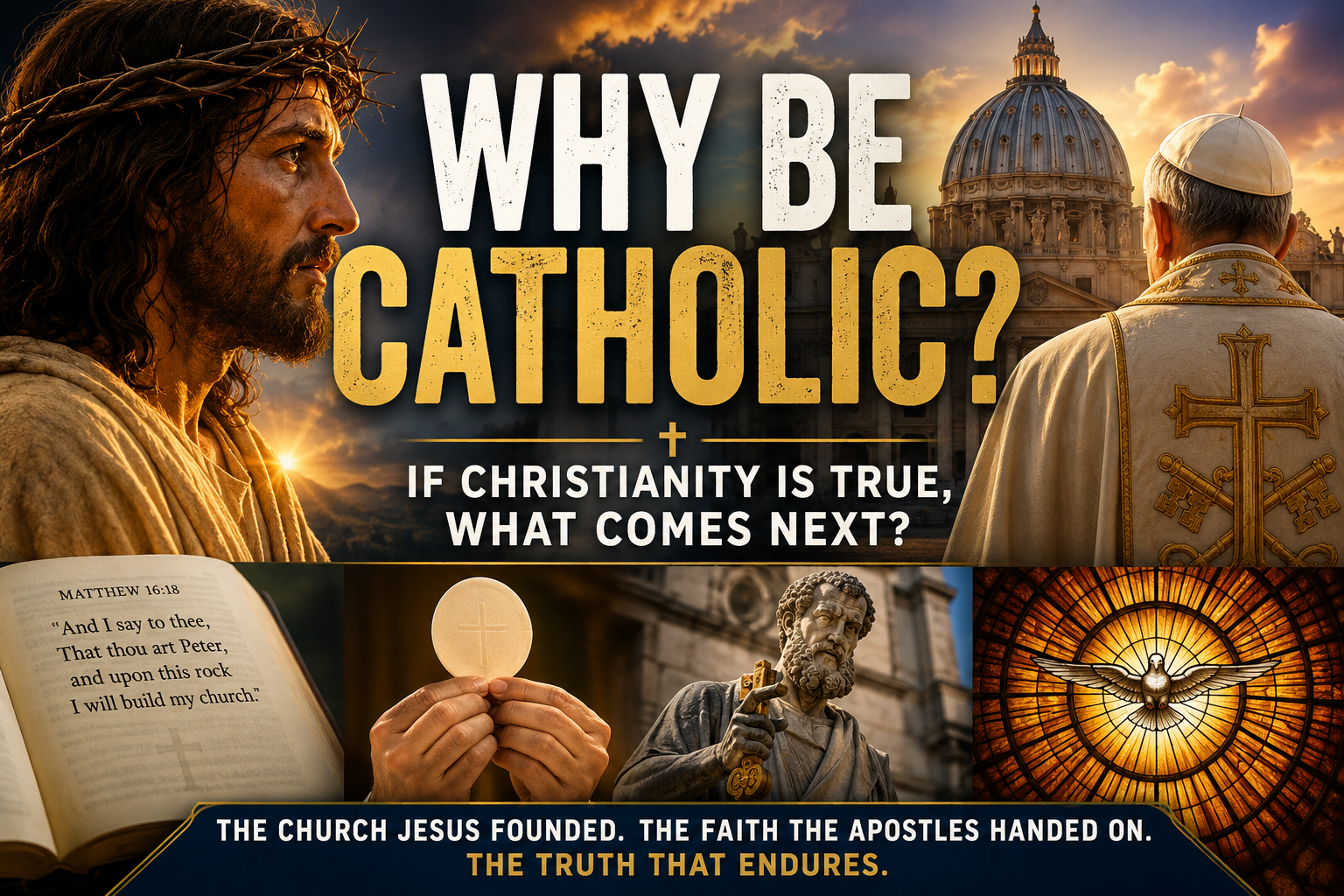
If Christianity Is True, What Comes Next?
Suppose for a moment that Christianity is true.
Suppose Jesus of Nazareth really is who He claimed to be.
Suppose He truly rose from the dead.
A new question immediately emerges:
Which Christian Church did Christ establish?
This question matters because Jesus did not simply leave behind a book.
He founded a community.
He gathered disciples.
He appointed Apostles.
He gave authority.
He established sacraments.
And He promised to remain with His Church until the end of the age (Matthew 28:20).
The Catholic Church claims to be that Church.
Not because Catholics believe themselves superior to other Christians.
Not because Catholic history is free from scandal, corruption, or failure.
And certainly not because every Catholic lives a holy life.
The Catholic claim is much simpler:
The Catholic Church is the Church founded by Jesus Christ and preserved through history by the Holy Spirit.
If that claim is true, it changes everything.
Christianity Began With a Church, Not a Bible
Many Christians today assume Christianity began when the New Testament was written.
History tells a different story.
Jesus never wrote a book.
The Apostles never carried New Testaments.
For decades after Christ’s Resurrection, Christianity spread through preaching, worship, and the life of the Church.
The Church existed before the New Testament.
The Church preserved the apostolic teaching before it was written.
The Church discerned which books belonged in the New Testament.
The Church copied those books, defended them, and proclaimed them throughout the world.
The Bible emerged from the life of the Church.
This raises an important question:
If Christ founded a Church before He gave us a New Testament, what authority did that Church possess?
The Catholic answer is found in Apostolic Succession.
Apostolic Succession: The Church Through Time
Jesus did not merely gather followers.
He appointed Apostles and entrusted them with His mission.
To them He gave authority to teach, govern, and sanctify.
The Apostles understood that this authority was not meant to die with them.
When Judas fell from his office, another took his place (Acts 1:15–26).
The apostolic office continued.
Generation after generation, bishops succeeded bishops through the laying on of hands.
This unbroken chain stretches from the Apostles to the present day.
The Church is therefore not merely an organization that remembers the Apostles.
It is the living continuation of their ministry.
Around AD 180, St. Irenaeus pointed to the succession of bishops as evidence of authentic Christianity. For the earliest Christians, apostolic succession was not optional—it was how one identified the true Church.
The Catholic Church preserves that succession to this day.
Why the Papacy?
Among the Apostles, one figure consistently stands at the center:
Peter.
His name appears first in every apostolic list.
Jesus changes Simon’s name to Peter, meaning “Rock.”
Then Christ declares:
“Thou art Peter; and upon this rock I will build my church.”
— Matthew 16:18
Jesus then entrusts Peter with the keys of the Kingdom.
Throughout Scripture, keys symbolize governing authority. The imagery comes directly from the Davidic kingdom, where the king appointed a chief steward to govern in his absence (Isaiah 22:20–22).
Catholics see Peter fulfilling this role in Christ’s Kingdom.
The Bishop of Rome succeeds Peter in this office.
The Pope is not a replacement for Christ.
He is Christ’s servant.
His role is to preserve unity and safeguard the faith entrusted to the Church.
Empires have risen and fallen.
Kingdoms have disappeared.
Yet the See of Peter remains—a visible sign of continuity stretching back to the first century.
The Eucharist: The Heart of Catholicism
If someone asked what makes Catholicism unique, the answer is ultimately not the Pope.
It is the Eucharist.
At the Last Supper, Jesus did not say:
“This represents my body.”
He said:
“This is my body.”
— Matthew 26:26
Nor did He say:
“This symbolizes my blood.”
He said:
“This is my blood.”
— Matthew 26:28
The early Christians took these words literally.
St. Ignatius of Antioch, writing around AD 107, described the Eucharist as the flesh of Christ.
St. Justin Martyr taught the same.
So did the Fathers throughout the ancient Church.
Catholics believe that in the Eucharist, Christ becomes truly present:
Body, Blood, Soul, and Divinity.
The Eucharist is not merely a reminder of Christ.
It is Christ Himself.
The same Jesus born in Bethlehem.
The same Jesus who walked on water.
The same Jesus who died on Calvary and rose from the dead.
Present under the appearances of bread and wine.
For Catholics, everything flows from this mystery.
Why Confession?
Every Christian recognizes the need for forgiveness.
The question is how Christ intended that forgiveness to be received.
After His Resurrection, Jesus appeared to the Apostles and said:
“Whose sins you shall forgive, they are forgiven them.”
— John 20:23
This is a remarkable passage.
Christ delegated His authority to forgive sins.
Catholics therefore do not confess because priests replace God.
Catholics confess because Christ chose to work through His ministers.
The priest acts in persona Christi—in the person of Christ.
When absolution is given, it is ultimately Christ Himself who forgives.
Confession is not about humiliation.
It is about healing.
The soul encounters the mercy of God in a concrete and personal way.
The Communion of Saints
Death does not divide the Body of Christ.
Jesus declared:
“He is not the God of the dead, but of the living.”
— Matthew 22:32
Those who die in Christ remain alive in Him.
The Church therefore exists in three dimensions:
- The Church Militant on Earth
- The Church Suffering being purified
- The Church Triumphant in Heaven
Together they form one family.
Catholics honor the saints because they reveal what God’s grace can accomplish.
The saints are not competitors with Christ.
They are trophies of Christ’s victory.
Their lives point beyond themselves toward God.
When Catholics ask saints for prayers, they are doing what Christians have always done:
Asking fellow believers to pray for them.
The only difference is that these believers are already in Heaven.
Mary and the Mystery of the Incarnation
No human being is more closely connected to Jesus than His mother.
The Church honors Mary because of who Christ is.
If Jesus is truly God, then Mary is truly the Mother of God.
This title does not elevate Mary above God.
It protects the truth about Jesus.
The early Church recognized that denying Mary as Mother of God ultimately weakened belief in Christ’s divinity.
Mary’s greatness lies not in herself.
It lies in her complete openness to God’s will.
She is the first disciple.
The first Christian.
The first to receive Christ.
Every authentic Marian devotion ultimately leads to Jesus.
As Mary herself says:
“Do whatever he shall say to you.”
— John 2:5
Why Authority Matters
Modern Christianity faces a difficult question:
If Scripture alone is the authority, who has the authority to interpret Scripture?
History reveals thousands of competing interpretations.
Thousands of denominations.
Thousands of disagreements.
Yet Christ prayed that His followers would be one.
The Catholic Church proposes that Christ established a living teaching authority—the Magisterium—to preserve unity and guard authentic doctrine.
Without such authority, every believer becomes his own final court of appeal.
The result is not unity.
The result is fragmentation.
Authority exists not to dominate.
Authority exists to preserve truth.
Scripture and Tradition
Many people assume Catholicism teaches two separate sources of revelation: Scripture and Tradition.
The reality is deeper than that.
The Gospel existed before it was written.
The Apostles preached before they wrote.
Sacred Tradition is the living transmission of that apostolic faith.
Scripture itself emerged from this Tradition.
The two therefore cannot be separated.
They are not rivals.
They are partners.
Together they communicate the one Deposit of Faith entrusted to the Church.
The Bible is the inspired Word of God.
Tradition is the living context through which that Word is authentically understood.
Common Objections
“The Bible Alone Is Sufficient”
Scripture is inspired.
But Scripture never teaches Scripture alone.
The New Testament repeatedly points believers to both written and oral apostolic teaching (2 Thessalonians 2:15).
The early Church relied upon both.
“Catholics Worship Mary”
Catholics worship God alone.
The honor given to Mary is fundamentally different from the worship offered to God.
Mary’s role is always to lead believers to Christ.
“Confession Should Be Made Directly to God”
Catholics agree that all forgiveness comes from God.
The question is whether Christ established a sacramental means through which that forgiveness is ordinarily communicated.
John 20 strongly suggests He did.
“The Pope Is Not in the Bible”
Neither is the word Trinity.
The question is not whether the word appears.
The question is whether the concept appears.
Catholics believe Christ’s words to Peter establish a unique office that continues within the Church.
“The Eucharist Is Only Symbolic”
The earliest Christians overwhelmingly believed in Christ’s Real Presence.
The symbolic interpretation became widespread many centuries later.
The historical evidence strongly favors the Catholic understanding.
The Catholic Difference
Catholicism is not simply one denomination among many.
It is a claim about continuity.
A claim that the Church founded by Christ still exists.
A claim that the sacraments Christ established still remain.
A claim that the faith preached by the Apostles continues to be proclaimed today.
The Catholic Church contains sinners.
It always has.
But its truth does not depend upon the holiness of every member.
It depends upon Christ.
The same Christ who promised:
“Behold I am with you all days, even to the consummation of the world.”
— Matthew 28:20
The ultimate question is not whether Catholics are perfect.
The ultimate question is whether the Catholic Church is the Church Jesus founded.
If it is, then Catholicism is not merely one option among many.
It is home.
“The church of the living God, the pillar and ground of the truth.”
— 1 Timothy 3:15
“This is my body.”
— Matthew 26:26
If the Catholic Church is the Church Jesus founded, then the search for Christianity ultimately leads home.
Leave a Reply