

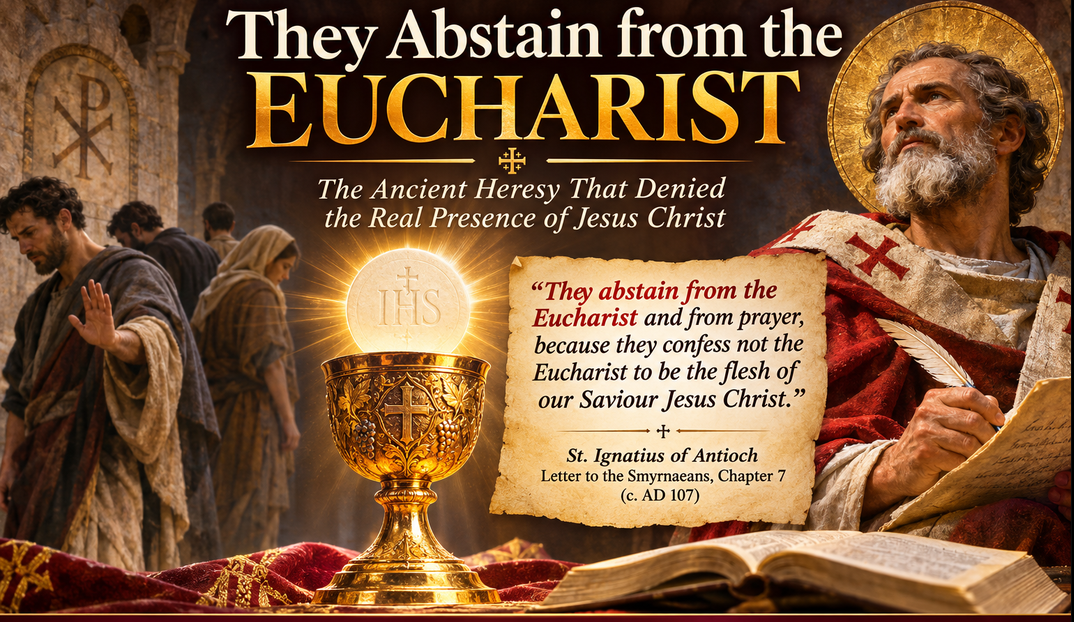
The Ancient Heresy That Denied the Real Presence of Jesus Christ
“They abstain from the Eucharist and from prayer, because they confess not the Eucharist to be the flesh of our Saviour Jesus Christ.”
— St. Ignatius of Antioch, Letter to the Smyrnaeans, Chapter 7 (c. AD 107)
Introduction: A Warning from the Early Church
Nearly two thousand years ago, a Catholic bishop on his way to martyrdom wrote words that should awaken every Christian to the sacred reality of the Holy Eucharist.
His name was St. Ignatius of Antioch, a bishop of the early Church who lived within the generations immediately following the Apostles.
While being transported to Rome, where he would suffer martyrdom, Ignatius wrote several letters defending the faith handed down from the Apostles.
In his Letter to the Smyrnaeans, Chapter 7, he identified a dangerous error spreading among certain professing Christians: they refused to recognize the Eucharist as the true Flesh of Jesus Christ.
Notice what Ignatius did not say.
He did not accuse these people merely of misunderstanding a religious symbol or disagreeing about a secondary doctrine.
He identified their rejection of the Eucharist as part of a fundamental departure from the apostolic faith.
Why?
Because the Eucharist is not merely something that reminds us of Christ. The Eucharist is Christ Himself.
1. What Did St. Ignatius Mean?
To understand this ancient warning, we must understand the heresy Ignatius was confronting.
Certain false teachers denied that Jesus Christ had truly possessed human flesh or genuinely suffered in His Passion. This error is associated with Docetism, which treated Christ’s humanity and suffering as merely apparent.
Their rejection of the reality of Christ’s Flesh extended to their rejection of the Eucharist.
St. Ignatius responded by affirming that the Eucharist is the very Flesh of the Savior who suffered for our sins and whom the Father raised from the dead.
This is extraordinarily important.
Ignatius did not invent a new Eucharistic doctrine. He testified to the faith already being professed and celebrated by the Church.
His letter shows that, at the beginning of the second century, the Eucharist was understood as something far greater than ordinary bread or a symbolic memorial.
It was recognized as the true Flesh of Jesus Christ.
The Catholic doctrine of the Real Presence is not a medieval invention. Its roots are apostolic.
2. Jesus Christ Himself Taught the Real Presence
The teaching of the Catholic Church comes first and foremost from the words of Jesus Christ.
In the sixth chapter of the Gospel according to St. John, Our Lord declares:
“For my flesh is meat indeed: and my blood is drink indeed.”
— John 6:56, Douay-Rheims
Jesus did not merely tell His followers to remember His Flesh.
He commanded them to eat it.
He did not merely tell them to think about His Blood.
He commanded them to drink it.
When His listeners struggled with this teaching, He did not withdraw His words.
Instead, He declared:
“He that eateth my flesh, and drinketh my blood, hath everlasting life.”
— John 6:55, Douay-Rheims
Some of His disciples found the teaching intolerable and departed from Him (John 6:61–67).
Yet Our Lord did not abandon the truth simply because some refused to accept it.
At the Last Supper, He revealed how He would give Himself to His Church sacramentally.
Taking bread, He declared:
“This is my body, which is given for you.”
— Luke 22:19, Douay-Rheims
He did not say that the bread merely represented His Body.
He said, “This is my body.”
Through the Eucharist, the same Jesus Christ who suffered upon Calvary makes His Body and Blood truly present under the appearances of bread and wine.
This is the mystery the Catholic Church has faithfully preserved.
3. St. Paul Warned Against Receiving Unworthily
The testimony of St. Paul further confirms that the Eucharist cannot be reduced to an ordinary symbolic meal.
Writing to the Corinthians, he warned that whoever receives the Eucharist unworthily becomes guilty of the Body and Blood of the Lord.
He also commanded Christians to examine themselves before receiving Holy Communion.
(1 Corinthians 11:27–29)
Consider the seriousness of this warning.
If the Eucharist were merely ordinary bread representing Jesus Christ, why would St. Paul describe unworthy reception as an offense against the Lord’s Body and Blood?
His warning makes sense precisely because the Eucharist is holy beyond comparison.
The communicant encounters not ordinary food but the sacramental presence of the Crucified and Risen Savior.
4. The Catholic Church Has Never Abandoned This Teaching
The Catechism of the Catholic Church declares that in the Most Blessed Sacrament of the Eucharist, the Body and Blood, together with the Soul and Divinity of Our Lord Jesus Christ, are truly, really, and substantially contained.
(Catechism of the Catholic Church, §1374)
This teaching is called the Real Presence.
Through transubstantiation, the whole substance of bread is changed into the Body of Christ, and the whole substance of wine into His Blood, while the appearances of bread and wine remain.
(Catechism of the Catholic Church, §1376; Council of Trent, Session XIII, Chapter 4)
The Eucharist is therefore not merely a representation of Calvary.
The Holy Mass makes sacramentally present the one sacrifice of Jesus Christ, without repeating His bloody sacrifice upon the Cross.
(Catechism of the Catholic Church, §§1366–1367)
The Church has defended this mystery because she has received it from Christ.
5. The Ancient Warning Still Speaks Today
Today, many Christians sincerely love Jesus Christ yet do not accept the Catholic doctrine of the Real Presence.
Some understand the Lord’s Supper primarily as a symbolic memorial. Others hold different understandings of Christ’s Eucharistic presence.
We must approach such Christians with charity, recognizing their sincerity while explaining the fullness of Catholic teaching.
It is also important to recognize that the specific heresy condemned by St. Ignatius involved the denial of Christ’s true humanity and suffering. His words should not be used to claim that every modern Christian who disagrees with Catholic Eucharistic doctrine holds that same ancient heresy.
Nevertheless, his testimony presents a serious question:
If Christians living so close to the age of the Apostles confessed that the Eucharist was truly the Flesh of Jesus Christ, on what authority should that confession be rejected?
The Catholic response is clear.
We do not possess authority to overturn what Christ established and the Apostles handed down.
The Church is the guardian, not the master, of divine revelation.
6. Abstaining Out of Reverence Is Not Rejecting the Eucharist
An essential distinction must be made.
St. Ignatius condemned those who withdrew from the Eucharist because they rejected its reality.
But the Catholic who refrains from Holy Communion because he is conscious of unconfessed mortal sin acts out of obedience and reverence.
The Church teaches that anyone conscious of mortal sin must ordinarily receive sacramental absolution before approaching Holy Communion.
(Catechism of the Catholic Church, §§1385, 1457)
Such a person does not deny the Real Presence.
On the contrary, he recognizes the holiness of the One whom he desires to receive.
This temporary abstinence should lead him toward repentance, Confession, and a worthy return to the Eucharistic table.
There is an infinite difference between refusing the Eucharist because one rejects Christ’s teaching and refraining because one reveres His sacred presence.
7. The Eucharist Is the Heart of Catholic Life
The Eucharist is not one devotion among many.
It is the source and summit of the Christian life.
(Catechism of the Catholic Church, §1324)
Every Holy Mass places us before the mystery of Christ’s redeeming love.
The same Lord who was born of the Blessed Virgin Mary, who suffered under Pontius Pilate, who died upon the Cross, and who rose gloriously from the tomb is truly present in the Blessed Sacrament.
He gives Himself to His people as heavenly nourishment.
He invites us into communion with His divine life.
And He remains present in the tabernacles of Catholic churches throughout the world.
Before such a mystery, the appropriate response is not indifference but faith, adoration, repentance, and love.
Conclusion: Will We Believe Him?
The warning of St. Ignatius of Antioch continues to challenge Christians nearly two thousand years after it was written.
Those who denied the reality of Christ’s Flesh also rejected the Eucharist as His Flesh.
But the Catholic Church continues to proclaim what she has believed from the beginning:
The Eucharist is truly the Body, Blood, Soul, and Divinity of Jesus Christ.
Not merely a symbol.
Not ordinary bread.
Not an empty memorial.
But Jesus Christ Himself, substantially present beneath the sacramental appearances.
The question is not whether this mystery surpasses our understanding. It certainly does.
The question is whether we will trust the words of the One who revealed it.
For the faithful Catholic, the answer must always be the answer of St. Peter:
“Lord, to whom shall we go? thou hast the words of eternal life.”
— John 6:69, Douay-Rheims
May we never turn away from the gift of the Holy Eucharist through unbelief or indifference.
May we approach the altar with reverence, receive Our Lord worthily, and adore Him with undivided hearts.
For the One who awaits us in the Blessed Sacrament is the very One who died upon the Cross for our salvation.
Jesus Christ, truly present in the Most Holy Eucharist.
O Sacrament Most Holy, O Sacrament Divine, all praise and all thanksgiving be every moment Thine.
Primary Sources
- St. Ignatius of Antioch, Letter to the Smyrnaeans, Chapters 6–8.
- Holy Bible, Douay-Rheims: John 6:48–69; Luke 22:19–20; 1 Corinthians 10:16–17; 11:23–29.
- Catechism of the Catholic Church, §§1324, 1366–1367, 1374–1376, 1385, 1457.
- Council of Trent, Session XIII (AD 1551), Decree Concerning the Most Holy Sacrament of the Eucharist.
- Second Vatican Council, Lumen Gentium, §11 (AD 1964).