

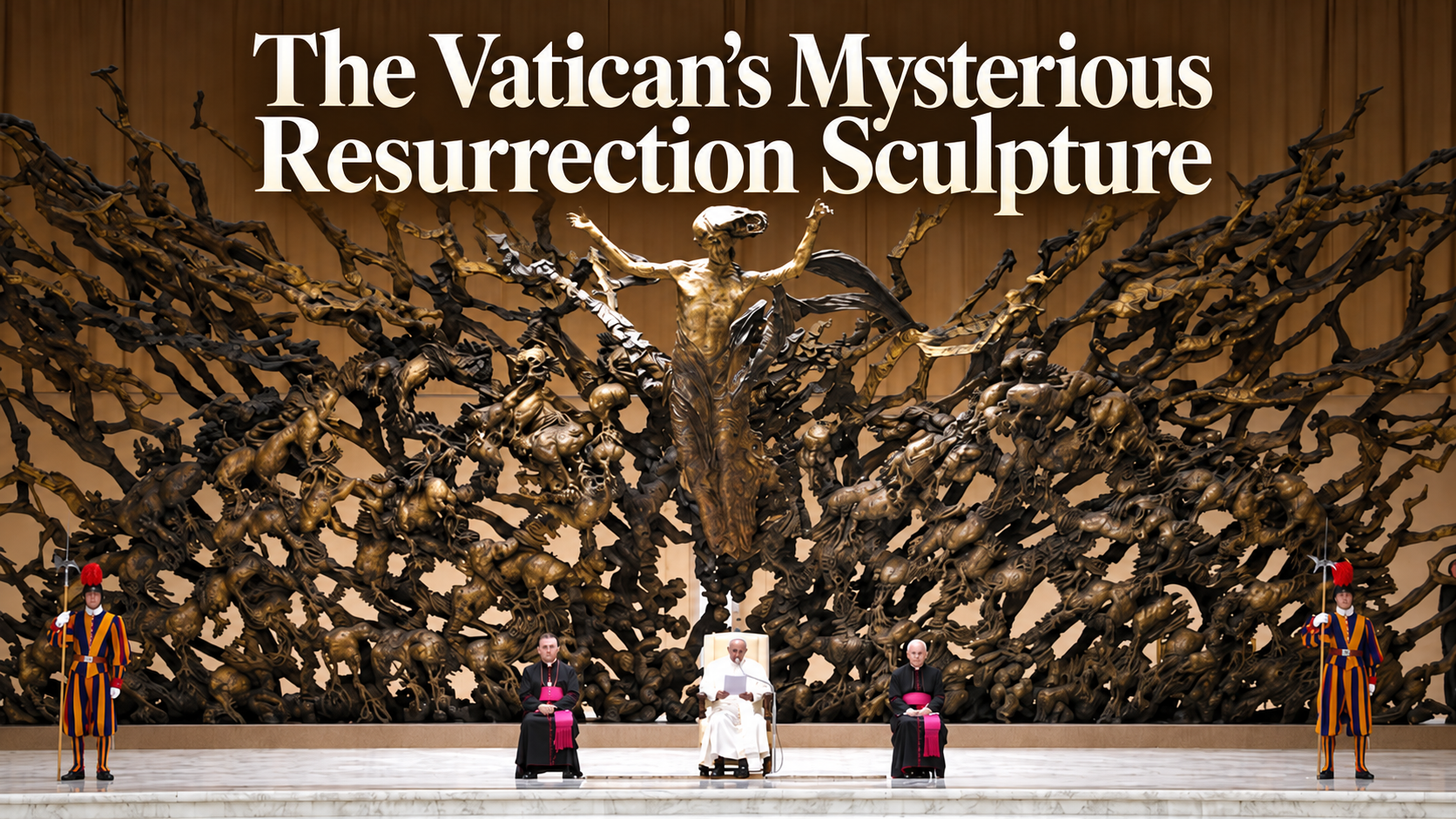
Behind the pope in the Vatican’s great audience hall stands one of the most unusual religious sculptures ever created. Its twisted bronze branches, devastated landscape, and mysterious central figure have inspired fascination, controversy, and even accusations of demonic imagery. But the remarkable story behind Pericle Fazzini’s The Resurrection reveals something very different: an artist’s attempt to portray the victory of Jesus Christ over a world threatened by nuclear annihilation.
By CatholicG33K | Catholic Art, History & Apologetics
A Strange and Unforgettable Image Inside the Vatican
Imagine entering a vast hall at the Vatican and looking toward the stage where the pope addresses thousands of pilgrims.
Behind the papal chair rises an enormous wall of bronze.
Twisted branches reach outward like skeletal fingers. Dark, jagged shapes appear to explode in every direction. The entire structure resembles a landscape shattered by some unimaginable catastrophe.
And at the center stands a figure with outstretched arms, seemingly emerging from the destruction.
That figure is Jesus Christ.
The artwork is called La Resurrezione (The Resurrection), created by Italian sculptor Pericle Fazzini (1913–1987) and inaugurated by Pope St. Paul VI on September 28, 1977.
It stands in the Paul VI Audience Hall, often called the Nervi Hall after its architect, Pier Luigi Nervi.
Measuring approximately 66 feet (20 meters) across and 23 feet (7 meters) high, the composition is one of the Vatican’s most visually imposing modern artworks.
For decades, millions of people have encountered its image through papal audiences, photographs, and televised events.
Yet many have never been told what it represents.
Perhaps its most surprising feature is that the sculpture was deliberately conceived around the imagery of a nuclear explosion.
This is not merely an interpretation invented by modern commentators. It comes from Fazzini himself and is confirmed by the Vatican Museums.
To understand why an artist would place the risen Christ in the middle of a nuclear catastrophe, we must return to the twentieth century, the Second Vatican Council, and a pope who wanted the Church to speak to the modern world through art.
Who Was Pericle Fazzini?
Pericle Fazzini was born on May 4, 1913, in Grottammare, a coastal town in Italy’s Marche region.
His father was a carpenter, and Fazzini grew up working with wood. His early experience in the family workshop introduced him to shaping material with his hands.
In 1930, he moved to Rome, where his artistic career began to develop.
Over the following decades, Fazzini became an important figure in twentieth-century Italian sculpture.
His work was frequently characterized by movement, tension, expressive human figures, and forms that seemed to struggle against the materials from which they were made.
The Italian poet Giuseppe Ungaretti famously described him as the sculptor of the wind.
It was an appropriate description.
Fazzini’s figures often appear to be caught in motion, their bodies and surroundings swept by forces that cannot themselves be seen.
His sculpture was also shaped by the political and spiritual upheavals of his lifetime.
During the years surrounding the Second World War, Fazzini created works addressing suffering and violence. His 1946 sculpture Executed portrays a resistance fighter killed by a firing squad.
Art historian Alessandro Masi has connected Fazzini’s opposition to fascism with his Catholic convictions, noting that the artist presented victims of political violence in ways reminiscent of Christian martyrdom.
For Fazzini, religious art was not necessarily an escape from the tragedies of the modern world.
It could confront them directly.
That conviction would eventually find its greatest expression in The Resurrection.
Pope Paul VI and the Church’s Renewed Friendship With Artists
The story of the sculpture is inseparable from Pope St. Paul VI.
During the 1960s, the Catholic Church was undergoing a period of extraordinary reflection and renewal.
The Second Vatican Council met from 1962 to 1965, seeking to articulate the Church’s mission in a rapidly changing world.
Paul VI believed that artists had an important responsibility in communicating the mysteries of Christianity.
On May 7, 1964, he celebrated a special Mass for artists in the Sistine Chapel.
During his homily, he acknowledged that the relationship between the Church and modern artists had become strained.
Artists sometimes felt restricted by ecclesiastical expectations, while Church leaders sometimes struggled to understand newer artistic expressions.
Paul VI called for renewed friendship and cooperation.
The following year, in his December 8, 1965, message to artists at the conclusion of Vatican II, the pope explained that Christian art could help make spiritual realities accessible through visible forms.
He also offered a profound warning about the importance of beauty in human life:
“This world in which we live needs beauty in order not to sink into despair.”
For Paul VI, beauty was not simply decoration.
It could awaken the soul to truth, encourage contemplation, and help communicate the Gospel.
This vision provides essential context for Fazzini’s commission.
The pope was not simply looking for an ornament to fill a large wall.
He wanted art capable of speaking to the spiritual struggles of contemporary humanity.
The Creation of the Paul VI Audience Hall
Before the sculpture could become a reality, the Vatican needed a new space for major papal gatherings.
In 1964, Paul VI entrusted architect Pier Luigi Nervi with designing an audience hall.
Construction began in 1966.
The building was inaugurated on June 30, 1971.
Its purpose was practical as well as pastoral. Growing numbers of pilgrims wanted to attend papal audiences, and St. Peter’s Basilica was not always the most suitable setting for such gatherings.
The new hall provided an alternative.
Unlike St. Peter’s Basilica, the audience hall was not designed primarily as a church for liturgical worship. It was a place for encounters, instruction, and communication.
Nervi designed the building with a sweeping concrete ceiling and an architectural arrangement intended to direct attention toward the papal stage.
Paul VI eventually wanted a monumental artwork behind that stage.
The Vatican Museums explain that Fazzini first entered discussions with the Vatican in 1965.
Although the artist began developing the project in 1970, the definitive decision to engage him came in 1972, following Paul VI’s personal intervention.
The distinction matters: the early discussions, the beginning of artistic work, and the final commission were different stages of a lengthy process.
Fazzini’s assignment was to create a monumental representation of the Resurrection.
But his vision would be unlike the familiar Easter images found in many Catholic churches.
A Resurrection Emerging From Nuclear Devastation
Traditional Catholic depictions of the Resurrection frequently show Christ emerging triumphantly from the tomb, holding a banner, surrounded by light, or appearing before astonished witnesses.
Fazzini chose a radically different artistic setting.
He imagined Christ rising above a landscape resembling the Garden of Gethsemane after a nuclear explosion.
In a reflection preserved by Vatican News, Fazzini said he conceived the idea of Christ rising from Gethsemane as though the garden had been devastated by an atomic blast.
The Vatican Museums likewise record his description of a tremendous eruption from the earth, with olive trees, stones, clouds, and lightning thrown into the air while Christ rises serenely amid the turmoil.
This was the central concept.
The explosion represents the destructive violence of the world. Christ represents the victory of life over death.
The contrast was intentional.
The artist was not attempting to recreate a literal scene from first-century Jerusalem.
He was using a modern catastrophe to express a timeless Christian truth.
Humanity can manufacture instruments capable of devastating entire cities.
Yet even humanity’s greatest destructive power cannot overturn the Resurrection of Jesus Christ.
For Christians, death itself has already met its conqueror.
As St. Paul writes:
“And the enemy death shall be destroyed last.”
— 1 Corinthians 15:26, Douay-Rheims
The sculpture can therefore be understood as a visual confrontation between two powers: the destructive force of sin and death, and the life-giving power of the risen Savior.
Why the Garden of Gethsemane?
The Garden of Gethsemane occupies an important place in the Gospels.
It was there, after the Last Supper, that Jesus prayed before His arrest.
In Matthew 26:36–46, Christ enters the garden with His disciples and prepares Himself for the suffering that awaits Him.
Gethsemane is therefore associated with obedience, anguish, abandonment, and the acceptance of the Father’s will.
By placing the Resurrection within the imagery of Gethsemane, Fazzini brings together two moments of the Paschal Mystery: Christ’s suffering and His victory.
The olive trees become more than background scenery.
They connect the sculpture to the place where Jesus willingly submitted to the Passion.
Their twisted and shattered branches suggest a world wounded by violence.
Yet above them stands the risen Lord.
The connection is spiritually meaningful, but a distinction is necessary.
According to the Gospels, Christ rose after being buried in a tomb; the Resurrection did not historically occur in Gethsemane.
Fazzini’s composition is symbolic rather than a literal reconstruction of the biblical event.
This artistic freedom should not be confused with a claim that the Church has altered the Gospel account.
The Catechism of the Catholic Church, paragraphs 638–658, clearly affirms the historical reality of Christ’s Resurrection and the testimony of those who encountered Him afterward.
Fazzini’s work is best understood as a meditation on that mystery.
Looking Closely: What Do the Twisted Forms Mean?
At first glance, the sculpture can seem chaotic.
But its major visual elements form a dramatic composition centered on Christ.
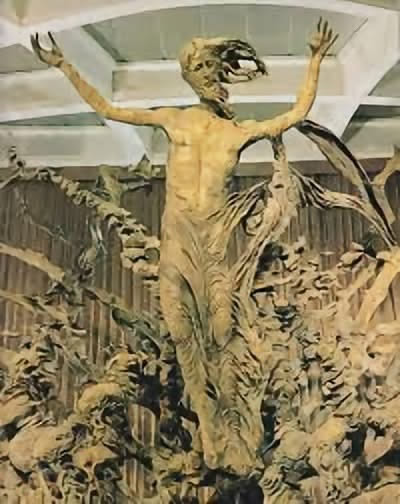
The outstretched arms
At the center, Christ raises and extends His arms.
The gesture can suggest emergence, victory, and blessing.
The placement of the arms also recalls the Crucifixion, connecting the suffering Christ with the risen Christ.
The olive branches
The great mass surrounding Jesus is composed largely of forms resembling olive trees, roots, and branches.
These elements connect the artwork to Gethsemane.
They are also part of the visual explosion, appearing to bend, fracture, and fly outward.
The Vatican’s own descriptions identify the olive trees as essential to the composition.
The rocks, clouds, and lightning
The fractured landscape becomes increasingly difficult to distinguish from the storm surrounding it.
This merging of forms gives the impression that the natural world itself is being torn apart.
The Vatican Museums specifically mention stones, clouds, and lightning in Fazzini’s conception.
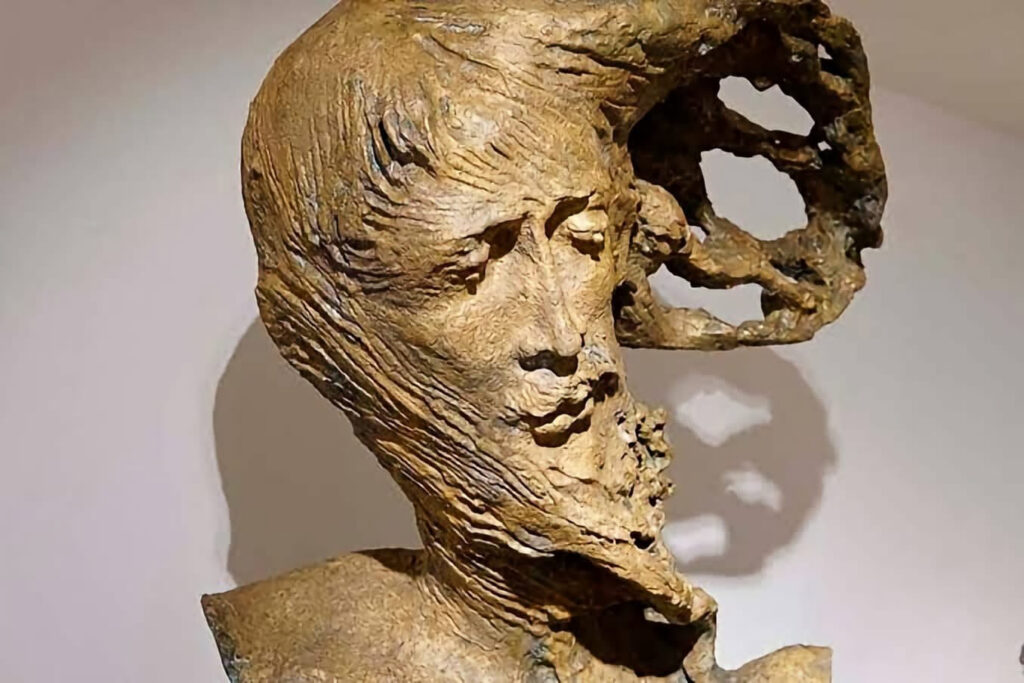
The face of Christ
The figure of Jesus is not presented with the polished idealization familiar from many classical sculptures.
His long hair and beard appear swept by powerful winds.
His body is slender and expressive.
The face seems marked by suffering, even as His position communicates transcendence over the destruction below.
This combination of suffering and victory is especially important to the Christian meaning of the piece.
The risen Lord is not someone unrelated to the Crucifixion.
He is the same Jesus who suffered, died, and rose again.
The disturbing shapes below
Some viewers perceive skulls, skeletal remains, or anguished faces within the mass of bronze.
Such impressions are understandable given the fractured, organic forms.
However, viewers should distinguish between shapes they believe they recognize and imagery whose specific meaning is documented by the artist.
The Vatican’s descriptions emphasize the shattered olive grove, the explosive movement, and Christ’s emergence.
Not every apparent face or skull in a photograph can be confidently identified as a deliberate, individually intended figure.
The composition is dramatic partly because it allows darkness and destruction to occupy so much visual space.
But Christ remains its unmistakable center.
The Cold War and the Fear of Nuclear Annihilation
To understand the nuclear imagery, we must consider the world in which Fazzini lived.
The atomic bombings of Hiroshima and Nagasaki occurred in August 1945.
During the following decades, the United States and the Soviet Union developed increasingly powerful nuclear arsenals.
The Cold War created widespread fear that humanity might destroy itself.
The Cuban Missile Crisis of October 1962 brought the world dangerously close to nuclear conflict.
Catholic leaders took these dangers seriously.
Pope St. John XXIII addressed the nuclear arms race in his 1963 encyclical Pacem in Terris.
In paragraph 112, he stated:
“Nuclear weapons must be banned.”
The encyclical called for disarmament, mutual trust among nations, and the protection of human dignity.
The Second Vatican Council also condemned forms of warfare directed toward the indiscriminate destruction of populations.
These concerns remain reflected in the Catechism, particularly paragraph 2314.
Fazzini’s sculpture emerged from precisely this historical environment.
It was an age in which humanity had acquired the ability to unleash immense physical destruction but had not solved the moral problems that made such destruction possible.
According to Catholic News Service reporting in 2023, Fazzini was especially affected by the devastation associated with Hiroshima.
His nuclear imagery was not simply a demand for a particular political policy.
It was part of a larger spiritual question.
What does the Resurrection mean to a civilization capable of annihilating itself?
The Christian answer is not that nuclear war is unimportant or that earthly suffering can be ignored.
Rather, the Resurrection teaches that death and destruction do not possess ultimate authority over the destiny of humanity.
Christ does.
How the Monumental Sculpture Was Actually Made
Creating a sculpture of such complexity required years of experimentation, physical labor, and technical skill.
Fazzini needed to construct a full-size model before the metal components could be cast.
Traditional modeling materials presented major challenges.
The composition was enormous, with intricate branches and projecting forms that would have been extremely difficult to create using conventional heavy materials.
The artist therefore chose polystyrene.
The Vatican Museums record that he shaped it using electrically heated tools.
The process allowed him to carve elaborate forms while avoiding some of the weight-related difficulties of working on such a large scale.
The Vatican made the former church of San Lorenzo in Piscibus available to him as a working space.
There, Fazzini developed the life-size model.
The work was then translated into metal through the efforts of skilled foundry workers associated with the Michelucci foundry in the Pistoia area of Tuscany.
Accounts of the fabrication describe the use of lost-wax casting, a traditional technique in which carefully prepared molds are used to reproduce sculptural forms in metal.
Separate sections were cast, transported, and assembled.
The completed work incorporated bronze and brass alloys, producing variations in color and reflectivity.
These differences were important to the final visual effect.
The artist’s task was physically demanding.
A 2012 account in the Italian Catholic newspaper Avvenire reports that Fazzini suffered a thrombosis in August 1975 after completing the full-scale polystyrene model.
He required a lengthy period of recovery but continued overseeing the artwork.
The heated materials also created difficult working conditions, including fumes.
Some later accounts have connected his health problems to exposure during production. However, the claim that these fumes directly caused his eventual death in 1987 should not be presented as an established medical conclusion.
What is certain is that Fazzini devoted extraordinary effort to the project.
The work became both an artistic undertaking and a deeply personal spiritual experience.
“This Sculpture Was a Great Prayer”
Perhaps one of the most revealing details in the entire history of The Resurrection is how Fazzini described the experience of creating it.
In statements preserved by Vatican News and reported by Avvenire, the sculptor spoke of the work as a profound act of prayer.
He described experiencing a creative force that seemed greater than his own capacities.
His words convey the intensity of the undertaking.
For Fazzini, the process was not simply the production of a public monument.
It was an encounter between faith, artistic imagination, human effort, and physical matter.
This provides a useful corrective to a common misunderstanding.
It is possible to dislike the artistic style of The Resurrection while acknowledging that the artist intended it as a Christian work.
Its unconventional appearance does not, by itself, establish an anti-Christian purpose.
In Fazzini’s own account, the sculpture was directed toward the mystery of the risen Lord.
September 28, 1977: Pope Paul VI Unveils the Sculpture
The decisive moment came on Wednesday, September 28, 1977.
Pope Paul VI inaugurated The Resurrection during his general audience.
The event followed his eightieth birthday on September 26.
Fortunately, the pope’s original address survives.
It is one of the most important primary sources for understanding how the Vatican intended the sculpture to be received.
The address was titled The Presence of Christ in the History of the World.
Rather than concentrating on the frightening details of the surrounding landscape, Paul VI immediately directed attention toward the central figure.
He identified the artwork as the representation of Jesus Christ risen, alive, and blessing.
He then explained why such an image belonged behind the papal stage.
The mission of the successor of St. Peter is to proclaim the crucified and risen Christ.
The sculpture therefore served as a visible witness to the fundamental message of the papal ministry.
Paul VI declared, in words translated from the original Italian:
“Christ is alive, Christ is real.”
This is the key to understanding his address.
The pope did not present the sculpture as an occult symbol, an independent object of religious devotion, or a mysterious revelation hidden from the faithful.
He publicly identified its subject and connected it to the apostolic proclamation of Jesus Christ.
The address continued by reflecting on the presence of Christ throughout history and His closeness to suffering humanity.
That message becomes especially powerful when considered alongside the sculpture’s devastated landscape.
The world may be scarred by war, suffering, and destruction.
But Christ remains alive.
The papal address thus gave a clear Christian interpretation to an artwork that might otherwise have seemed difficult to understand.
Is the Sculpture Demonic or Satanic?
The artwork’s unusual appearance has produced considerable controversy, especially online.
Photographs circulating on social media have inspired comparisons with horror films, strange creatures, and disturbing religious imagery.
Some critics have described the sculpture as demonic.
Others have suggested that its twisted forms contain hidden occult symbolism.
These claims deserve careful examination.
First, it is entirely reasonable for someone to find the sculpture unsettling.
Christian art does not always produce the same emotional response in every viewer.
Some Catholics prefer traditional devotional imagery that immediately communicates peace, beauty, and reverence.
Fazzini’s expressive modernism can feel harsh by comparison.
A Catholic may also reasonably question whether the work successfully communicates the glory of the Resurrection.
These are legitimate matters for artistic and theological discussion.
However, a claim that the sculpture was deliberately created as a satanic image requires evidence of that intention.
The documented evidence points in the opposite direction.
The Vatican Museums identify the subject as the Resurrection of Christ amid the shattered Garden of Gethsemane.
The artist described the work in explicitly Christian and prayerful terms.
Pope Paul VI publicly inaugurated it as an image of the living, risen, and blessing Savior.
There is no sound basis in these primary sources for claiming that its intended subject is Satan rather than Christ.
A viewer’s perception of sinister shapes is not sufficient to establish a hidden satanic program.
At the same time, rejecting unsupported accusations does not require declaring the sculpture aesthetically perfect.
The more useful question is whether its dramatic imagery leads viewers toward the truth it was intended to express.
That is a question Catholics can discuss seriously without resorting to speculation.
Is This an Accurate Catholic Representation of the Resurrection?
This question requires an important distinction between Catholic doctrine and artistic symbolism.
Catholics profess that Jesus Christ truly rose from the dead, bodily and gloriously.
The Resurrection is not merely a metaphor for hope or the survival of Christ’s teachings.
It is a real event at the center of the Christian faith.
The Catechism states in paragraph 638 that the Resurrection is the crowning truth of faith in Christ.
Paragraphs 645–646 explain that the risen Jesus possesses a real, glorified body.
He is not merely a spirit or an immaterial idea.
In paragraph 647, the Catechism also notes something especially relevant to religious artists: no one witnessed the precise moment when Christ rose, and the evangelists do not describe its physical unfolding.
This leaves artists with the challenge of depicting an event whose central mystery surpasses ordinary human observation.
Fazzini answered that challenge through a dramatic symbolic composition.
His nuclear catastrophe was not offered as part of the historical Gospel narrative.
Instead, it placed the victory of Christ within a visual representation of modern humanity’s deepest fears.
Catholic theology also teaches that God is distinct from His creation, even while sustaining it in existence (Catechism, paragraphs 300–301).
Therefore, any description of the artwork as revealing God within the material universe must not be confused with the idea that God is literally identical with matter.
Nor should the Resurrection be understood as Christ’s body dissolving into cosmic energy.
The Christian proclamation is more profound.
The crucified Jesus truly rose, His humanity glorified by divine power.
The sculpture’s imagery may invite meditation on that mystery, but it does not replace the Church’s doctrinal explanation.
The Resurrection and the Promise of a New Creation
Beyond its historical connection with nuclear warfare, the sculpture can also invite reflection on the final destiny of creation.
The Catholic faith teaches that the universe is not destined simply for meaninglessness.
God’s saving plan reaches beyond the redemption of individual souls.
The Catechism teaches in paragraphs 1042–1044 that creation itself will ultimately be renewed in Christ.
Sacred Scripture expresses this promise in the Book of the Apocalypse:
“Behold, I make all things new.”
— Apocalypse 21:5, Douay-Rheims
This does not mean that Fazzini intended every branch or fragment to illustrate a particular biblical prophecy.
But his image can be read in harmony with the Christian hope that the powers of death and corruption will not have the final word.
The artist places Christ in the middle of a world coming apart.
Yet the central figure does not disappear into the destruction.
He rises above it.
For the believer, this can become a reminder that the Resurrection is not only an event of the past.
It is also the foundation of Christian hope for the future.
The Restoration That Revealed Another Side of the Sculpture
Over decades, the metal surfaces of The Resurrection underwent changes in appearance.
A conservation project undertaken in 2011 and reported in 2012 helped recover aspects of the original visual character of the work.
The restoration was particularly significant because Fazzini had used different metal alloys to create contrasts of light and color.
According to Avvenire, cleaning brought renewed attention to the brighter brass tones illuminating parts of Christ’s face, torso, and hands.
These details matter because photographs can make the entire sculpture appear uniformly dark.
The original interplay of bronze and brass provides greater visual separation between the central figure and the surrounding turmoil.
The conservation work also revealed details of the extraordinary fabrication process.
One account describes a small metal component carrying the inscription Fine—Italian for “end”—and another bearing the artist’s signature.
Such details remind us that this monumental object was assembled through many individual acts of craftsmanship.
Behind the famous image stood years of physical work by sculptors, technicians, metalworkers, and restorers.
The Sculpture’s Life Beyond Its Creator
Pericle Fazzini died in Rome on December 4, 1987, at the age of seventy-four.
But his most famous work continued to form the backdrop of papal history.
The sculpture has appeared in countless photographs and broadcasts of papal audiences.
For many people around the world, it has become one of the most recognizable visual features of the Vatican’s modern public life.
Interest in Fazzini’s work has also continued among scholars and museum curators.
In 2023, Rome’s Museo Carlo Bilotti hosted Pericle Fazzini, lo scultore del vento—Pericle Fazzini, Sculptor of the Wind—an exhibition marking the 110th anniversary of his birth.
The exhibition included approximately one hundred works, among them drawings, models, and preparatory studies connected with his artistic career.
Such studies are particularly valuable because they allow viewers to examine how the monumental Resurrection evolved from initial ideas into its final form.
A preparatory model for the sculpture also belongs to the Vatican Museums’ collection of modern and contemporary art.
The surviving studies, artist statements, and papal documents provide a much richer picture than the viral photographs alone.
What Catholics Can Learn From This Unusual Artwork
Whether one admires Fazzini’s The Resurrection or finds it disturbing, several lessons emerge from its history.
First, understanding a work of religious art requires attention to its historical circumstances.
Without knowing about the Cold War and the threat of nuclear destruction, the tangled bronze landscape can seem almost incomprehensible.
Second, the artist’s documented intentions matter.
Visual resemblance alone is not proof of secret symbolism.
Third, Christian art does not have only one permissible style.
The Church possesses a long artistic tradition that includes solemn icons, delicate mosaics, monumental medieval sculptures, Renaissance paintings, and modern experiments.
Not every attempt is equally successful, and individual Catholics may make thoughtful judgments about beauty and appropriateness.
But an unconventional style is not automatically a rejection of Christian truth.
Most importantly, the central doctrine must remain clear.
The Resurrection of Jesus Christ is the foundation of Christian hope.
Fazzini’s sculpture confronts the viewer with a dramatic contrast.
Humanity creates weapons capable of destroying life.
Christ conquers death itself.
The first reveals the terrifying reach of human power when separated from moral wisdom.
The second reveals the saving power of God.
Conclusion: Christ Rises Above the Ruins
The next time you see a photograph of the pope seated before the massive bronze sculpture, consider what lies behind its unsettling appearance.
It is the work of an Italian artist shaped by war, Catholic faith, and the artistic upheavals of the twentieth century.
It is connected to Pope St. Paul VI’s desire to renew the relationship between the Church and modern artists.
Its twisted branches evoke the Garden of Gethsemane.
Its violent eruption reflects an age haunted by nuclear catastrophe.
And its central figure proclaims the Resurrection of Jesus Christ.
The sculpture was never intended to show that destruction is beautiful or that suffering is insignificant.
Rather, its documented Christian message is that even the most terrible manifestations of death do not stand above the risen Lord.
We may debate whether Fazzini communicated that truth effectively.
We may prefer a different artistic representation.
But we should understand the actual history before assigning hidden meanings to the work.
When Paul VI inaugurated the sculpture in 1977, he directed attention not to the surrounding destruction but to the living Christ at its center.
That remains the most important distinction.
The branches are broken.
The earth appears shattered.
The world is in turmoil.
But Christ is risen.
And death does not have the final word.
As St. Paul writes:
“But thanks be to God, who hath given us the victory through our Lord Jesus Christ.” — 1 Corinthians 15:57, Douay-Rheims
Sources and Further Reading
The following primary documents, museum records, and historical reporting were consulted in researching this article.
- Vatican Museums, Pericle Fazzini, Bozzetto per la “Resurrezione”. Official museum account of the sculpture’s conception, commission, and technique. Read the Vatican Museums’ record.
- Pope Paul VI, General Audience, September 28, 1977, La presenza di Cristo nella storia del mondo. Original papal address inaugurating the sculpture. Read the address.
- Vatican News, Musei Vaticani. Io credo la resurrezione, April 2023. Includes Fazzini’s reflections on the nuclear-explosion imagery and the spiritual experience of creating the sculpture. Read the feature.
- Pope Paul VI, Homily at the Mass for Artists, May 7, 1964, and Message to Artists, December 8, 1965. Documents explaining his approach to sacred art and dialogue with artists.
- Pope John XXIII, Pacem in Terris, April 11, 1963, especially paragraphs 109–113, addressing nuclear weapons and disarmament.
- Catechism of the Catholic Church, paragraphs 638–658 (Resurrection), 1042–1044 (new creation), 1159–1162 (sacred images), and 2314 (indiscriminate warfare).
- Roberto I. Zanini, Resurrezione risorta, Avvenire, April 12, 2012. Reporting on the sculpture’s original fabrication, Fazzini’s illness, and its conservation.
- Justin McLellan, Catholic News Service, April 28, 2023, reporting on Fazzini’s artistic intentions and the Carlo Bilotti exhibition. Published by The Dialog.
- Christopher Parker, The Story Behind the Vatican’s Colossal Sculpture of Jesus Rising From Nuclear Destruction, America, August 29, 2022.
- Museo Carlo Bilotti, Pericle Fazzini, lo scultore del vento, exhibition catalogue and museum presentation, March–July 2023.
CatholicG33K explores Catholic faith, history, art, culture, and the deeper stories behind the Church’s most fascinating traditions and mysteries. Our goal is to examine extraordinary claims carefully, understand the historical evidence, and place Catholic teaching at the center of the conversation.