

Some prayers feel as though they were written for a quiet room.
The Trisagion feels as though it belongs before the throne of God.
Its name comes from the Greek word trisagion, meaning “thrice holy.” The prayer is brief:
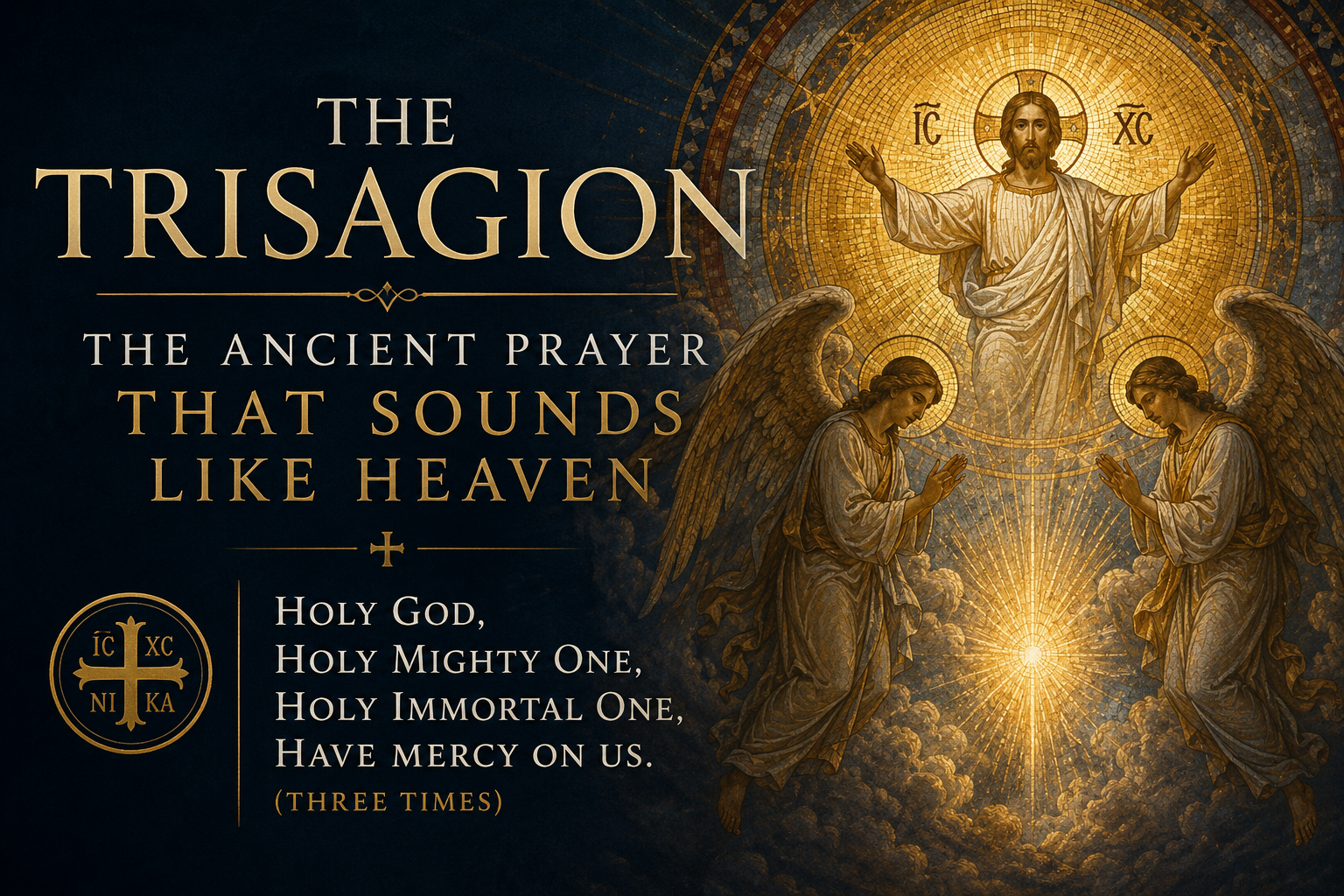
Holy God, Holy Mighty One, Holy Immortal One, have mercy on us.
Traditionally, it is prayed three times.
Those few words contain an entire theology of worship. They confess who God is, acknowledge our complete dependence upon Him, and unite the Church on earth with the worship of heaven.
A Prayer Built Around God
Many of our prayers begin with our needs. We ask for healing, guidance, forgiveness, protection, or peace. These are good and necessary petitions.
The Trisagion begins somewhere deeper.
It begins with God Himself.
“Holy God.”
God is not merely better than us. He is not simply the greatest being in the universe, as though He were one being among many. God is the uncreated source of all that exists. He is infinitely perfect, utterly without sin, and completely worthy of adoration.
The prophet Isaias heard the seraphim crying out:
“Holy, holy, holy, the Lord God of hosts, all the earth is full of his glory.”
— Isaias 6:3
Saint John later received a similar vision of heavenly worship:
“Holy, holy, holy, Lord God Almighty, who was, and who is, and who is to come.”
— Apocalypse 4:8
The threefold proclamation of holiness does not imply that God is holy only three times over. In biblical language, repetition intensifies meaning. God is not simply holy. He is holiness itself.
When Christians pray the Trisagion, we join that heavenly song.
Holy God
The prayer first addresses God as holy.
Holiness means that God is completely set apart from sin, corruption, weakness, and imperfection. Everything good in creation reflects Him, but nothing created can contain or equal His infinite goodness.
The Catechism teaches that God’s holiness is “the inaccessible center of his eternal mystery.” Yet this holy God draws near to us and invites us into communion with Him. He does not merely command us to admire His holiness from a distance. He calls us to share in it.
“Be you therefore perfect, as also your heavenly Father is perfect.”
— Matthew 5:48
The Christian life is the gradual transformation of the human person by grace. God makes sinners into saints—not by erasing their humanity, but by healing and perfecting it.
Holy Mighty One
The second title is “Holy Mighty One.”
God’s power is not the unstable power of an earthly ruler. Human power can be abused, lost, resisted, or overthrown. God’s power is inseparable from His wisdom and goodness.
He does not struggle to maintain control of creation. He gives creation its very existence.
As Saint Paul proclaimed in Athens:
“For in him we live, and move, and are.”
— Acts 17:28
Every heartbeat, every breath, every act of the intellect, and every moment of existence depends upon God.
Calling God “Mighty” is therefore not merely saying that He can perform impressive miracles. It means that He is the foundation of all reality. Nothing exists apart from His sustaining will.
Yet the supreme revelation of divine power appears in a surprising place: the Cross.
Christ conquers not through violence, but through sacrificial love. He defeats death by entering into death. He triumphs over sin by offering Himself for sinners.
The power of God is revealed not only in creating the stars, but in forgiving His enemies.
Holy Immortal One
The third title is “Holy Immortal One.”
Everything we encounter in this world changes. Buildings decay. Technology becomes obsolete. Civilizations rise and fall. Human bodies age and die.
God does not decay, weaken, or pass away.
He is eternal.
God possesses the fullness of life in Himself. He does not receive existence from another. He simply is.
When God revealed His name to Moses, He said:
“I am who am.”
— Exodus 3:14
The Trisagion therefore directs our minds beyond everything temporary. It reminds us that our ultimate hope cannot rest in wealth, political power, popularity, comfort, or technological progress. Every created thing is limited.
Only God is eternal.
Through the Incarnation, the immortal Son of God truly assumed a mortal human nature. Jesus Christ truly suffered and truly died. Yet death could not hold Him.
Saint Peter declared:
“Whom God hath raised up, having loosed the sorrows of hell, as it was impossible that he should be holden by it.”
— Acts 2:24
Because Christ is risen, death is no longer the final word for those united to Him.
Have Mercy on Us
After proclaiming God’s holiness, power, and immortality, the prayer turns toward our condition:
“Have mercy on us.”
This is not despair. It is honesty.
When Isaias saw the holiness of God, he immediately recognized his own sinfulness:
“Woe is me, because I have held my peace; because I am a man of unclean lips.”
— Isaias 6:5
The closer we come to the light, the more clearly we see what must be healed within us.
Mercy is not God pretending that sin does not matter. Mercy is God acting to rescue us from sin. He forgives, heals, restores, and strengthens us through grace.
To ask for mercy is to admit that we cannot save ourselves.
It is also an act of trust.
We ask because God is good.
Why Is It Prayed Three Times?
The Trisagion is traditionally repeated three times as an expression of solemnity and as an act of worship directed to the Most Holy Trinity: Father, Son, and Holy Ghost.
Christians do not believe in three gods. We believe in one God in three divine Persons.
As the Athanasian Creed professes, the Father is God, the Son is God, and the Holy Ghost is God; yet there are not three Gods, but one God.
The threefold prayer trains the heart to remain before this mystery. It slows us down. It prevents the words from becoming merely informational.
The first repetition may come from the lips.
The second begins to engage the mind.
The third may finally descend into the heart.
A Prayer for the Digital Age
The Trisagion may be ancient, but it is especially valuable in an age of constant distraction.
Our screens train us to move rapidly from one piece of information to another. Notifications interrupt thought. Algorithms compete for attention. Even prayer can become hurried.
The Trisagion offers a different rhythm.
It is short enough to memorize, but deep enough to contemplate for a lifetime.
It can be prayed:
- before opening a laptop for work;
- when tempted to anger online;
- after encountering disturbing news;
- before making an important decision;
- during anxiety or spiritual dryness;
- before reading Sacred Scripture;
- or whenever the mind needs to be redirected toward God.
The prayer works almost like a spiritual reset—not because its words are magical, but because they restore the proper order of reality.
God is holy.
God is mighty.
God is immortal.
We are creatures in need of mercy.
That is the truth, regardless of what is trending.
How to Pray the Trisagion
Begin slowly.
Make the Sign of the Cross and place yourself consciously in the presence of God.
Then pray:
Holy God, Holy Mighty One, Holy Immortal One, have mercy on us.
Repeat it three times.
Do not rush. Consider each title.
When saying “Holy God,” adore His infinite perfection.
When saying “Holy Mighty One,” entrust your weakness to His power.
When saying “Holy Immortal One,” remember that He alone is eternal.
When saying “have mercy on us,” place before Him your sins, wounds, fears, family, Church, and world.
The prayer may take less than a minute.
But a minute spent facing eternity is never wasted.
The Song of Earth and Heaven
The Trisagion is more than an ancient formula. It is a school of theology, humility, and adoration.
It teaches us to begin with God rather than ourselves.
It reminds us that divine power is united to goodness, that eternal life is found in Christ, and that sinners may confidently ask for mercy.
Each time we pray it, we stand spiritually beside Isaias, the seraphim, Saint John, the angels, the saints, and generations of Christians who have spoken the same words.
And for a moment, amid the noise of this world, the Church on earth echoes the worship of heaven:
Holy God, Holy Mighty One, Holy Immortal One, have mercy on us.
Sources
Sacred Scripture, Douay-Rheims Bible: Exodus 3:14; Isaias 6:3–5; Matthew 5:48; Acts 2:24; Acts 17:28; Apocalypse 4:8.
Catechism of the Catholic Church, nos. 42–43, 208–209, 253–256, 2809, and 2813.
Saint John Damascene, An Exact Exposition of the Orthodox Faith, Book III.
The Athanasian Creed, Quicumque Vult.