

By CatholicG33K
What if the greatest mystery is not an eye hidden inside our brain, but the spiritual sight that God desires to awaken within our souls?
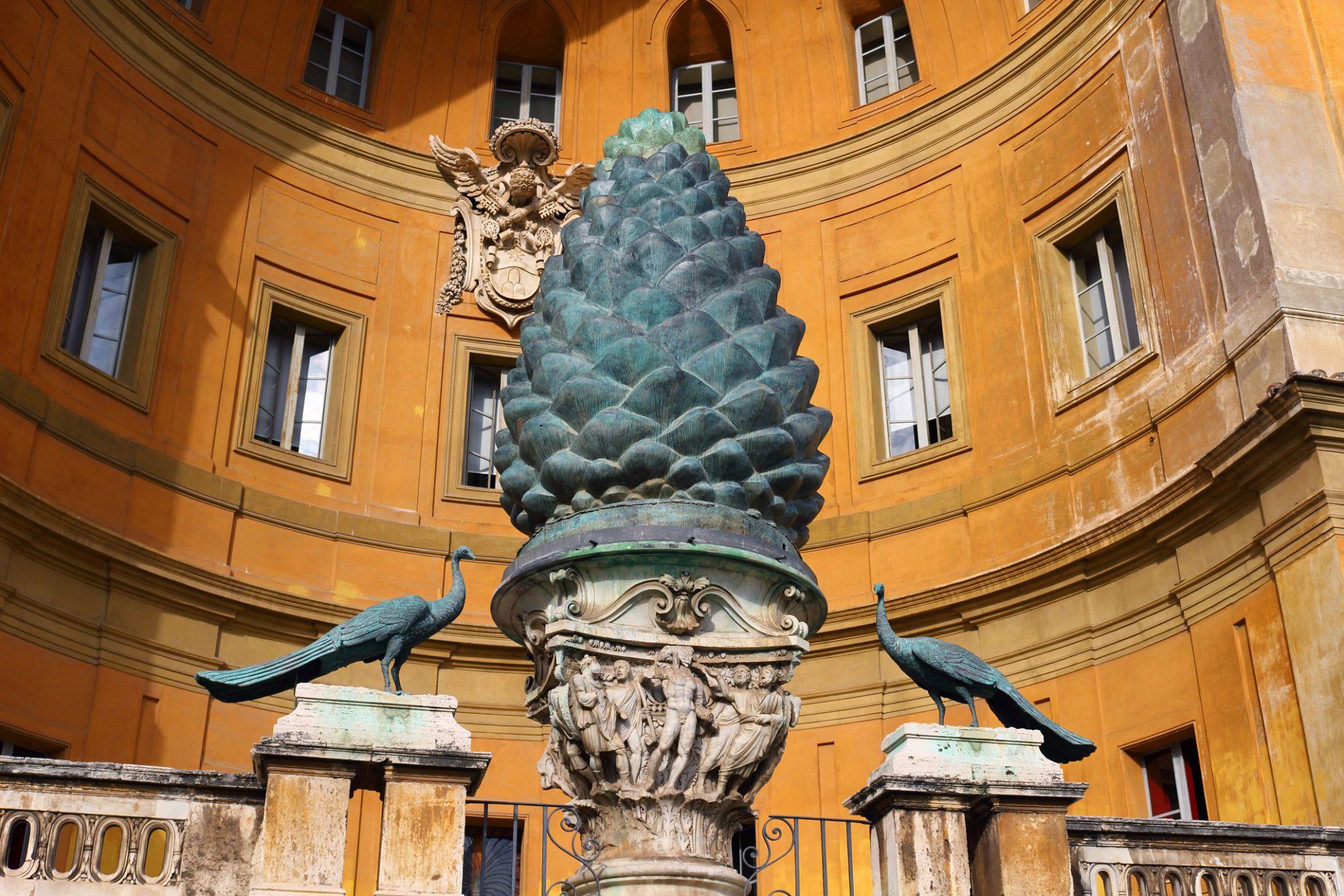
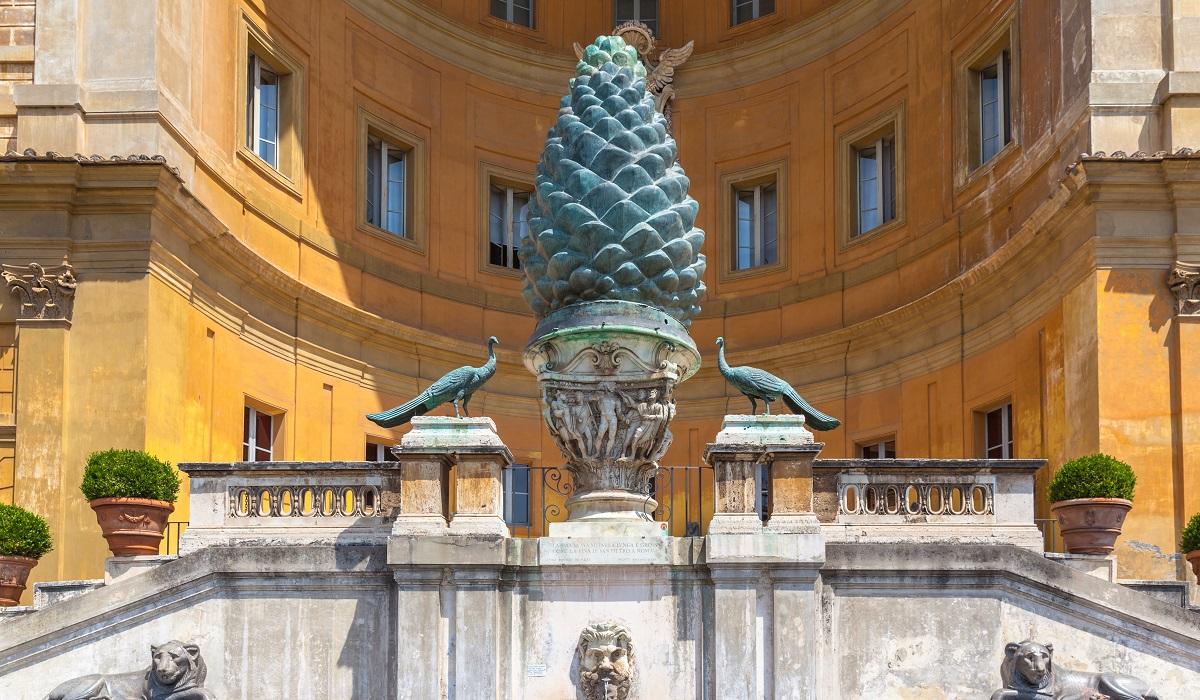
Deep within the Vatican Museums stands an enormous bronze pinecone known as the Pigna.
It is an extraordinary artifact of ancient Rome, created during the first or second century AD. Over the centuries, it became part of the architectural landscape associated with St. Peter’s Basilica before finding its present home in the Vatican’s Courtyard of the Pinecone.
But there is something fascinating about its shape.
Deep within the human brain lies a small endocrine organ called the pineal gland.
The pineal gland derives its name from its resemblance to a pinecone. It produces melatonin, a hormone involved in regulating the body’s sleep-wake cycle.
Throughout the history of philosophy and spirituality, some thinkers have associated this gland with consciousness, the soul, or what later traditions call the third eye.
These connections invite a question:
Does Scripture speak of another kind of sight—one that belongs not merely to the physical eyes but to the spiritual life of the human person?
The answer is yes.
However, to understand this mystery, we must distinguish historical symbolism, human anatomy, and the actual teachings of Jesus Christ.
1. THE EYE THAT CHRIST SPOKE ABOUT
Jesus says something remarkable in the Gospel of Matthew:
“The light of thy body is thy eye. If thy eye be single, thy whole body shall be lightsome.” — Matthew 6:22, Douay-Rheims
Read those words carefully.
Christ speaks of an eye that must be single.
What does that mean?
He is not giving a scientific description of a hidden organ in the brain, nor instructing His followers to activate an occult faculty.
He is teaching about the interior condition of the human person.
In Matthew 6:19–24, Jesus speaks about heavenly treasures, the heart, spiritual light, and the impossibility of serving both God and mammon.
The single eye points toward an undivided interior orientation: a life directed toward God rather than divided by competing masters.
A person can possess perfect physical eyesight while remaining spiritually blind.
A person can understand the material world and yet fail to recognize divine truth.
The real question, then, is not simply:
What are my eyes looking at?
It is:
What is illuminating my soul?
2. THE EYES OF THE HEART
St. Paul takes this mystery even deeper.
In Ephesians 1:17–18, he prays that God will grant believers the spirit of wisdom and revelation in the knowledge of Him, enlightening the eyes of their hearts so that they may understand the hope of His calling.
Notice the extraordinary language.
The heart has eyes.
Not anatomical eyes.
Not an additional physical organ.
Rather, St. Paul speaks of a supernatural understanding made possible through divine grace.
This is where the Christian understanding of spiritual illumination becomes especially profound.
In Catholic theology, faith is not an invisible force we manufacture through secret exercises.
It is a supernatural gift from God.
God elevates the human intellect through faith and moves the human will through grace.
We begin to perceive reality in relation to its ultimate source: God Himself.
The Catechism of the Catholic Church, paragraph 2563, describes the heart as the person’s hidden center, the place of truth, decision, encounter, and covenant.
In other words, the deepest center of our spiritual existence is not reducible to a physical location within the brain.
It is the interior life of the person called into communion with God.
3. THE PINEAL GLAND AND THE THIRD EYE
The pineal gland occupies a position deep within the brain and is associated with the regulation of circadian rhythms.
Certain philosophical and esoteric traditions have interpreted it as a center of spiritual perception.
The philosopher René Descartes, writing in the seventeenth century AD, famously associated the pineal gland with interactions between mind and body.
But an important distinction must be made.
There is no established anatomical or scientific evidence that the human pineal gland enables supernatural sight, and there is no established historical evidence that the Vatican’s ancient pinecone was designed to symbolize that gland.
The Bible does not identify the pineal gland as a third eye.
Nevertheless, a physical resemblance can inspire a meaningful theological reflection without becoming a historical claim or a doctrine of the Church.
The pinecone can serve as a reminder to look beyond appearances, examine the human longing for spiritual understanding, and ask where genuine illumination originates.
For Christians, the answer is not a hidden biological mechanism.
It is Jesus Christ.
4. CHRIST IS THE TRUE LIGHT
In the Gospel of John, Jesus declares:
“I am the light of the world: he that followeth me, walketh not in darkness, but shall have the light of life.” — John 8:12, Douay-Rheims
This changes everything.
Christian enlightenment is not fundamentally the discovery of secret powers within ourselves.
It is receiving the light of Christ.
Consider the healing of the man born blind in John 9.
Jesus restores his physical eyesight, but the miracle points toward something still greater: the revelation of His identity and the awakening of faith.
The man eventually confesses his belief in Jesus and adores Him (John 9:38).
He receives more than the ability to distinguish light from darkness.
He comes to recognize the Lord.
This is the transformation that the Christian spiritual life seeks.
The greatest blindness is not the inability to see the physical world. It is the refusal to receive the truth God reveals.
And the greatest illumination is not possession of extraordinary sensations or visions.
It is knowing and loving God.
5. THE INNER EYE IN THE CHRISTIAN TRADITION
The Church has long spoken of spiritual vision and contemplation.
St. Augustine writes:
“Thou hast made us for Thyself, and our heart is restless until it rests in Thee.” — Confessions, I, 1, 1
The human person is created for something beyond material existence.
Our intellect seeks truth.
Our will seeks goodness.
Our hearts seek a happiness that finite things cannot fully satisfy.
St. Thomas Aquinas explains that humanity’s ultimate happiness consists in the vision of the divine essence (Summa Theologiae, I–II, q. 3, a. 8).
This is called the Beatific Vision.
It is not physical vision through the eyes, nor a power produced by the pineal gland.
It is the supernatural knowledge of God granted to the blessed in heaven.
This gives us a genuinely Catholic understanding of ultimate spiritual sight.
The destination of the human soul is not merely to look inward.
It is to behold God.
As St. Paul writes:
“We see now through a glass in a dark manner; but then face to face.” — 1 Corinthians 13:12, Douay-Rheims
Here lies the deepest mystery of illumination.
We live by faith now.
We hope for the fullness of vision in eternity.
6. THE VATICAN PINECONE AS A SYMBOLIC MEDITATION
Return for a moment to the great bronze pinecone in the Vatican.
Historically, it is an ancient Roman work. It was not created as an official Christian teaching about the brain, and the Vatican does not present it as a secret map to spiritual enlightenment.
Yet an ordinary object can become an occasion for contemplating extraordinary truths.
The pinecone contains seeds, evoking the beginning of new life.
Scripture repeatedly uses the imagery of seeds to express the mysteries of growth, death, resurrection, and God’s kingdom.
Jesus says:
“Unless the grain of wheat falling into the ground die, itself remaineth alone. But if it die, it bringeth forth much fruit.” — John 12:24, Douay-Rheims
The original passage concerns a grain of wheat, not a pinecone. But the broader natural imagery can lead us to contemplate spiritual growth.
The seed reminds us that new life often begins in hiddenness.
So does the life of grace.
God can work within a soul long before that transformation becomes visible to others.
The pinecone may remind us of hidden life.
The eye may remind us of spiritual perception.
The light may remind us of divine truth.
But Christ—not the symbol—is the source of salvation.
7. THE REAL AWAKENING
What, then, should a Catholic think when encountering discussions of the third eye?
First, we should recognize that spiritual language can carry different meanings in different religious and philosophical traditions.
Second, we should avoid confusing those traditions with the teaching of Jesus Christ.
And third, we should rediscover the profound language of spiritual sight already present in Scripture and Catholic spirituality.
The Catechism, paragraph 2715, teaches that contemplation is a gaze of faith fixed upon Jesus. His light purifies the heart and illuminates our interior vision.
This is not a technique for unlocking a secret organ.
It is a relationship with the living God.
The Christian path of illumination is found in prayer, repentance, the sacraments, charity, and faithful union with Christ.
The Holy Spirit grants wisdom, understanding, knowledge, and the other gifts that perfect the Christian life (Isaiah 11:2–3; Catechism, 1831).
No hidden anatomical awakening can replace sanctifying grace.
No extraordinary spiritual experience can replace the Eucharist.
And no supposed secret knowledge can surpass the revelation of God in Jesus Christ.
FINAL REFLECTION: OPEN THE EYES OF MY HEART, LORD
Perhaps the most beautiful question inspired by the Vatican pinecone is not whether the Church concealed knowledge of a third eye.
Perhaps the deeper question is why human beings, across so many centuries, have yearned to perceive a reality beyond what their physical senses reveal.
Christianity answers that longing with a person.
Jesus Christ.
He opens the eyes of the blind.
He enlightens the minds of His disciples.
He reveals the Father.
He conquers death.
And He promises His faithful the unimaginable fulfillment of seeing God face to face.
The pinecone may awaken our curiosity.
The brain may reveal the wonder of God’s creation.
The language of the inner eye may stir our imagination.
But Scripture reveals the truth toward which Christian contemplation is directed:
We were not created merely to discover a hidden eye within ourselves. We were created to know, love, and behold the living God.
“For with thee is the fountain of life; and in thy light we shall see light.” — Psalm 35:10, Douay-Rheims (Psalm 36:9 in many modern Bibles).
A PRAYER FOR SPIRITUAL SIGHT
Lord Jesus Christ,
Open the eyes of my heart.
Remove the darkness of sin, pride, and confusion.
Grant me the wisdom to distinguish Your truth from human speculation.
Purify my intentions, strengthen my faith, and fill my soul with the light of Your Holy Spirit.
May I seek neither hidden power nor extraordinary knowledge for its own sake, but the grace to know You, love You, and follow You.
And when my earthly journey is complete, grant that I may behold You face to face.
Amen.
CATHOLICG33K
Faith seeks understanding. Scripture illuminates the mind. Christ transforms the soul.
References: Douay-Rheims Bible: Matthew 6:19–24; Luke 11:34–36; John 8:12; John 9; John 12:24; Ephesians 1:17–18; 1 Corinthians 13:12; Psalm 35:10; Isaiah 11:2–3. Catechism of the Catholic Church, 2563, 2709–2719, 1831. St. Augustine, Confessions, I, 1, 1. St. Thomas Aquinas, Summa Theologiae, I–II, q. 3, a. 8. Vatican Museums, The Pinecone Returns to the Niche of the Belvedere, September 30, 2020.