

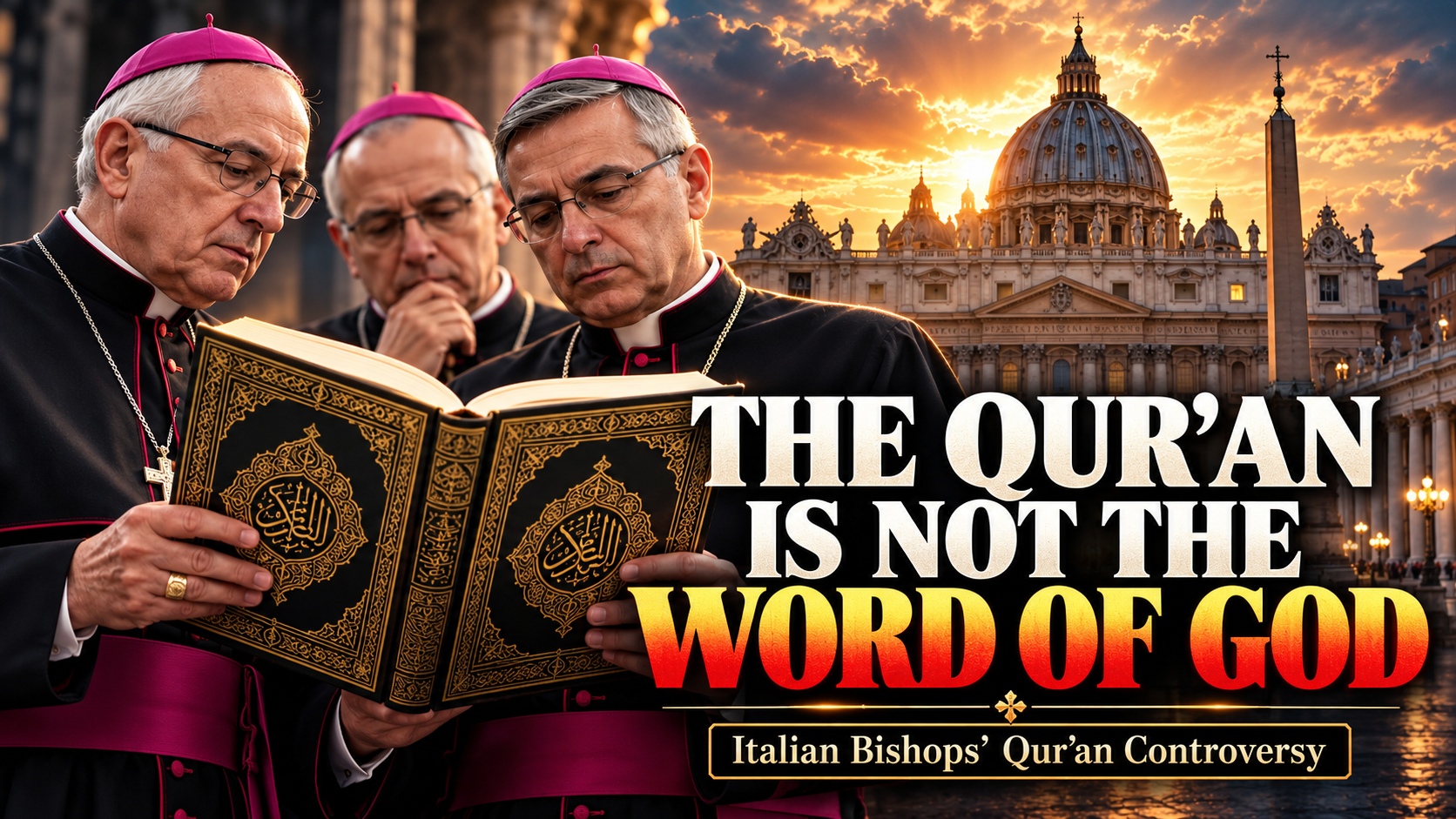
Why Catholics must reject religious relativism, demand doctrinal clarity, and distinguish actual Church teaching from misleading headlines.
October 30, 2026 | Catholic Commentary and Analysis
A Controversy That Demands the Truth
On October 30, 2026, End Time Headlines published an article titled “Italian Bishops Promoting the Qur’an as the ‘Revealed Word of God’?”
The report questioned whether educational materials promoted by the Italian Bishops’ Conference were presenting the Qur’an as genuine divine revelation.
This is a serious matter. If Catholic bishops were actually teaching that the Qur’an is the inspired Word of God, such teaching would contradict the Catholic faith.
The Catholic Church cannot acknowledge as divine revelation a religious text that contradicts the definitive revelation of God in Jesus Christ.
However, Catholic apologetics requires intellectual honesty. We must examine what was actually published, distinguish questionable language from formal doctrinal teaching, and correct errors without manufacturing accusations.
1. What Did the Italian Bishops Actually Publish?
The Italian Bishops’ Conference (CEI), collaborating with the Pontifical Institute for Arabic and Islamic Studies (PISAI), developed eleven educational fact sheets titled Schede per conoscere l’Islam (Factsheets for Understanding Islam).
The materials were originally presented in November 2025 and publicly presented again on October 21, 2026, with Cardinal Matteo Zuppi participating.
The fourth document bears this unmistakable heading:
“IL CORANO: PAROLA RIVELATA DI DIO”
Translated:
“The Qur’an: Revealed Word of God.”
That is the actual title. It is neither invented nor fabricated.
Moreover, the opening paragraphs describe the Islamic understanding of God’s Word becoming accessible through the recitation and reading of the Qur’an. These explanations initially lack an explicit qualification identifying them as Muslim beliefs.
Only afterward does the document introduce the phrase “Secondo l’Islam” — “According to Islam.”
This distinction is important.
A theological explanation of what Muslims believe is legitimate. Presenting that belief as an unqualified Christian assertion would not be.
Catholic educators should make that distinction unmistakable from the beginning, especially when dealing with divine revelation.
2. What the Reports Leave Out
The ninth fact sheet, titled Christianity and Islam: Convergences and Divergences, provides crucial additional context.
It begins its comparison of sacred texts with the potentially confusing statement:
“Corano e Bibbia rappresentano la ‘Parola di Dio’.”
In English, this presents the Qur’an and Bible as representing the Word of God.
Taken alone, this formulation is theologically problematic.
But the very same section immediately distinguishes the Islamic understanding of the Qur’an from the Christian understanding of Scripture and the Incarnate Word.
Most importantly, it explicitly states:
“Per questo il Cristianesimo non può contemplare altre rivelazioni ‘pubbliche’ di Dio.”
In other words, Christianity cannot recognize additional public revelations of God.
The document also identifies Jesus Christ as the eternal Word made flesh.
This means the materials contain language that legitimately deserves criticism, but they also explicitly affirm a central Catholic teaching that contradicts the claim that the Qur’an is a new Christian revelation.
Ignoring that qualification produces an incomplete and potentially misleading accusation.
3. The Catholic Church Has Already Settled This Question
The Catholic Church does not teach that the Qur’an is divinely inspired Scripture.
This is not an undecided theological question.
The Gospel of St. John declares:
“And the Word was made flesh, and dwelt among us.” — John 1:14, Douay-Rheims
The eternal Word of God is Jesus Christ, the Second Person of the Most Holy Trinity.
The Second Vatican Council taught in Dei Verbum, paragraph 4, that Jesus Christ brought divine revelation to its completion and that no further new public revelation is expected before His glorious return.
The Catechism of the Catholic Church, paragraphs 65–67, teaches the same doctrine.
Furthermore, the Congregation for the Doctrine of the Faith declared in Dominus Iesus, paragraph 8, that the designation of divinely inspired texts belongs to the canonical Scriptures of the Old and New Testaments.
Consequently, no Catholic may treat the Qur’an as another inspired book alongside the Bible.
The Qur’an may contain certain truths. That does not make it inspired Scripture.
Recognizing an element of truth within another religion is entirely different from acknowledging that religion’s sacred text as supernatural revelation.
To confuse these categories is to misunderstand Catholic theology.
4. Why the Qur’an Cannot Be Accepted as Divine Revelation
Christianity and Islam make fundamentally incompatible claims concerning Jesus Christ.
Catholicism professes that Jesus Christ is the eternal Son of God, consubstantial with the Father, truly God and truly man.
Islam rejects His divinity and divine Sonship.
Catholicism proclaims the historical Crucifixion, atoning death, and bodily Resurrection of Christ.
The Qur’an, particularly Surah 4:157, denies that Jesus was killed by crucifixion as Christians profess.
These are not minor theological disagreements.
They concern the very identity and saving work of Jesus Christ.
Both contradictory claims cannot be true in the same sense.
Jesus Himself declared:
“I am the way, and the truth, and the life. No man cometh to the Father, but by me.” — John 14:6, Douay-Rheims
It follows that Catholicism cannot affirm a purported revelation that contradicts the revelation definitively given in Christ.
This conclusion does not justify hostility toward Muslims. It simply demands fidelity to divine truth.
5. Respecting Muslims Does Not Require Religious Relativism
Some Catholics mistakenly believe that interreligious dialogue requires avoiding fundamental doctrinal disagreements.
It does not.
The Second Vatican Council’s declaration Nostra Aetate, paragraph 3, urges Christians and Muslims toward mutual understanding, respect, and cooperation.
But nowhere does it declare that Islam and Christianity are equally valid revelations or that the Qur’an is inspired Scripture.
Indeed, Nostra Aetate, paragraph 2, reaffirms the Church’s obligation to proclaim Jesus Christ as the fullness of religious life.
The Church can recognize what is true and good among Muslims while rejecting doctrines contrary to the Gospel.
Respect is not agreement.
Dialogue is not doctrinal surrender.
True charity never requires pretending that theological contradictions do not exist.
6. A Necessary Rebuke: Catholic Leaders Must Speak Clearly
Although the materials contain an explicit acknowledgment of Christianity’s definitive revelation, their presentation deserves serious scrutiny.
Why should a document prepared under Catholic episcopal sponsorship use an unqualified heading that can reasonably be interpreted as affirming the Qur’an as God’s revealed Word?
Why should readers have to search through a separate fact sheet to discover the necessary theological qualification?
Educational resources about religion must carefully distinguish between describing another faith and affirming its doctrinal claims.
This is especially important when Catholics and Muslims jointly prepare the material.
Catholic bishops are successors of the Apostles and guardians of the deposit of faith. Their responsibility is not merely to encourage mutual understanding but to safeguard and clearly proclaim the truth entrusted to the Church.
St. Paul instructed St. Timothy:
“Keep the good thing committed to thy trust by the Holy Ghost, who dwelleth in us.” — 2 Timothy 1:14, Douay-Rheims
This obligation does not disappear in the name of religious dialogue.
Catholic bishops should clarify explicitly that the Qur’an is regarded as revelation by Muslims but is not accepted as divinely inspired revelation by the Catholic Church.
Such clarification would protect Catholic teaching while treating Muslims honestly.
7. A Necessary Correction to the Media Narrative
The controversy surrounding the Italian Bishops’ Conference demands accuracy, transparency, and an unwavering commitment to Catholic doctrine.
On October 29, 2026, Vincenzo Corrado, director of the CEI’s National Office for Social Communications, publicly rejected allegations that the Italian bishops were attempting to introduce Islamic religious instruction into Italian schools.
Corrado characterized those allegations as “fake news.”
He explained that the educational fact sheets were intended as reference materials for publishers of Catholic religious education textbooks, not as a replacement for Catholic teaching.
However, an important distinction must be made.
Corrado’s clarification addressed allegations concerning Islamic religious instruction in schools. It did not directly address the theological controversy surrounding the document titled “Il Corano: Parola Rivelata di Dio” — “The Qur’an: Revealed Word of God.”
Consequently, it would be inaccurate to claim that the bishops provided no clarification whatsoever. But it would be equally inaccurate to suggest that their statement resolved every legitimate theological concern raised by these materials.
The fundamental question remains:
Why would Catholic educational materials employ language that appears to identify the Qur’an as divine revelation without immediately and unmistakably clarifying that this is an Islamic belief, not Catholic doctrine?
The distinction is not trivial.
The Catholic Church definitively teaches that God’s public revelation reaches its fullness in Jesus Christ and that no further public revelation is expected before His glorious manifestation (Dei Verbum, 4; CCC 65–67).
Furthermore, the Congregation for the Doctrine of the Faith explicitly affirms in Dominus Iesus, paragraph 8, the unique divine inspiration of the canonical Scriptures of the Old and New Testaments.
Therefore, the Qur’an cannot be presented as divinely inspired revelation within Catholic theology.
At the same time, the evidence examined does not establish that the Italian Bishops’ Conference has formally adopted the Qur’an as inspired Scripture. Indeed, another document within the same educational series explicitly acknowledges that Christianity cannot accept additional public revelation.
That acknowledgment is important, but it does not eliminate the responsibility to correct confusing or misleading theological language.
Catholic bishops have a sacred obligation to teach the faith clearly, guard the deposit of revelation, and protect the faithful from doctrinal confusion.
Catholics are justified in respectfully demanding clarification when episcopally sponsored educational materials appear to blur essential distinctions between Christianity and Islam.
Yet legitimate criticism must remain grounded in documented facts rather than sensationalism or unsupported accusations of heresy.
The faithful should neither excuse theological ambiguity in the name of interreligious dialogue nor manufacture accusations that the evidence does not support.
We must demand both doctrinal fidelity and intellectual honesty.
For Catholic apologetics, the standard must always remain the same:
Defend the truth without compromise. Correct errors without exaggeration. And never sacrifice the clarity of Christ’s revelation for the sake of religious diplomacy.
Respect for Muslims is entirely compatible with firmly proclaiming that Jesus Christ alone is the definitive revelation of God.
That is not intolerance.
That is fidelity to the Catholic faith.
8. The Church Must Proclaim Christ, Not Equate Him With Other Religious Claims
The Church’s mission was never simply to facilitate religious coexistence.
Jesus commanded His Apostles to teach all nations and baptize them in the name of the Father, and of the Son, and of the Holy Ghost (Matthew 28:19).
Peaceful dialogue has an important place in this mission, but it cannot replace the proclamation of the Gospel.
In Dominus Iesus, paragraphs 5–8 and 21–22, the Church reaffirmed the fullness of revelation in Jesus Christ, the unique character of biblical inspiration, and the necessity of avoiding religious indifferentism.
Catholics must never abandon these truths.
We do not honor Muslims by misrepresenting their religion, and we do not honor Christ by diminishing the uniqueness of His divine revelation.
Both honesty and charity demand that we speak plainly.
Conclusion: Jesus Christ Is the Definitive Word of God
This controversy presents two dangers.
The first is religious relativism — language or teaching that blurs the essential distinction between the revelation of Jesus Christ and religious claims that contradict Him.
The second is misrepresentation — accusing Church authorities of formally teaching something that the evidence does not establish.
Both must be rejected.
The Italian bishops’ educational materials contain formulations that warrant clarification and improvement. But those same materials also affirm that Christianity recognizes no additional public revelation beyond the definitive revelation of Christ.
The faithful have every right to expect clarity from their shepherds, especially on matters touching the identity of Jesus Christ and the authority of divine revelation.
The Church does not need to compromise the Gospel to dialogue with the world.
The Qur’an is not inspired Scripture. Muhammad is not a prophet recognized by the Catholic Church as bringing divine revelation. Jesus Christ is not merely one prophet among many. He is the eternal Son of God, the Word made flesh, the crucified and risen Savior of mankind.
Catholics can respect Muslims, reject prejudice, encourage peace, and defend human dignity without surrendering a single truth of the Catholic faith.
The mission of the Church is not to make Christ one religious voice among others. It is to proclaim Jesus Christ, the fullness of divine revelation and the only Savior of the world.
Sources & References
1. Italian Bishops’ Conference (CEI) and Pontifical Institute for Arabic and Islamic Studies (PISAI). Schede per conoscere l’Islam, Sheet 4: “Il Corano: Parola Rivelata di Dio” (“The Qur’an: Revealed Word of God”), 2025, p. 1.
Original document:
https://unedi.chiesacattolica.it/wp-content/uploads/sites/32/2025/11/10/4-IlCoranoparolarivelatadiDio.pdf
2. Italian Bishops’ Conference (CEI) and PISAI. Schede per conoscere l’Islam, Sheet 9: “Cristianesimo e Islam: Convergenze e Divergenze” (“Christianity and Islam: Convergences and Divergences”), 2025, pp. 1–2.
Original document:
https://irc.chiesacattolica.it/wp-content/uploads/sites/29/2025/11/13/9-CristianesimoeIslam-convergenzeedivergenze.pdf
3. Italian Bishops’ Conference — National Service for Catholic Religious Education. “CEI e PISAI, ecco le Schede per conoscere l’Islam.” Official publication and collection of the eleven educational documents, November 2025.
https://irc.chiesacattolica.it/cei-e-pisai-ecco-le-schede-per-conoscere-lislam
4. Vatican News. “Contro i muri del pregiudizio, CEI e Pisai presentano le Schede per conoscere l’islam,” October 22, 2026. Reporting on the presentation attended by Cardinal Matteo Zuppi.
5. AgenSIR — Italian Catholic News Agency. “Islam: Corrado (CEI), ‘c’è un nome per tutto ciò: fake news’,” October 29, 2026. Statement by Vincenzo Corrado clarifying the purpose of the educational materials.
6. Second Vatican Council. Dei Verbum, Dogmatic Constitution on Divine Revelation, November 18, 1965, §4. Affirms Jesus Christ as the fullness of divine revelation and that no further public revelation is expected.
7. Congregation for the Doctrine of the Faith. Dominus Iesus, Declaration on the Unicity and Salvific Universality of Jesus Christ and the Church, August 6, 2000, especially §§5–8. Reaffirms Christ’s definitive revelation and reserves divine scriptural inspiration to the canonical Old and New Testaments.
8. Second Vatican Council. Nostra Aetate, Declaration on the Relation of the Church to Non-Christian Religions, October 28, 1965, §§2–3. Explains the Church’s respect for Muslims while maintaining the necessity of proclaiming Jesus Christ.
9. Catechism of the Catholic Church. §§65–67, “Christ Jesus — Mediator and Fullness of All Revelation.” Affirms that Jesus Christ is God’s definitive Word and that no new public revelation is expected.
10. Sacred Scripture — Douay-Rheims Bible. John 1:1–14; John 14:6; Matthew 28:19–20; Hebrews 1:1–2; 2 Timothy 1:14.
Editorial Note: Quotations from the Italian-language documents have been translated into English. The original Italian documents are linked above for independent verification. Descriptions of Islamic belief in the CEI–PISAI materials should be distinguished from formal doctrinal affirmations of the Catholic Church.
Original Article from Endtimes Headlines