

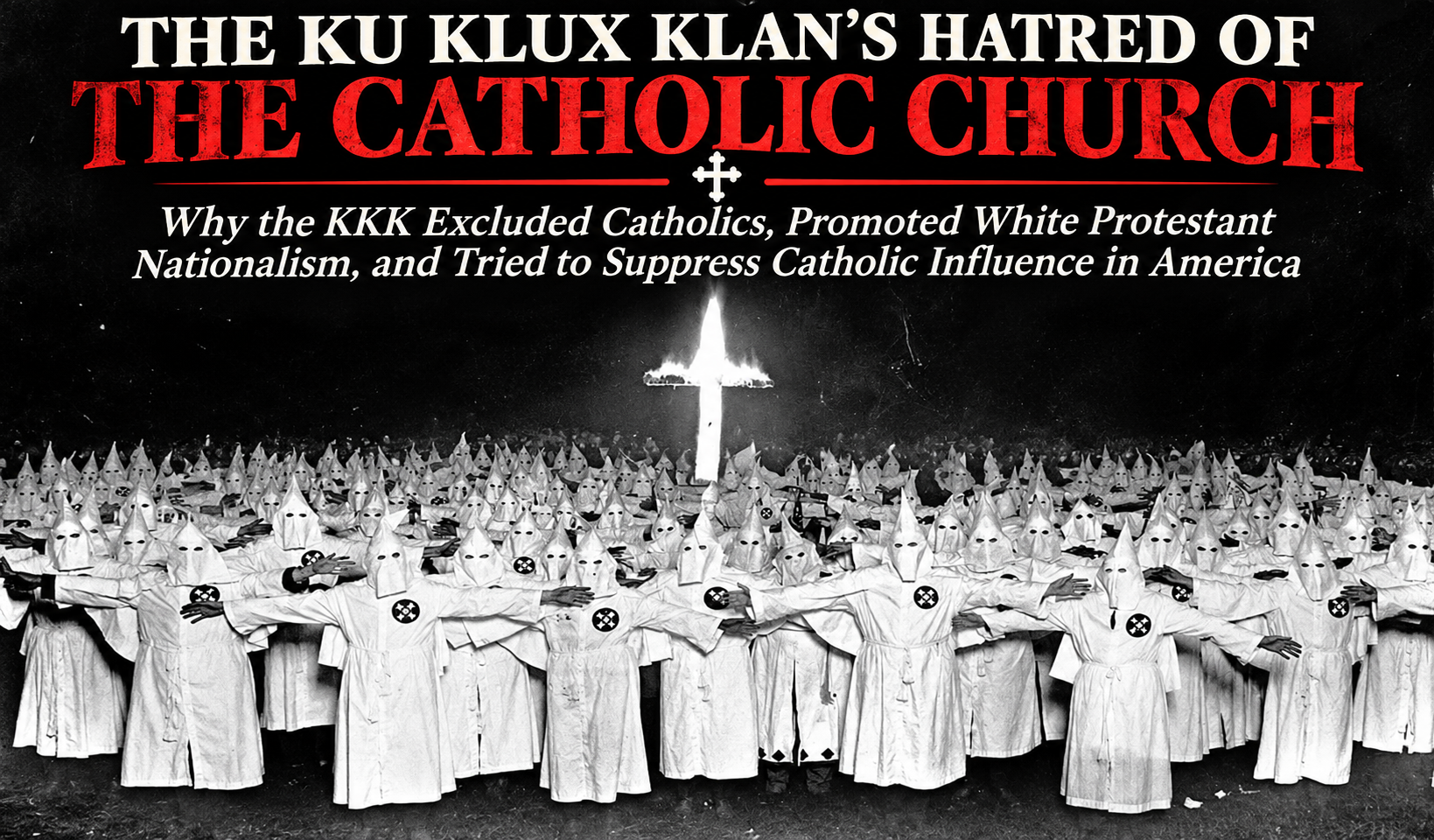
Why the KKK Excluded Catholics, Promoted White Protestant Nationalism, and Tried to Suppress Catholic Influence in America
INTRODUCTION: THE FORGOTTEN HISTORY OF ANTI-CATHOLICISM IN AMERICA
The Ku Klux Klan (KKK) was not only a white supremacist organization but also a fiercely anti-Catholic movement. During the 1920s, the KKK considered the Catholic Church one of its greatest enemies. It spread false accusations that Catholics were loyal to the pope instead of America, promoted hostility toward Catholic immigrants, intimidated Catholic communities, and supported efforts to eliminate Catholic schools. The Klan also opposed Catholic political candidates, including Al Smith, the first Catholic nominated for president by a major American political party in 1928.
The KKK’s hatred of Catholicism reveals that its ideology was rooted not only in racism but also in religious bigotry and intolerance. Its persecution of Catholics stands as a dark chapter in American history and a reminder of the importance of defending religious liberty.
Yet one of the most revealing aspects of this history is often overlooked: the Klan excluded Catholics even when they were white, native-born American citizens.
Why?
Because the revived Ku Klux Klan of the early twentieth century believed that genuine American identity required more than citizenship or loyalty to the Constitution. Its ideal American was white, native-born, Protestant, and committed to what the movement regarded as traditional American culture.
Catholics did not fit that definition.
To the Klan, the Catholic Church represented a religious institution whose spiritual allegiance to the pope allegedly threatened American independence. Catholic schools, immigrants, religious communities, and political candidates were therefore treated as potential dangers to the nation’s Protestant character.
The Klan’s anti-Catholicism was not confined to theological disagreement. It became an organized campaign of religious exclusion, political propaganda, intimidation, and efforts to restrict Catholic institutions.
Understanding this history requires examining the rise of the Second Ku Klux Klan, its membership requirements, its religious propaganda, and its confrontations with Catholic Americans.
It also requires asking a deeper question:
How could an organization claiming to defend Christianity use Christian symbols while advocating racial supremacy and hostility toward fellow Christians?
The historical evidence reveals a profound contradiction between the Klan’s religious nationalism and the universal dignity of the human person proclaimed by Christianity.
1. THE RISE OF THE KU KLUX KLAN AND ITS ANTI-CATHOLIC IDEOLOGY
The original Ku Klux Klan emerged in Pulaski, Tennessee, in AD 1865, after the American Civil War.
Its earliest incarnation became a violent white supremacist organization dedicated to overturning Reconstruction and preventing formerly enslaved African Americans from exercising their newly recognized political and civil rights.
Klan members used intimidation, assault, and murder to reinforce white dominance, particularly in the former Confederate states.
The original Klan’s central objective was racial and political domination.
Although anti-Catholic prejudice already existed in nineteenth-century America, it was not the central organizing feature of the first Klan in the way it would become for the revived organization.
That transformation began in AD 1915.
William Joseph Simmons founded a new Ku Klux Klan in Georgia, drawing inspiration from romanticized accounts of the original organization, white supremacist ideology, and the enormous popularity of D. W. Griffith’s film The Birth of a Nation.
The revived organization expanded its list of perceived enemies.
African Americans remained central targets of racial hatred, but the movement also directed hostility toward Jews, Catholics, immigrants, and others who did not conform to its preferred national identity.
During the early and middle 1920s, the Second Klan grew into a national movement with several million members.
Its influence reached far beyond the American South.
It became especially powerful in states such as Indiana and Oregon, while establishing a presence throughout much of the Midwest, West, and Northeast.
The organization used parades, rallies, cross burnings, propaganda, social pressure, and political organizing to advance its ideology.
The Second Klan sought to define who counted as a genuine American—and Catholics were deliberately placed outside that definition.
This distinction is historically important. The anti-Catholic membership rules and campaigns examined here belong especially to the Second Klan of the 1920s. The original Reconstruction-era Klan and later Klan organizations differed in structure and emphasis.
Historical references: Thomas R. Pegram, One Hundred Percent American (2011); Linda Gordon, The Second Coming of the KKK (2017); Kelly J. Baker, Gospel According to the Klan (2011).
2. WHY THE KLAN ONLY ADMITTED WHITE PROTESTANTS
The Klan’s exclusion of Catholics was not merely a matter of individual prejudice among its members.
It was built into the revived organization’s formal membership requirements.
The Second Klan presented itself as a fraternal brotherhood of white, native-born, Gentile Protestant Americans.
In a statement reported on August 29, 1924, Imperial Wizard Hiram Wesley Evans described the requirements for membership. Applicants had to be:
“native-born, white, gentile protestant American citizens”
The statement also required good moral character.
The Klansman’s Manual of 1925 similarly described the organization as a brotherhood of native-born white Gentile men who owed no allegiance to foreign governments, institutions, rulers, or persons.
These restrictions excluded several groups simultaneously.
African Americans were rejected because of race. Jews were excluded because of religious and ethnic identity. Foreign-born immigrants were generally excluded from ordinary membership in the central male organization. Catholics were rejected because they did not meet its Protestant religious requirement.
Even a white Catholic born in the United States, whose family had lived in America for generations, could not satisfy that religious qualification.
The Klan also maintained separate affiliated organizations, including organizations for women, without abandoning its broader commitment to racial and religious exclusion.
This reveals something essential about its ideology.
For the Klan, being white was not enough. Being American was not enough. A man also had to conform to the organization’s preferred Protestant religious identity.
Catholicism was therefore treated not simply as a different Christian tradition but as a disqualifying characteristic.
A Catholic could serve in the armed forces, pay taxes, vote, obey the law, and demonstrate devotion to the United States, yet still be regarded by the Klan as religiously unfit for membership in its supposed patriotic brotherhood.
Primary references: Hiram Wesley Evans, statement reported August 29, 1924; Knights of the Ku Klux Klan, Klansman’s Manual (1925).
3. THE KLAN’S FALSE CLAIM THAT CATHOLICS WERE LOYAL TO THE POPE INSTEAD OF AMERICA
One of the most persistent themes in Klan propaganda was the allegation that Catholics could not be trusted as American citizens because of their allegiance to the pope.
Klan leaders portrayed the papacy as a foreign political power seeking to control American institutions.
They claimed that Catholic citizens might obey the pope rather than the Constitution, follow instructions from Rome instead of American law, or place Catholic interests above national interests.
These accusations exploited an important misunderstanding of Catholic ecclesiastical authority.
Spiritual authority is not the same as civil government.
The Catholic Church recognizes the pope as the successor of St. Peter and the visible head of the Church on earth.
His pastoral and doctrinal authority concerns the Church’s mission, teaching, discipline, and governance.
This does not mean that ordinary American Catholics must surrender their civic responsibilities to a foreign government.
Catholic doctrine recognizes legitimate civil authority and teaches that citizens have real obligations toward their communities and nations.
Our Lord Jesus Christ teaches:
“Render therefore to Caesar the things that are Caesar’s; and to God, the things that are God’s.”
— Matthew 22:21, Douay-Rheims
St. Paul likewise instructs Christians to respect legitimate governing authority in Romans 13:1–7.
The Catechism affirms the moral duties of citizens toward civil society while also recognizing that no earthly government possesses unlimited authority over conscience.
The Klan’s propaganda largely ignored such distinctions.
Instead, it treated Catholic religious identity as evidence of potential political disloyalty.
This accusation could be applied indiscriminately to Catholic immigrants and native-born citizens alike.
It was not necessary for a Catholic to have committed any act of disloyalty.
Simply belonging to the Catholic Church was enough to generate suspicion.
The Klan confused religious allegiance with political treason, turning Catholic identity into a supposed threat to American patriotism.
Catholic sources: Matthew 22:21; Romans 13:1–7; Catechism of the Catholic Church (CCC), 2238–2243.
Historical references: Klansman’s Manual (1925); Mark Paul Richard, Not a Catholic Nation (2015).
4. WHITE PROTESTANT NATIONALISM AND THE MYTH OF “100% AMERICANISM”
The Second Klan promoted an ideology commonly called 100% Americanism.
Its conception of American identity was more restrictive than citizenship under the Constitution.
It associated authentic Americanism with white ancestry, Protestant religion, native birth, and conformity to its preferred social traditions.
Catholics challenged this worldview because Catholicism was a major Christian tradition outside Protestantism.
The Church maintained its own ecclesiastical hierarchy, schools, hospitals, universities, religious communities, charities, and devotional practices.
These institutions allowed Catholic Americans to preserve their religious identity while participating in American society.
But the Klan portrayed Catholic independence as suspicious.
Catholic communities were accused of maintaining foreign loyalties, resisting assimilation, and threatening the country’s supposed Protestant foundations.
This ideology reflected the convergence of several forms of prejudice.
Religious prejudice cast Catholicism as incompatible with American freedom.
Nativism treated immigrants and foreign-associated communities as threats.
White supremacy organized society around racial hierarchy.
Political exclusion sought to protect the influence of those who met the Klan’s preferred identity.
The result was a movement that claimed to defend American unity while advocating the exclusion of millions of Americans.
Catholics did not need to reject the Constitution or threaten public order to become targets.
Their continued existence as a distinct religious community was enough.
The underlying issue was therefore larger than disagreement over the papacy or the sacraments.
It was an attempt to determine which religious communities deserved full acceptance within American public life.
Historical references: Pegram, One Hundred Percent American (2011); Gordon, The Second Coming of the KKK (2017).
5. WHY CATHOLIC IMMIGRANTS BECAME PARTICULAR TARGETS
The revival of the Klan occurred after decades of substantial immigration to the United States.
Large numbers of immigrants had arrived from Europe, including predominantly Catholic populations from Ireland, Italy, and Poland.
Other communities brought Jewish, Orthodox Christian, Protestant, and additional religious traditions.
The growing religious diversity of American society challenged older assumptions that American national culture should remain overwhelmingly Protestant.
For nativist organizations, immigration became a source of anxiety concerning employment, politics, education, language, and cultural change.
The Klan exploited these fears.
Catholic immigrants were sometimes depicted as members of a vast foreign religious network capable of undermining American institutions.
Klan propaganda frequently blurred distinctions between immigrants, Catholics, and supposed political conspirators.
This created overlapping forms of discrimination.
An Irish Catholic immigrant might be attacked because of Catholic religious identity, ethnic background, or foreign birth.
An Italian Catholic could face similar prejudice.
Even native-born descendants of immigrant Catholic communities remained vulnerable to anti-Catholic suspicion.
The Klan’s treatment of Catholics therefore reveals why its ideology cannot be understood solely through modern assumptions about racial categories.
Many Catholics targeted by the Klan were considered white under American law.
Nevertheless, they were excluded from the Klan’s preferred social and religious order.
The Klan’s hatred of Catholics demonstrates that religious intolerance and white supremacy could operate together, reinforcing one another rather than functioning as separate prejudices.
Historical references: Richard, Not a Catholic Nation (2015); Pegram, One Hundred Percent American (2011); Gordon, The Second Coming of the KKK (2017).
6. THE KLAN USED CHRISTIANITY TO JUSTIFY ANTI-CATHOLICISM
Perhaps the most disturbing aspect of the Klan’s religious identity was its use of Christian language and symbols.
The organization presented itself as a defender of Protestant Christianity.
Its ceremonies and propaganda frequently invoked God, Jesus Christ, Scripture, Christian morality, and the Cross.
The Klan also attracted the support of some Protestant ministers, who treated the movement as a means of defending their understanding of American religious culture.
Some Klan publications portrayed opposition to Catholicism as a religious obligation.
Catholics were described as enemies of Protestant liberty, while Catholic political influence was portrayed as a step toward foreign domination.
This created a striking contradiction.
An organization that publicly professed Christian principles was promoting hostility toward fellow Christians because they belonged to another Christian tradition.
The Klan used religious identity as a boundary separating those it considered legitimate Americans from those it regarded as outsiders.
Its use of the Cross was especially significant.
The Christian Cross commemorates the saving death of Jesus Christ.
Yet within Klan rituals, the burning cross became a symbol of organizational power and, in many circumstances, intimidation.
The Klan’s appropriation of Christian symbolism did not make its racial and religious ideology an authentic expression of Christianity.
Religious terminology does not automatically establish religious truth.
What does Scripture teach?
Genesis 1:26–27 identifies humanity as created in God’s image and likeness.
Matthew 22:37–40 commands love of God and neighbor.
The parable of the Good Samaritan in Luke 10:25–37 challenges the restriction of moral concern to one’s preferred religious or social community.
Galatians 3:28 teaches the unity of those belonging to Christ.
James 2:1–9 condemns unjust favoritism and partiality.
These teachings stand in direct tension with the Klan’s efforts to establish a racial and religious hierarchy.
The Cross cannot legitimately become a justification for treating people as inferior because of ancestry or religious affiliation.
At the same time, the Klan’s conduct should not be attributed indiscriminately to all Protestant Christians.
Many Protestants opposed the organization, including ministers and civic leaders who condemned its intolerance.
The Klan’s ideology must be distinguished both from Catholic Christianity and from the many Protestant Christians who rejected the movement.
Historical reference: Kelly J. Baker, Gospel According to the Klan: The KKK’s Appeal to Protestant America, 1915–1930 (2011).
7. THE KLAN’S CAMPAIGN AGAINST CATHOLIC SCHOOLS IN OREGON
One of the strongest examples of organized anti-Catholic discrimination occurred in Oregon during the early 1920s.
In AD 1922, Oregon voters approved a compulsory public-school attendance measure.
The proposal originated with Scottish Rite Masons and received strong support from the Ku Klux Klan and other organizations hostile to Catholic educational independence.
The law would have required most children between the ages of eight and sixteen to attend public schools rather than private or parochial schools, subject to limited exceptions.
Although formally applicable beyond Catholics, the measure was directed especially against Catholic education.
Catholic parents who wanted their children educated in Catholic schools would have faced a major restriction.
The practical consequences could have been devastating for Catholic educational institutions.
The controversy exposed a fundamental question of religious and parental liberty:
Did the state possess the authority to require children to attend government schools even when parents preferred legitimate private religious education?
Catholic religious sisters challenged the law.
The Sisters of the Holy Names of Jesus and Mary were joined in the legal challenge by Hill Military Academy, an Episcopal-associated private school.
Other religious organizations also supported opposition to the measure.
The case reached the United States Supreme Court.
On June 1, 1925, the Court ruled unanimously against the law in Pierce v. Society of Sisters, 268 U.S. 510.
The Court affirmed the liberty of parents and guardians to direct their children’s upbringing and education.
Its opinion declared:
“The child is not the mere creature of the state.”
This decision became an important protection for private and religious education.
It did not prevent governments from establishing reasonable educational standards.
But it rejected the attempt to impose a general state monopoly over children’s education.
The significance for Catholics was enormous.
An attempt supported by anti-Catholic organizations to undermine Catholic schooling had been defeated through constitutional litigation.
The case also demonstrated that religious liberty protections could serve people of many denominations.
Catholics, Episcopalians, Seventh-day Adventists, Lutherans, and other communities possessed legitimate interests in preserving private religious education.
The Oregon controversy proved that anti-Catholicism was not merely a matter of hostile rhetoric. It could become an organized campaign to restrict Catholic institutions through legislation.
Primary source: Pierce v. Society of Sisters, 268 U.S. 510 (1925).
Historical reference: Robert Bunting, “Pierce v. Society of Sisters (1925),” The Oregon Encyclopedia.
8. NOTRE DAME STUDENTS CONFRONTED THE KLAN IN 1924
Another significant event occurred in South Bend, Indiana, in May AD 1924.
Indiana had become one of the strongest centers of Klan influence.
The organization enjoyed considerable political support and sought to demonstrate its authority through public gatherings and parades.
South Bend was home to the University of Notre Dame, one of America’s best-known Catholic universities.
Notre Dame represented the Catholic educational and religious identity that the Klan opposed.
The Klan planned a public gathering in the city on May 17, 1924.
Hundreds of Notre Dame students confronted arriving Klansmen.
The confrontation escalated into physical altercations in downtown South Bend.
Students removed Klan robes and hoods from some participants, and tensions continued over several days.
University president Father Matthew J. Walsh, C.S.C., had urged students to avoid confrontation and remain on campus.
He later intervened personally and persuaded them to return.
The episode became an important part of Notre Dame’s institutional memory and the history of Catholic resistance to the Klan.
It also illustrates the emotional intensity of anti-Catholic hostility during the period.
Students viewed the Klan’s public demonstration as an affront to their religious community.
Klansmen, in turn, sought to assert their influence in a city associated with Catholic education.
The confrontation should not be romanticized as though every act of violence were justified.
Its historical importance lies in demonstrating that Catholic Americans were unwilling to accept religious intimidation without resistance.
The Klan attempted to display its power in a major Catholic community and encountered organized opposition from Catholic students.
Historical references: University of Notre Dame Archives, Ku Klux Klan and Notre Dame Collection; Todd Tucker, Notre Dame vs. the Klan (2004).
9. THE KLAN OPPOSED AL SMITH BECAUSE HE WAS CATHOLIC
The Klan’s hostility to Catholicism extended directly into American politics.
In AD 1928, Alfred E. Smith, the Democratic governor of New York, became the first Catholic presidential nominee of a major American political party.
His candidacy exposed the depth of anti-Catholic prejudice within American public life.
Some opponents questioned whether a Catholic could serve as president without submitting to supposed political instructions from Rome.
Others spread conspiracy theories that a Catholic president would undermine Protestant institutions or permit the Vatican to exercise political control over the United States.
The Ku Klux Klan participated in spreading anti-Catholic propaganda against Smith.
His campaign was also affected by other political controversies, especially Prohibition, party divisions, and regional differences.
But religious prejudice was a major part of the opposition he encountered.
In AD 1927, Smith answered questions concerning his Catholicism in an essay titled Catholic and Patriot.
He rejected the claim that Catholic religious faith was incompatible with loyalty to the United States.
The controversy raised a constitutional principle.
Article VI of the Constitution prohibits religious tests for federal public office.
Yet Smith’s religion was treated by some opponents as a reason to question his fitness for the presidency.
The Klan’s actions showed that its exclusion of Catholics was not limited to private membership rules.
It also sought to shape political participation by questioning the legitimacy of Catholic candidates.
The issue was no longer simply whether a Catholic could join the Klan. It was whether a Catholic could be accepted as a legitimate leader of the nation.
Primary reference: Alfred E. Smith, “Catholic and Patriot: Governor Smith Replies,” The Atlantic Monthly (May 1927).
Historical reference: Pegram, One Hundred Percent American (2011).
10. WHY THE KLAN FEARED CATHOLIC CHURCHES, SCHOOLS, AND INSTITUTIONS
The Klan’s anti-Catholicism becomes clearer when we consider the institutional strength of American Catholicism.
Catholics did not exist merely as isolated believers.
They established parishes, schools, hospitals, universities, orphanages, religious communities, charitable organizations, and fraternal societies.
These institutions served both Catholics and the broader public.
They also made it possible for Catholic families to maintain their religious identity across generations.
Catholic schools were particularly important because they transmitted faith, culture, moral instruction, and community identity.
To the Klan, the independence of these institutions challenged its desire for a culturally uniform Protestant America.
The organization feared that Catholic education would preserve Catholic religious differences rather than produce the type of national identity it preferred.
Its opposition to Catholic schools therefore served a larger ideological purpose.
It was not simply about curriculum.
It was about which institutions would shape the next generation.
Similarly, Catholic political organizations and public officials challenged the assumption that civic leadership should remain predominantly Protestant.
Catholic hospitals and charities demonstrated the ability of Catholic communities to organize independently.
The Klan regarded this institutional independence with suspicion.
But the existence of Catholic institutions did not make Catholics disloyal citizens.
It reflected the normal freedom of religious communities to organize, educate, worship, and serve society according to their convictions.
Religious liberty includes not merely the right to believe privately, but also the ability to practice one’s faith and maintain legitimate religious institutions.
Historical references: Mark Paul Richard, Not a Catholic Nation (2015); Pegram, One Hundred Percent American (2011).
11. WHY THE KLAN’S USE OF THE CROSS CONTRADICTED CHRISTIAN TEACHING
The Cross occupies the center of Catholic Christianity.
For Catholics, it is the sign of Christ’s sacrifice for the redemption of humanity.
It reveals divine love, mercy, obedience, and victory over sin and death.
The Klan’s burning cross carried a radically different social meaning.
Within the organization’s rituals, it symbolized its identity, racial ideology, and public presence. In many circumstances, it was used to frighten or intimidate targeted communities.
This appropriation of a Christian symbol raises a serious theological question.
Can the Cross be used to justify contempt for human beings created in God’s image?
Catholic teaching answers no.
The redemptive work of Jesus Christ is not limited to one race or nationality.
The Church’s mission is universal.
Christ commanded His apostles to teach all nations.
The Gospel therefore cannot be reconciled with the claim that one racial or ethnic group possesses an exclusive right to human dignity or Christian belonging.
The Klan’s ideology also conflicted with the biblical command to love one’s neighbor.
Jesus did not restrict this obligation to members of one’s own nation, ethnicity, or religious community.
The Good Samaritan demonstrates the importance of mercy across social and religious divisions.
St. James condemns unjust favoritism, while St. Paul emphasizes the unity of those incorporated into Christ.
The contradiction is therefore theological as well as historical.
The Cross is the sign of Christ’s redemptive love. It is not a mandate for racial supremacy, political intimidation, or hatred of Catholics.
Biblical references: Genesis 1:26–27; Matthew 22:37–40; Matthew 28:19; Luke 10:25–37; Galatians 3:28; James 2:1–9.
12. WHAT THE CATHOLIC CHURCH TEACHES ABOUT RACISM AND RELIGIOUS LIBERTY
The Catholic Church teaches that every human being possesses inherent dignity because each person is created in the image and likeness of God.
This dignity does not depend on race, nationality, language, birthplace, political affiliation, or religion.
The Catechism teaches that discrimination contrary to fundamental human rights must be overcome as incompatible with God’s design.
The Catechism of the Catholic Church
CCC 1934 teaches the fundamental equality of human beings in dignity and nature.
CCC 1935 rejects discrimination in fundamental personal rights, including discrimination based on race and religion.
CCC 2106 recognizes religious freedom as a right rooted in the dignity of the human person.
CCC 2238–2243 explains the responsibilities of citizens toward legitimate civil authority and the moral limits of political obedience.
These teachings are directly relevant to the Klan’s ideology.
The Klan attempted to arrange social belonging according to racial and religious qualifications.
Catholic doctrine affirms that human dignity precedes such distinctions.
The Second Vatican Council
In Dignitatis Humanae, promulgated in AD 1965, the Second Vatican Council taught that the human person possesses a right to religious freedom.
This includes immunity from coercion in religious matters within just limits.
The right is not restricted to people whose religious convictions are accepted by the government or the majority population.
It belongs to the human person.
This principle protects Catholics, Protestants, Jews, and people of other religious convictions alike.
It also requires historical honesty.
Catholics themselves have sometimes violated the rights of religious minorities or defended coercive policies.
Such actions should be examined critically rather than excused.
The proper Catholic response to the Klan is therefore not to replace anti-Catholic prejudice with hostility toward Protestants.
It is to affirm the dignity and legitimate religious freedom of every person.
Catholic sources: CCC 1934–1935, 2104–2109, 2238–2243; Second Vatican Council, Dignitatis Humanae, 2, 6, 12.
13. DID ALL PROTESTANTS SUPPORT THE KU KLUX KLAN?
No.
The Second Klan explicitly identified itself with a form of Protestant Americanism.
Some Protestant ministers and church members supported the organization.
Its leaders also drew upon Protestant religious vocabulary and imagery to justify their ideology.
But the Klan did not represent all Protestant Christians.
Many Protestants opposed the movement and condemned its racism, religious prejudice, intimidation, and political extremism.
This distinction is vital.
Historical evidence that a particular organization claimed Protestant identity does not establish that every Protestant denomination, congregation, minister, or believer shared its ideology.
The same principle must be applied consistently.
The wrongdoing of Catholics cannot automatically be attributed to all Catholics.
The wrongdoing of Protestants cannot automatically be attributed to all Protestants.
Religious and historical criticism should identify the people, organizations, doctrines, and actions actually involved.
The opposition to Oregon’s compulsory public-school law offers a useful example.
Although Catholics were principal targets of the measure, other religious communities also opposed it.
Such cooperation demonstrated that religious liberty was a concern extending beyond one denomination.
Catholic apologetics must defend the Church without turning historical criticism into collective religious condemnation.
That standard is necessary for both intellectual honesty and Christian charity.
14. THE DEEPER REASON THE KLAN EXCLUDED WHITE CATHOLICS
The Klan’s rejection of white Catholics reveals the defining character of its ideology.
If the Klan had been concerned solely with race, a white Catholic would have met its central qualification.
But the revived organization demanded something more.
It required adherence to a particular understanding of American religious and cultural identity.
Catholics were excluded because their Church possessed a distinct history, hierarchy, sacramental theology, educational system, and spiritual relationship with the papacy.
These characteristics made Catholicism incompatible with the Klan’s ideal of a white Protestant nation.
The organization also associated Catholic communities with immigration and alleged foreign influence.
Its propaganda converted Catholic religious identity into a supposed problem of political loyalty.
Thus, anti-Catholicism served several interconnected purposes.
It gave the Klan a religious enemy.
It strengthened the movement’s claim to represent Protestant Americanism.
It supplied a justification for campaigns against Catholic schools and institutions.
It helped mobilize members through fear of imagined foreign control.
And it provided a means of questioning the patriotism of Catholic voters and political candidates.
This explains why native-born white Catholics remained excluded.
They could satisfy the Klan’s racial and citizenship requirements while failing its religious test.
The Klan’s objection was not that Catholics could not be American citizens. It was that Catholics did not fit the version of America the Klan wanted to construct.
This is why anti-Catholicism was not an accidental feature of the Second Klan.
It was fundamental to its vision of national identity.
15. THE LESSONS OF ANTI-CATHOLIC PERSECUTION IN AMERICA
The history of the Klan’s hostility toward Catholics contains lessons extending beyond the particular events of the 1920s.
Religious liberty must protect everyone.
Catholics had good reason to resist attempts to restrict their schools, institutions, and public participation.
But the same protection must extend to all people.
A right ceases to be genuinely universal if it is reserved only for members of a preferred religious community.
Christian faith cannot be defined by race.
The Catholic Church is universal.
Its mission extends to every nation, people, and culture.
The Gospel does not teach that racial ancestry determines a person’s dignity or eligibility for salvation.
Patriotism cannot require religious conformity.
Love of country is compatible with serious religious commitment.
The Klan attempted to make loyalty to its preferred Protestant identity a condition of authentic Americanism.
But citizens need not share one denomination to possess the same fundamental civic dignity.
Historical injustice must not be hidden.
Catholics should neither exaggerate nor minimize the history of anti-Catholicism.
The Klan’s membership restrictions, propaganda, activities in Oregon, confrontation with Notre Dame, and opposition to Al Smith are legitimate subjects of historical study.
Recognizing these facts does not require portraying Catholics as the only victims of the Klan.
African Americans were primary targets of its racial terror, while Jews, immigrants, and other communities also suffered from its campaigns of exclusion.
The defense of Catholicism must remain grounded in truth.
Historical arguments are strongest when they distinguish documented evidence from speculation.
Catholic apologetics should defend genuine doctrine, acknowledge wrongdoing, and avoid broad accusations against entire religious communities.
The objective is truth, not retaliation.
CONCLUSION
THE KLAN’S HATRED OF CATHOLICISM EXPOSED ITS VISION OF A WHITE PROTESTANT AMERICA
The Ku Klux Klan’s exclusion of Catholics reveals an important and often neglected aspect of American history.
The Second Klan was not simply a movement of racial supremacy.
It was also a movement of religious exclusion that sought to preserve a particular white Protestant vision of American society.
Its leaders claimed that Catholics were politically suspect because of their spiritual relationship with the pope.
They associated Catholic communities with foreign influence and demographic change.
They supported efforts to restrict Catholic educational institutions.
They attempted to intimidate Catholic communities and opposed Catholic participation in national political leadership.
The controversies surrounding Oregon’s compulsory public-school law, the 1924 confrontation at Notre Dame, and Al Smith’s 1928 presidential campaign demonstrated the reach of this prejudice.
Yet Catholic Americans were not necessarily foreign-born, politically disloyal, or culturally alien.
Many were native-born citizens whose families had lived in the United States for generations.
They could be excluded from the Klan simply because they were Catholic.
That fact reveals the movement’s underlying assumption:
America belonged, in the Klan’s preferred vision, to white native-born Protestants rather than equally to all its citizens.
The Catholic response to this history must be founded upon truth and the dignity of the human person.
The Church teaches that every human being is created in God’s image.
No race possesses exclusive human dignity.
No denomination possesses the right to deny others their fundamental civil freedoms.
No political organization may legitimately transform the Cross of Jesus Christ into a justification for religious persecution.
The Klan claimed to defend Christianity while organizing against Catholics, who profess the divinity, Incarnation, death, and Resurrection of Jesus Christ.
Its conduct demonstrated how Christian language and symbolism could be appropriated in the service of racial and religious exclusion.
The lesson is not that Protestants are responsible collectively for the Klan’s ideology.
Nor is it that Catholics have never committed acts of intolerance themselves.
The lesson is that religious identity becomes distorted when it is used to deny the dignity and freedom of others.
The history of the Klan’s anti-Catholicism reminds us that the freedom to practice one’s faith cannot depend on belonging to the religion favored by those who possess political or cultural power.
For Catholics, the ultimate answer is found in Jesus Christ, whose command to love God and neighbor transcends the divisions that human prejudice seeks to impose.
As St. Paul teaches:
“For in one Spirit were we all baptized into one body, whether Jews or Gentiles, whether bond or free.”
— 1 Corinthians 12:13, Douay-Rheims
The Catholic faith is universal in its mission and uncompromising in its affirmation of human dignity.
The Klan’s hostility toward the Catholic Church remains a warning about the consequences of combining racial supremacy, religious prejudice, and exclusionary nationalism.
The Cross of Christ is a sign of redemption, not racial superiority. The dignity of the human person is not determined by nationality, ancestry, or religious membership.
HISTORICAL TIMELINE
| Year | Event |
|---|---|
| AD 1865 | The original Ku Klux Klan emerges during Reconstruction. |
| AD 1915 | William Joseph Simmons establishes the revived Klan in Georgia. |
| AD 1920–1925 | The Second Klan expands nationally, promoting white Protestant Americanism and anti-Catholicism. |
| AD 1922 | Oregon voters approve a compulsory public-school law supported by the Klan and particularly threatening Catholic schools. |
| AD 1924 | Notre Dame students confront Klansmen in South Bend, Indiana. |
| AD 1924 | Imperial Wizard Hiram Wesley Evans publicly confirms the Klan’s restrictive membership requirements. |
| AD 1925 | The Supreme Court strikes down Oregon’s compulsory public-school law in Pierce v. Society of Sisters. |
| AD 1928 | The Klan participates in anti-Catholic opposition to presidential candidate Al Smith. |
| Late 1920s | The Second Klan’s national influence declines amid scandals, internal conflicts, and public opposition. |
PRIMARY SOURCES AND HISTORICAL REFERENCES
Primary Historical Documents
1. Hiram Wesley Evans. Statement concerning Ku Klux Klan membership requirements, reported August 29, 1924, in the Jewish Daily Bulletin. Evidence of the Klan’s explicit white, native-born, Gentile Protestant membership standard.
2. Knights of the Ku Klux Klan. Klansman’s Manual (1925). Original organizational material outlining the movement’s membership qualifications, purpose, and ideology.
3. Supreme Court of the United States. Pierce v. Society of Sisters, 268 U.S. 510 (1925). Landmark decision invalidating Oregon’s compulsory public-school law and affirming parental educational liberty.
4. Alfred E. Smith. “Catholic and Patriot: Governor Smith Replies,” The Atlantic Monthly (May 1927). Smith’s response to questions about Catholic allegiance and American political responsibility.
5. University of Notre Dame Archives. Ku Klux Klan and Notre Dame Collection. Original archival materials concerning the 1924 confrontation between Notre Dame students and the Klan.
Historical Scholarship
6. Thomas R. Pegram. One Hundred Percent American: The Rebirth and Decline of the Ku Klux Klan in the 1920s (2011). Examines Klan membership, racial supremacy, anti-Catholicism, public education, and political organizing.
7. Linda Gordon. The Second Coming of the KKK: The Ku Klux Klan of the 1920s and the American Political Tradition (2017). Explores the Second Klan’s national expansion, social influence, and ideology.
8. Kelly J. Baker. Gospel According to the Klan: The KKK’s Appeal to Protestant America, 1915–1930 (2011). An important study of the religious beliefs, symbolism, and rhetoric employed by the revived Klan.
9. Mark Paul Richard. Not a Catholic Nation: The Ku Klux Klan Confronts New England in the 1920s (2015). Examines anti-Catholic prejudice and Klan activity in New England.
10. Todd Tucker. Notre Dame vs. the Klan: How the Fighting Irish Defied the KKK (2004). Documents the confrontation between Notre Dame students and the Klan in South Bend.
Catholic Doctrinal References
11. Sacred Scripture. The Holy Bible, Douay-Rheims Version. Genesis 1:26–27; Matthew 22:21, 37–40; Matthew 28:19; Luke 10:25–37; Romans 13:1–7; 1 Corinthians 12:13; Galatians 3:28; James 2:1–9.
12. Catechism of the Catholic Church. Paragraphs 1934–1935, 2104–2109, and 2238–2243.
13. Second Vatican Council. Dignitatis Humanae (December 7, 1965), especially paragraphs 2, 6, and 12, concerning religious liberty and the dignity of the human person.
CATHOLICG33K
Catholic History • Apologetics • Faith and Reason
THE CATHOLIC FAITH DOES NOT FEAR HISTORICAL TRUTH.
Ad Majorem Dei Gloriam — For the Greater Glory of God