

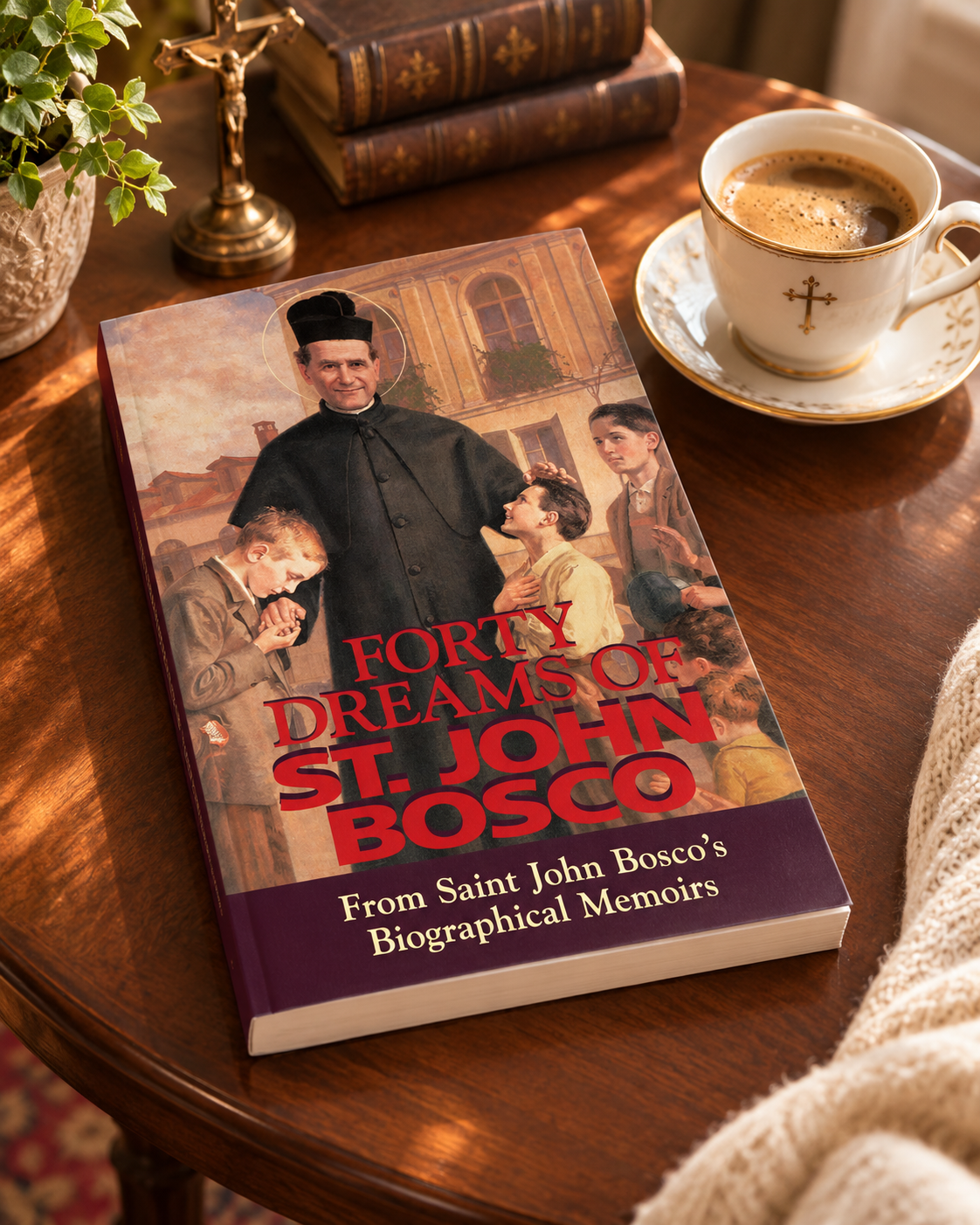
An in-depth Catholic reflection on the extraordinary dreams of St. John Bosco, the battle for souls, the dangers of sin, the protection of the Blessed Virgin Mary, and the enduring power of the Holy Eucharist.
CatholicG33k | Faith. Truth. Reason.
Introduction: What If We Could See the Spiritual Battle Around Us?
What if we could see the condition of our souls as clearly as we see the world around us?
What if the invisible consequences of sin suddenly became visible? What if we could recognize the spiritual dangers threatening our families, our children, and the Church? And what if we were shown that, despite the darkness, God has already provided the means to persevere?
These are some of the questions that emerge from reading Forty Dreams of St. John Bosco: The Apostle of Youth.
Saint John Bosco (1815–1888), the beloved Italian priest and founder of the Salesians, devoted his life to the education and salvation of young people. Yet his spiritual legacy includes something extraordinary: numerous dreams through which he believed he received warnings, guidance, and encouragement for his apostolic mission.
The book gathers forty accounts drawn principally from the Biographical Memoirs of St. John Bosco. Some contain frightening representations of temptation, sin, demonic influence, and eternal punishment. Others describe the beauty of virtue, the protection of the Blessed Virgin Mary, the importance of Confession, and the transforming power of the Eucharist.
One of the most famous, the dream of the Two Columns, portrays the Church as a great ship surrounded by enemies and struggling through a violent sea.
Yet the deepest lesson of this collection is not simply that evil threatens the Church.
It is that God never abandons His people, and that the battle for the Church begins with the conversion of individual souls.
These dreams invite us to examine our spiritual lives with an urgency that modern Catholics sometimes struggle to recover.
Before exploring them, however, an important theological distinction is necessary.
How Should Catholics Understand the Dreams of a Saint?
The Church recognizes St. John Bosco as a canonized saint, but that does not mean every dream attributed to him must be accepted as a supernatural revelation.
The Catechism teaches that private revelations do not belong to the deposit of faith and cannot improve upon or complete God’s definitive Revelation in Jesus Christ (CCC 67).
Even an extraordinary mystical experience must be understood in the light of Scripture, Sacred Tradition, and the teaching authority of the Church.
The edition examined here contains a nihil obstat and imprimatur dated 1969. These are ecclesiastical permissions concerning publication and doctrinal suitability; they do not constitute a declaration that every reported event occurred supernaturally.
We should therefore approach these dreams neither with sensationalism nor with automatic dismissal.
We should ask a more important question:
How can these accounts encourage us to live the Catholic Faith more faithfully?
1. The First Dream: Souls Are Won Through Charity, Not Force
One of the most beautiful accounts in the entire collection describes a dream Don Bosco experienced at approximately nine years of age.
In the dream, he encounters a group of young boys who are fighting, cursing, and behaving badly.
His immediate response is to intervene physically. He attempts to stop their wrongdoing through force.
Then a mysterious and radiant Man appears, whom the narrative identifies with Jesus Christ.
The Man instructs young John that he must win these boys through gentleness and kindness rather than blows.
John is subsequently introduced to a majestic Lady, understood to be the Blessed Virgin Mary. Through a symbolic transformation of wild animals into gentle lambs, he is shown the nature of his future mission.
The message is remarkable.
Don Bosco was not being called merely to discipline rebellious children.
He was being called to help transform their hearts.
The Catholic Lesson: Truth Must Be United to Charity
How often do Catholics recognize something wrong in the world and immediately respond with anger?
We see attacks on the Church, disrespect toward the sacraments, confusion about morality, or the abandonment of Christian traditions.
Sometimes our first instinct is to argue, condemn, or humiliate.
But Don Bosco’s first dream challenges that instinct.
He was not instructed to ignore sin. He was taught a better way to lead sinners toward virtue.
The distinction is essential.
Charity without truth becomes sentimentality. Truth proclaimed without charity can become harshness.
Saint Paul teaches that charity is patient and kind (1 Corinthians 13:4).
The Church likewise teaches that genuine charity seeks the true good of another person (CCC 1822–1829).
This means Catholic evangelization is not about winning arguments for personal satisfaction.
It is about winning souls for Christ.
Parents must correct their children. Priests must teach moral truth. Catholic educators must defend the Faith.
But correction should always be ordered toward conversion, not humiliation.
Reflection: When someone disagrees with my Catholic beliefs, am I more concerned with proving that I am right or helping that person encounter Jesus Christ?
Source: Forty Dreams of St. John Bosco, Dream 1, “The First Dream”; Biographical Memoirs, Vol. I, p. 94.
2. The Deadly Nooses: The Hidden Danger of an Unrepentant Soul
In Dream 8, “Deadly Nooses,” Don Bosco describes finding himself inside a church crowded with boys preparing for Confession.
He notices something disturbing.
Some of the boys appear to have ropes or nooses around their necks. Behind them are hideous creatures attempting to remain hidden.
As the dream progresses, these images become symbols of spiritual captivity and the ways temptation and dishonesty can obstruct sincere repentance.
The dream directs attention toward the importance of making a good Confession.
It is an unsettling image, but one with a deeply practical purpose.
The Catholic Lesson: Sin Promises Freedom but Produces Slavery
The modern world frequently describes freedom as the ability to do whatever we desire.
Catholic theology offers a different understanding.
True freedom is not simply the ability to choose between alternatives. It is the capacity to choose what is genuinely good.
The Catechism teaches that the more one does what is good, the freer one becomes, while choosing evil abuses freedom and leads toward slavery to sin (CCC 1733).
This is precisely the spiritual danger symbolized by the nooses.
A person may believe that a particular sinful habit is harmless.
Perhaps it is dishonesty, pornography, resentment, pride, habitual drunkenness, or the refusal to forgive.
At first, the person believes the behavior is under control.
Yet repeated choices can gradually weaken the will and make repentance more difficult.
What once appeared to be freedom becomes a form of captivity.
The dream also challenges a common misunderstanding about Confession.
The sacrament is not merely an opportunity to list our faults.
It is an encounter with the mercy of Jesus Christ.
Through sacramental absolution, a properly disposed penitent receives forgiveness of sins and reconciliation with God and the Church (CCC 1422, 1446, 1468).
A good Confession requires sincere contrition, a willingness to turn away from sin, and honest disclosure of mortal sins that one remembers after a careful examination of conscience.
The dream’s warning should never lead someone into despair or scrupulosity.
If a Catholic has sincerely confessed and received absolution, that person should trust God’s mercy rather than endlessly question whether forgiveness was real.
God does not invite us into Confession to humiliate us. He invites us there to restore us.
Reflection: Is there a sin I have become comfortable with because I have stopped recognizing the spiritual harm it causes?
Source: Dream 8, “Deadly Nooses”; Biographical Memoirs, Vol. IX, p. 278. See also CCC 1451–1458.
3. The Snake and the Rosary: Why the Enemy Fears a Praying Soul
Among the most striking accounts is Dream 23, “The Snake and the Rosary.”
Don Bosco encounters an enormous, terrifying serpent.
A mysterious guide provides a rope, and through a symbolic struggle the serpent is defeated.
When the rope is later examined, it takes the form of the words Ave Maria.
The guide explains that the serpent symbolizes the devil and the rope represents the Hail Mary and the Holy Rosary.
The symbolism is unmistakable.
Don Bosco is being reminded of the importance of prayer and the spiritual assistance of the Blessed Virgin Mary.
The Catholic Lesson: The Rosary Leads Us to the Victory of Christ
The Rosary is sometimes misunderstood as a prayer that places Mary in competition with Jesus.
Nothing could be further from authentic Catholic teaching.
The Rosary is profoundly Christ-centered.
Its mysteries lead the faithful to contemplate the Incarnation, public ministry, Passion, Death, Resurrection, and glory of Jesus Christ.
Mary’s role is always maternal and subordinate to the unique mediation of her Divine Son.
The Second Vatican Council teaches that Mary’s maternal intercession neither diminishes nor adds to the unique mediation of Christ, but draws its effectiveness entirely from Him (Lumen Gentium, 60–62).
This distinction is essential when interpreting Don Bosco’s dream.
The Rosary is not a magical charm that defeats evil automatically through repetition.
It is a prayer of faith that places us before the mysteries of Christ and asks the Blessed Mother’s intercession.
When we pray the Rosary sincerely, we are reminded that evil has already been decisively overcome through the saving work of Jesus Christ.
Yet something else in the dream deserves attention.
Some boys later attempt to consume pieces of the defeated serpent, despite being warned of the danger.
Their behavior symbolizes the tragic tendency to return to sin even after recognizing its destructive nature.
How often do we do something similar?
We ask God to deliver us from temptation, yet continue placing ourselves in situations that make temptation stronger.
We pray for purity but deliberately consume material that encourages impurity.
We pray for peace but refuse to let go of resentment.
We ask for holiness while protecting the very habits that lead us away from God.
Prayer must therefore be joined to conversion.
The Rosary should not become a substitute for repentance. It should help lead us toward repentance.
Reflection: Am I asking Our Lady to help me overcome sin while continuing to make room for that same sin in my daily life?
Source: Dream 23, “The Snake and the Rosary”; Biographical Memoirs, Vol. VII, pp. 143–145. See also CCC 971.
4. Beneath the Mantle of Mary: A Mother Who Does Not Abandon Her Children
In Dream 12, “A Fiendish Elephant,” Don Bosco sees a terrifying creature attacking young people.
The elephant is described as causing great destruction, while some boys become caught up in the disorder.
Then the Blessed Virgin Mary appears.
Her mantle expands to provide shelter for those seeking refuge.
The wounded who reach her protection are healed, and some of the boys courageously venture outward to help rescue those still in danger.
This dream contains two powerful images.
The first is Mary protecting her spiritual children.
The second is the responsibility of those already protected to help others.
The Catholic Lesson: Marian Devotion Must Produce Apostolic Charity
It is beautiful to imagine oneself sheltered beneath the mantle of the Mother of God.
But notice what happens in Don Bosco’s account.
Some of the boys do not remain concerned exclusively with their own safety.
They go out to rescue others.
This is an important insight into authentic Catholic devotion.
A person who truly loves the Blessed Virgin should grow in love for the souls whom her Son came to save.
Mary’s maternal care never replaces Jesus Christ.
Rather, she intercedes for the faithful and directs them toward Him.
At Cana, her words summarize the purpose of authentic Marian devotion:
“Whatsoever he shall say to you, do ye.”
— John 2:5, Douay-Rheims Bible
The lesson extends directly into our lives.
It is not enough to pray for our own sanctification while remaining indifferent to others.
We must care about the spiritual lives of our children, our spouses, our friends, our neighbors, and those who have wandered from the Faith.
This does not mean forcing people into religious practice.
It means loving them, praying for them, offering a faithful example, and patiently inviting them toward Christ.
Reflection: Who in my life needs me to offer patient encouragement, prayer, or a loving invitation back to the sacraments?
Source: Dream 12, “A Fiendish Elephant”; Biographical Memoirs, Vol. VII, p. 212.
5. The Rose Pergola: Why the Path to Holiness Includes Suffering
One of the most personally moving dreams is Dream 33, “The Rose Pergola.”
Don Bosco sees a beautiful pathway covered with magnificent roses.
The Blessed Virgin invites him to walk along it.
At first, the path seems delightful.
But beneath the flowers are sharp thorns.
As he proceeds, they pierce his feet and legs. The journey becomes increasingly painful.
Others join him but eventually become discouraged when they discover that the apparently beautiful path also involves suffering.
Some abandon the journey.
Yet Don Bosco continues.
At the end, he reaches a place of beauty and consolation.
The Blessed Virgin explains that the roses symbolize charity and the thorns represent sufferings, difficulties, disappointments, and attachments that may obstruct his mission.
The Catholic Lesson: Holiness Is Not the Absence of Suffering
Our culture often measures success by comfort, pleasure, recognition, and financial security.
The Gospel measures success differently.
Jesus teaches that those who wish to follow Him must take up their cross (Matthew 16:24).
Don Bosco’s rose pergola gives us a vivid picture of this truth.
There will be roses in the Christian life.
The joy of Baptism.
The peace of a good Confession.
The consolation of Eucharistic adoration.
The happiness of Christian marriage.
The blessings of children, friendship, and parish life.
But there will also be thorns.
Misunderstanding.
Sickness.
Financial difficulties.
Family disagreements.
Spiritual dryness.
Disappointment in others.
The suffering that comes from remaining faithful when the world demands compromise.
The presence of thorns does not mean we are on the wrong path.
Sometimes it means that love is asking something difficult of us.
Saint Thomas Aquinas teaches that fortitude enables a person to remain firm in the pursuit of the good despite serious difficulties (Summa Theologiae, II-II, q. 123).
But we must be careful.
Christian suffering is not valuable simply because it is painful. Nor does fidelity require remaining in an abusive or dangerous situation.
Suffering becomes spiritually fruitful when endured or addressed with faith, charity, prudence, and union with Christ.
The thorns themselves are not our salvation.
Jesus Christ is.
Reflection: Have I mistaken the difficulties of following Christ for evidence that God has abandoned me?
Source: Dream 33, “The Rose Pergola”; Biographical Memoirs, Vol. III, p. 25.
6. To Hell and Back: When Eternal Life Becomes More Than a Theological Idea
Few subjects are treated as cautiously in modern religious conversations as the reality of Hell.
Yet Don Bosco did not avoid the subject.
In Dream 32, “To Hell and Back,” he describes a frightening symbolic journey concerned with the consequences of grave sin and the danger of final separation from God.
The narrative is deliberately disturbing.
Its purpose, however, is not simply to frighten the reader.
It is to awaken spiritual seriousness and encourage repentance.
The Catholic Lesson: God’s Mercy Is Infinite, but Our Choices Matter
The Catholic Church teaches that Hell exists.
The Catechism describes its essential suffering as the definitive self-exclusion from communion with God (CCC 1033).
God desires the salvation of every human being.
Yet He does not force anyone to love Him.
Because human freedom is real, the possibility of definitively rejecting God is also real.
This gives tremendous importance to our daily moral choices.
But there is an important distinction between a healthy fear of sin and an unhealthy fear of God.
The Christian life is not supposed to become a constant state of panic.
The Church teaches that God predestines no one to Hell and continually calls sinners to conversion (CCC 1037).
We also cannot use Don Bosco’s dream to determine the eternal fate of particular individuals.
Only God knows the full condition of a soul.
The proper response to a meditation on Hell is therefore not to speculate about who may be damned.
It is to repent, trust divine mercy, and pray for the salvation of others.
The terrible imagery in this chapter should ultimately awaken charity.
If eternal life matters, then every human person matters.
Every opportunity for reconciliation matters.
Every soul deserves our prayers.
Every act of Christian witness has significance.
Reflection: If I truly believed that eternal life was the most important reality of my existence, what would I change about the way I live today?
Source: Dream 32, “To Hell and Back”; Biographical Memoirs, Vol. IX, p. 85. See also CCC 1033–1037.
7. The Two Columns: The Church in the Storm
Perhaps no dream in this collection speaks more powerfully to Catholics concerned about the challenges facing the Church than Dream 40, “The Two Columns in the Sea.”
Don Bosco describes an enormous ship sailing through a vast and turbulent sea.
The ship represents the Church.
It is surrounded by hostile vessels attempting to attack, damage, and destroy it.
The Pope is at the helm.
The battle is fierce, and the ship experiences repeated assaults.
In the midst of the sea, however, stand two enormous columns.
Upon the greater column is the Sacred Host, identified with the salvation of the faithful.
Upon the other stands the Blessed Virgin Mary under the title Help of Christians.
The ship eventually reaches these two columns and finds security.
The Catholic Lesson: The Church Will Not Be Saved by Worldly Power
It would be easy to interpret this dream exclusively in terms of modern controversies.
One might see the ships as political ideologies, hostile governments, false teachings, secularism, or persecution.
Some of these comparisons may be spiritually useful.
But we must avoid turning private revelations into a speculative code for identifying particular popes, predicting deaths, or assigning a timetable to current events.
The dream’s central spiritual meaning is much clearer.
The Church must remain faithful to Jesus Christ, especially through the Holy Eucharist, while seeking the maternal intercession of the Blessed Virgin Mary.
These two columns do not represent two equal sources of salvation.
Jesus Christ alone is the Savior.
Mary is His Mother, the first and most perfect disciple, and a powerful intercessor whose assistance depends entirely upon His grace.
This distinction is fundamental to Catholic doctrine.
The First Column: The Holy Eucharist
The Eucharist is the heart of Catholic life.
The Catechism calls it the source and summit of the Christian life (CCC 1324).
At every valid celebration of the Holy Mass, the Church encounters the sacramental presence of Christ’s one saving sacrifice.
Under the appearances of bread and wine, Jesus Christ is truly present: Body, Blood, Soul, and Divinity (CCC 1374).
This is not merely a symbol of Christian fellowship.
It is the sacramental presence of the Lord Himself.
In the midst of confusion, scandal, or persecution, the Church does not survive through public relations, political influence, or popularity.
She lives through the grace of Jesus Christ.
For Catholics, devotion to the Eucharist should therefore produce concrete changes.
Greater reverence at Mass.
Careful preparation for Holy Communion.
Frequent sacramental Confession when necessary.
Time spent in Eucharistic adoration.
Deeper gratitude for the Real Presence.
A willingness to conform our lives to the One we receive.
The Second Column: Mary, Help of Christians
The second column directs attention to the Blessed Virgin Mary.
Throughout Don Bosco’s dreams, she appears as a mother, teacher, protector, and guide.
Her presence is not incidental.
It reflects Don Bosco’s confidence that the Mother of Christ continues to intercede for the members of His Mystical Body.
At Calvary, Jesus said to the beloved disciple:
“Behold thy mother.”
— John 19:27, Douay-Rheims Bible
Catholic tradition recognizes a profound spiritual significance in Christ’s entrusting of Mary to the disciple.
The Church teaches that Mary’s maternal care continues in the order of grace (Lumen Gentium, 61–62).
This is why Catholics invoke her as Help of Christians.
Not because she replaces Jesus.
Not because her power is independent of God.
But because God has graciously chosen to associate her maternal intercession with His saving work.
The Most Important Question in the Two Columns Dream
The question is not simply whether the Church is surrounded by enemies.
The Church has endured conflict throughout her history.
The greater question is whether we ourselves are anchored to Christ.
A Catholic may spend hours discussing Church controversies while neglecting personal prayer.
Another may defend Eucharistic doctrine online while rarely attending Mass.
Someone may post beautiful images of Our Lady while refusing to forgive a family member.
Don Bosco’s dream challenges this contradiction.
It invites us to move beyond merely defending Catholic symbols and toward living the realities those symbols represent.
A Catholic cannot remain spiritually secure merely by discussing the two columns. We must actually draw near to the Eucharistic Lord and live as faithful children of Mary.
Source: Dream 40, “The Two Columns in the Sea”; Biographical Memoirs, Vol. VII, Chapter XVIII, p. 169ff.
8. The Hidden Message of the Dreams: The Salvation of Young Souls
There is another important aspect of this book that can easily be overlooked.
Many readers focus on the dramatic imagery: demons, serpents, monsters, storms, frightening journeys, and extraordinary warnings.
But what was Don Bosco actually trying to accomplish?
He was trying to save young souls.
He wanted boys who were neglected, troubled, poor, spiritually vulnerable, or lacking moral guidance to encounter the love of Jesus Christ.
This is the key to understanding the entire collection.
Even the most frightening dreams must be read within the context of Don Bosco’s pastoral mission.
He was not interested in fear for its own sake.
He wanted conversion.
And conversion required more than warnings.
It required teaching, friendship, patience, spiritual formation, and sacramental life.
The 1884 Letter: When Young People No Longer Believe They Are Loved
The uploaded book concludes its collection with an important additional text: Don Bosco’s 1884 letter on education.
In it, he reflects upon the relationship between educators and the young people entrusted to their care.
He describes the dangers of mistrust and the loss of the family spirit that once characterized his Oratory.
The central lesson is profound.
Young people need more than rules.
They need to know that the adults responsible for them genuinely love them.
This does not mean abandoning discipline or moral standards.
Rather, discipline must be exercised within a relationship ordered toward the true good of the young person.
Here Don Bosco’s first dream and his later educational reflections come together.
The boy who once attempted to stop wrongdoing with blows became the priest who understood the transforming power of kindness.
What This Means for Catholic Parents Today
Many Catholic parents are deeply concerned about the spiritual condition of their children.
They see the influence of social media, pornography, moral relativism, religious indifference, and the increasing hostility toward Christian teaching.
These concerns are understandable.
But fear alone cannot transmit the Faith.
Children need to see Catholicism lived joyfully and consistently.
They need parents who pray.
Parents who apologize when they are wrong.
Parents who attend Mass faithfully.
Parents who teach the truth without cruelty.
Parents who explain why the Church teaches what she teaches.
Parents who make the home a place of forgiveness and trust.
Parents who understand that the salvation of their children matters more than appearances or social approval.
A child may forget many theological explanations.
But that child may never forget witnessing a father kneeling in prayer or a mother showing mercy after a painful disagreement.
We cannot expect our children to love a Faith that we consistently present without love.
The Catechism describes parents as the first heralds of the Faith to their children and emphasizes their responsibility to create a home marked by tenderness, forgiveness, respect, fidelity, and service (CCC 1656, 2223).
Don Bosco’s educational vision remains extraordinarily relevant.
Source: “A Letter Written by St. John Bosco on Education,” dated Rome, May 10, 1884; Biographical Memoirs, Vol. XVII, Chapter III.
9. What Do These Dreams Say to the Catholic Church Today?
Reading Forty Dreams of St. John Bosco in the modern world naturally invites comparison with the challenges facing Catholic families and communities.
We live in an age of constant distraction.
Many people struggle to find silence.
Religious truth is often treated as a matter of personal preference.
Christian morality is frequently challenged.
Some Catholics experience discouragement over scandals, divisions, declining participation in religious life, or the apparent indifference of society toward God.
It is tempting to respond with anxiety or anger.
But Don Bosco’s dreams point us toward a better response.
The solution is not to become obsessed with darkness.
It is to become more deeply rooted in Christ.
The solution is not to treat every crisis as proof that the Church is about to collapse.
It is to remember that Christ promised to remain with His Church.
The solution is not to withdraw from every difficult conversation.
It is to defend the truth with courage, charity, and humility.
The solution is not to despair over our own weakness.
It is to return to the mercy of God.
Don Bosco’s symbolic visions repeatedly return to the same spiritual truths.
Sin is dangerous.
Conversion is necessary.
The sacraments are gifts of mercy and grace.
Mary intercedes for her children.
Young people deserve faithful spiritual guidance.
And suffering, when united to Christ, need not defeat the Christian.
These are not fashionable messages.
They are enduring Catholic truths.
The Church Does Not Need More Panic. She Needs More Saints.
There is a difference between recognizing a spiritual crisis and allowing that crisis to consume our interior life.
A Catholic who constantly studies the errors of the world but neglects prayer risks becoming spiritually exhausted.
A Catholic who can identify every controversy but cannot forgive another person has missed something essential.
A Catholic who knows every reported prophecy but does not know the teachings of the Gospel needs to reconsider his priorities.
This is why the dreams of Don Bosco should lead us to the confessional, the altar, the Rosary, and works of charity.
The greatest contribution we can make to the renewal of the Church is to cooperate with God’s grace and become holy.
Holiness is not a retreat from reality.
It is the deepest and most enduring response to evil.
10. Five Ways to Put Don Bosco’s Message Into Practice
The best response to this book is not merely admiration for extraordinary dreams.
It is a renewed commitment to Catholic life.
- Make a sincere examination of conscience. Identify habits or attitudes that are weakening your relationship with God. Seek sacramental Confession when needed, and approach God’s mercy with confidence.
- Return to the Holy Eucharist with greater reverence. Attend Sunday Mass faithfully, prepare well for Holy Communion, and spend time in adoration when possible.
- Pray the Rosary regularly. Begin with a decade if you are struggling to establish the habit. Meditate upon the life of Christ and ask Our Lady to help you follow Him.
- Practice charity within your family. Correct wrongdoing with patience, encourage your children, forgive quickly, and make your home a place where the Faith is lived rather than merely discussed.
- Persevere through the thorns. Do not abandon prayer or the practice of the Faith simply because life becomes difficult. Ask for the grace of fortitude and entrust your sufferings to Christ.
These practices may appear ordinary compared with the dramatic imagery of Don Bosco’s dreams.
Yet the ordinary means of grace are precisely where authentic Catholic holiness takes root.
Conclusion: The Two Columns Are Still Before Us
The dreams of St. John Bosco confront us with an uncomfortable but necessary truth.
Our souls matter eternally.
Our choices matter.
Our families matter.
The spiritual formation of our children matters.
And our fidelity to Jesus Christ matters infinitely more than the approval of the world.
But these dreams should not leave us afraid.
They should leave us awake.
Awake to the danger of sin.
Awake to the beauty of repentance.
Awake to the mercy available through the sacraments.
Awake to the loving intercession of the Blessed Virgin Mary.
And awake to our responsibility to bring others closer to Christ.
The image of the Church surrounded by hostile ships is certainly dramatic.
Yet the decisive image is not the storm.
It is the great ship finding security beside the two columns.
There is a reason why this dream has endured in Catholic devotional reflection.
It reminds us that the Church’s hope does not rest upon worldly strength.
It rests upon the faithfulness of her Divine Founder.
Jesus Christ remains the Head of the Church (Colossians 1:18).
He remains truly present in the Most Holy Eucharist.
His Blessed Mother continues to intercede for His faithful.
And the gates of Hell shall not prevail against His Church (Matthew 16:18).
The storms will come.
The thorns will pierce.
Temptations will arise.
Some will abandon the path.
But the Christian who remains united to Christ never walks without hope.
The final message of Don Bosco’s dreams is not that darkness is powerful. It is that God’s grace is greater, and that every soul is worth fighting for.
The question we must now ask ourselves is simple:
When the storms of life rise around me, where have I placed my anchor?
In the passing promises of the world?
In my own strength?
In fear, anger, or anxiety?
Or in Jesus Christ, who alone has the words of eternal life?
May we follow the example of St. John Bosco by loving souls, defending Catholic truth, remaining faithful to the sacraments, and entrusting ourselves to the maternal care of Our Lady, Help of Christians.
A Prayer Inspired by the Dreams of St. John Bosco
Lord Jesus Christ,
You are the Good Shepherd who seeks the lost, the Divine Physician who heals wounded souls, and the Savior who conquered sin and death through Your Holy Cross.
Protect us from the temptations that lead us away from You.
Give us the humility to recognize our sins, the courage to repent, and the confidence to seek Your forgiveness.
Increase our faith in Your Real Presence in the Most Holy Eucharist.
Make us reverent in worship, steadfast in suffering, charitable toward our neighbors, and faithful to the teachings of Your Holy Church.
Through the intercession of the Blessed Virgin Mary, Help of Christians, protect our families, strengthen our priests, and guide young people who are struggling to find truth and meaning.
Teach us to love as St. John Bosco loved: with patience, kindness, courage, and an unwavering desire for the salvation of souls.
When the storms of life surround us, keep our hearts anchored in You.
May we never lose sight of the eternal happiness for which You created us.
Amen.
Mary, Help of Christians, pray for us.
St. John Bosco, pray for us.
Sources and Catholic References
Primary Source
St. John Bosco, Forty Dreams of St. John Bosco: The Apostle of Youth. TAN Books, ISBN 978-0-89555-597-7. Based on accounts preserved in the Biographical Memoirs of St. John Bosco. This article reflects upon the following selections:
- Dream 1: The First Dream
- Dream 8: Deadly Nooses
- Dream 12: A Fiendish Elephant
- Dream 23: The Snake and the Rosary
- Dream 32: To Hell and Back
- Dream 33: The Rose Pergola
- Dream 40: The Two Columns in the Sea
- A Letter Written by St. John Bosco on Education (1884)
Sacred Scripture
Douay-Rheims Bible: Matthew 16:18, Matthew 16:24, John 19:27, John 2:5, 1 Corinthians 13:4, and Colossians 1:18.
Magisterial and Theological References
Catechism of the Catholic Church: Paragraphs 67, 971, 1033–1037, 1324, 1374, 1422, 1446, 1451–1458, 1468, 1656, 1733, 1822–1829, and 2223.
Second Vatican Council: Lumen Gentium (November 21, 1964), especially paragraphs 60–62.
St. Thomas Aquinas: Summa Theologiae, II-II, question 123, on fortitude.
Editorial note: The dreams examined in this reflection are drawn from the uploaded devotional collection. Their spiritual imagery is interpreted in light of established Catholic doctrine. The Church’s canonization of St. John Bosco does not require Catholics to accept each reported dream as a supernatural revelation.
CatholicG33k | Faith. Truth. Reason.
Defending the Faith. Explaining Tradition. Glorifying Christ.