

The devil rarely begins by asking you to reject God outright.
His strategy is far more subtle.
He whispers, “Tomorrow.”
He tells you you’re too tired, too distracted, too discouraged, or too unworthy to pray today.
And if he can persuade you to delay long enough, he often doesn’t need to convince you to stop believing. He only needs to convince you to stop showing up.
That is his trap.
Many Catholics mistakenly believe prayer only “counts” when it is fervent, focused, or filled with consolation. But God is not measuring the intensity of your emotions. He sees the love hidden within your fidelity.
As St. Teresa of Calcutta reminded us:
“God has not called me to be successful; He has called me to be faithful.”
The Rosary you struggle through while your mind wanders…
The distracted Our Father after a difficult day…
The exhausted Sign of the Cross before falling asleep…
These are not failures.
They are acts of love.
A poor prayer prayed is infinitely better than a perfect prayer never offered.
St. Alphonsus Liguori, the great Doctor of the Church on prayer, wrote:
“He who prays is certainly saved; he who does not pray is certainly lost.”
God honors the soul that continues to pray—even when prayer feels dry, difficult, or imperfect.
The saints understood this well. Their holiness was not built upon constant spiritual ecstasy but upon ordinary faithfulness. They prayed when they felt inspired. They prayed when they felt nothing. They prayed through dryness, confusion, suffering, and temptation. They persevered because they trusted that God’s grace was at work even when they could not perceive it.
Near the end of her life, St. Thérèse of Lisieux endured profound spiritual darkness, yet she continued choosing Christ every day. She wrote:
“Holiness consists simply in doing God’s will, and being just what God wants us to be.”
This is why perseverance terrifies the enemy.
The devil does not fear your emotions. He does not fear passing moments of enthusiasm.
He fears the soul that refuses to quit.
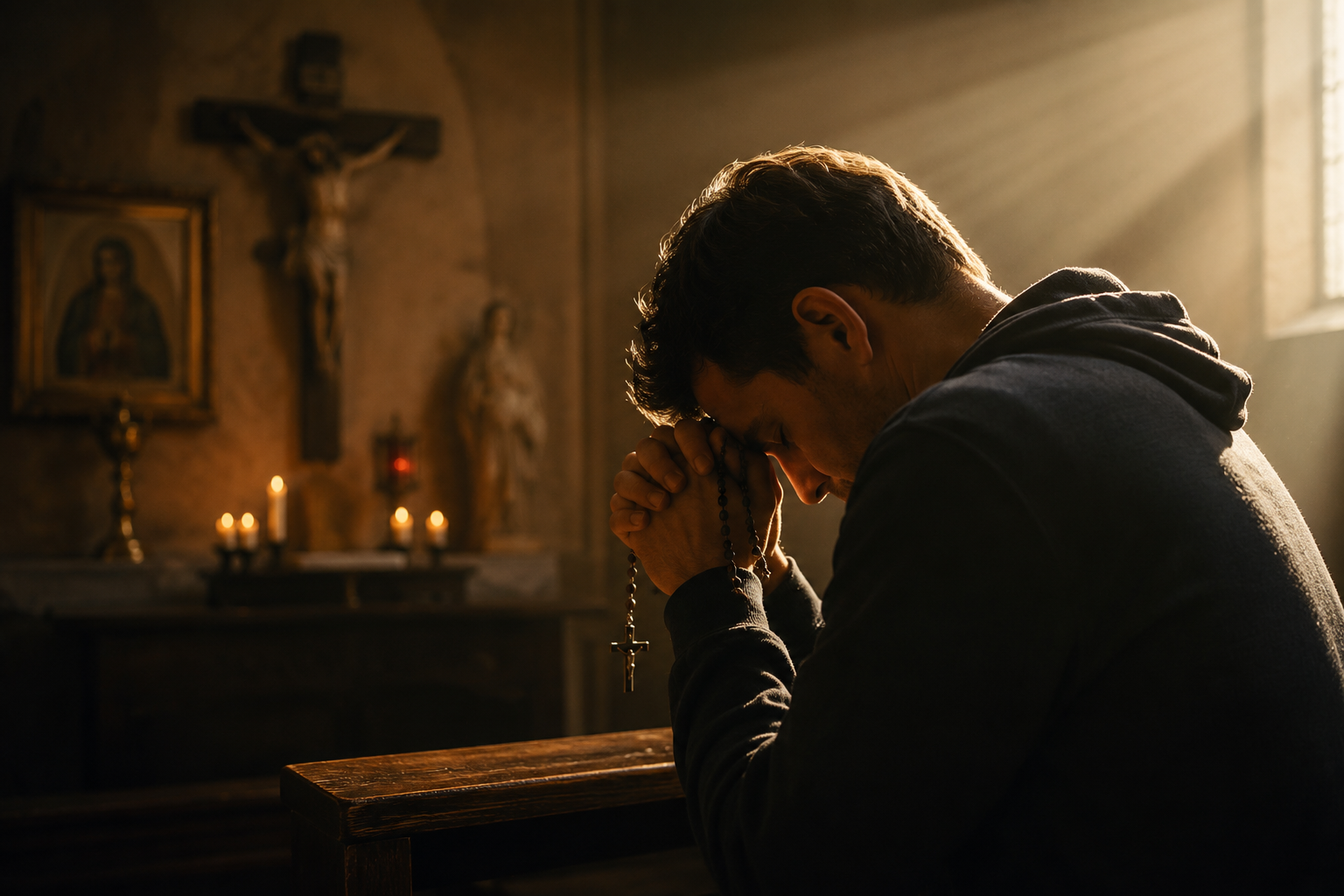
He fears the Christian who kneels despite exhaustion, who picks up the Rosary despite distraction, who returns to Confession after falling, who continues trusting Christ when every feeling says to give up.
Our Lord Himself assures us:
“But he that shall persevere to the end, he shall be saved.”
—
Perseverance is one of the greatest victories of grace because it proclaims that God is worthy of our love even when we receive no sensible consolation in return.
As St. Thérèse also wrote:
“Our Lord does not look so much at the greatness of our actions, nor even at their difficulty, but at the love with which we do them.”
Prayer is not valuable because it always feels powerful.
Prayer is valuable because it is an act of faith, hope, and charity directed toward God.
Even when your words are weak, His grace is strong.
So don’t let doubt finish what temptation has started.
Don’t let discouragement steal what grace has already begun.
Show up anyway.
Pray anyway.
Trust anyway.
St. Teresa of Calcutta offered this beautiful counsel:
“If you ever feel distressed during your day, call upon Our Lady. Just say this simple prayer: ‘Mary, Mother of Jesus, please be a mother to me now.’ I must admit, this prayer has never failed me.”
One day, in eternity, you may discover that the Rosary you almost skipped, the prayer you nearly abandoned, or the weary Sign of the Cross you made before bed became the very means by which God strengthened your soul, protected your family, or granted graces you never knew to ask for.
The prayer you almost didn’t pray may be the one that wins the day.
And the soul that refuses to quit is a soul that, by the grace of God, the devil can never overcome.
Sources
- Sacred Scripture
- Douay-Rheims Bible, Matthew 24:13.
- St. Thérèse of Lisieux
- Story of a Soul (L’Histoire d’une âme), trans. John Clarke, OCD.
- Letters of St. Thérèse of Lisieux (for the quotation on holiness).
- St. Alphonsus Liguori
- The Great Means of Salvation and of Perfection: Prayer, especially Part I on the necessity of prayer.
- St. Teresa of Calcutta (Mother Teresa)
- A Simple Path.
- Come Be My Light: The Private Writings of the Saint of Calcutta.