

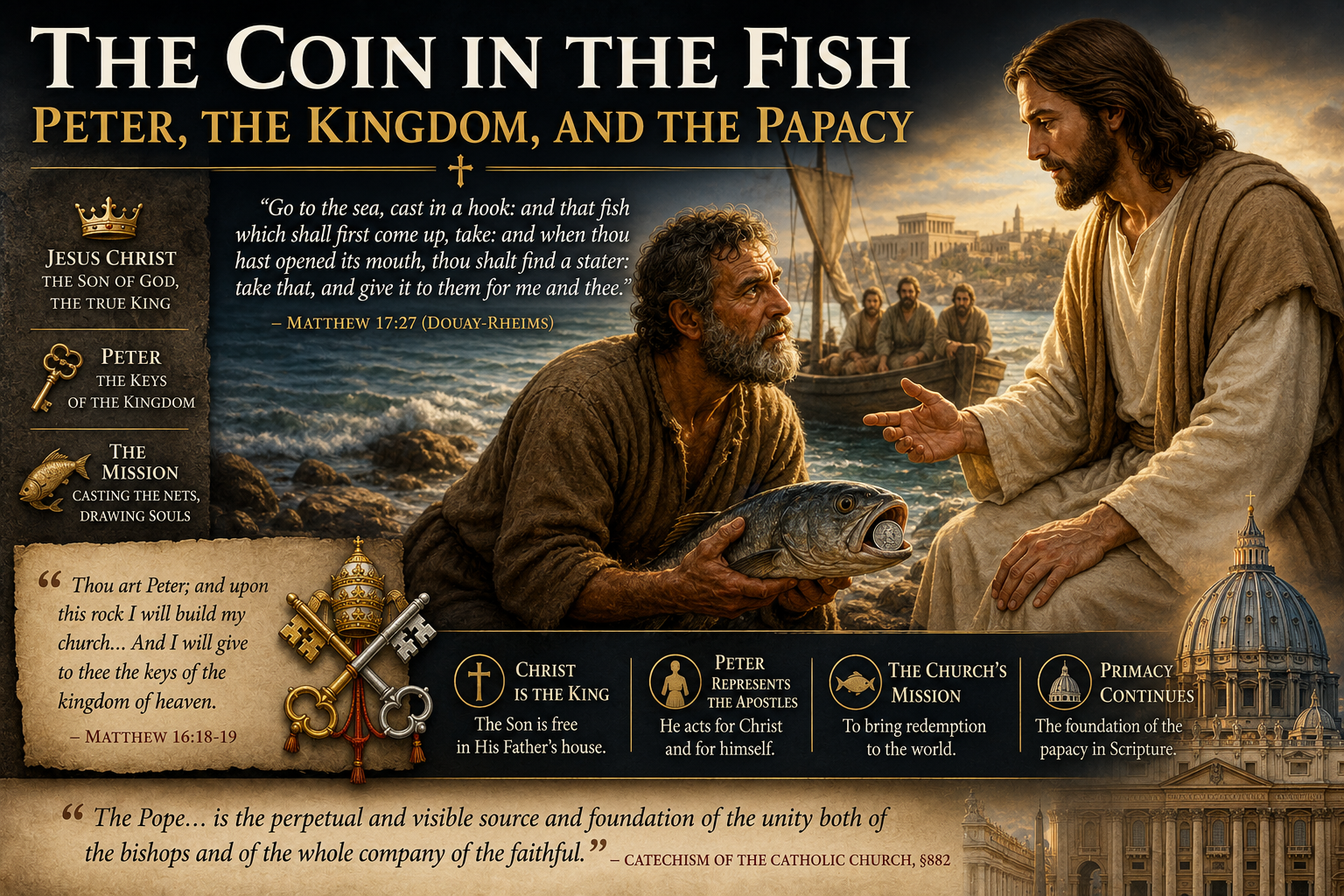
How one overlooked miracle reveals Christ’s divine sonship, Peter’s unique role, and the biblical foundation of the papacy.
“Go to the sea, cast in a hook: and that fish which shall first come up, take: and when thou hast opened its mouth, thou shalt find a stater: take that, and give it to them for me and thee.”
A Small Miracle with Great Meaning
The account of the coin in the fish (Matthew 17:24–27) is one of the shortest miracles recorded in the Gospels. It is often overlooked, yet it contains profound theological significance.
Far more than a miraculous provision for paying the Temple tax, this passage reveals the divine identity of Jesus Christ and sheds light on the unique role entrusted to Saint Peter.
To appreciate its significance, we must begin with the setting.
The Temple Tax
When Jesus and His disciples arrived in Capernaum, the collectors of the Temple tax approached Peter and asked:
“Doth not your master pay the didrachmas?”
— Matthew 17:24
The Temple tax originated in the Law of Moses:
“Every one that passeth… shall give half a sicle… for the service of the tabernacle.”
By the first century AD, faithful Jews contributed this annual tax to support the Temple in Jerusalem.
Yet one detail immediately stands out.
The collectors do not approach every apostle.
They approach Peter.
Throughout the New Testament, Peter repeatedly serves as the spokesman and representative of the apostolic college.
He confesses Christ’s identity (Matthew 16:16), speaks on behalf of the apostles, and after Pentecost becomes the first to preach publicly, heal, and lead the Church (Acts 1–5).
Saint John Chrysostom observed:
“The collectors come to Peter, as to the mouth of the apostles.”
Peter is already functioning as the visible spokesman of the apostolic body.
The Son Is Free
Before Peter even speaks, Jesus already knows what has happened.
He asks:
“Simon, what is thy opinion? The kings of the earth, of whom do they receive tribute or custom? of their own children, or of strangers?”
— Matthew 17:25
Peter answers:
“Of strangers.”
Jesus replies:
“Then the children are free.”
— Matthew 17:26
This simple exchange reveals an extraordinary truth.
The Temple belongs to God the Father.
Jesus is the eternal Son of the Father.
Therefore, the Son is not obligated to pay a tax for His own Father’s house.
Without openly announcing His divinity, Christ quietly reveals it.
The Miracle of the Coin
Although Jesus is exempt, He chooses to pay the tax:
“But that we may not scandalize them…”
— Matthew 17:27
He sends Peter to the sea.
The first fish caught contains a coin in its mouth.
This miracle reveals several truths simultaneously.
- Christ possesses divine knowledge.
- Christ exercises authority over creation.
- Christ freely humbles Himself to avoid unnecessary offense.
Even creation obeys its Creator.
“For Me and for Thee”
The most remarkable detail appears in Christ’s final instruction.
Jesus tells Peter:
“…give it to them for me and thee.”
— Matthew 17:27
Not for all twelve apostles.
Not for every disciple.
Only for Jesus and Peter.
The Gospel itself does not explicitly explain why Peter alone is paired with Christ. Catholics have long understood this detail as another narrative sign of Peter’s unique representative role among the apostles, especially when read alongside the surrounding chapters.
This follows immediately after one of the most important passages in Scripture.
Only one chapter earlier Jesus declared:
“Thou art Peter; and upon this rock I will build my church… And I will give to thee the keys of the kingdom of heaven.”
— Matthew 16:18–19
The sequence is striking.
Matthew 16: Peter receives the Keys.
Matthew 17: Peter alone stands beside Christ in this miracle.
The narrative quietly reinforces Peter’s distinctive office.
The Keys of the Kingdom
To understand this more fully, we must look to the Old Testament.
Under the Davidic kingdom, the king appointed a chief steward who governed in his absence.
Isaiah describes this office:
“And I will lay the key of the house of David upon his shoulder: and he shall open, and none shall shut: and he shall shut, and none shall open.”
— Isaiah 22:22
This steward exercised royal authority under the king.
When Jesus gives Peter the keys of the Kingdom of Heaven, He deliberately echoes this royal office.
The Church Fathers recognized this connection.
Saint Leo the Great wrote:
“Peter alone was chosen to preside over the calling of all nations.”
Peter’s authority is not independent of Christ, but exercised under Christ, just as the royal steward served under the Davidic king.
Peter and the Church
The Church Fathers consistently testified to Peter’s unique role.
Saint Ambrose wrote:
“Where Peter is, there is the Church.”
Saint Cyprian declared:
“The Lord says to Peter: ‘I say to thee that thou art Peter.’ Upon him He builds the Church.”
These witnesses understood Peter’s primacy as serving the unity and visible structure of Christ’s Church.
A Beautiful Spiritual Symbolism
Many spiritual writers have also seen rich symbolism within the miracle.
The sea represents the world.
The fish represents humanity.
The coin represents redemption.
The hook represents the apostolic mission.
Peter, the fisherman, draws from the sea the coin that satisfies the debt.
This beautifully foreshadows the Church’s mission.
The apostles cast their nets into the world, bringing souls to Christ and proclaiming the redemption He has won.
The Foundation of the Papacy
What appears to be a simple miracle becomes a profound revelation.
It proclaims Christ’s divine sonship.
It highlights Peter’s unique relationship with Christ.
It reinforces the representative authority entrusted to Peter.
For these reasons, the Catholic Church teaches that Peter held a visible primacy among the apostles—a primacy that continues through his successors, the Bishops of Rome.
As the Catechism teaches:
“The Pope… is the perpetual and visible source and foundation of the unity both of the bishops and of the whole company of the faithful.”
— Catechism of the Catholic Church, §882
Conclusion
The miracle of the coin in the fish is far more than an account of paying the Temple tax.
It quietly proclaims three great truths:
- Jesus Christ is the divine Son of God.
- Peter possesses a unique office among the apostles.
- Christ established a visible leadership within His Church that continues through the papacy.
A small miracle.
A single coin.
A fisherman.
And another glimpse into the unfolding Kingdom of God.
Sources
Sacred Scripture (Douay-Rheims):
- Exodus 30:11–16
- Isaiah 22:22
- Matthew 16:13–19
- Matthew 17:24–27
- Acts 1–5
Catechism of the Catholic Church:
- §§551–553
- §§880–882
Church Fathers:
- St. John Chrysostom, Homilies on the Gospel of Matthew
- St. Leo the Great, Sermons
- St. Cyprian of Carthage, On the Unity of the Catholic Church
- St. Ambrose of Milan, Commentary on Psalm 40
Leave a Reply